
Test 17 of 25 · 20 questions · Free 2026
KS Permit Practice Test 17
Jump to the test ↓A fixed 20 question set from the Kansas bank with answers and plain English explanations. The real KS exam is 25 questions, 80 percent to pass; take the full length version on the main practice page.
Question 1 of 20 · 0 right so far
All 20 questions in test 17
Every question below comes from the Kansas question bank on this page. Open a question to see the correct answer and the explanation. Nothing here is hidden behind a signup.
1. When should Kansas drivers switch to high beams at night on an open road?
- Only on roads without street lights or signs
- Whenever no oncoming vehicles are present
- Never, because low beams are always safer
- When following another vehicle closely in fog
Show answer
Whenever no oncoming vehicles are present. High beams roughly double your seeing distance, exposing animals, debris, and curves far earlier. Use them whenever no oncoming traffic faces you, then dim promptly as vehicles approach, within about a block. Low beams belong in following, fog, rain, and snow, where glare and reflection shrink vision. Sunglasses or tinted lenses at night only darken an already dim world. Seeing distance sets safe night speed, so brighter light used properly buys real safety.
Study this in the handbook: Slippery roads and hydroplaning
2. On a Kansas road with three or more lanes in your direction and heavy entering traffic, which lane is preferred?
- The left lane for all through traffic
- The right lane regardless of entering traffic
- Switch lanes often to balance traffic flow
- The center travel lane
Show answer
The center travel lane. Lane choice adapts to lane count. With two lanes in your direction, the right lane is home except when passing. With three or more lanes and heavy traffic pouring in from ramps and side streets, the center lane smooths your trip and leaves the right lane for merging vehicles. The left lane remains passing oriented. Constant switching to chase small gains multiplies conflict points. Pick the lane that fits the road design and hold it with purpose.
3. What do zero tolerance laws for drivers under 21 generally mean in Kansas guidance?
- Young drivers may hold a .05 BAC legally
- No alcohol in the circulatory system for young drivers
- Tolerance applies only after a first arrest or written warning
- Zero tolerance covers only hard liquor drinks
Show answer
No alcohol in the circulatory system for young drivers. All states hold drivers under twenty one to zero tolerance or similar laws: no alcohol in the circulatory system. Kansas makes underage purchase, possession, and drinking illegal outright, and a young driver can be arrested for alcohol impairment at .02 BAC. The philosophy matches learning science, since impairment effects run greater while driving skills are still forming. Beer and wine count exactly like spirits in blood. For young drivers the only safe reading is the one with nothing to read.
Study this in the handbook: How alcohol and drugs affect driving
4. You miss your exit on a Kansas interstate. How should you turn around?
- Cross the median where grass looks flat
- Go to the next exit and turn around there
- Use the crossover reserved for emergency vehicles
- Back along the shoulder to the exit ramp
Show answer
Go to the next exit and turn around there. Interstates are built with frequent exits partly so mistakes solve themselves. Ride to the next exit, leave, and re-enter in the opposite direction. Crossing the median strip or borrowing crossovers reserved for emergency vehicles is illegal and puts you nose to nose with high speed traffic. Backing on an interstate shoulder compounds the danger. The extra miles cost minutes at most. Every other option risks a crash at the highest speeds Kansas roads carry.
5. You want to pass a slow tractor on a Kansas two-lane road, and the solid yellow line is on your side of the centerline. What applies?
- You may pass because farm vehicles always yield to cars behind them
- The solid line matters only after dark on two-lane Kansas roads
- Passing from your side is prohibited while that solid line is yours
- Passing is allowed if you finish before the next hill crest arrives
Show answer
Passing from your side is prohibited while that solid line is yours. Centerline paint assigns passing rights by side. A solid yellow line on your side closes passing from your direction, whatever the vehicle ahead speed. A dashed line on your side would open it with a safe gap, and double solid lines close both directions while still allowing turns with gaps. Tractor speed and daylight change nothing in the paint language. Wait behind the tractor until markings and sight distance genuinely reopen the move, rather than inventing agricultural exceptions.
Study this in the handbook: Work zone, guide and incident signs
6. The road through Kansas hills shows this winding arrow. How should your speed be managed?

- Set a pace you can hold through a series of curves ahead
- Alternate speeding and braking for each separate curve
- Keep highway speed, since curves straighten your tires out
- Slow only for the first curve, then resume full speed
Show answer
Set a pace you can hold through a series of curves ahead. The handbook tells drivers approaching a curve to check traffic thoroughly in all directions. Before entering the curve, reduce your speed so further braking is not required in the curve. Keep the vehicle in the lane and continue checking traffic in all directions. Maintain a safe speed through the curve and follow posted warning signs. A winding arrow warns of a series of curves, so the speed you set before the first bend has to be one you can hold through the whole stretch without needing to brake in the middle of a curve.
7. A Kansas driver tests at .06 BAC, weaves across lane lines, and claims the .08 limit acquits them. Is that right?
- Yes; Kansas law forbids any alcohol conviction whenever the reading falls below the .08 per se threshold figure
- Only drivers under twenty one can be convicted below .08, because adults receive full protection of the limit
- Weaving alone can never support a charge without a reading above the statutory per se concentration level
- No; impairment can still support a conviction below .08
Show answer
No; impairment can still support a conviction below .08. The .08 figure is a shortcut for the state, not a shield for the driver. Kansas law allows conviction for driving impaired even with a BAC below .08, because impairment, visible in weaving, slowed reactions, and poor judgment, is the underlying offense. Crossing .08 simply proves the violation by number alone. This is also why impairment starting with the first drink matters legally and not just medically. A driver can be under the famous number and under arrest on the same stop without contradiction.
Study this in the handbook: How alcohol and drugs affect driving
8. This warning appears mid-block in a Kansas shopping district. What should you expect?

- A school zone speed limit begins at the sign post
- Pedestrians are banned from crossing at this location
- A bus stop shelter sits on the far sidewalk corner
- People may be crossing the roadway ahead of you
Show answer
People may be crossing the roadway ahead of you. A pedestrian crossing warning tells you people on foot may cross ahead, at marked and unmarked crosswalks alike. Mid-block crossings carry their own signs and markings, and drivers must yield there as at corners. Slow enough to stop for someone stepping from between parked cars, especially in shopping districts full of visual clutter. The sign never bans the pedestrians it pictures; it protects them. Children, joggers, and recreational users all count as pedestrians sharing your duty of care.
Study this in the handbook: Traffic lights and arrows
9. Why should you avoid entering a Kansas shared center turn lane too early?
- The lane charges a toll for early entry
- Early entry makes your turn signal cancel itself sooner than usual
- Longer stays risk meeting an opposite turner head-on
- Oncoming drivers never use the center lane
Show answer
Longer stays risk meeting an opposite turner head-on. The center lane serves left turns from both directions, so it can contain a vehicle heading straight at you. Sliding in early and cruising there stretches the time you share that narrow space with opposing turners. Enter close to your turn, after checking ahead, mirrors, signals, and your left blind spot, then wait for a gap in oncoming traffic. Never use the lane for through travel or passing. Short occupancy is the safety feature of the whole design.
Study this in the handbook: Lane markings and special lanes
10. What visual lead should a Kansas driver maintain to spot problems in the travel path?
- Only the vehicle directly in front of you at all times in every condition
- Only the space covered by headlight beams
- The next intersection, regardless of speed
- An area 20 to 30 seconds ahead of the vehicle
Show answer
An area 20 to 30 seconds ahead of the vehicle. A visual lead means searching the area twenty to thirty seconds ahead of the front of the vehicle. That deep search exposes changes in the path and leaves room to pick an alternate route or slow down calmly. Two or three seconds describes following distance, which is a different cushion. Headlights matter at night but do not set the daytime search depth. The longer lead turns surprises into routine adjustments.
Study this in the handbook: Following distance, scanning and space
11. You approach a through street in Kansas where stop signs face you. After stopping completely, when may you proceed?
- When you can do so without interfering with other traffic
- Immediately, since stopping paid your right-of-way
- After counting three seconds at the line
- Whenever cross traffic is more than a block away
Show answer
When you can do so without interfering with other traffic. A stop at a through street has two parts: halt completely, then enter only when your movement will not interfere with traffic already on that street. The stop itself buys no priority over vehicles flowing past. Counting seconds cannot substitute for judging gaps, and distance alone misleads because cross traffic speed varies. Wait for an opening that fits your crossing or turn time. Rolling in on hope transfers your duty to drivers who never agreed to brake for you.
Study this in the handbook: Right of way at intersections
12. If you must make a U-turn in Kansas, how should the maneuver begin?
- Start from the left lane beside the center line
- Turn as soon as oncoming traffic seems far enough away
- Start far to the right and wait for a large gap
- Begin rolling slowly and let traffic adjust to you
Show answer
Start far to the right and wait for a large gap. A legal U-turn starts from the far right position you can reach. Wait there for a genuinely large gap in both directions, since you will cross every lane slowly. Then turn the wheel left sharply, settle into the opposite lane, and match traffic speed. Watch for drivers turning right into your target path. Curves, hilltops, and spots where others cannot see you for five hundred feet ban the maneuver entirely, as do posted signs.
Study this in the handbook: Driveways, yield signs and roundabouts
13. You wait at a Kansas side street and a motorcycle approaching on the main road has its left signal flashing. What should you do?
- Wait until the rider actually begins to turn before you pull out
- Pull out at once, because a flashing signal means the turn is happening
- Pull out only if the rider is more than a block away
- Sound your horn so the rider cancels the signal
Show answer
Wait until the rider actually begins to turn before you pull out. Turn signals on motorcycles, scooters, and mopeds may not self-cancel, so a rider can forget to switch one off. A flashing light by itself does not prove a turn is coming. The handbook says to wait until the machine is beginning to turn before you pull out in front of it. Some of these vehicles have no turn signals at all, so leave enough room for the rider to maneuver. Pulling out early puts you across the path of a vehicle whose speed and distance are hard to judge.
Study this in the handbook: Following distance, scanning and space
14. You are lost in a Kansas town and need to reverse direction where this sign is posted. What applies?
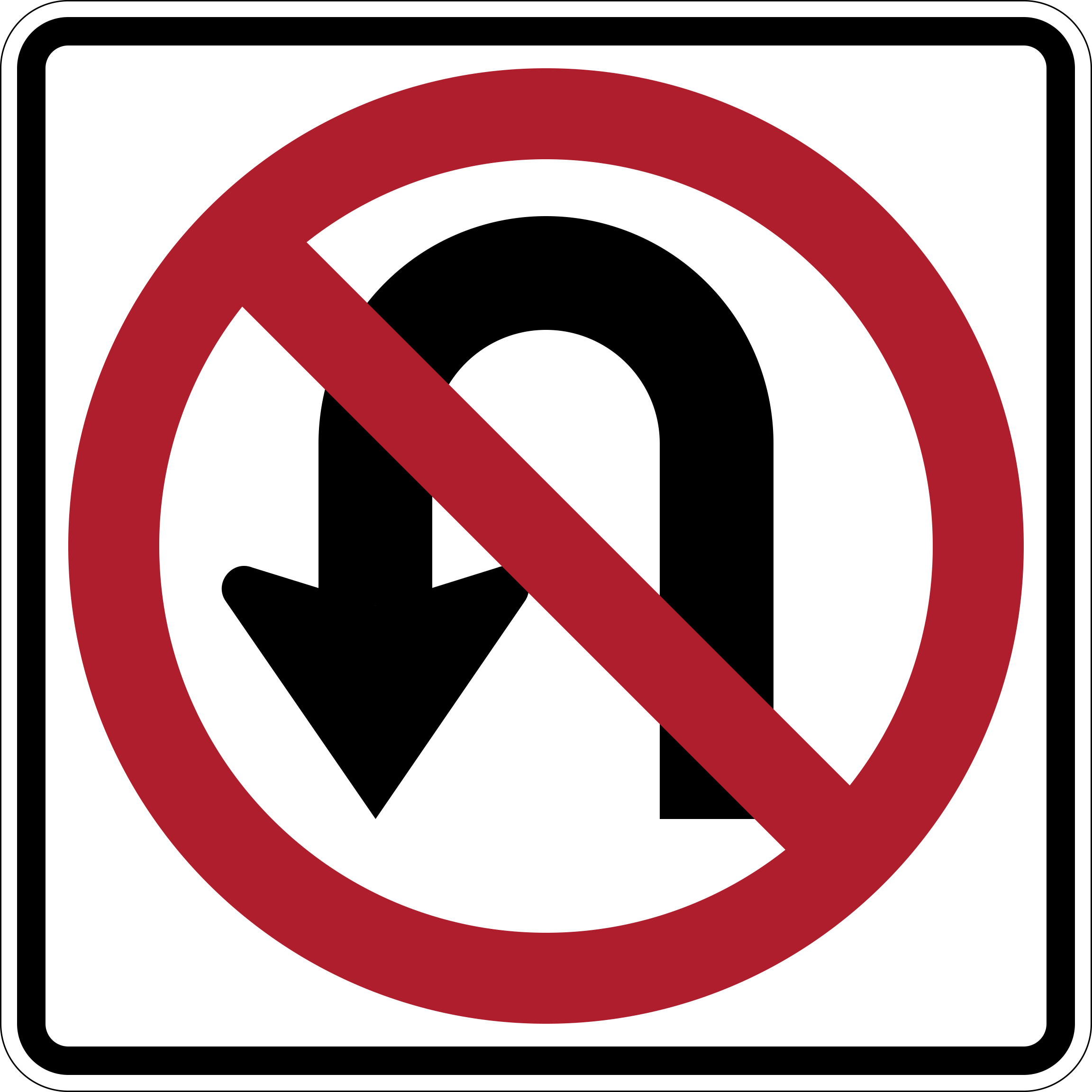
- U-turns are allowed after midnight at that corner
- A U-turn is prohibited at that location
- You may U-turn if you signal for 200 feet first
- Only trucks are barred from U-turning at the sign
Show answer
A U-turn is prohibited at that location. The red slashed U shaped arrow deletes one maneuver at that spot: the U-turn. Being lost explains the temptation without creating an exception, and neither the hour nor a long signal rewrites a prohibition sign. Continue to a place where turning around is legal, ideally around the block or at the next exit. Vehicle size plays no role. Prohibition signs with the red circle and slash all share this grammar: the pictured action is forbidden here.
Study this in the handbook: Driveways, yield signs and roundabouts
15. Your Kansas car has anti-lock brakes and you must steer while stopping hard. What should your foot do?
- Release the brake completely before steering anywhere
- Keep full brake pressure while steering toward open space
- Pump the brake while steering to keep wheels rolling
- Brake only after the vehicle points the new direction
Show answer
Keep full brake pressure while steering toward open space. Anti-lock systems exist to combine braking with steering. Keep the pedal pressed as hard as you can and hold that pressure while steering where you want to travel; the system prevents lockup wheel by wheel. You may feel the pedal push back as it works, which is normal. Lifting off or pumping defeats the technology. Without anti-lock brakes, avoid hard braking mid steer and brake harder once straight. Knowing which system your car has decides the technique.
Study this in the handbook: Emergency braking, skids and vehicle failures
16. At a Kansas crash scene, a firefighter waves you into the opposite lane around wreckage. What should you do?
- Obey the direction of emergency personnel on the scene
- Follow the painted lane markings instead of hand directions
- Stop and wait for the traffic light cycle to resume
- Obey only written signs posted after the crash
Show answer
Obey the direction of emergency personnel on the scene. During an emergency, law enforcement and emergency services personnel on the scene direct traffic, and their instructions govern your movements. Hand directions can suspend normal lane expectations so rescue vehicles and tow trucks can work. Obey promptly and predictably, watching for workers on foot. The same obedience applies to highway personnel and school crossing guards in their settings. Painted lines resume control once the scene clears and officials release the roadway back to ordinary rules.
Study this in the handbook: Emergency vehicles, move over and traffic stops
17. You face a Kansas yield sign and the crossing road is completely empty. Must you stop?
- Yes; a yield sign demands a full and complete stop at every approach
- Yes; stop and count to three before entering the roadway
- Yield signs apply only when a police officer directs traffic
- No; stop only when needed to avoid interfering with traffic or pedestrians who have priority
Show answer
No; stop only when needed to avoid interfering with traffic or pedestrians who have priority. A yield sign assigns priority without mandating theater. Slow down, and stop only when stopping is necessary to avoid interfering with other traffic or pedestrians holding the right-of-way. An empty crossing road therefore allows a slow, careful roll through. The moment cross traffic appears, your duty hardens into a stop if that is what non-interference requires. This conditional design keeps minor junctions flowing while protecting the same people a stop sign would. Misreading yield as stop everywhere breeds rear end collisions from surprised followers.
Study this in the handbook: Right of way at intersections
18. What does Kansas law require for children under age 14 riding in a vehicle?
- They may ride in front if the trip is under five miles
- Only children under age 8 have any restraint duties
- Rear seat placement with proper restraints while moving
- Front seat riding is allowed with an air bag off switch
Show answer
Rear seat placement with proper restraints while moving. Kansas sets a broad rear seat rule: all children under fourteen must be secured in the rear seat and wear appropriate safety restraints while the vehicle is in motion. Younger children layer stricter duties on top: safety seats under four, seats or boosters from four to eight unless tall or heavy enough, and belts from eight upward. The middle of the back seat rates safest of all. Distance, switches, and convenience create no exceptions to the under fourteen placement.
Study this in the handbook: Seat belts, child seats and air bags
19. When passing on a Kansas two-lane road, how many vehicles should you pass at once as a rule?
- Only one vehicle at a time
- Two vehicles if they travel close together
- As many as fit before the next curve
- Any number when the dashed line is long
Show answer
Only one vehicle at a time. Passing one vehicle already takes longer than most drivers guess, sometimes twenty to thirty seconds in the opposing lane. Strings of vehicles multiply that exposure and make the needed gap nearly impossible to judge. Settle back after each pass, rebuild your view, and evaluate the next vehicle separately. Paint alone never certifies the move; sight distance and oncoming traffic rule the decision. Patience in a queue beats a long gamble against headlights.
20. You are on a Kansas acceleration lane and no gap has opened yet. What should you do?
- Stop on the main roadway shoulder and wave at traffic to pass you
- Cross the solid white line early to claim a space in the traffic flow
- Slow down on the acceleration lane to wait for a gap, without crossing the solid white line
- Enter slowly and let highway traffic adjust around you
Show answer
Slow down on the acceleration lane to wait for a gap, without crossing the solid white line. A missing gap is handled on the ramp, not on the highway. Slow down while still on the acceleration lane, let a suitable opening develop, and keep your vehicle off the solid white line that guards the merge point. Entering slowly into fast traffic forces dangerous braking behind you. Once the gap arrives, signal, check over your shoulder, and accelerate to match the flow. Patience on the ramp protects everyone already traveling at speed.
Study this in the handbook: Safe speed and stopping distance
Every question is written from the official Kansas Driving Handbook. Need paper? Printable KS practice test with answer key.
Last verified 2026-10-05. How we check every question · Study all 500 as flashcards
Frequently asked questions
How many questions are on this Kansas practice test?
This fixed set has 20 questions. It is test 17 of 25 from the 500 question Kansas bank. The real KS exam asks 25 questions and you need 20 correct.
What is the passing score for the real Kansas test?
You must score an 80% to pass the knowledge test That figure comes from the official Kansas source cited on the DMV facts page.
How does this fixed test relate to the full Kansas bank?
Each numbered test is a fixed set of questions in a fixed order, so you can retake the same test later and compare. Every test mixes road signs and the other topics in about the same proportion as the full bank. Tests 1 to 25 together cover every question in the Kansas bank once. The full practice page mixes the whole bank at random.
Last verified 2026-10-05. See the Kansas DMV facts page for sourced state details.