
Test 25 of 25 · 20 questions · Free 2026
KS Permit Practice Test 25
Jump to the test ↓A fixed 20 question set from the Kansas bank with answers and plain English explanations. The real KS exam is 25 questions, 80 percent to pass; take the full length version on the main practice page.
Question 1 of 20 · 0 right so far
All 20 questions in test 25
Every question below comes from the Kansas question bank on this page. Open a question to see the correct answer and the explanation. Nothing here is hidden behind a signup.
1. A Kansas 12-year-old asks to ride in the front seat for a short trip to a nearby store. What does the law require?
- Front riding is allowed under five miles, because the rear seat law measures protection by trip distance in Kansas
- A twelve year old may ride in front whenever the vehicle air bag has an off switch the driver can disable manually
- Only children under the age of eight have rear seat requirements under the Kansas child passenger safety rules
- Children under 14 must ride secured in the rear seat with proper restraints
Show answer
Children under 14 must ride secured in the rear seat with proper restraints. Kansas draws the rear seat line at fourteen: all children under that age must be secured in the rear seat and wear appropriate safety restraints while the vehicle moves. Store trips are where most crashes live, so distance exemptions would gut the rule, and air bag switches never override placement law. Beneath that umbrella, stricter layers apply by size: safety seats under four, boosters four to eight unless height or weight graduates the child, belts afterward. Your twelve year old rides in back, belted, whatever the errand.
Study this in the handbook: Seat belts, child seats and air bags
2. You turn a Kansas corner and find a pedestrian with a white cane already mid-crosswalk. Your light just turned green. What do you do?
- Creep forward slowly to prompt them to hurry across
- Stay stopped until the pedestrian finishes crossing completely
- Sound a light horn tap so they know you are waiting
- Proceed once your half of the crosswalk looks clear
Show answer
Stay stopped until the pedestrian finishes crossing completely. A green light never outranks a visually impaired pedestrian. A person carrying a white cane or using a guide dog receives the right-of-way always, and drivers must come to a complete stop. Horn use is doubly wrong here because it can confuse or frighten the pedestrian or the dog. Creeping pressure is its own threat to someone who cannot see your bumper moving. Wait with full patience until the crossing finishes, then proceed as you would for any pedestrian still inside a signalized crosswalk.
Study this in the handbook: Pedestrians, bicycles, motorcycles and trucks
3. Your Kansas route needs a right turn, but this crossed-arrow sign faces your lane. What applies?

- Right turns are prohibited where this sign is posted
- Right turns allowed after a complete stop at the sign
- You may turn right if no police car is present nearby
- Only trucks may not turn right at this intersection
Show answer
Right turns are prohibited where this sign is posted. A right arrow under a red slash bans the right turn at that approach, full stop or not. The enforcement presence, vehicle size, and your schedule are all irrelevant to a prohibition sign. Continue straight or turn left where lawful and re-route, perhaps around the block. Right turn bans often guard pedestrian heavy corners or awkward geometries where the turn conflicts with other flows. Obeying costs a minute; the corner design usually explains itself as you pass through it legally.
Study this in the handbook: Kansas speed limits
4. Your Kansas corner posts NO TURN ON RED, and the light is red with no traffic anywhere. What must you do?
- Turn right carefully, since the sign targets left turns mainly
- Turn after a full stop because the street is visibly empty
- Wait for the green light before turning in either direction
- The sign applies only during school and business hours
Show answer
Wait for the green light before turning in either direction. No Turn on Red removes the usual red light turning privilege completely at that corner. Neither right nor left turns may be made during the red; you wait for green, empty street or not. Engineers post it where sight lines, pedestrian flows, or geometry make red turns dangerous even at quiet moments. Where no such sign exists, right on red after stopping remains available, and the Stop Here on Red sign marks your halting place. Posted bans always outrank general permissions.
Study this in the handbook: Kansas speed limits
5. What does the Kansas handbook say about alcoholic beverages for anyone under twenty-one?
- Purchasing, possessing, or drinking them is illegal
- It is legal at home when a parent is there to supervise
- It is legal as long as the person does not drive afterward
- It is illegal only on days when the person is driving
Show answer
Purchasing, possessing, or drinking them is illegal. The Kansas handbook states that if you are under the age of twenty-one, it is illegal to purchase, possess or drink alcoholic beverages. It lists no exception for drinking at home or under supervision, and the prohibition does not wait for a person to get behind the wheel. Alcohol and other impairing drugs affect a person's ability to perceive their surroundings, react to emergencies, and skillfully operate a motor vehicle, and the effects are greater for new drivers still learning complex skills. The handbook adds that all states have Zero Tolerance laws for young drivers.
Study this in the handbook: Fatigue, distractions and driver responsibility
6. You see a runaway truck ramp on a long Kansas downgrade. Who may use it, and what must you never do there?
- Only brake-failed large vehicles; never stop or park there
- Any driver who feels tired on the downgrade
- Cars may park there for photographs of the view
- Trucks may park there overnight between hauls
Show answer
Only brake-failed large vehicles; never stop or park there. Escape ramps on long downgrades are last resort arrestor beds for large vehicles that cannot stop, typically from brake failure. Their gravel is engineered to swallow a runaway truck, which makes the area lethal parking for anyone else. Never stop or park in or near a ramp, even briefly. A truck arriving brake less at highway speed needs every foot of that bed clear. Treat ramps like railroad tracks: infrastructure whose emptiness is its function, not an invitation.
Study this in the handbook: Pedestrians, bicycles, motorcycles and trucks
7. You approach a blind Kansas curve too fast and brake hard halfway through it. What error did you make?
- Curves require braking halfway through to settle the vehicle suspension properly before the exit straightens
- The error was braking at all, since coasting through curves needs no speed change on any Kansas road surface
- Speed should have been reduced before the curve, not inside it
- Only trucks err by braking in curves, because passenger cars grip bends at any posted speed in dry weather
Show answer
Speed should have been reduced before the curve, not inside it. Curve speed is decided on the approach. Reduce speed before entering, to a pace that permits slight, constant acceleration through the bend. Hard braking after entry can break the tires loose because the vehicle momentum already strains grip toward the outside. Slow even more when traction is poor, traffic rides ahead, or the curve hides its exit. Advisory plaques suggest entry speeds under good conditions. Your mid curve braking grabbed the result of an entry mistake; the fix lives fifty feet earlier where slowing was still cheap.
Study this in the handbook: Safe speed and stopping distance
8. What can trip a sliding Kansas vehicle into a rollover?
- A curb, guardrail, stump, or soft ground at the roadside
- Only another vehicle striking its side at speed
- Smooth dry pavement with no roadside objects
- A properly worn safety belt inside the vehicle
Show answer
A curb, guardrail, stump, or soft ground at the roadside. A rollover needs a trip. When a vehicle slides sideways out of control, friction with an object converts sliding into tipping: a curb, guardrail, tree stump, or soft uneven ground at the roadside can all serve. Speeding or turning the wheel too sharply can even let tire friction itself trip the vehicle. Taller vehicles with higher centers of gravity tip more readily. Preventing the initial loss of control, and slowing gradually when you leave pavement, denies the trip its setup.
Study this in the handbook: Emergency braking, skids and vehicle failures
9. You approach slow farm equipment in Kansas wearing an orange and red triangle on its rear. How fast is it going?
- Exactly 55 mph, the county road default speed limit
- Between 45 and 50 mph like ordinary farm traffic
- The triangle means it is stopped and parked ahead
- Less than 25 mph, so close the gap with caution
Show answer
Less than 25 mph, so close the gap with caution. The fluorescent or reflective orange and red triangle is the slow moving vehicle emblem. Displayed on animal drawn vehicles, farm equipment, or construction equipment, it certifies travel under twenty five miles per hour. Closing speeds deceive: you approach far faster than instinct suggests, so slow early and pass only when clearly safe. Farm machinery may be wide enough to fill more than one lane and may swing left before turning right. The emblem converts a distant speck into an urgent speed adjustment.
Study this in the handbook: Pedestrians, bicycles, motorcycles and trucks
10. How should the lap part of a Kansas safety belt be worn?
- Loose across the stomach for comfort on trips
- Snug and low across your hips after fastening
- Behind your back when the shoulder belt is on
- Over the top of a thick winter coat unadjusted
Show answer
Snug and low across your hips after fastening. Belt geometry decides whether it protects or injures. The lap belt should sit snug and lying low across your hips after fastening, loading the strong pelvic bones. The shoulder harness belongs across shoulder and chest with minimal slack. A lap belt riding loose over the stomach can drive into soft tissue in a crash. Sit upright, back against the seat, feet on the floor, and check both belts after bulky clothing changes the fit.
Study this in the handbook: Seat belts, child seats and air bags
11. Your Kansas lane splits around a concrete island with this sign on it. Which side do you take?

- Stay to the right of the island or obstruction
- Take whichever side has less traffic at the moment
- Pass on the left when following a large truck closely
- Stop before the island until opposing traffic clears it
Show answer
Stay to the right of the island or obstruction. Keep Right answers a lane split question in advance: traffic stays to the right of the median, island, or divider the sign guards. Choosing sides by traffic volume or following a truck to the left puts you against the designed flow and possibly into opposing lanes. No stop is involved; the movement is continuous at reduced, attentive speed. Similar logic applies wherever roadway features divide paths. The sign exists because the obstruction itself cannot explain which side is lawful at closing speed.
Study this in the handbook: Regulatory signs
12. When an oncoming vehicle approaches while you are overtaking a pedestrian near the roadway, what should you do?
- Speed up and pass both road users together
- Sound the horn until the pedestrian leaves the roadway
- Move onto the shoulder so all three can proceed
- Slow down and let the oncoming vehicle pass first
Show answer
Slow down and let the oncoming vehicle pass first. Kansas gives an example of handling one potential hazard at a time. If a vehicle is approaching from the opposite direction during the pedestrian pass, reduce speed and let that vehicle clear first. Then pass the pedestrian with enough room. Speeding up combines two conflicts and leaves less space for everyone. The shoulder is not a shortcut for resolving the situation, and a horn cannot replace a safe separation. The practical cue is to wait, let the opposing vehicle clear, then complete one passing movement.
Study this in the handbook: Night driving, fog and floods
13. An orange diamond sign appears on your Kansas commute route that was clear yesterday. What changed?
- A permanent speed trap enforcement zone begins at that point
- A work zone ahead brings workers, equipment, or changing surfaces
- The road becomes a toll facility from that sign onward today
- School crossing hours now apply along the whole street
Show answer
A work zone ahead brings workers, equipment, or changing surfaces. Orange speaks only about work. A fresh orange diamond or rectangle means construction, maintenance, or emergency operations ahead, with possible workers, reduced speeds, detours, slow equipment, and suddenly changing surfaces. The color coding across Kansas roads is strict: yellow warns of permanent conditions, blue guides to services, pink marks unplanned incidents, and orange always means work. Yesterday clear road can host todays crew, so yesterday memory never overrides a fresh orange warning.
Study this in the handbook: Work zone, guide and incident signs
14. How should you adjust lane position when passing a row of parked cars on a Kansas street?
- Move right until your tires touch the curb
- Move to the left portion of your lane without crossing the centerline
- Stop behind each parked car before passing it
- Any opening slightly wider than your own vehicle body in the next lane
Show answer
Move to the left portion of your lane without crossing the centerline. Parked rows hide people stepping out, doors swinging open, and cars pulling away without warning. Shifting to the left portion of your own lane, while staying off the centerline, buys reaction space from all three. The curb side offers no room at all. Entering the oncoming lane trades a possible hazard for a certain conflict. Ease the speed a little as well, since children can emerge between vehicles with almost no notice.
Study this in the handbook: Following distance, scanning and space
15. What is the purpose of a shared center left-turn lane?
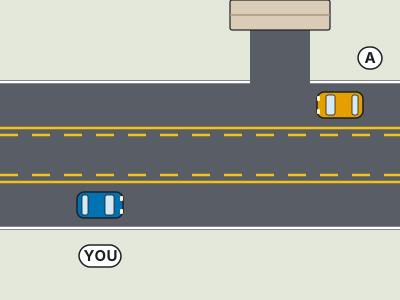
- Passing slower vehicles in either direction
- Parking during busy traffic periods
- Left turns by vehicles traveling in either direction
- Through travel when the outside lanes are closed
Show answer
Left turns by vehicles traveling in either direction. A shared center left-turn lane is reserved for left turns by traffic traveling in either direction. It is not a passing lane, a parking strip, or a substitute through lane when ordinary lanes are busy. Enter it only as needed for the turn, check opposing traffic, signal, and choose a suitable opening. Staying in the center lane too early increases the chance of meeting another vehicle coming toward you, so timing matters as much as position.
Study this in the handbook: Lane markings and special lanes
16. How should a Kansas driver check a blind spot before moving sideways?
- Trust the side mirrors alone, even at highway speed in traffic
- Ask a passenger to watch that side for you
- Glance at the rearview mirror twice and then move
- Turn your head and look over your shoulder in the direction you plan to move
Show answer
Turn your head and look over your shoulder in the direction you plan to move. Mirrors leave areas near the rear corners that they cannot show. Turning your head and looking over your shoulder in the direction of the move reveals vehicles hiding there. Mirror checks still come first, and a quick head turn keeps your eyes off the road ahead only briefly. Passengers can help in parking lots but cannot replace the driver check in traffic. Look several short times rather than one long stare if traffic ahead is busy.
Study this in the handbook: Safe speed and stopping distance
17. Under ideal conditions at 50 mph, what minimum total distance does a vehicle need to stop in Kansas guidance?
- A minimum of 123 feet to stop
- A minimum of 158 feet to stop
- A minimum of 268 feet to stop
- A minimum of 359 feet to stop
Show answer
A minimum of 268 feet to stop. Total stopping distance adds perception distance, reaction distance, and braking distance together. At fifty miles per hour under ideal conditions the vehicle travels a minimum of two hundred sixty eight feet before halting. The smaller figures name single parts of that sum or the slower thirty mile per hour total. The sixty mile per hour total runs longer still. Dry pavement, good brakes, and an alert driver are already assumed in the number.
Study this in the handbook: Safe speed and stopping distance
18. What two qualities must a Kansas parking place have besides being legal?
- Shaded during summer days and brightly lit during winter months
- Close to your destination and on a flat surface
- Marked with fresh paint and a posted sign
- Away from travel lanes and visible from both directions
Show answer
Away from travel lanes and visible from both directions. A parked vehicle must never become a surprise hazard. Choose a spot far enough from travel lanes to avoid interfering with traffic, and visible to drivers approaching from either direction. Designated areas come first whenever they exist. A legal but hidden spot over a crest still fails the visibility test. Shade, convenience, and fresh paint are comforts, not safety criteria. Think of parking as the final driving decision of the trip, judged by the traffic that must pass your stopped vehicle.
Study this in the handbook: Where not to park and parking on hills
19. How much time should a Kansas driver allow to complete a left turn from a stop and get up to speed?
- About 3 to 5 seconds, the same as going straight
- About 15 to 18 seconds to finish the turn and reach traffic speed
- About fifteen feet traveled while reacting at that speed on dry roads
- Left turns never require judging a time gap
Show answer
About 15 to 18 seconds to finish the turn and reach traffic speed. A left turn from a stop is the slowest common entry. The vehicle must cross opposing lanes, settle into the target lane, and accelerate, which normally takes fifteen to eighteen seconds. Right turns run a bit quicker at twelve to fifteen. Straight crossings take only three to five. Pick an oncoming gap that covers the full left turn time, and never trust that a signaling driver will actually turn before your path.
20. You are stopped at a Kansas red light and it turns green while cross traffic is still clearing. What should you do?
- Enter slowly and weave through clearing traffic
- Sound the horn and claim the intersection
- Allow the crossing traffic to clear before you go ahead
- Proceed, because green removes all other duties
Show answer
Allow the crossing traffic to clear before you go ahead. A fresh green does not sweep the intersection clean by itself. Vehicles still clearing from the cross street need room to finish, so wait until they pass before rolling ahead. This pause also catches late runners hurrying through their yellow. Green means go when the way is clear, not go regardless. A two second courtesy prevents the classic fresh green collision that happens in the first moments after the change.
Study this in the handbook: Traffic lights and arrows
Every question is written from the official Kansas Driving Handbook. Need paper? Printable KS practice test with answer key.
Last verified 2026-10-05. How we check every question · Study all 500 as flashcards
Frequently asked questions
How many questions are on this Kansas practice test?
This fixed set has 20 questions. It is test 25 of 25 from the 500 question Kansas bank. The real KS exam asks 25 questions and you need 20 correct.
What is the passing score for the real Kansas test?
You must score an 80% to pass the knowledge test That figure comes from the official Kansas source cited on the DMV facts page.
How does this fixed test relate to the full Kansas bank?
Each numbered test is a fixed set of questions in a fixed order, so you can retake the same test later and compare. Every test mixes road signs and the other topics in about the same proportion as the full bank. Tests 1 to 25 together cover every question in the Kansas bank once. The full practice page mixes the whole bank at random.
Last verified 2026-10-05. See the Kansas DMV facts page for sourced state details.