
Test 19 of 25 · 20 questions · Free 2026
KS Permit Practice Test 19
Jump to the test ↓A fixed 20 question set from the Kansas bank with answers and plain English explanations. The real KS exam is 25 questions, 80 percent to pass; take the full length version on the main practice page.
Question 1 of 20 · 0 right so far
All 20 questions in test 19
Every question below comes from the Kansas question bank on this page. Open a question to see the correct answer and the explanation. Nothing here is hidden behind a signup.
1. A regulatory sign shows a bicycle symbol under a red circle and slash in Kansas. What does the slash mean?
- Bicycles receive priority over cars at that location
- The pictured action or use is prohibited at that place
- The slash marks the end of a bicycle route in town
- Red slashes warn of danger but allow the action slowly
Show answer
The pictured action or use is prohibited at that place. On regulatory signs, a red circle with a slash through a symbol always delivers the same sentence: the action represented is prohibited. It applies to turns, U-turns, trucks, bicycles, or any pictured use. It never grants priority, ends routes by itself, or softens into a caution that permits the act at low speed. Reading the symbol plus the slash together is a core sign literacy skill. Where the slash appears, remove that maneuver from your options completely.
Study this in the handbook: Kansas speed limits
2. You are about to open your door into a Kansas street after parking. What is the required check?
- Open the door fully first so approaching drivers can see your intention and slow down for your exit today
- No check is required at night, because parked vehicles display reflectors that warn every approaching driver
- Check mirrors and traffic before opening the door, then shut it promptly
- Signal with your hazard flashers for five seconds, which replaces any need to look behind the parked vehicle
Show answer
Check mirrors and traffic before opening the door, then shut it promptly. A parked car rejoining the world starts with its door, and doors kill cyclists and clip mirrors. Check mirrors and traffic before opening, exit promptly, and shut the door as soon as you can. The Dutch Reach habit, opening with the far hand, forces your body to turn toward approaching traffic. Modern versions of the rule add bicyclist checks to the sides and rear before exiting. Signaling cannot do your looking for you, and darkness increases rather than retires the duty, since an opened door at night is nearly invisible until struck.
Study this in the handbook: Where not to park and parking on hills
3. Water rushes across a Kansas low road after a storm, depth unclear but moving fast. Your SUV feels heavy and capable. What does the guidance say?
- Do not drive through; about 2 feet of rushing water can carry most vehicles away
- A heavy SUV may cross rushing water up to four feet deep, because vehicle weight anchors it against the current flow
- Cross slowly in the center of the flow where the water runs deepest and cleanest over the hidden road surface today
- Six inches of moving water is dangerous only to small motorcycles, never to enclosed passenger vehicles in Kansas
Show answer
Do not drive through; about 2 feet of rushing water can carry most vehicles away. Rushing floodwater defeats vehicle weight quickly. About two feet of it can carry away most vehicles, SUVs included, while just six inches reaches the bottom of most passenger cars, causing loss of control or stalling. Depth over a road is unreadable anyway, since water hides dips and washed out pavement. Flash floods can arrive minutes after excessive rain, especially at night. The guidance has no capable vehicle exception: turn around, find another route, or wait on higher ground until waters subside.
Study this in the handbook: Night driving, fog and floods
4. Why should a Kansas driver avoid sounding the horn close to a bicyclist just to announce the car is there?
- It may startle the rider into steering into your path
- It uses up battery power faster than most drivers expect
- It tells the rider that you intend to turn at the next intersection
- It is legal only on interstate highways and rural county roads
Show answer
It may startle the rider into steering into your path. The handbook says not to sound your horn close to bicyclists unless there is a chance of a collision. A horn meant only to announce your presence may startle the rider, who could then steer into your path and cause a crash. A bicycle gives its rider little protection, and a sudden jolt of fright can send it off its line. Slow down and leave as much space as possible when passing, and save the horn for a real danger of collision.
Study this in the handbook: Pedestrians, bicycles, motorcycles and trucks
5. What do solid white lines that form turn lanes near a Kansas intersection prevent?
- Turning from the marked lanes at the next traffic light is prohibited
- Stopping behind the stop line in turn lanes
- Entering the lanes from side streets only
- Lane changes near the intersection within those lanes
Show answer
Lane changes near the intersection within those lanes. Solid white paint does more than separate same direction lanes. Near intersections it designates turn lanes and locks drivers into their chosen paths by preventing late lane changes. Decide your lane early, because darting across solid white at the last moment cuts off drivers who planned properly. The lanes still serve their turns and stops normally. Their message is commitment: once the paint turns solid, stay with the movement you selected.
Study this in the handbook: Work zone, guide and incident signs
6. How much caffeine equals the alertness boost the Kansas handbook describes for tired drivers?
- One sip of coffee restores full alertness
- About two cups of coffee worth, lasting several hours
- Caffeine removes the need for any sleep
- Five energy drinks before driving is safest
Show answer
About two cups of coffee worth, lasting several hours. Caffeine is a bridge, not a cure. The equivalent of two cups of coffee can increase alertness for several hours, and drinking it before a short nap can combine benefits when the nap ends. But caffeine wears off, and excess brings its own problems. It never substitutes for the seven to nine hours of sleep adults need, nor for stopping when eyes grow heavy. Use it to reach a safe rest stop, then actually rest. The best fatigue prevention remains sleep itself.
Study this in the handbook: Fatigue, distractions and driver responsibility
7. Your vehicle breaks down on a Kansas highway. Where should you position it for visibility?
- Where drivers can see it clearly, not hidden by hill or curve
- Just beyond a hill crest so traffic slows naturally
- Around a curve where speeds are already lower
- Anywhere the shoulder is widest, visible or not
Show answer
Where drivers can see it clearly, not hidden by hill or curve. A disabled vehicle must be discoverable by eyes, not by impact. Stop where approaching drivers hold a clear view of it, never hidden just over a hill or around a curve where sight lines collapse. Use emergency flashers, set flares well behind, and consider the white cloth or raised hood signal. If a phone is available, notify authorities about the breakdown. Then stay off the roadway itself while waiting, since the shoulder beside live traffic remains dangerous.
8. A Kansas driver drinks coffee and takes a cold shower after drinking. What effect does that have on sobriety?
- Coffee removes alcohol as fast as one hour per drink
- Nothing removes it; only time clears alcohol from the body
- Cold showers sober a driver within minutes
- A large meal cancels drinks already consumed
Show answer
Nothing removes it; only time clears alcohol from the body. Coffee, fresh air, cold showers, and food can make a drinker feel alert without removing alcohol from the circulatory system. Time is the only medically proven method: the body needs about an hour per normal drink. Feeling awake while still impaired is especially dangerous because confidence returns before skill does. Four drinks therefore mean four hours or more before driving. Sober has a strict meaning here: no alcohol or impairing drugs left circulating in the body at all.
Study this in the handbook: How alcohol and drugs affect driving
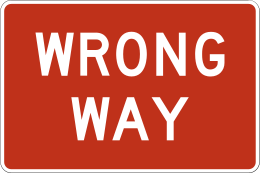
9. After a wrong turn at night in Kansas, this sign faces your windshield. What has happened?
- The road ahead closes for nightly maintenance work
- You have entered a street reserved for buses only
- Your vehicle is moving in the wrong direction
- Oncoming traffic has been detoured into your lane
Show answer
Your vehicle is moving in the wrong direction. This sign delivers a personal diagnosis: your vehicle is traveling the wrong way. Expect it on expressway ramps just past a Do Not Enter sign, or after turning wrongly onto a one-way street, alley, or driveway. The remedy is immediate and humble: stop safely, turn around where it can be done without facing traffic, and rejoin the correct flow. No maintenance or bus story applies. Head-on closing speeds make every second in the wrong lane expensive, so act at the first warning.
Study this in the handbook: Regulatory signs
10. What mechanical problems can cause accelerator failure in a Kansas vehicle?
- A low fuel tank or dirty windshield washer fluid
- Worn brake pads at the end of their service life
- A dead battery that only affects the starter
- A broken spring or a pedal stuck in the down position
Show answer
A broken spring or a pedal stuck in the down position. A racing or stuck accelerator traces to simple hardware: a broken return spring or a pedal physically stuck down. The response is identical either way: shift to neutral, search for an escape path, steer smoothly, brake gently, and pull off the roadway. Then switch the vehicle off and have the pedal repaired at a service center before driving again. Fuel, brakes, and starting systems produce different failures with different symptoms. Recognizing runaway acceleration quickly keeps it a maneuver instead of a crash.
Study this in the handbook: Emergency braking, skids and vehicle failures
11. Kansas permits some left turns on a red light where allowed. Which of these is one of them?
- From a one-way street onto a two-way street
- From a two-way street onto a one-way street
- From any street when no traffic is coming
- None; left turns on red are never allowed
Show answer
From a two-way street onto a one-way street. Kansas says some left turns may be permitted on red when moving from a one-way street onto another one-way street, or from a two-way street onto a one-way street. In both cases the street you turn onto is one-way. Turning onto a two-way street is not on the list, and an empty intersection alone does not make a left turn on red legal. Where it is permitted, check for traffic and pedestrians crossing in front of or beside your vehicle before turning.
Study this in the handbook: Traffic lights and arrows
12. What must be true of a Kansas highway before its 75 mph maximum can apply?
- Any highway with more than one lane in each direction automatically carries seventy five by Kansas statute alone
- A county may declare seventy five on its roads by painting the number on the pavement surface in large numerals
- Drivers may use seventy five on any state highway whenever traffic is light and weather is clear at midday
- It must be a separated, multilane highway designated and posted for it
Show answer
It must be a separated, multilane highway designated and posted for it. Seventy five is Kansas fastest statutory class and the most conditional. It applies only on a separated, multilane highway that the Secretary of Transportation has designated and posted for that speed. Lane count alone does not qualify an ordinary highway, and pavement paint cannot substitute for the designation process. Elsewhere state highways run sixty five and counties fifty five. Confusing the classes inflates your lawful speed by ten or twenty miles per hour, which is exactly the error these rotated road class questions hunt for.
Study this in the handbook: Kansas speed limits
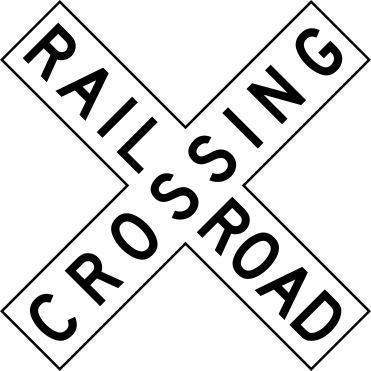
13. You reach a Kansas crossing marked by this white X-shaped sign. Who holds the right-of-way?
- Your vehicle, if you arrive before the train sounds a horn
- Pedestrians crossing the tracks ahead of your vehicle
- Trains and railroad vehicles; you wait until the crossing is clear
- Drivers who stop closest to the rails go first in order
Show answer
Trains and railroad vehicles; you wait until the crossing is clear. The crossbuck stands at the crossing itself and marks where trains own the right-of-way absolutely. Your vehicle waits behind the stop line or before the intersection until the crossing is clear, however quiet the rails seem. Arrival order, horn audibility, and stopping position create no car priority over a train that needs a mile to stop. A number of tracks plaque below warns when a second train can follow. The blue ENS sign posted here supplies the dispatch number for reporting blockages or device failures.
Study this in the handbook: Warning signs
14. At a quiet Kansas neighborhood corner with no painted lines, a walker steps from the sidewalk into the street. Is there a crosswalk?
- No; without paint the walker is jaywalking by definition here
- Crosswalks exist only where a crossing guard is posted daily
- Only corners with pedestrian signals create legal crosswalks
- Yes; crosswalks exist at intersections where sidewalks meet, painted or not
Show answer
Yes; crosswalks exist at intersections where sidewalks meet, painted or not. Paint advertises crosswalks but does not create them. At every intersection where a sidewalk meets the street, a crosswalk exists in law, and drivers must yield to pedestrians inside it. Mid-block crossings add signs and markings, and school patrols add human control, but neither invention is required at corners. Assuming an unmarked walker is jaywalking leads drivers to roll through people who hold the right-of-way. In neighborhoods, treat every sidewalk corner as the crossing it legally is, especially where children travel.
Study this in the handbook: Pedestrians, bicycles, motorcycles and trucks
15. Your Kansas light is steady green and you want to turn left, but pedestrians fill your target crosswalk. What governs?
- Wait until the way is clear of oncoming traffic and walkers
- Turn slowly through the crosswalk since your light is green
- Pedestrians must wait because vehicle green outranks walkers
- Complete the turn and stop beyond the crosswalk to wait
Show answer
Wait until the way is clear of oncoming traffic and walkers. Steady green gives left turners permission wrapped in yields: turn only when the intersection is clear, yielding to oncoming traffic traveling straight or turning right, and to pedestrians crossing in front or beside your vehicle. A crosswalk full of walkers is the opposite of clear, so the vehicle waits in its ready position inside the junction. Green arrows protect turns differently, but even they demand pedestrian vigilance. Vehicle signals never demote people on foot to obstacles whose patience the driver can presume.
Study this in the handbook: Traffic lights and arrows
16. The light turns steady yellow as you near a Kansas intersection with a truck close behind you. What does the yellow mean?
- The light is about to change to red, so stop if traffic behind permits safely
- Accelerate, because yellow legally extends your green period today
- Stop instantly regardless of who follows behind your vehicle
- Yellow means cross traffic must yield to late entries always
Show answer
The light is about to change to red, so stop if traffic behind permits safely. Steady yellow is a warning that red is imminent. The guidance is conditional on purpose: slow and stop if the traffic flow behind you allows it, because a truck breathing down your bumper changes the safe answer. If you are already inside the intersection when yellow appears, continue through safely. Beating the red by accelerating teaches the worst habit in signal driving. Reading the mirror along with the light is what experienced drivers do with this indication.
Study this in the handbook: Traffic lights and arrows
17. You must slow where a following driver would not expect it, such as a hidden driveway. How can you warn the driver behind?
- Flash your high beams repeatedly at the driver behind
- Turn on the hazard flashers for every slowdown
- Tap the brake pedal three or four times lightly
- Brake hard once so the warning is unmistakable
Show answer
Tap the brake pedal three or four times lightly. Brake lights speak to the driver behind you. Tapping the pedal three or four times lightly flashes that message before a slowdown at a place where following traffic expects steady speed, like a private driveway or a hidden hazard. The gentle taps warn without throwing away speed suddenly. Hazard flashers suit stopped or disabled vehicles, not routine slowing. Early, clear communication lets the follower lift off smoothly instead of discovering your bumpers at the last moment.
18. When temperatures sit near freezing, why does wet ice become even more slippery in Kansas guidance?
- Near freezing, ice turns rougher and grips better
- Water over ice makes it more slippery than ice well below freezing
- Meltwater drains instantly off crowned roads
- Cold ice below freezing is always the slickest surface
Show answer
Water over ice makes it more slippery than ice well below freezing. Around the freezing point, a thin film of water can form over ice. That water layer acts like a lubricant, making the surface slicker than hard ice at temperatures well below freezing. Treat near freezing wet pavement as a top tier hazard: slow down, widen following space, and steer gently. Bridges, overpasses, and shaded bends deserve the same caution. If steering feels light or vague, ease off the speed without sharp inputs.
Study this in the handbook: Safe speed and stopping distance
19. You are stopped at a Kansas intersection and parked cars block your view of cross traffic. What should you do?
- Pull out quickly so cross traffic can see you
- Honk continuously while entering the intersection
- Edge forward slowly until you can see clearly
- Wait for a driver behind you to wave you forward
Show answer
Edge forward slowly until you can see clearly. When buildings, trees, or parked vehicles block the view from a stop, creep forward slowly until the cross street opens up. Moving gently lets crossing drivers spot the front of your vehicle and slow or warn you before you commit. Darting out removes that warning chance. A horn or a wave from behind cannot substitute for your own clear view. Enter only when the path through is visible and safe.
Study this in the handbook: Safe speed and stopping distance
20. Making a left turn in Kansas, why should you avoid cutting the corner sharply?
- You would cut in front of traffic approaching from the left
- Sharp corner cuts are faster and always safer in busy traffic
- Cutting corners only affects vehicles behind you
- The rule applies only at rural intersections
Show answer
You would cut in front of traffic approaching from the left. Turning left means entering lanes used by others, including drivers approaching from your left whose path a tight cut invades early. Swing with control into the lane just beyond the center line, leaving room for oncoming drivers who are also turning left in front of you. Always start from the left-most lane unless markings allow more. A smooth wide arc feels slower but keeps your vehicle predictable. Corner cutting trades a second saved for a conflict nobody can brake out of.
Every question is written from the official Kansas Driving Handbook. Need paper? Printable KS practice test with answer key.
Last verified 2026-10-05. How we check every question · Study all 500 as flashcards
Frequently asked questions
How many questions are on this Kansas practice test?
This fixed set has 20 questions. It is test 19 of 25 from the 500 question Kansas bank. The real KS exam asks 25 questions and you need 20 correct.
What is the passing score for the real Kansas test?
You must score an 80% to pass the knowledge test That figure comes from the official Kansas source cited on the DMV facts page.
How does this fixed test relate to the full Kansas bank?
Each numbered test is a fixed set of questions in a fixed order, so you can retake the same test later and compare. Every test mixes road signs and the other topics in about the same proportion as the full bank. Tests 1 to 25 together cover every question in the Kansas bank once. The full practice page mixes the whole bank at random.
Last verified 2026-10-05. See the Kansas DMV facts page for sourced state details.