
Test 20 of 25 · 20 questions · Free 2026
KS Permit Practice Test 20
Jump to the test ↓A fixed 20 question set from the Kansas bank with answers and plain English explanations. The real KS exam is 25 questions, 80 percent to pass; take the full length version on the main practice page.
Question 1 of 20 · 0 right so far
All 20 questions in test 20
Every question below comes from the Kansas question bank on this page. Open a question to see the correct answer and the explanation. Nothing here is hidden behind a signup.
1. Why should you avoid swinging wide to the left before a Kansas right turn?
- Wide swings are required before every right turn at intersections
- Swinging wide protects cyclists on your left side
- It only matters for large trucks making turns
- A driver behind may misread it and try passing you on the right
Show answer
A driver behind may misread it and try passing you on the right. A right turn should start from the right-most lane and stay tight. Swinging wide left first broadcasts the wrong message: the driver behind may read it as a lane change or a left turn and dive up your right side just as you cut back across their path. Large vehicles sometimes need space from other lanes to clear corners, but ordinary cars do not. Signal, approach from the proper lane, and turn into the nearest lane going your direction.
2. Why should a driver increase the following interval behind emergency equipment?
- Police, ambulance, and fire crews need more space to operate
- Emergency equipment is allowed to ignore every traffic rule
- The following interval should be reduced so responders can be passed
- A driver must stop 500 feet behind every ordinary passenger car
Show answer
Police, ambulance, and fire crews need more space to operate. The handbook advises leaving more space behind police vehicles, ambulances, and fire trucks because those crews need room to operate. Following closely can obstruct responders, limit their options, and reduce the time available if they slow or stop. The rule does not grant emergency equipment permission to ignore every traffic law, and reducing the gap would create the very obstruction the advice seeks to prevent. The 500-foot choice applies a separate figure to ordinary cars without support. Notice emergency equipment early, ease off the accelerator, and preserve a generous buffer behind it.
Study this in the handbook: Following distance, scanning and space
3. A Kansas work zone posts this orange sign ahead of you. What should you expect?
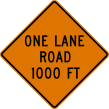
- Two lanes will merge into three
- Only one lane of the road will be open ahead
- The road ahead becomes a one-way street
- Your lane will end in about a mile
Show answer
Only one lane of the road will be open ahead. Work zone signs are construction, maintenance, or emergency operation signs that alert you to work zones ahead and warn you that people are working on or near the roadway. They are generally diamond or rectangular and orange with black letters or symbols. A one lane road sign tells you that only a single lane stays open through the work area, so vehicles may have to take turns. Reduce your speed, do not tailgate, and be ready to stop suddenly.
Study this in the handbook: Work zone, guide and incident signs
4. An ambulance passes you on a Kansas highway and you resume driving behind it toward the same exit. What following distance is required?
- One hundred feet suffices once its lights stop flashing at the next interchange along your shared route today
- Stay at least 500 feet behind the emergency vehicle
- You may follow closely to use the path it clears through traffic until your exit ramp finally appears ahead
- Five hundred feet applies only to fire trucks, while ambulances allow one hundred feet in Kansas guidance
Show answer
Stay at least 500 feet behind the emergency vehicle. After an emergency vehicle passes, distance becomes the duty: stay at least five hundred feet away from it. That buffer protects crews who may stop suddenly, turn across lanes, or stage in unexpected places, and it matches the expanded following interval emergency equipment always deserves. Using its cleared path as a personal express lane is exactly the behavior the figure forbids. The same five hundred appears behind emergency equipment in space management guidance, translated into seconds at speed. Fresh room behind responders is part of yielding, not an optional sequel.
Study this in the handbook: Emergency vehicles, move over and traffic stops
5. Overhead lane signals show a green arrow above your lane in a Kansas reversible-lane street. What does it grant?
- The lane is yours for the entire rest of the day
- You must exit the lane because arrows mark closures
- Green arrows apply only to transit buses in Kansas
- You may use the lane beneath the green arrow at that time
Show answer
You may use the lane beneath the green arrow at that time. Reversible lanes change direction with demand, and overhead signals are their constitution. A green arrow opens the lane beneath it for your direction now, no longer promise attached. A red X closes a lane outright, flashing yellow X reserves turning, and steady yellow X orders you out as use changes. Always read the signal before entering, since drivers from the other direction can lawfully occupy the same pavement in another period. Todays open lane is tomorrows head-on trap if you drive from memory.
Study this in the handbook: Lane markings and special lanes
6. A school bus stops with its arm out across a Kansas road divided only by a center turn lane. You approach from the opposite direction. What must you do?
- Proceed, because a center turn lane counts as a divided highway
- Stop only when children step into the center turn lane area
- Stop even though the bus is on the opposite side of the road
- Pass slowly on the right if your lane remains fully open
Show answer
Stop even though the bus is on the opposite side of the road. Center turn lanes are paint, not barriers. Kansas requires your stop for a school bus across a center turning lane exactly as across double yellow lines, multi-lane highways, and intersections: bus side makes no difference. Only a median or physical barrier on a truly divided highway releases opposing traffic. Children cross the turn lane without treating it as a refuge, so waiting for their first step is waiting too long. Hold until red lights stop and the arm retracts, then proceed only when children have fully cleared the roadway.
Study this in the handbook: School buses and required stops
7. You enter a Kansas town and the business blocks begin, but no speed sign is posted. What maximum applies?
- 30 mph in the urban district
- 20 mph throughout the town, because business districts set the lowest posted speed everywhere in Kansas towns
- 55 mph until a sign appears, because town entry alone does not change the county road maximum outside cities
- 65 mph for the first mile inside town while through traffic maintains highway speed into the business district
Show answer
30 mph in the urban district. Unless another limit is posted, thirty miles per hour is the maximum in any urban district. Twenty miles per hour governs only properly marked school zones and business districts where that limit is specifically posted. Highway figures never bleed into town: the district change itself resets the ceiling before any sign confirms it. Drivers who carry sixty five into the first blocks meet pedestrians, parked cars, and cross traffic at three times the energy the street was designed around. Town entry is a speed event, not a suggestion.
Study this in the handbook: Kansas speed limits
8. Snow begins falling on a Kansas road posted 55 mph, and visibility drops. The posting officer clocked you at 50 mph. Can that still violate the law?
- No; driving below the posted maximum can never violate Kansas speed law under any weather conditions at all
- Yes; basic speed law forbids speed unreasonable for the conditions present
- Only commercial drivers owe basic speed duties when snow falls on roads posted above forty miles per hour
- The posted number becomes unlawful only after an official storm declaration closes the road to ordinary travel
Show answer
Yes; basic speed law forbids speed unreasonable for the conditions present. Basic speed law sits beneath every posted number: never drive faster than is reasonable and prudent under the conditions then existing, weighing road, weather, vehicle condition, and your own physical state. A lawful fifty five on dry pavement becomes unlawful at fifty in snow with shrinking visibility. That is why officers can cite too fast for conditions without any sign change. Posted limits assume ideal conditions that storms cancel. The speedometer reading that matters is the one your stopping distance can support.
Study this in the handbook: Kansas speed limits
9. Your vehicle begins losing traction on a Kansas road. Why lift off both pedals briefly?
- Lifting off makes the skid end on its own within seconds
- Pedals lock the wheels whenever traction fades
- Releasing pedal pressure reveals which end is sliding
- Coasting adds grip by heating the tires quickly
Show answer
Releasing pedal pressure reveals which end is sliding. When traction first fades, releasing brake and accelerator pressure gives the tires a chance to roll and reveals which end is sliding. A vehicle plowing straight points to front loss, while sideways drift names the rear. That diagnosis chooses your next move: ease and reapply brakes for the front, steer into the intended path for the rear. With anti-lock brakes, full braking can restore front steering control. Pedals are inputs to manage, not switches that doom or save you automatically.
Study this in the handbook: Emergency braking, skids and vehicle failures
10. You approach this sign in Kansas and traffic is flowing across your path. What is required?

- Stop fully for a count of three whether traffic flows or not
- Enter slowly and expect crossing drivers to brake for you today
- Speed up to merge into the flow before the gap closes ahead
- Slow down and let right-of-way traffic cross before you enter
Show answer
Slow down and let right-of-way traffic cross before you enter. The downward red and white triangle assigns priority to everyone else. Slow down and allow traffic holding the right-of-way to cross before entering, stopping outright when interference would otherwise happen. It differs from the stop sign, which demands a halt every time, and from a merge, where lanes combine as equals. Crossing drivers owe you nothing while you face this triangle. Enter only into a gap that needs no braking from the people the sign protects.
Study this in the handbook: Kansas speed limits
11. At what point does alcohol impairment begin for a Kansas driver?
- Impairment begins only at a .08 BAC reading
- Impairment begins after the third normal drink
- Impairment starts with the first drink
- One drink can never affect driving ability
Show answer
Impairment starts with the first drink. There is no free first drink. Impairment starts with the first drink, and even one drink can reduce the ability to operate a motor vehicle. With more drinks a person is visibly impaired and can be arrested for driving under the influence well below dramatic drunkenness. Kansas can convict an impaired driver under the .08 figure too. The safe plan forms before drinking starts: a sober driver, a cab, or staying over. Waiting until you feel impaired means judgment is already compromised.
Study this in the handbook: How alcohol and drugs affect driving
12. When is checking traffic to the rear most important for a Kansas driver?
- Only when backing out of a parking space onto a busy street
- Only after a crash has already happened
- Before changing lanes, slowing, entering traffic, or hills
- Rear checks matter solely on interstate highways
Show answer
Before changing lanes, slowing, entering traffic, or hills. The rear view matters most whenever your speed or position is about to change relative to traffic behind. Before lane changes, slowdowns, entries from side streets, and long descents, mirrors reveal tailgaters and fast closers in time to adjust. Heavy traffic calls for even more frequent checks. Vehicles build speed downhill, especially large trucks, so a glance before descending protects your rear. Making rear checks habitual turns following traffic from a surprise into managed information.
Study this in the handbook: Safe speed and stopping distance
13. Which dashboard behaviors warn a Kansas driver that fatigue is taking over?
- Needing sunglasses during bright afternoon drives
- Checking mirrors more often than usual in traffic
- Feeling hungry during a long afternoon trip
- Radio up, window down, heavy eyes, or drifting lanes
Show answer
Radio up, window down, heavy eyes, or drifting lanes. Fatigue announces itself through the tricks drivers use to fight it. Needing the radio louder or the window down for cold air, struggling to keep eyes open, or drifting from your lane all mean the battle is already being lost. The response is to stop driving: pull off at the next exit or rest area, take a fifteen to twenty minute nap in a safe parking area, or sleep for the night. Between midnight and six in the morning, simply not driving prevents many fatigue crashes.
Study this in the handbook: Fatigue, distractions and driver responsibility
14. Besides separating lanes, what else do solid white lines mark in Kansas?
- The right edge of the roadway and parking spaces
- The center of two-way roadways at night
- Bicycle lanes on every city street
- The edge where passing is always allowed
Show answer
The right edge of the roadway and parking spaces. White paint works several jobs. Dashed white separates same direction lanes you may cross with a safe gap, while solid white also marks the right edge of the roadway and outlines parking spaces. Yellow, not white, divides opposing traffic. Bicycle lanes use their own markings and signs toward the right side. Knowing which white line you face tells you whether crossing it is a lane change, a departure from the road, or parking outside a legal space.
Study this in the handbook: Work zone, guide and incident signs
15. Where do crosswalks exist in Kansas even when no white lines are painted?
- Only where crossing signs are posted overhead
- Only at mid-block locations with signals
- At all intersections where a sidewalk meets the street
- No one at all, since sidewalks sit outside ordinary traffic law rules
Show answer
At all intersections where a sidewalk meets the street. Crosswalks exist at every intersection where a sidewalk meets the street, whether or not paint marks them. Mid-block crossings add signs and markings, but corner crosswalks need no paint to be real. Drivers must yield to pedestrians inside them just the same. Expect people crossing at unmarked corners in neighborhoods and business districts. Assuming no paint means no pedestrians is how drivers roll into people who had every right to be there.
Study this in the handbook: Pedestrians, bicycles, motorcycles and trucks
16. At what speeds can badly worn tires lose traction through hydroplaning in Kansas guidance?
- At much lower speeds, about 25 to 30 mph
- Only above 70 mph on flooded highways
- At the same 45 to 50 mph as new tires
- Worn tires never hydroplane on wet roads
Show answer
At much lower speeds, about 25 to 30 mph. Healthy tires in heavy rain can lose all contact around forty five to fifty miles per hour. Badly worn tires give up far earlier, around twenty five to thirty miles per hour, because shallow tread cannot push water aside. That means a worn set can start skating at ordinary street speeds in pooled water. Slowing down in rain or standing water is the defense for any tire. Replacing worn tires removes the early risk altogether.
Study this in the handbook: Safe speed and stopping distance
17. A Kansas work zone warning appears, but you see no workers after the sign. What should you assume?
- Crews may still be ahead because some work zones move with the work
- The zone was abandoned and signs no longer apply
- You may ignore lane shifts until workers appear
- Mobile work never uses warning signs in Kansas
Show answer
Crews may still be ahead because some work zones move with the work. Line painting, patching, and mowing crews travel as they work, so the workers may sit well beyond the first warning sign or around a bend. Their absence from your first view proves nothing. Keep obeying signs, lane shifts, and reduced speeds until the End Road Work sign appears. Traffic patterns in long zones can also change daily. Assume the hazard is real and simply not visible yet, which is the entire point of advance warning.
Study this in the handbook: Work zone, guide and incident signs
18. You are following a large truck on a Kansas highway. How should you position your vehicle?
- Where the driver can see your vehicle in the side mirrors
- Directly behind the truck to stay out of the wind
- Close behind the bumper to prevent others from cutting in
- Beside the rear wheels so you can watch the trailer
Show answer
Where the driver can see your vehicle in the side mirrors. Large vehicles have huge blind spots directly behind them. If you follow too closely, the driver cannot see your car, and you cannot see what is ahead of you. When the truck brakes or stops suddenly, you have no place to go and could run into it. The handbook advises you to avoid following the vehicle too closely and to position your vehicle so the driver can see it in the side mirrors.
Study this in the handbook: Pedestrians, bicycles, motorcycles and trucks
19. A Kansas learner sees a diamond sign with black symbols on a yellow field. What kind of sign is it most likely?
- A guide sign giving distances to the next Kansas towns ahead
- A warning sign, since most warnings are yellow, black, and diamond shaped
- A regulatory sign that sets a legal speed for the roadway
- An incident sign reporting a crash scene further ahead
Show answer
A warning sign, since most warnings are yellow, black, and diamond shaped. Most Kansas warning signs share one uniform: yellow with black lettering or symbols, usually diamond shaped. Regulatory signs run white with black, red, or green, guide signs wear green, brown, or blue, and fluorescent pink announces temporary incidents. School, crossing, and pedestrian warnings may upgrade to fluorescent yellow, but the diamond silhouette still signals caution ahead. Learning the color and shape code lets you classify a sign before you can read it, buying decision time at speed.
Study this in the handbook: Traffic lights and arrows
20. A stop sign stands at a Kansas corner, and open curb space begins 25 feet before it on your approach. May you park in that space?
- Yes; twenty five feet exceeds the twenty foot clearance that Kansas requires near stop signs on side streets
- Yes, if you park facing away from traffic so your vehicle profile narrows beside the stop sign approach lane
- Only delivery vehicles must respect the thirty foot figure, because their stops are longer than private cars
- No; keep at least 30 feet from signals, stop signs, or flashing beacons on approach
Show answer
No; keep at least 30 feet from signals, stop signs, or flashing beacons on approach. Approach clearance protects the view of control devices. Kansas bars parking within thirty feet of any traffic control signal, stop sign, or flashing beacon at the side of the roadway, measured on the approach. Your twenty five foot space sits inside that protected window where a parked vehicle would hide the sign from arriving drivers. Fire hydrants take fifteen feet and railroad rails fifty, each number tuned to its hazard. Delivery status changes none of the distances; duration of the stop is not the variable the rule measures.
Study this in the handbook: Where not to park and parking on hills
Every question is written from the official Kansas Driving Handbook. Need paper? Printable KS practice test with answer key.
Last verified 2026-10-05. How we check every question · Study all 500 as flashcards
Frequently asked questions
How many questions are on this Kansas practice test?
This fixed set has 20 questions. It is test 20 of 25 from the 500 question Kansas bank. The real KS exam asks 25 questions and you need 20 correct.
What is the passing score for the real Kansas test?
You must score an 80% to pass the knowledge test That figure comes from the official Kansas source cited on the DMV facts page.
How does this fixed test relate to the full Kansas bank?
Each numbered test is a fixed set of questions in a fixed order, so you can retake the same test later and compare. Every test mixes road signs and the other topics in about the same proportion as the full bank. Tests 1 to 25 together cover every question in the Kansas bank once. The full practice page mixes the whole bank at random.
Last verified 2026-10-05. See the Kansas DMV facts page for sourced state details.