
Key points
Yellow lines separate traffic moving in opposite directions, and a dashed yellow line means you may pass if a safe gap exists.
Source: Handbook p. 43
“Lines separating traffic moving in opposite directions are yellow. Dashed yellow lines between opposing lanes of traffic mean that you may pass if a safe gap in traffic is available.”
Kansas Driving Handbook, Handbook p. 43With a solid and a dashed yellow line, do not pass if the solid line is on your side.
Source: Handbook p. 43
“Where there is both a solid and a dashed yellow line between opposing lanes of traffic you should not pass if the solid yellow line is on your side.”
Kansas Driving Handbook, Handbook p. 43Two solid yellow lines mean neither side may pass, but you may cross a solid yellow line to turn.
Source: Handbook p. 43
“Two solid yellow lines between lanes of traffic means neither side may pass. You may cross a solid yellow line to turn when gaps in traffic flow exist.”
Kansas Driving Handbook, Handbook p. 43A dashed white line between same direction lanes may be crossed to change lanes when a safe gap exists.
Source: Handbook p. 43
“A dashed white line between lanes of traffic means that you may cross it to change lanes if a safe gap in traffic is available.”
Kansas Driving Handbook, Handbook p. 43A solid white line means stay in your lane unless a special situation requires a change.
Source: Handbook p. 43
“A solid white line between lanes of traffic means that you must stay within the lane unless a special situation requires a lane change.”
Kansas Driving Handbook, Handbook p. 43A shared center left turn lane may be used by traffic from either direction only to turn left, never to pass.
Source: Handbook p. 44
“The solid yellow centerline means you cannot use the center lane for passing. The broken yellow centerlines show that vehicles traveling in either direction may use the center lane only to make left turns.”
Kansas Driving Handbook, Handbook p. 44On reversible lanes, a green arrow means you may use the lane and a red X means the lane is closed to you.
Source: Handbook p. 45
“A green arrow means you can use the lane beneath it; a red “X” means the lane is not available.”
Kansas Driving Handbook, Handbook p. 45HOV lanes are reserved for vehicles with 2 or more people in them.
Source: Handbook p. 45
“HOV signs or markings mean “High Occupancy Vehicles” and indicate lanes reserved for vehicles with two or more people in them.”
Kansas Driving Handbook, Handbook p. 45You must yield to pedestrians entering or in a crosswalk, and not all crosswalks are marked.
Source: Handbook p. 44
“You must yield to pedestrians entering or in a crosswalk. Not all crosswalks are marked.”
Kansas Driving Handbook, Handbook p. 44
Numbers to know
| Number | What it means | Manual |
|---|---|---|
| 2 or more | people needed for a standard HOV lane | Handbook p. 45 |
| HOV 3 | at least 3 people must be in the vehicle | Handbook p. 45 |
Recognize these signs
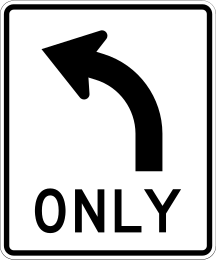
Left turn only lane
3 questions from the Kansas practice test
1. When two solid yellow lines separate opposing lanes, what passing rule applies?
- Both directions may pass when drivers signal
- Passing is permitted for the side nearest the shoulder
- Only trucks may cross to overtake
- Neither side may pass
Show answer
Neither side may pass. Two solid yellow lines separate opposing traffic and prohibit passing from either direction. A driver may cross a solid yellow line for a turn when a safe gap exists, but that exception does not turn the marking into a passing lane. Signaling does not override the restriction, and vehicle type does not create a special privilege. Read the lines as a barrier between opposing flows. If overtaking would require crossing them, remain in lane and wait for a permitted passing area.
2. What does a dashed white line between lanes traveling in the same direction permit?
- Crossing only to pass on the shoulder
- Crossing to change lanes when a safe gap is available
- Never crossing under any circumstance
- Traveling in opposite directions on either side
Show answer
Crossing to change lanes when a safe gap is available. Dashed white lane markings separate traffic moving in the same direction and may be crossed for a lane change when a safe gap exists. The marking does not guarantee that the next lane is clear or that changing is wise at that moment. Check mirrors and the blind spot, signal, judge the speed of nearby traffic, and move only when the lane can accept the vehicle. A solid white line signals a stronger restriction, while yellow markings separate opposing traffic.
3. What is the purpose of a shared center left-turn lane?
- Passing slower vehicles in either direction
- Parking during busy traffic periods
- Left turns by vehicles traveling in either direction
- Through travel when the outside lanes are closed
Show answer
Left turns by vehicles traveling in either direction. A shared center left-turn lane is reserved for left turns by traffic traveling in either direction. It is not a passing lane, a parking strip, or a substitute through lane when ordinary lanes are busy. Enter it only as needed for the turn, check opposing traffic, signal, and choose a suitable opening. Staying in the center lane too early increases the chance of meeting another vehicle coming toward you, so timing matters as much as position.
Practice this topic
Lock it in with signals and markings questions from the free Kansas practice test. Every answer comes with a plain English explanation.
Source: the Kansas Driving Handbook, Section 6: Rules of the Road. This lesson is a plain English summary, not the law itself; where it differs, the manual and the statute govern. Last checked 2026-09-27.