
Key points
Stop when meeting or overtaking a school bus, church bus or day care bus that is stopped to pick up or let off children.
Source: Handbook p. 18
“You must stop when meeting or overtaking a school bus, church bus or day care bus that is stopped to pick up or let off children.”
Kansas Driving Handbook, Handbook p. 18Stay stopped until the stop signal is pulled back and the red lights are off.
Source: Handbook p. 18
“You must remain stopped until the STOP signal is retracted, and the red lights are turned off.”
Kansas Driving Handbook, Handbook p. 18Traffic on the opposite roadway of a divided highway does not have to stop for a school bus.
Source: Handbook p. 18
“Traffic approaching a school bus in the opposing roadway of a divided highway is not required to stop.”
Kansas Driving Handbook, Handbook p. 18You must stop for a school bus on either side of the road on a multi lane highway.
Source: Handbook p. 51
“You must stop for a school bus when you are on a multi-lane highway, whether the school bus is on your side of the road or on the opposite side of the road.”
Kansas Driving Handbook, Handbook p. 51You must also stop from either direction when only a center turning lane separates the roadways.
Source: Handbook p. 51
“You must stop for a school bus when there is a center turning lane between the roadways, whether the school bus is on your side of the road or on the opposite side of the road.”
Kansas Driving Handbook, Handbook p. 51Once the stop arm is no longer visible, watch for children and do not go until they have completely left the roadway.
Source: Handbook p. 50
“the stop arm is no longer visible, watch for children along the side of the road and do not proceed until it is safe, after they have completely left the roadway.”
Kansas Driving Handbook, Handbook p. 50At a stop sign, stop at the marked stop line, or if none, before the crosswalk on the near side of the intersection.
Source: Handbook p. 18
“At a stop sign. You must stop at a clearly marked stop line, but if none, before entering the crosswalk on the near side of the intersection”
Kansas Driving Handbook, Handbook p. 18You must stop when a school crossing guard holds an official flag in the STOP position.
Source: Handbook p. 18
“When a school crossing guard is displaying an official flag in a STOP position.”
Kansas Driving Handbook, Handbook p. 18Increase your following distance behind buses, delivery vans and police cars, which stop often or turn suddenly.
Source: Handbook p. 18
“When you are following vehicles, which stop often or make sudden turns (buses, delivery vans, police cars etc.) you should increase your following distance.”
Kansas Driving Handbook, Handbook p. 18
Recognize these signs
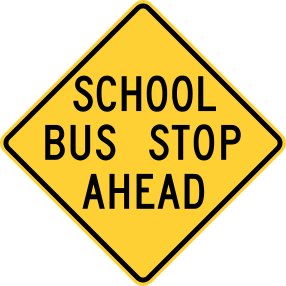
School bus stop ahead
3 questions from the Kansas practice test
1. When must you stop for a school bus that is stopped to pick up or release children?
- When meeting or overtaking it, until the stop signal is retracted and red lights are off
- Only when following it on a two-lane road, and only for five seconds
- Only when children are visible in the roadway after leaving the bus
- Only when the bus is in your own lane ahead of you
Show answer
When meeting or overtaking it, until the stop signal is retracted and red lights are off. Kansas requires a driver meeting or overtaking a stopped school bus, church bus, or day care bus that is loading or unloading children to stop. Remain stopped until the stop signal is retracted and the red lights are off. The rule is not limited to five seconds, to visible children, or to traffic behind the bus, because drivers meeting it from the other direction must stop too. The one stated exception is traffic approaching in the opposing roadway of a divided highway, which is why the roadway design must be identified carefully.
2. A school bus is stopped to pick up children on a two-lane road. When may a driver who meets the bus continue?
- As soon as the driver sees no children in the roadway
- After the bus retracts its STOP signal and turns off its red lights
- After slowing to 15 mph and passing on the shoulder
- When the bus driver waves traffic through while the red lights remain on
Show answer
After the bus retracts its STOP signal and turns off its red lights. When a school bus is stopped to pick up or let off children, Kansas requires an approaching or overtaking driver to stop. The vehicle must remain stopped until the STOP signal is retracted and the red lights are turned off. Seeing no children does not replace the required signal condition because a child may still enter the roadway. Slowing to 15 mph or using the shoulder does not make passing legal, and a wave cannot override active red lights. Treat the bus signals as the controlling cue and wait for both release conditions.
3. Why should the gap behind a bus or delivery van be larger than the usual following space?
- Their brake lights are not required to work
- Their drivers are always permitted to exceed the speed limit
- Those vehicles may stop often or make sudden turns
- They must be followed closely to prevent other cars merging
Show answer
Those vehicles may stop often or make sudden turns. Buses, delivery vans, and police cars can make frequent stops or unexpected turns. The handbook advises increasing the following distance behind vehicles with those behaviors, then adding still more space in bad weather. Extra room improves your view and creates time to respond when the larger vehicle blocks sight lines or changes speed. Tailgating does the opposite: it hides conditions ahead and leaves little room for a controlled stop. Treat the vehicle's operating pattern as a cue to lengthen the gap early.
Practice this topic
Lock it in with safe driving questions from the free Kansas practice test. Every answer comes with a plain English explanation.
Source: the Kansas Driving Handbook, Section 2: State Laws and Rules of the Road. This lesson is a plain English summary, not the law itself; where it differs, the manual and the statute govern. Last checked 2026-09-27.