
Key points
Bicyclists count as vehicles on the road and follow the same rules as motor vehicles.
Source: Handbook p. 80
“Bicyclists are considered vehicles when used on roadways. They are expected to follow the same rules of the road as motorized vehicles.”
Kansas Driving Handbook, Handbook p. 80Do not pass a bicyclist immediately before you make a right turn.
Source: Handbook p. 81
“If you are about to make a right turn, you must not pass a bicyclist immediately before the turn.”
Kansas Driving Handbook, Handbook p. 81The Dutch Reach means opening your car door with your right hand, which turns your body to see traffic behind you.
Source: Handbook p. 82
“It entails that the motorist uses their right hand to pull the handle to open the door which will inherently turn your body to provide better visibility of traffic approaching from the rear.”
Kansas Driving Handbook, Handbook p. 82Do not pass a motorcycle, scooter or moped in the same lane.
Source: Handbook p. 83
“Do not pass a motorcycle/scooter/moped in the same lane.”
Kansas Driving Handbook, Handbook p. 83A loaded truck at 55 mph needs at least 335 feet to stop.
Source: Handbook p. 86
“traveling at 55 mph requires a minimum of 335 feet before coming to a complete stop”
Kansas Driving Handbook, Handbook p. 86Large vehicles have blind spots directly behind them that reach up to 200 feet.
Source: Handbook p. 86
“Unlike cars, large vehicles have huge blind spots directly behind them that extend up to 200 feet.”
Kansas Driving Handbook, Handbook p. 86If you cannot see the truck driver's face in the side mirror, the driver cannot see you.
Source: Handbook p. 86
“If you cannot see the driver's face in the side view mirror, they cannot see you.”
Kansas Driving Handbook, Handbook p. 86An orange and red triangle on the back of a vehicle means it travels under 25 mph.
Source: Handbook p. 88
“A fluorescent or reflective orange and red triangle displayed on the rear of vehicles drawn by animals, farm equipment or construction equipment means the vehicle is traveling less than 25 mph.”
Kansas Driving Handbook, Handbook p. 88You may pass a trolley safety zone only when safe and at no more than 10 mph.
Source: Handbook p. 87
“You may pass the zone as soon as it is safe to do so and at no faster than 10 mph.”
Kansas Driving Handbook, Handbook p. 87Allow a 3 to 4 second following distance behind a motorcycle, scooter or moped, or more in wet conditions.
Source: Handbook p. 84
“When following a motorcyclist/scooter/moped, allow for a 3 to 4 second following distance or more in wet conditions”
Kansas Driving Handbook, Handbook p. 84
Numbers to know
| Number | What it means | Manual |
|---|---|---|
| 335 feet at 55 mph | minimum stopping distance of a loaded truck | Handbook p. 86 |
| 200 feet | length of a large vehicle's rear blind spot | Handbook p. 86 |
| 25 mph | slow moving vehicle emblem means under this speed | Handbook p. 88 |
| 10 mph | maximum speed passing a trolley safety zone | Handbook p. 87 |
| 3 to 4 seconds | following distance behind a motorcycle, scooter or moped | Handbook p. 84 |
Recognize these signs

Slow moving vehicle 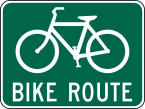
Bike route
3 questions from the Kansas practice test
1. When following a motorcycle, what minimum interval should a driver allow in normal conditions?
- One second because motorcycles stop quickly
- Three to four seconds or more
- One car length at every speed
- No gap if the motorcycle is using its headlight
Show answer
Three to four seconds or more. Motorcycles can stop quickly, and the handbook warns that following too closely endangers your life and that of the motorcyclist. The handbook recommends a three to four second following distance, with additional room in wet conditions. That space provides time to recognize a stop, brake without an abrupt maneuver, and account for a motorcycle's smaller profile. A single car length changes meaning with speed and is not a reliable measure. Look through the motorcycle's path, keep your attention forward, and avoid crowding the rider.
2. Why should you wait to move in front of a large vehicle until its whole front is visible in your rear-view mirror?
- The rear-view mirror shows only the truck's license plate
- The truck cannot see any vehicle in its side mirrors
- Large vehicles are required to stop immediately after a pass
- The large vehicle needs more stopping distance than a car
Show answer
The large vehicle needs more stopping distance than a car. Large vehicles need substantially more distance to stop than passenger cars. Before moving back into the lane ahead of one, wait until the vehicle's entire front appears in your rear-view mirror. That visual cue gives the truck a safer cushion if traffic slows and prevents cutting off a vehicle that cannot brake as quickly. Seeing only part of the front means the gap is still too small. Complete the pass smoothly, maintain a predictable speed, and leave room for the truck's longer stopping response.
3. You are about to turn right in Kansas and a bicyclist is ahead. What does the handbook say?
- Pass quickly, then turn
- Turn from the bike lane
- Honk so the cyclist stops
- Do not pass the bicyclist immediately before the turn; slow down and let the cyclist clear the intersection
Show answer
Do not pass the bicyclist immediately before the turn; slow down and let the cyclist clear the intersection. Give bicyclists as much space as possible and consider their speed when you pass. If you are about to make a right turn, you must not pass a bicyclist immediately before the turn. To avoid a collision, slow down and let the cyclist clear the intersection before making your turn. Turning from a bike lane is not the instruction, and sounding the horn close to a bicyclist can startle the rider into your path. After passing a bicyclist, do not slow down or stop quickly, because a motor vehicle's brakes are more powerful than a bicycle's.
Practice this topic
Lock it in with safe driving questions from the free Kansas practice test. Every answer comes with a plain English explanation.
Source: the Kansas Driving Handbook, Section 9: Sharing the Road. This lesson is a plain English summary, not the law itself; where it differs, the manual and the statute govern. Last checked 2026-09-27.