
Key points
Do not park within 15 feet of a fire hydrant or more than 12 inches from a curb.
Source: Handbook p. 19
“Within 15 feet of a fire hydrant. • More than 12” from a curb.”
Kansas Driving Handbook, Handbook p. 19Do not park within the 30 feet before a traffic signal, stop sign or flashing beacon.
Source: Handbook p. 19
“Within the 30 feet approaching any traffic control signal, stop sign, or flashing beacon at the side of the roadway.”
Kansas Driving Handbook, Handbook p. 19Do not park within 50 feet of the nearest rail at a railroad crossing.
Source: Handbook p. 19
“Within 50 feet of the nearest rail at railroad crossings.”
Kansas Driving Handbook, Handbook p. 19Stay 20 feet from a fire station driveway on the same side, and 75 feet from it on the opposite side of the street.
Source: Handbook p. 19
“Within 20 feet of driveway entrance to a fire station and on side of street opposite the entrance within 75 feet of entrance.”
Kansas Driving Handbook, Handbook p. 19Never park in a crosswalk at an intersection, in front of a driveway, or on a bridge or in a tunnel.
Source: Handbook p. 19
“Within a pedestrian crosswalk at an intersection. Within 15 feet of a fire hydrant. More than 12” from a curb. In front of a driveway. On a bridge or other elevated structure upon a highway or within a tunnel.”
Kansas Driving Handbook, Handbook p. 19Parking double, or two deep along the curb, is not allowed.
Source: Handbook p. 19
“Double or, “two-deep” along the curb or side of street.”
Kansas Driving Handbook, Handbook p. 19Downhill, with or without a curb, stop parallel to and within 12 inches of the curb or road edge.
Source: Handbook p. 52
“When parking your vehicle on a downhill, whether with a curb or without a curb bring the vehicle to a stop parallel to and within 12 inches of the curb or road edge.”
Kansas Driving Handbook, Handbook p. 52Uphill with a curb, stop within 12 inches of the curb, then move slowly forward turning the wheel sharply away from the curb.
Source: Handbook p. 52
“When parking your vehicle on an uphill with a curb, bring the vehicle to a stop parallel to and within 12 inches of the curb. Move slowly forward turning the steering wheel sharply away from the curb.”
Kansas Driving Handbook, Handbook p. 52Always set your parking brake, then put the car in park or in gear.
Source: Handbook p. 52
“Always set your parking brake when you park. Then place the vehicle in gear if it has a manual transmission or in “park” if it has an automatic transmission.”
Kansas Driving Handbook, Handbook p. 52Painted curbs: white means short stops only, yellow a loading zone, blue a handicap restriction and red a fire zone.
Source: Handbook p. 55
“White indicates that only short stops are permitted Yellow indicates a loading zone or some other restriction Blue indicates a handicap restriction Red indicates fire zone restrictions”
Kansas Driving Handbook, Handbook p. 55
Numbers to know
| Number | What it means | Manual |
|---|---|---|
| 15 feet | from a fire hydrant | Handbook p. 19 |
| 12 inches | maximum distance from the curb | Handbook p. 19 |
| 30 feet | before a traffic signal, stop sign or flashing beacon | Handbook p. 19 |
| 50 feet | from the nearest rail of a railroad crossing | Handbook p. 19 |
| 20 feet | from a fire station driveway, same side | Handbook p. 19 |
| 75 feet | from a fire station entrance, opposite side of the street | Handbook p. 19 |
Recognize these signs
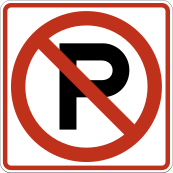
No parking 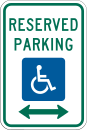
Handicapped parking
3 questions from the Kansas practice test
1. Kansas prohibits parking within what distance of a fire hydrant?
- Within 5 feet
- Within 10 feet
- Within 15 feet
- Within 25 feet
Show answer
Within 15 feet. Kansas prohibits parking within 15 feet of a fire hydrant. The five-foot and ten-foot choices leave too little clearance, while 25 feet is farther than the handbook's stated boundary and is not the tested figure. The reason for the restriction is practical: a parked vehicle can obstruct firefighters who need to connect equipment and reach the hydrant quickly. As you approach a hydrant, count at least 15 feet of space before leaving the vehicle. Do not treat the rule as a courtesy-only suggestion, because the handbook places it among locations where parking is not allowed.
2. When parking uphill beside a curb in Kansas, how close should the vehicle be to the curb?
- No more than 24 inches
- No more than 12 inches
- At least 3 feet
- Any distance if hazard lights are on
Show answer
No more than 12 inches. The Kansas parking instructions place the vehicle parallel to and within 12 inches of the curb when parking uphill beside one. The 24-inch and three-foot choices leave too much space, while the option allowing any distance ignores the required positioning. After stopping close to the curb, move slowly forward while turning the wheel sharply away from it, then let the vehicle roll back until the tire touches the curb. That way, if the vehicle starts to roll, it rolls away from traffic. The memory cue is within 12 inches, or one foot.
3. How far from a curb may a vehicle be parked in Kansas?
- No more than 12 inches
- No more than 18 inches
- No more than 24 inches
- No more than 36 inches
Show answer
No more than 12 inches. The Kansas list of illegal parking places includes parking more than 12 inches from a curb, along with parking within 15 feet of a fire hydrant, in front of a driveway, on a bridge or in a tunnel, in No Parking zones, and double parking along the curb. Eighteen, 24, and 36 inches all leave more space than the handbook allows. When parking downhill, stop parallel to and within 12 inches of the curb or road edge and turn the wheels toward it.
Practice this topic
Lock it in with parking questions from the free Kansas practice test. Every answer comes with a plain English explanation.
Source: the Kansas Driving Handbook, Section 2: State Laws and Rules of the Road. This lesson is a plain English summary, not the law itself; where it differs, the manual and the statute govern. Last checked 2026-09-27.