
Printable KS Permit Practice Test
25 questions in the real KS exam format, 80 percent (20 of 25) to pass. Answer key on the last page. Last verified 2026-09-05 against the official Kansas driver manual.
1. How far before slowing, turning, or changing lanes must a driver give a required signal?
- At least 25 feet before the move
- At least 100 feet before the move
- At least 50 feet before the move
- Only after beginning the move
2. At a Kansas four-way stop, which vehicle normally receives priority from the other drivers?
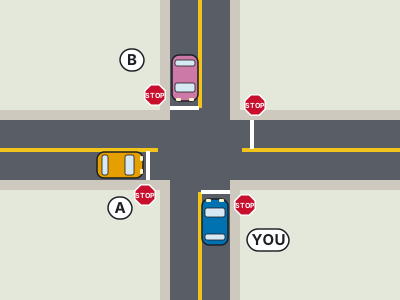
- The vehicle with the loudest horn
- The largest vehicle
- The vehicle that reached the intersection first
- The vehicle signaling a turn
3. When must Kansas drivers turn on headlights because of weather?
- Only after complete darkness begins
- Whenever the vehicle wipers are being used
- Only during snowfall at highway speed
- Only when another driver flashes headlights
4. A Kansas driver's license expired 14 months ago. What testing does renewal require?
- Only a vision screening
- Full testing: the vision, written, and driving examinations
- Only the written examination
- No testing, just a late penalty
5. What following interval should a driver use under adverse conditions?
- One second
- Two seconds
- Three seconds
- Four seconds
6. The pictured merge warning sign should be read as what type of sign?

- A red regulatory command that requires an immediate stop
- A yellow warning of a roadway condition or hazard ahead
- A blue guide sign naming a destination
- A white sign declaring a parking restriction
7. Before emerging from an alley or driveway in a business or residential district, where must a driver stop?
- After crossing the sidewalk
- Immediately before driving onto the sidewalk or sidewalk area
- Only at the edge of the roadway
- Only when a pedestrian is visible
8. What does the pedestrian crossing warning sign tell a driver to expect?

- People may be crossing the roadway ahead
- Pedestrians are forbidden from entering the road
- A sidewalk repair crew controls the next lane
- Only bicycles may cross at the marked location
9. A Kansas driver misses a court date on a traffic ticket. What license action does the handbook list?
- A 30 day suspension
- A warning letter only
- No action unless the ticket was for speeding
- A mandatory indefinite suspension
10. Unless a sign sets a different limit, what is the Kansas maximum speed on a county or township road?
- 35 mph
- 45 mph
- 65 mph
- 55 mph
11. At a flashing red traffic light, what must a driver do before entering?
- Yield only to vehicles approaching from the left
- Slow without stopping if the intersection is clear
- Continue because flashing signals have no control effect
- Stop completely before proceeding
12. A driver entering a main road from a driveway must yield to which traffic?
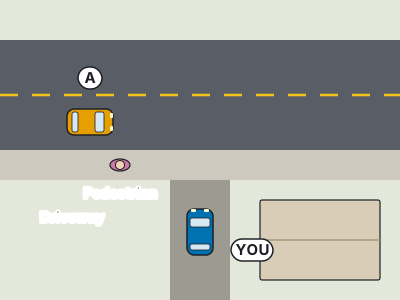
- Vehicles already on the main road
- Only vehicles approaching from the left
- Only vehicles that are turning toward the driveway
- No traffic if the driver activates a turn signal
13. A school bus with its stop arm out is stopped on the far side of a road with a center turning lane. What must you do?
- Keep going, because a center turn lane counts as a median
- Slow to 20 mph and pass carefully
- Stop, even though the bus is on the opposite side
- Stop only if children are visible
14. What score must an applicant reach to pass the Kansas knowledge test?
- 70%
- 75%
- 80%
- 90%
15. In Kansas, how close to a traffic signal, stop sign, or flashing beacon may you park on the approach?
- No closer than 15 feet
- No closer than 30 feet
- No closer than 20 feet
- No closer than 50 feet
16. A 15-year-old holds a Kansas instruction permit. When is the teen eligible to take the Driver's License Test?
- After holding the permit 30 days
- After holding the permit one full year or reaching 17, whichever comes first
- After holding the permit six months
- Only after turning 18
17. Your car breaks down on the highway. Where should you place emergency flares?
- Directly beside the driver's door
- About 20 to 30 feet behind the vehicle
- About 200 to 300 feet behind the vehicle
- About a mile behind the vehicle
18. What precaution is most appropriate after seeing the pictured skidding-car warning?

- Reduce speed and be prepared for a slippery roadway
- Increase speed so the tires spend less time on the pavement
- Brake hard while turning to test the available traction
- Follow the vehicle ahead more closely for guidance
19. What does the handbook say about insisting on priority in a traffic conflict?
- The vehicle with priority may ignore pedestrians
- A driver may force the movement because priority guarantees safety
- Priority rules apply only when a police officer is present
- A driver must still do everything possible to prevent a collision
20. Which sign treatment may identify a school zone, school crossing, or pedestrian crossing?
- Flashing red only
- Solid blue
- Brown and white
- Fluorescent yellow
21. A vehicle is tailgating you on a Kansas road with no empty lane. What does the handbook say to do?
- Wait until the road ahead is clear, then reduce speed slowly to encourage the tailgater to pass
- Brake hard once
- Slow down quickly to make the driver back off
- Speed up to open a gap
22. Unless another limit is posted, what is the maximum speed on a designated separated, multilane highway outside a town?
- 55 miles per hour
- 75 miles per hour
- 70 miles per hour
- 65 miles per hour
23. What is the youngest age for a Kansas Class C instruction permit, and what extra step applies before 16?
- 15, with proof of driver education enrollment
- 14, with a written application from a parent or guardian
- 16, with no parent involvement
- 14, with no parent involvement
24. What does a round yellow sign with an X and RR letters warn a driver about?

- A highway-railroad grade crossing
- A hospital entrance
- A temporary detour
- A school-zone speed change
25. What is the default maximum speed on a designated and posted separated, multilane Kansas highway?
- 55 mph
- 65 mph
- 70 mph
- 75 mph
Answer key
- 1. B
- 2. C
- 3. B
- 4. B
- 5. D
- 6. B
- 7. B
- 8. A
- 9. D
- 10. D
- 11. D
- 12. A
- 13. C
- 14. C
- 15. B
- 16. B
- 17. C
- 18. A
- 19. D
- 20. D
- 21. A
- 22. B
- 23. B
- 24. A
- 25. D