
Test 23 of 25 · 20 questions · Free 2026
KS Permit Practice Test 23
Jump to the test ↓A fixed 20 question set from the Kansas bank with answers and plain English explanations. The real KS exam is 25 questions, 80 percent to pass; take the full length version on the main practice page.
Question 1 of 20 · 0 right so far
All 20 questions in test 23
Every question below comes from the Kansas question bank on this page. Open a question to see the correct answer and the explanation. Nothing here is hidden behind a signup.
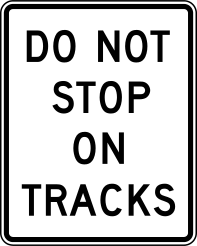
1. You approach a railroad crossing marked with this sign while traffic beyond the tracks is backed up. What should you do?
- Stop on the tracks and keep watching for a train
- Cross at once so the traffic keeps moving behind you
- Wait on the tracks until the gate begins to lower
- Stay back until you can clear the tracks completely
Show answer
Stay back until you can clear the tracks completely. A train cannot stop quickly because of its huge weight and size, so you must never let traffic trap you on the tracks. The handbook says that if you need to stop for traffic or a signal near railroad tracks, you stop at the stop line before the tracks. Only proceed through a crossing if you are sure you can completely clear it without stopping on the tracks. When vehicles are backed up beyond the crossing, hold back until there is room for your whole vehicle on the far side.
Study this in the handbook: Railroad crossing signs and safety
2. On a Kansas dirt road you see this sign ahead. What should you do?

- Slow down and increase your following distance
- Hold your speed and keep to the center of the road
- Speed up to carry momentum through the low spot
- Stop at the sign and wait for traffic behind you to pass
Show answer
Slow down and increase your following distance. Gravel or dirt roads can be narrow and have little to no shoulder, and they may have sharp dips or unexpected turns. A dip sign warns that the road drops ahead. The handbook says that because of these hazards you should slow down and increase your following distance. Extra space ahead gives you more time to react if the vehicle in front brakes or swerves, and a lower speed lets you keep control through a sudden change in the road.
Study this in the handbook: Slippery roads and hydroplaning
3. On wet Kansas roadways, how much should you reduce speed below recommended speeds?
- About 25 mph below recommended speeds
- Only 1 or 2 mph below recommended speeds
- No reduction while tires have good tread
- About 10 mph below recommended speeds
Show answer
About 10 mph below recommended speeds. Wet pavement stretches stopping distance and weakens steering grip. Reducing speed about ten miles per hour below recommended speeds buys back room to stop and turn. Packed snow demands a far deeper cut, roughly half or more, while ice calls for crawling or staying off the road. Good tread helps channel water but cannot restore dry grip. The ten mile reduction assumes ordinary rain on a wet road, not a flooded stretch, which you should avoid entirely.
Study this in the handbook: Safe speed and stopping distance
4. You drive 25 mph in a 55 mph Kansas zone on a clear day for no reason, and traffic stacks behind you. What law do you risk breaking?
- None, because slower driving can never be unlawful in Kansas under any circumstances on any road class
- The minimum speed law applies only on interstate highways with signs, so county roads exempt you from fines
- You break the law only if one of the stacked drivers honks at you twice during the same mile of travel
- Driving so slowly as to impede or block normal traffic movement
Show answer
Driving so slowly as to impede or block normal traffic movement. Traffic law polices both tails of the speed distribution. Posted minimums bind where they exist, and even without one, driving so slowly as to impede or block normal traffic movement is unlawful unless safe operation under basic speed law requires the crawl. Your clear day example offers no such excuse while a queue forms. More than fifteen miles per hour below the flow can be as dangerous as speeding, bunching vehicles into risky passes. When safe, the slow vehicle pulls over and lets the line pass.
Study this in the handbook: Kansas speed limits
5. You finish parallel parking on a Kansas street and measure 14 inches from tire to curb. What does the rule say?
- Fourteen inches passes, because the Kansas limit allows a full eighteen inches of space beside parked vehicles
- You are too far out; no more than 12 inches from the curb is allowed
- Distance from the curb is unregulated in Kansas as long as the vehicle sits fully off the sidewalk pavement
- You must sit exactly twelve inches away, since both closer and farther measurements violate the parking rule
Show answer
You are too far out; no more than 12 inches from the curb is allowed. Parallel parking ends with a measurement: the vehicle may sit no more than twelve inches from the curb. Your fourteen inches leaves the car protruding toward traffic and fails the rule. Twelve inches is a ceiling, not a target band, so tucking closer is fine. The same twelve inch figure governs stopping parallel to curbs or road edges in hill parking setups. A foot of tolerance total is all you get; wheels hugging traffic invite mirrors, cyclists, and passing trucks into the conflict the rule prevents.
Study this in the handbook: Where not to park and parking on hills
6. At a Kansas red light, a driver reads and answers a text thread, then drives on. The light cycle was red throughout the reading. Was the law broken?
- Yes; writing, sending, or reading a written communication while driving is prohibited
- No; the texting prohibition pauses whenever the vehicle sits stopped at a traffic signal on a Kansas roadway
- No; Kansas bans only composing new messages, while reading incoming texts remains lawful for adult drivers today
- Yes, but only because the driver answered, since reading a text without replying violates no Kansas statute
Show answer
Yes; writing, sending, or reading a written communication while driving is prohibited. The electronic device ban targets the communication, not the motion. Kansas prohibits using any device to write, send, or read a written communication while driving, texting and email included. A red light pause does not park the vehicle or the duty of attention, and reading is named as plainly as sending. GPS devices and weather reports sit outside the ban. Adults may talk or dial, however distracting, but the written word is categorically out. The safe version of this scene ends with the phone untouched until the car is parked.
Study this in the handbook: Where not to park and parking on hills
7. How can a Kansas driver keep from becoming aggressive in the first place?
- Plan routes that avoid all other traffic completely
- Relax, obey limits, allow real travel time, stay forgiving
- Skip signaling so other drivers cannot react badly
- Expect every driver to yield to your schedule
Show answer
Relax, obey limits, allow real travel time, stay forgiving. Prevention starts before ignition. Relax and concentrate on driving, hold the posted speed limit, be realistic about travel time, and practice courtesy plus forgiveness toward mistakes. Running late is the classic aggression trigger, so schedules built with slack remove it. Other drivers will still err; forgiving them costs seconds. If you meet serious aggression anyway, drive away from the area when possible and report it. Managing your own temper protects strangers who never know they were spared.
Study this in the handbook: Fatigue, distractions and driver responsibility
8. You leave the pavement in heavy Kansas traffic and the shoulder is wide. What should you do?
- Force your way back onto the pavement between two vehicles
- Stop fully on the shoulder and wait for a large gap
- Stop half on the pavement until traffic passes
- Reenter slowly without checking mirrors or gaps
Show answer
Stop fully on the shoulder and wait for a large gap. Heavy traffic changes the drop off recovery. When the shoulder is wide, use it: drive fully onto the shoulder and stop rather than fighting back into a dense stream. Then wait for a genuinely large gap in traffic before reentering, checking mirrors and blind spots as you would for any merge. If returning is impossible, pull as far from the road as possible and wait for help. Half pavement positions block both the lane and the shoulder at once.
Study this in the handbook: Emergency braking, skids and vehicle failures
9. Your Kansas highway exit passes while you were in the wrong lane. What must you never do?
- Stop in travel lanes or on the shoulder for the missed exit
- Take the next exit and turn around there
- Continue to a safe place to change direction
- Follow signs back toward your destination
Show answer
Stop in travel lanes or on the shoulder for the missed exit. Travel lanes and shoulders are not recovery zones. Stopping there for confusion, a breakdown that still rolls, or dropping a passenger endangers everyone streaming past. Keep moving until you can pull fully off the road in a parking area or take the next exit and turn around legally. Crossing a median or using emergency crossovers on interstates is illegal. The next exit always exists; a stopped car in fast traffic creates the emergency it fears.
Study this in the handbook: Lane markings and special lanes
10. What injury are head restraints in a Kansas vehicle designed to prevent?
- Whiplash if you are hit from behind
- Broken legs in frontal collisions only
- Sun glare injuries during morning drives
- Shoulder injuries from the safety belt itself
Show answer
Whiplash if you are hit from behind. Head restraints exist for rear impacts. When another vehicle hits you from behind, your head snaps back; a properly positioned restraint catches it and prevents whiplash, the neck injury that follows. Keep the restraint no higher than the top of your shoulders and below chin level in its working zone, and brace against the seat back with your head against it when a rear hit is coming. Belts and restraints work together, each covering motions the other cannot.
11. Driving through a Kansas work zone at night with no workers in sight, what still applies?
- Normal highway speed resumes after dark when crews have gone home
- Use extreme caution, since lane shifts and equipment may still be present
- Closed lanes reopen automatically at night
- Orange signs stop applying when crews leave
Show answer
Use extreme caution, since lane shifts and equipment may still be present. Work zones stay hazardous after crews clock out. Lane shifts, barrels, rough surfaces, and parked equipment remain in place overnight, and lighting makes them harder to judge. Extreme caution at night applies whether or not workers are visible. Reduced limits and flagger directions still govern inside the zone. Only the End Road Work sign releases you back to normal rules. An empty looking zone can still narrow to one lane around the next curve.
Study this in the handbook: Work zone, guide and incident signs
12. What does BAC actually measure in a Kansas driver body?
- The number of drinks consumed in one hour
- The percentage of alcohol in a single drink
- A score from the roadside balance exercises
- The share of alcohol compared with the blood in your body
Show answer
The share of alcohol compared with the blood in your body. Blood alcohol concentration is a ratio, not a drink count. It states the percentage of alcohol in relation to the amount of blood in your body. That is why the same drinks produce different readings across people and why counting drinks cannot certify fitness. At .08 or higher a Kansas driver violates the general per se law, while impairment and conviction remain possible below it. Vision effects begin as low as .02. The percentage in your blood is what officers test and courts use.
Study this in the handbook: How alcohol and drugs affect driving
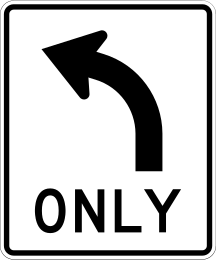
13. A Kansas driver sees this sign over a lane at an intersection. What does it tell drivers in that lane?
- Traffic in that lane must go straight ahead
- Drivers in that lane must turn left
- Drivers in that lane may turn left or go straight
- That lane is reserved for buses and bicycles
Show answer
Drivers in that lane must turn left. Lane use control signs are black and white and tell you where you can go and where you can turn, often with an arrow symbol. They can stand beside the road or hang over the lane, and arrows may also be painted on the pavement as a supplement. A curved arrow with the word ONLY means traffic in that lane must make that turn. Choose your lane early, at least one block before the turn, instead of cutting across lanes at the last moment.
Study this in the handbook: Kansas speed limits
14. At a Kansas intersection you plan to turn left across oncoming traffic. Why look carefully for motorcycles before you go?
- Motorcycles always travel faster than other vehicles on the road
- Motorcycles must stop for any car whose left turn signal is on
- Their small profile makes their speed and distance hard to judge
- Motorcycles may use the left turn lane as their own lane
Show answer
Their small profile makes their speed and distance hard to judge. Nearly 40 percent of motorcycle, scooter, and moped crashes with another vehicle were caused by the other vehicle turning left in front of the rider. A motorcycle has a much smaller profile than a car, which makes its speed and distance harder to judge as it approaches. Before you turn left, look carefully to the front and sides of your vehicle and wait if you are unsure. A gap that looks big enough for a car can close quickly.
Study this in the handbook: Pedestrians, bicycles, motorcycles and trucks
15. Your turn signal keeps blinking after you finish a lane change on a Kansas highway. What should you do?
- Flash your high beams repeatedly into the rearview mirror ahead of you
- Alternate signals to show the maneuver ended
- Signals always cancel, so no action is needed
- Cancel it yourself so other drivers are not confused
Show answer
Cancel it yourself so other drivers are not confused. Not every signal cancels itself, especially after gentle lane changes. A lingering blinker tells a false story, and other drivers may pull out expecting a turn that never comes. Cancel it manually whenever it fails to shut off. Using the lane change device, holding the lever partway, also reduces leftover signals. Accurate communication is a continuous duty, not just a pre turn ritual. Check the indicator as part of settling into the new lane.
16. Two vehicles reach a Kansas four-way stop at exactly the same time. Who goes first?
- The vehicle on the right goes first
- The vehicle on the left goes first
- The larger vehicle goes first for safety
- Both vehicles proceed together slowly
Show answer
The vehicle on the right goes first. First arrival normally takes a four-way stop. When arrivals tie, the tiebreaker gives the turn to the vehicle on the right, while the driver on the left yields. Size plays no role in the rule. Moving together invites a meeting in the middle of the junction. If the other driver waves you ahead instead, accept only with clear eye contact and caution, since law and courtesy sometimes negotiate a different order at creeping speeds.
Study this in the handbook: Right of way at intersections
17. You plan to pass on a Kansas two-lane road and spot railroad tracks a short distance ahead. What should you do?
- Pass quickly so you finish before any train could reach the crossing
- Pass only on the tracks where sight lines open up
- Trains always stop for cars caught mid-pass
- Do not pass if a railroad crossing lies within the next 20 to 25 seconds of travel
Show answer
Do not pass if a railroad crossing lies within the next 20 to 25 seconds of travel. Passing needs a long, predictable stretch of road. A railroad crossing inside the next twenty to twenty five seconds breaks that predictability, since crossing traffic must slow, look, and sometimes stop for trains. Being caught alongside another vehicle at the rails leaves no escape. Finish any pass well before crossings or wait until beyond them. The same patience applies at intersections and other entry points where vehicles can appear suddenly.
18. A school bus stops on the far side of a divided Kansas highway with a wide grass median. You travel the opposite way. Must you stop?
- No; opposing traffic on a separated divided highway need not stop
- Yes; every divided highway still requires both directions to stop
- Yes, but only until the bus driver waves opposing traffic onward
- You must slow to 10 mph but may roll past the bus zone
Show answer
No; opposing traffic on a separated divided highway need not stop. School bus stopping has one geographic release: when the opposing roadway is separated on a divided highway, traffic approaching from the other direction is not required to stop. Paint alone never creates that release. Two solid yellow lines, a center turn lane, multi-lane highways, and intersections all still demand your stop across from the bus. The divider must be physical separation. When it exists, continue with ordinary caution, watching for the bus own side traffic performing its full stop around the loading children.
Study this in the handbook: Right of way at intersections
19. You approach a Kansas uncontrolled corner as another car is already crossing inside it from your left. What must you do?
- Proceed, because vehicles on the right always go first here
- Enter slowly and share the intersection space together
- Yield to the vehicle already in the intersection
- Flash your lights to claim the remaining intersection space
Show answer
Yield to the vehicle already in the intersection. The first right-of-way layer at uncontrolled junctions protects occupancy: a driver approaching must yield to a vehicle that has already entered the intersection from a different highway. Right side priority only settles simultaneous arrivals, which this is not. The crossing car cannot vanish to honor your position rule, so your entry waits until it clears. Sharing the box invites the sideswipe the sequence exists to prevent. Light flashing claims nothing. Patience measured in seconds is the whole cost of the correct order.
Study this in the handbook: Right of way at intersections
20. After a tire blowout in Kansas, where should you bring the vehicle to a stop?
- In the nearest travel lane with flashers on
- On the railroad tracks where pavement is flat
- Off the road in a safe place, with flashers on
- Exactly where the tire failed, whatever the lane
Show answer
Off the road in a safe place, with flashers on. A blown tire ends with the vehicle out of traffic. Once slowed gradually without hard braking, pull off the road into a safe place when possible and switch on emergency flashers so others see the disabled vehicle. Stopping in a travel lane invites a rear end crash at highway closing speeds. Tracks and the failure spot itself keep you in harm path. Change the tire only where you can work clear of moving traffic, or call for help.
Study this in the handbook: Emergency braking, skids and vehicle failures
Every question is written from the official Kansas Driving Handbook. Need paper? Printable KS practice test with answer key.
Last verified 2026-10-05. How we check every question · Study all 500 as flashcards
Frequently asked questions
How many questions are on this Kansas practice test?
This fixed set has 20 questions. It is test 23 of 25 from the 500 question Kansas bank. The real KS exam asks 25 questions and you need 20 correct.
What is the passing score for the real Kansas test?
You must score an 80% to pass the knowledge test That figure comes from the official Kansas source cited on the DMV facts page.
How does this fixed test relate to the full Kansas bank?
Each numbered test is a fixed set of questions in a fixed order, so you can retake the same test later and compare. Every test mixes road signs and the other topics in about the same proportion as the full bank. Tests 1 to 25 together cover every question in the Kansas bank once. The full practice page mixes the whole bank at random.
Last verified 2026-10-05. See the Kansas DMV facts page for sourced state details.