
Test 24 of 25 · 20 questions · Free 2026
KS Permit Practice Test 24
Jump to the test ↓A fixed 20 question set from the Kansas bank with answers and plain English explanations. The real KS exam is 25 questions, 80 percent to pass; take the full length version on the main practice page.
Question 1 of 20 · 0 right so far
All 20 questions in test 24
Every question below comes from the Kansas question bank on this page. Open a question to see the correct answer and the explanation. Nothing here is hidden behind a signup.
1. Why should a Kansas driver avoid sunglasses or colored glasses at night?
- Tinted lenses are only a problem for brand new night drivers in Kansas
- They make headlights look brighter and clearer
- Tinted lenses cut the light you need and slow eye adjustment
- Night driving requires no eye adjustment at all
Show answer
Tinted lenses cut the light you need and slow eye adjustment. Night driving already starves your eyes of light. Sunglasses or colored lenses, even ones sold for glare, dim the scene further and make your eyes adjust even more slowly between bright and dark areas. Wear clear corrective lenses if your license requires them, and keep a spare set in the vehicle. Reduce glare problems with clean windows, sun visors in daylight, and looking toward the right edge when bright traffic passes at night.
Study this in the handbook: Night driving, fog and floods
2. A trooper pulls you over on a Kansas highway. How should you set up the stop for communication?
- Stop in the nearest lane and exit toward traffic
- Keep the engine and radio on so the officer hurries
- Pull right clear of traffic, engine off, flashers on, window down
- Roll the window up until documents are requested
Show answer
Pull right clear of traffic, engine off, flashers on, window down. A traffic stop starts with positioning: move right and stop as far out of traffic flow as safely possible. Turn off the engine, radio, and anything else that interferes with talking, switch on hazard flashers, and at night add interior lights so the officer can see inside. Roll the window down to communicate. Keep your belt fastened, hands on the wheel, and movements limited. Provide license, insurance, and registration when asked, announcing where they are before reaching slowly.
Study this in the handbook: Emergency vehicles, move over and traffic stops
3. By getting a Kansas driver license, what testing have you implicitly agreed to if suspected of impaired driving?
- No testing without a court hearing first
- A lawful test of blood, breath, urine, or bodily substance
- Only a field balance test at the roadside
- Testing only after a first conviction occurs
Show answer
A lawful test of blood, breath, urine, or bodily substance. Implied consent is the bargain inside every Kansas license: by accepting it, you have implicitly consented to a lawfully requested test measuring alcohol in blood, breath, urine, or another bodily substance when impaired driving is suspected. An alcohol concentration test is usually breath, blood, or urine. Refusing costs the license for a year on a first refusal. The consent travels with the license itself, so roadside negotiation cannot withdraw it. Court processes follow the arrest; they do not precede the test.
Study this in the handbook: How alcohol and drugs affect driving
4. Driving a rural Kansas road at dusk, you pass this round yellow sign. What should you start doing?

- Speed up to clear the crossing before any train can arrive there
- Assume no train runs at dusk and keep your current speed steady
- Slow down, look and listen for a train, and be ready to stop
- Stop on the tracks to check both directions before crossing them
Show answer
Slow down, look and listen for a train, and be ready to stop. The round yellow advance sign with an X and RR letters appears before the crossing itself. It orders an early response: slow down, look and listen for a train or railroad vehicle, and be ready to stop if one approaches. Trains keep no schedule you can consult and need more than a mile to stop from highway speed. Never stop on the tracks themselves to look. Your search happens on the approach, with room to halt before the rails.
Study this in the handbook: Warning signs
5. A pickup begins passing your sedan on a Kansas two-lane road. The driver misjudges and needs room. What must you do?
- Accelerate slightly so the pickup finishes sooner beside you
- Drift left to give the pickup driver a wider view around
- Match the pickup speed until it drops safely behind you
- Stay in your lane and do not increase your speed while being passed
Show answer
Stay in your lane and do not increase your speed while being passed. Being passed carries duties as real as passing. When another vehicle overtakes you on a two-lane road, stay in your lane and do not increase speed; if the pass turns marginal, easing off and keeping right helps the passer return safely. Accelerating converts a routine overtake into a race the passer cannot finish before oncoming traffic arrives. Drifting left crowds the passer from the other side. Cooperation when passed is invisible virtue: nothing happens, which is precisely the record everyone wants from the maneuver.
Study this in the handbook: Turn signals, U turns and passing
6. A Kansas driver deliberately tailgates and brake-checks another car to punish a slow merge. How does the handbook classify this?
- Aggressive driving, an intentional act endangering persons or property
- Ordinary careless driving, because no weapon was displayed during the tailgating and braking on the highway today
- Defensive driving, since the punishing driver was teaching the merger a lesson about proper highway speed courtesy
- Aggression requires a crash to occur; intentions without contact remain simple traffic mistakes in Kansas guidance
Show answer
Aggressive driving, an intentional act endangering persons or property. Aggressive driving is defined by intent plus endangerment: intentionally committing an action or moving traffic offense that endangers other persons or property. Deliberate tailgating and brake checking sit squarely on the behavior list beside speeding, erratic lane changes, disobeyed devices, threats, and chasing. No crash or weapon is needed to complete the classification. Careless mistakes lack the intentional punishment element your scenario supplies. The lawful responses remain separation: get out of the way, avoid eye contact and challenges, and report serious conduct.
Study this in the handbook: Fatigue, distractions and driver responsibility
7. The signal for your turning lane shows a red arrow in Kansas while the through lanes have green. May you turn?
- Yes, after stopping and yielding exactly like a right on red
- No; stop and wait until a green arrow or green light allows the turn
- Yes, if you turn slowly with hazard flashers running today
- Only buses must obey red arrows at Kansas intersections
Show answer
No; stop and wait until a green arrow or green light allows the turn. A red arrow is a direction specific red light. While it shines, you may not travel in the arrow direction at all until a green arrow or green light returns for that movement. The right on red courtesy for circular reds does not transfer to arrows, and flashers cannot launder the maneuver. Through traffic green beside you serves a different movement. These arrows guard turns whose conflicts, often pedestrians or heavy flows, made engineers remove every judgment call from the approach.
Study this in the handbook: Traffic lights and arrows
8. How do you know you are following too closely using the count method on a Kansas road?
- You can read the license plate ahead clearly
- About one full city block ahead of your vehicle at all speeds and places
- The driver ahead waves you closer at a stop
- You pass the fixed point before counting to one-thousand-two
Show answer
You pass the fixed point before counting to one-thousand-two. Pick a sign, pole, or other fixed point. When the rear of the vehicle ahead passes it, count one-thousand-one, one-thousand-two. Reaching the same point before finishing the count means your two second cushion is gone, so ease off and count again at the next point. Plate readability depends on eyesight and plate size, not time. Four seconds suits adverse conditions or extra caution, not the prime condition minimum check.
Study this in the handbook: Following distance, scanning and space
9. At 50 mph, how far does a Kansas driver travel while reacting before the brakes begin to slow the car?
- About 55 feet traveled during reaction
- About 15 feet traveled during reaction
- About 158 feet traveled during reaction
- About 268 feet traveled during reaction
Show answer
About 55 feet traveled during reaction. Reaction distance covers the ground traveled after seeing a hazard and before your foot actually presses the brake. At fifty miles per hour that averages about fifty five feet for an alert driver, using roughly three quarters to one second. Braking distance and total stopping distance run much longer, so mixing the figures understates or overstates each part. Knowing the reaction share shows why a hazard seen late cannot be answered instantly.
Study this in the handbook: Safe speed and stopping distance
10. You cross a sidewalk to enter a Kansas driveway. Who has the right-of-way there?
- Your vehicle, because driveways connect to the street
- Pedestrians only when a crosswalk is painted
- No one, since sidewalks are not part of traffic law
- Pedestrians on the sidewalk whom you must yield to
Show answer
Pedestrians on the sidewalk whom you must yield to. Entering or leaving a driveway, alley, or parking lot means crossing the sidewalk, and pedestrians there hold the right-of-way. Stop or slow enough to let them pass safely before rolling across. Painted crosswalks are not required, since sidewalks themselves are pedestrian paths. Driving along a sidewalk is illegal except to cross it at places like driveways. Treat every driveway throat as a small intersection where feet outrank wheels.
Study this in the handbook: Right of way at intersections
11. You approach a tractor on a Kansas state highway. Why should you use caution when it begins a right turn?
- Tractors cannot turn right at all on a state highway
- The tractor driver must signal each turn with a horn
- Farm machinery is limited to the right lane of any road
- Operators may swing wide left first, with no signals
Show answer
Operators may swing wide left first, with no signals. Tractors, combines, and other farm equipment move across rural roads and travel on state highways. The handbook warns that this machinery usually does not have turn signals and that operators may pull wide to the left before turning to the right. It can be wide enough to take up more than one lane and usually travels at less than 25 mph. The operator also cannot hear approaching vehicles, so pass with caution.
Study this in the handbook: Pedestrians, bicycles, motorcycles and trucks
12. At a steady green light in Kansas, which road users must you still yield to as required by law?
- No one, because green gives absolute priority
- Emergency vehicles and other road users the law protects
- Only vehicles larger than yours in the intersection
- Drivers who arrive at the light after you do
Show answer
Emergency vehicles and other road users the law protects. Steady green allows travel through a clear intersection, yet the permission carries conditions. Emergency vehicles and any other users the law protects still claim your yield, and left turns at green wait for oncoming traffic plus pedestrians. Treating green as absolute priority is how drivers enter against fire trucks and turning conflicts. Read the junction on every approach, even your daily commute. The light manages flow; it never assures an empty path.
Study this in the handbook: Traffic lights and arrows
13. How far ahead do Kansas high beam headlights let you see clearly at night?
- About 150 to 200 feet ahead
- About 350 to 400 feet ahead
- About 800 to 1,000 feet ahead
- High beams show the same distance as low beams
Show answer
About 350 to 400 feet ahead. Night speed must fit inside your light. Low beams reveal about one hundred fifty to two hundred feet, supporting roughly forty five miles per hour if you must stop within view. High beams extend clear sight to about three hundred fifty to four hundred feet, supporting about sixty five miles per hour on the same logic. Add at least one second of following distance at night, two on unfamiliar roads. Outdriving your beams means meeting hazards already too close to answer.
Study this in the handbook: Night driving, fog and floods
14. You miss your turn on a Kansas street. What is the lawful way to recover?
- Back up in the lane if no traffic is visible
- Stop in the lane and wait for a gap to reverse
- Reverse on the shoulder until you reach the turn
- Go on to where it is safe to turn around instead of backing up
Show answer
Go on to where it is safe to turn around instead of backing up. A missed turn calls for forward motion, not reverse. Continue to a place where turning around is safe, even if that means circling the block or using the next exit on an interstate. Backing in lanes or on shoulders surprises following drivers and invites collisions. Stopping in a live lane for confusion, a breakdown, or letting out a passenger creates the same problem. A small detour is always cheaper than a backing crash.
Study this in the handbook: Lane markings and special lanes
15. What does the railroad crossbuck identify at a crossing?
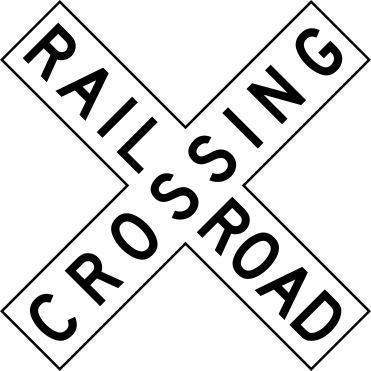
- A highway-railroad grade crossing where trains have right-of-way
- A school zone where children always cross
- A work zone requiring traffic to use the shoulder
- A one-way street with a special lane
Show answer
A highway-railroad grade crossing where trains have right-of-way. The crossbuck marks the highway-railroad grade crossing, where drivers must give right-of-way to trains and railroad vehicles. The sign is not a school, work-zone, or one-way-street control. As the vehicle approaches, the driver should slow, look, and listen, and be prepared to stop if a train is approaching. Never assume the absence of a gate or flashing signal makes the tracks safe to cross.
Study this in the handbook: Railroad crossing signs and safety
16. You park uphill beside a curb in Kansas and want the car to roll toward the curb if it moves. Walk through the wheel maneuver.
- Roll forward with wheels sharply away, then let the car settle back until the tire touches the curb
- Turn the wheels sharply toward the curb and roll forward until the front tire climbs halfway onto the sidewalk
- Leave the wheels straight, because an uphill curb will catch the rear tire first if the vehicle begins rolling
- Turn wheels toward traffic so a rolling car crosses the street slowly and stops against the opposite curb bank
Show answer
Roll forward with wheels sharply away, then let the car settle back until the tire touches the curb. Uphill with a curb reverses downhill logic. Stop parallel within twelve inches of the curb, move slowly forward while turning the wheel sharply away from the curb, stop, then allow the vehicle to roll slowly back until the tire rests against the curb as a block. If the brake fails, the geometry steers the car into the curb rather than into traffic. Downhill parking turns wheels the other way for the same traffic avoiding result. Memorizing the pair by outcome, never toward travel lanes, beats memorizing by direction words alone.
Study this in the handbook: Where not to park and parking on hills
17. Traffic on a Kansas highway flows at 60 mph while you cruise at 40 mph in the left lane. Why is this dangerous rather than cautious?
- Slow driving is always safer than traffic flow at every speed difference and on every Kansas highway class
- Driving over 15 mph slower than flow is as dangerous as excessive speed
- The danger exists only above a thirty mile per hour difference measured between fastest and slowest vehicles
- Left lane cruising at forty is lawful because no minimum speed can ever apply on Kansas multilane highways
Show answer
Driving over 15 mph slower than flow is as dangerous as excessive speed. Speed danger measures difference as much as altitude. Driving more than fifteen miles per hour slower than the traffic flow pattern can be just as dangerous as excessive speed, because vehicles bunch behind the slow mover and accept greater risks to pass. The remedy for a genuinely slow vehicle is to pull over when safe and let the queue go. Left lanes compound the offense by blocking the passing lane. Posted minimums enforce the same idea formally where they exist on high speed roads.
Study this in the handbook: Safe speed and stopping distance
18. You overtake slower traffic in Kansas and this pennant sign appears on your left. What begins?
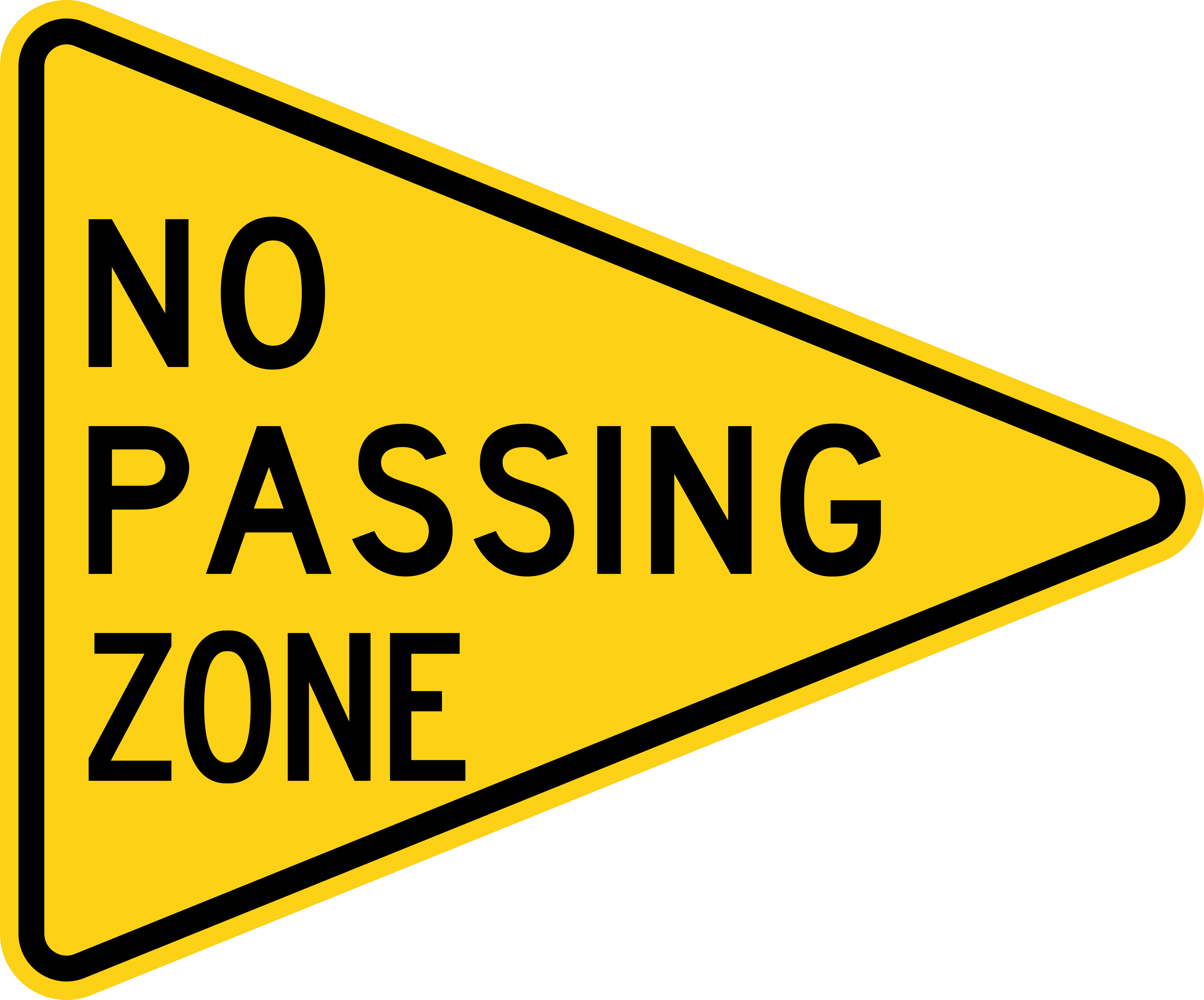
- A passing zone where overtaking slower traffic is newly allowed
- A flagger station controlling one lane traffic flow
- A no-passing zone, so stay behind until the zone ends
- The sign marks where school buses load on the left
Show answer
A no-passing zone, so stay behind until the zone ends. The pennant is unique among warning signs: a sideways triangle posted on the left side of the road facing you, marking the beginning of a no-passing zone. Sight distance beyond it, hills, curves, intersections, or driveways, cannot support safe passing. It does the opposite job of a Pass with Care sign, which ends such a zone. Move back and wait in line, however slow the vehicle ahead feels. The zone ends where signs and markings reopen passing with clear views.
Study this in the handbook: Turn signals, U turns and passing
19. Before starting a Kansas drive, when should seat and mirror adjustments happen?
- Adjust mirrors only after reaching highway speed
- Adjust the seat at the first red light downtown
- Mirrors need adjustment only for night driving
- Always adjust your seat and mirrors before you start to drive
Show answer
Always adjust your seat and mirrors before you start to drive. Pre-drive setup is driving, done early. Always adjust your seat and mirrors before you start moving, framing the rear window in the rearview mirror and setting side mirrors for the lanes beside you. Reaching for controls mid trip is a distraction that steals eyes and hands. Head restraints belong positioned to prevent whiplash in a rear hit. A correctly set seat also places your foot to pivot between brake and accelerator with the heel down. Ninety seconds parked prevents fumbling at speed.
20. From what following position should you start a pass on a Kansas two-lane road?
- From at least two seconds behind the vehicle to be passed
- From half a second behind the bumper to shorten the passing time
- From directly alongside the rear bumper
- Following position does not matter when passing
Show answer
From at least two seconds behind the vehicle to be passed. Beginning a pass from at least two seconds back serves two purposes. It keeps you from striking the rear corner of the vehicle ahead if it slows or drifts, and it gives you a view around it before committing. Tailgating into a pass blinds you and startles the other driver. Build the gap, check mirrors and shoulder, signal, then steer smoothly into the passing lane. Space before the move is what makes the move itself calm.
Every question is written from the official Kansas Driving Handbook. Need paper? Printable KS practice test with answer key.
Last verified 2026-10-05. How we check every question · Study all 500 as flashcards
Frequently asked questions
How many questions are on this Kansas practice test?
This fixed set has 20 questions. It is test 24 of 25 from the 500 question Kansas bank. The real KS exam asks 25 questions and you need 20 correct.
What is the passing score for the real Kansas test?
You must score an 80% to pass the knowledge test That figure comes from the official Kansas source cited on the DMV facts page.
How does this fixed test relate to the full Kansas bank?
Each numbered test is a fixed set of questions in a fixed order, so you can retake the same test later and compare. Every test mixes road signs and the other topics in about the same proportion as the full bank. Tests 1 to 25 together cover every question in the Kansas bank once. The full practice page mixes the whole bank at random.
Last verified 2026-10-05. See the Kansas DMV facts page for sourced state details.