
Test 9 of 10 · 20 questions · Free 2026
KS Permit Practice Test 9
Jump to the test ↓A fixed 20 question set from the Kansas bank with answers and plain English explanations. The real KS exam is 25 questions, 80 percent to pass; take the full length version on the main practice page.
Question 1 of 20 · 0 right so far
All 20 questions in test 9
Every question below comes from the Kansas question bank on this page. Open a question to see the correct answer and the explanation. Nothing here is hidden behind a signup.
1. A Kansas driver misses a court date on a traffic ticket. What license action does the handbook list?
- A 30 day suspension
- A warning letter only
- No action unless the ticket was for speeding
- A mandatory indefinite suspension
Show answer
A mandatory indefinite suspension. Failing to appear for a court date is listed as a mandatory indefinite suspension, and failing to respond to a traffic citation from Kansas or another state is also a ground for suspension. Indefinite means no fixed end date is set, so a 30 day period is wrong. A warning letter understates the consequence, and the rule does not depend on the type of ticket.
Study this in the handbook: License tests, renewal and losing your license
2. What does the handbook say about insisting on priority in a traffic conflict?
- The vehicle with priority may ignore pedestrians
- A driver may force the movement because priority guarantees safety
- Priority rules apply only when a police officer is present
- A driver must still do everything possible to prevent a collision
Show answer
A driver must still do everything possible to prevent a collision. Kansas explains that priority rules tell another road user who must wait, but they do not excuse a collision. The handbook says drivers must do everything possible to avoid striking a pedestrian, vehicle, or property regardless of the circumstances. A driver may have priority and still need to slow, stop, or yield when another person makes a mistake. Treat right-of-way as a communication aid, keep scanning for conflicts, and choose the action that prevents impact.
Study this in the handbook: Fatigue, distractions and driver responsibility
3. A yellow warning sign with a smaller STOP symbol tells you to prepare for what?

- A new minimum speed begins immediately
- A stop sign or other hazard may be ahead, requiring caution
- Parking is prohibited on the next block
- The roadway has become a one-way street
Show answer
A stop sign or other hazard may be ahead, requiring caution. The small stop symbol gives advance warning that a stop condition is ahead. Kansas says warning signs may tell a driver to slow down and be prepared to stop if necessary, which means the driver should locate the upcoming stop line or intersection and manage speed early. The sign itself is not the actual stop command, and it does not create a minimum speed, parking restriction, or one way roadway. Treat the image as an early cue, then obey the stop sign or traffic control device when you reach it.
Study this in the handbook: Traffic lights and arrows
4. An emergency vehicle approaches with a siren and flashing lights. What is the required response?
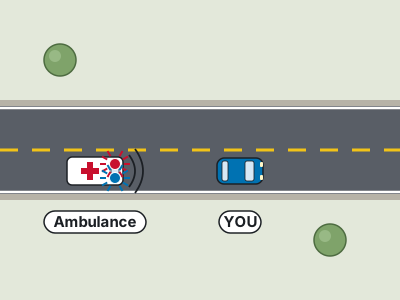
- Pull to the right edge and stop, keeping the intersection clear
- Stop in the lane immediately without moving right
- Turn left at the next opening to get away from it
- Accelerate until the emergency vehicle is no longer visible
Show answer
Pull to the right edge and stop, keeping the intersection clear. When a siren or flashing lights announce an approaching emergency vehicle, move right, pull beside the curb or road edge, and stop. The vehicle should be parallel and as close to the curb as practical, while intersections remain open for the emergency response. Stopping in the current lane can block the route. Turning away or accelerating creates uncertainty and may put the driver in the emergency vehicle's path. The useful cue is siren or flashing lights: right, curb, stop, clear the intersection.
Study this in the handbook: Emergency vehicles, move over and traffic stops
5. What warning does a yellow arrow give a driver who is turning?
- The turn is permanently protected with no need to check traffic
- The green arrow is ending, so prepare to stop and yield
- The lane is closed and reversing is required
- The signal gives priority over pedestrians forever
Show answer
The green arrow is ending, so prepare to stop and yield. A yellow arrow warns that the green arrow is ending. The driver should prepare to stop and yield to oncoming traffic or pedestrians. It does not preserve the protected-turn priority of the green arrow, and it does not announce a lane closure or require reversing. Watch the arrow's color change and decide whether a safe stop is possible rather than rushing through the remaining signal. The key cue is yellow: prepare, stop when appropriate, and yield to crossing road users.
Study this in the handbook: Traffic lights and arrows
6. How far from a Kansas fire station driveway must a parked vehicle stay on the opposite side of the street?
- 20 feet
- 30 feet
- 75 feet
- 50 feet
Show answer
75 feet. Parking is prohibited within 20 feet of the driveway entrance to a fire station and, on the side of the street opposite the entrance, within 75 feet of it, so apparatus can swing out. The list also bars parking within 50 feet of the nearest rail at a railroad crossing and alongside or opposite any street excavation or obstruction where parking would block traffic. Twenty feet is the same side figure.
Study this in the handbook: Where not to park and parking on hills
7. When a roadway first becomes wet from rain, what speed adjustment does the handbook recommend?
- Use high beams and keep the same speed
- Maintain the posted limit because wet pavement does not change traction
- Increase speed to get off the wet section quickly
- Reduce speed because water mixes with dirt, oil, and other substances
Show answer
Reduce speed because water mixes with dirt, oil, and other substances. The first rain can make pavement especially slippery because water mixes with dirt, oil, and other substances on the surface. Reducing speed gives the tires more opportunity to maintain contact and gives the driver additional time to respond. The posted limit is a maximum for suitable conditions, not a promise that the same speed is safe on wet pavement. Speeding across the area or relying on high beams does not restore traction. The cue is sudden rain after a dry spell: ease off early.
Study this in the handbook: Slippery roads and hydroplaning
8. How can a qualifying Kansas applicant avoid taking the noncommercial knowledge exam in the office?
- Complete the exam online and bring the passing results
- Have a parent sign an exam waiver
- Submit a driving-school attendance letter
- Pay an extra fee for automatic credit
Show answer
Complete the exam online and bring the passing results. Kansas offers a noncommercial online knowledge exam. An applicant who qualifies can complete it online, bring the passing results to the licensing process, and eliminate the in-office knowledge exam. The parent waiver choice is not mentioned as an alternative to testing. A driving-school attendance letter does not replace the passing exam result, and an extra payment does not create automatic credit. The key cue is the sequence: take the approved online knowledge exam, preserve the passing result, then bring that result in. The option is an alternate testing location, not a waiver from demonstrating knowledge.
Study this in the handbook: License tests, renewal and losing your license
9. What should you do if the drive wheels begin to spin on a slippery surface?
- Apply the parking brake immediately
- Press the accelerator harder to regain speed
- Turn sharply toward the shoulder
- Take your foot off the accelerator
Show answer
Take your foot off the accelerator. Wheel spin means the tires are losing traction, so adding power can make the slide worse. The handbook advises taking your foot off the accelerator when the drive wheels begin to spin. That reduces the force driving the wheels and gives traction a chance to return. Pressing harder, turning sharply, or grabbing the parking brake can make control less predictable. Ease off smoothly and keep the vehicle pointed along a safe path.
Study this in the handbook: Slippery roads and hydroplaning
10. What does a Pass with Care sign indicate?
- A mandatory stop before entering a railroad crossing
- The beginning of a no passing zone that bans passing everywhere
- The end of a no passing zone, where passing is allowed only when safe
- A lane reserved for vehicles carrying passengers
Show answer
The end of a no passing zone, where passing is allowed only when safe. A Pass with Care sign tells the driver that the no-passing zone has ended, but it does not make passing automatically safe. The handbook still requires checking sight distance, traffic, and roadway conditions before moving around another vehicle. The wrong choice changes an ending message into a permanent ban, while the railroad and passenger-lane choices assign meanings from unrelated signs or markings. Use the sign as permission to evaluate a pass, not as a command to begin one. Wait until the opposing lane and the road ahead are clearly safe.
Study this in the handbook: Regulatory signs
11. How often does the Kansas handbook say to schedule breaks on a long trip to fight fatigue?
- Every 500 miles
- Only when you feel sleepy
- About every 100 miles or two hours
- Once a day
Show answer
About every 100 miles or two hours. Before a long trip, the handbook says to get adequate sleep, since most adults need 7 to 9 hours to stay alert, and to schedule proper breaks about every 100 miles or two hours. Waiting until you feel sleepy is too late, and once a day or every 500 miles leaves far too long between rests. The handbook also suggests a travel companion to talk with and share the driving, and it reminds drivers that the best way to prevent fatigue is sleep.
Study this in the handbook: Fatigue, distractions and driver responsibility
12. At what BAC can a Kansas driver under 21 be arrested for alcohol impairment according to the handbook?
- .05 percent
- .02 percent
- .08 percent
- .10 percent
Show answer
.02 percent. The handbook identifies .02 percent as the BAC at which a Kansas driver under 21 can also be arrested for alcohol impairment. The familiar .08 figure applies to the general alcohol-law statement, so using it for every driver category misses the under-21 threshold. The .05 and .10 options are not the figures stated in this passage. A helpful cue is to pair the lower number with the younger driver group, then remember that impairment can exist even below .08. This rule is about alcohol concentration, not the number of drinks consumed.
Study this in the handbook: DUI law, implied consent and penalties
13. When approaching a stationary emergency vehicle with flashing warning lights on a multi-lane road, what should you do?
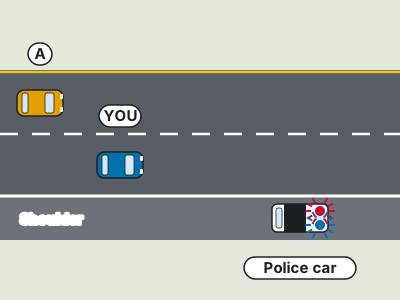
- Maintain speed in the adjacent lane because flashing lights do not affect passing traffic
- Move to a lane that is not next to it when possible, or slow with due caution
- Stop directly beside the emergency vehicle until its lights are turned off
- Use the shoulder to pass quickly without reducing speed
Show answer
Move to a lane that is not next to it when possible, or slow with due caution. Kansas requires a cautious response to a stationary emergency vehicle displaying flashing warning lights on a road with two or more lanes in each direction. Change to a lane that is not next to the stopped vehicle when that can be done safely. If a lane change is impossible, reduce speed and proceed with due caution. Driving past at normal speed, stopping beside the vehicle, or using the shoulder ignores the protection needed by responders and other road users.
Study this in the handbook: Emergency vehicles, move over and traffic stops
14. How many non-sibling minor passengers may a 16-year-old carry under the listed Kansas restrictions?
- None under any circumstance
- Four
- Two
- One
Show answer
One. The 16-year-old restrictions allow only one non-sibling minor passenger. Zero is too strict because the handbook expressly permits one, while two and four exceed the stated limit. The word non-sibling matters, since the restriction is not a blanket count of every person in the vehicle. Compare this stage with the 15-year-old rule, which prohibits non-sibling minor passengers altogether. The quick recall cue is a single unrelated minor passenger, alongside the separate hours and approved-purpose conditions.
Study this in the handbook: Restricted license at 16 and the unrestricted license
15. What does the downward-pointing red and white triangle require?
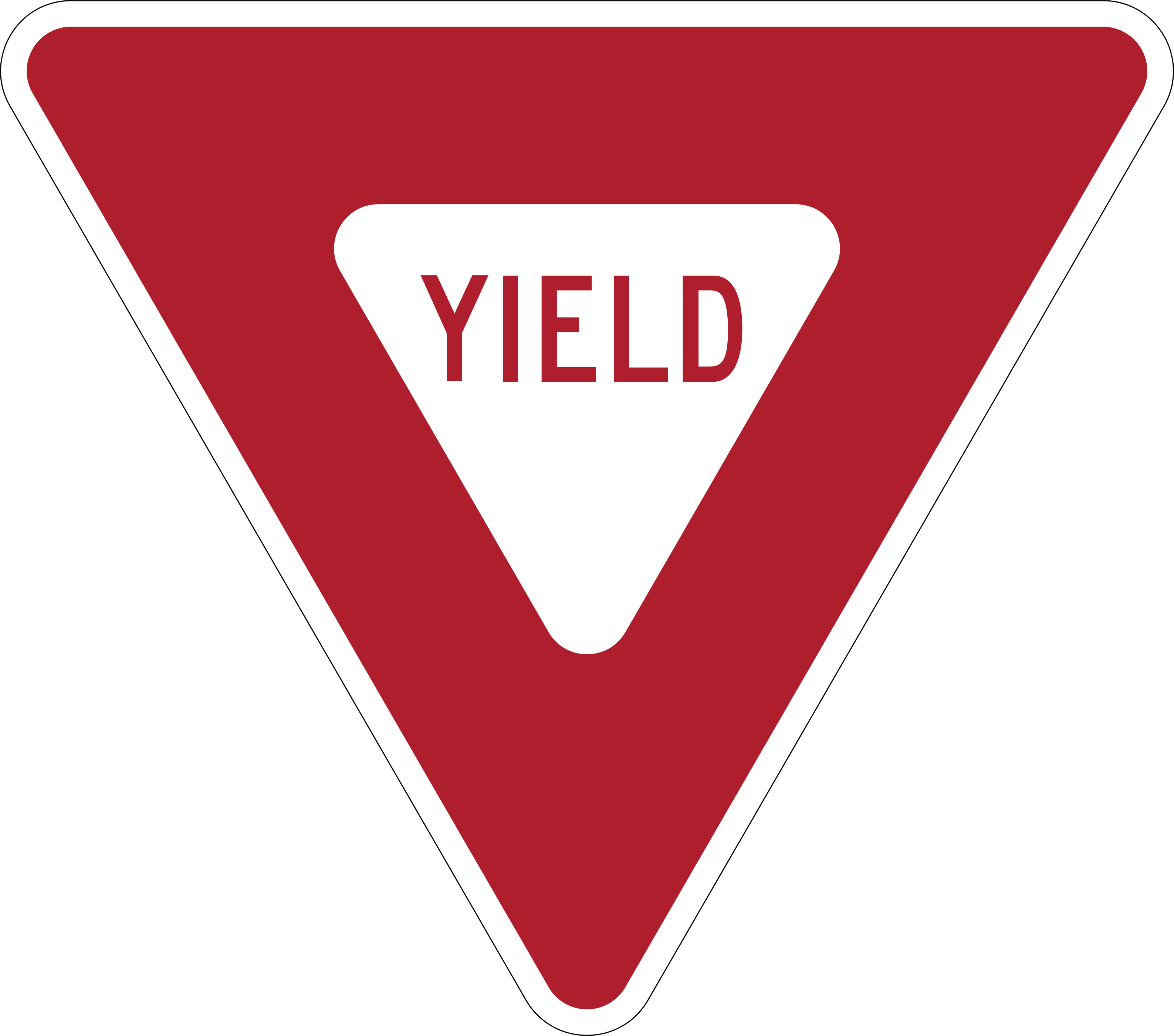
- Stop for a fixed ten seconds before every movement
- Slow down and allow right-of-way traffic to cross before entering
- Enter first because the sign grants priority
- Reverse immediately whenever another vehicle is present
Show answer
Slow down and allow right-of-way traffic to cross before entering. A yield sign calls for reduced speed and requires the driver to let traffic with the right-of-way cross before entering. A complete stop may be necessary, but the sign does not impose a fixed ten-second wait in every case. It also gives no priority over approaching traffic. Treat the triangle as a prompt to evaluate the gap, watch for pedestrians, and stop if yielding cannot be accomplished while moving.
Study this in the handbook: Kansas speed limits
16. When is opposing traffic on a divided highway not required to stop for a stopped school bus?
- Whenever the bus is parked at a school
- Only when the bus driver waves traffic through
- When the opposing roadway is separated on a divided highway
- Whenever the bus has no passengers aboard
Show answer
When the opposing roadway is separated on a divided highway. Kansas requires a stop when meeting or overtaking a school, church, or day care bus stopped to load or unload children. The exception is traffic approaching on the opposing roadway of a divided highway. That exception does not depend on the bus being at a school, empty, or accompanied by a hand signal. First identify whether the roadways are divided, then determine whether your vehicle is meeting the bus or traveling behind it.
Study this in the handbook: Right of way at intersections
17. When should a driver reduce speed before entering a curve?
- Before the curve, to a speed that permits slight, constant acceleration through it
- After entering, by braking hard at the midpoint
- Only when a separate lower speed sign is posted
- Never, because momentum improves cornering
Show answer
Before the curve, to a speed that permits slight, constant acceleration through it. The handbook advises reducing speed before entering a curve to a safe speed that permits slight, constant acceleration through the turn. Entering too quickly lets momentum carry the vehicle straight and can make the tires lose traction. Hard braking after entry may also cause traction loss. A separate sign is not required before a driver responds to the curve's visibility, surface, or traffic conditions. Ease off before the bend, then maintain controlled acceleration rather than making a late, abrupt brake application.
Study this in the handbook: Safe speed and stopping distance
18. What does an orange diamond or rectangular sign generally identify?
- A work zone ahead
- A route to a hospital
- A railroad crossing only
- A permanent parking regulation
Show answer
A work zone ahead. Orange diamond and rectangular signs identify work zones connected with construction, maintenance, or emergency operations. They warn that workers may be on or near the roadway and can accompany messages about reduced speed, detours, equipment, or changing pavement. A hospital route is guide information, railroad crossings use their own warning devices, and permanent parking rules are regulatory. Treat orange as a work zone cue. Reduce speed, watch for people and equipment, follow temporary directions, and be ready for traffic to stop or shift unexpectedly.
Study this in the handbook: Work zone, guide and incident signs
19. What is required when entering a Kansas roundabout?
- Enter first because circulating traffic must yield
- Stop inside the circle before choosing an exit
- Yield to traffic already circulating and travel counterclockwise
- Travel clockwise around the center island
Show answer
Yield to traffic already circulating and travel counterclockwise. Entering traffic yields to vehicles already circulating in the roundabout. Once inside, vehicles travel counterclockwise around the raised center island, then follow signs and pavement markings to the intended exit. Stopping in the circle interrupts traffic and can create a conflict. The entering driver does not receive priority merely by reaching the entrance, and clockwise travel is opposite the handbook’s direction. Slow before entry, select the proper lane, and avoid changing lanes or passing after entering.
Study this in the handbook: Driveways, yield signs and roundabouts
20. Which Kansas restricted license applicants must complete an approved driver's education course?
- Applicants who are 15; it is not required when applying at 16
- Every applicant under 18
- Only applicants who failed the written test
- Only applicants who are 16
Show answer
Applicants who are 15; it is not required when applying at 16. The driver's education requirement for the restricted license applies to 15-year-old applicants, and the handbook states it is not required for someone applying at age 16. That makes every applicant under 18 too broad, and 16-year-olds exactly backwards. Failing the written test does not trigger the course requirement; a failed test is simply retaken. A 16-year-old applicant instead needs 50 supervised hours and must pass the vision, written, and driving exams or bring the completion slip.
Study this in the handbook: Instruction permit, farm permit and the 15 year old restricted license
QualitySpace is expanding to Kansas
We are a California-based independent insurance brokerage working on licensing in more states. We cannot help with Kansas insurance yet. Leave your email and we will let you know when we can.
Every question is written from the official Kansas Driving Handbook. Need paper? Printable KS practice test with answer key.
Last verified 2026-10-05. How we check every question · Study all 211 as flashcards
Frequently asked questions
How many questions are on this Kansas practice test?
This fixed set has 20 questions. It is test 9 of 10 from the 211 question Kansas bank. The real KS exam asks 25 questions and you need 20 correct.
What is the passing score for the real Kansas test?
You must score an 80% to pass the knowledge test That figure comes from the official Kansas source cited on the DMV facts page.
How does this fixed test relate to the full Kansas bank?
Each numbered test is a fixed set of questions in a fixed order, so you can retake the same test later and compare. Every test mixes road signs and the other topics in about the same proportion as the full bank. Tests 1 to 10 together cover 200 of the 211 questions in the Kansas bank, each once. The full practice page mixes the whole bank at random.
Last verified 2026-10-05. See the Kansas DMV facts page for sourced state details.