
Test 15 of 25 · 20 questions · Free 2026
KS Permit Practice Test 15
Jump to the test ↓A fixed 20 question set from the Kansas bank with answers and plain English explanations. The real KS exam is 25 questions, 80 percent to pass; take the full length version on the main practice page.
Question 1 of 20 · 0 right so far
All 20 questions in test 15
Every question below comes from the Kansas question bank on this page. Open a question to see the correct answer and the explanation. Nothing here is hidden behind a signup.
1. Why leave extra space when stopped behind another vehicle on a Kansas hill?
- The vehicle ahead may roll back before moving forward
- Hill starts always stall the vehicle ahead
- Hill starts always stall the vehicle ahead of you on steep grades
- Space on hills is only for trucks with trailers
Show answer
The vehicle ahead may roll back before moving forward. Manual transmissions and hesitant starts let vehicles drift backward on grades before forward motion takes hold. Extra space at a hill stop absorbs that rollback without contact. It also gives you room to move if the vehicle ahead stalls repeatedly. The cushion costs nothing while stopped and can save a bumper. Once traffic flows, normal following intervals resume. Treat steep driveways and ramps the same way whenever you queue behind another vehicle.
Study this in the handbook: Following distance, scanning and space
2. Your lane will end after this Kansas sign. How do you get into the continuing lane?

- Force into the next lane immediately at the sign itself
- Stop at the exact point where your lane disappears fully
- Watch for the change ahead and merge when a safe gap is available
- Use the shoulder as an extra lane until traffic thins out
Show answer
Watch for the change ahead and merge when a safe gap is available. A lane ending asks for a planned merge, not a contest. Watch for the change ahead, signal, find a safe gap in the continuing lane, and blend at traffic speed. Forcing in at the sign or waiting until pavement vanishes both manufacture conflicts. Shoulders are not travel lanes for this purpose. Drivers in the continuing lane help by slightly adjusting speed to open space. Work zone lane drops add flaggers and orange signs, but the merge discipline is identical in spirit.
Study this in the handbook: Safe speed and stopping distance
3. A 20-year-old Kansas driver tests at .03 BAC after a party. The adult limit is .08. What exposure does the young driver face?
- None, because drivers under twenty one share the adult .08 threshold until their twenty first birthday arrives
- Arrest for alcohol impairment, possible at .02 BAC under age 21
- A warning only, since first underage readings below .05 cannot support an arrest under Kansas handbook rules
- Exposure begins at .05, the midpoint used for preliminary alcohol screening of young drivers at the roadside
Show answer
Arrest for alcohol impairment, possible at .02 BAC under age 21. Youth lowers the alcohol threshold dramatically. In Kansas a driver under twenty one can be arrested for alcohol impairment at .02 BAC, inside a zero tolerance framework where purchasing, possessing, or drinking is itself illegal. Your .03 scenario already clears that bar while sitting far below the adult .08 per se line. New drivers also suffer greater impairment effects while complex skills are still forming, which is the policy inside the number. For underage drivers the only safe BAC is one with nothing to measure.
Study this in the handbook: How alcohol and drugs affect driving
4. At 2 a.m. in a Kansas town, the light over the intersection flashes red in all directions. How do you enter?
- Slow down and roll through because cross streets are empty at night
- Stop fully, look both ways, and yield as you would at a stop sign
- Stop only if another vehicle is already waiting at the corner
- Treat it as a flashing yellow and proceed with simple caution
Show answer
Stop fully, look both ways, and yield as you would at a stop sign. A flashing red borrows the whole stop sign procedure: complete stop behind the line, crosswalk, or intersection, a look both ways, and yielding the right-of-way before entering. The hour does not dilute it, since the drivers you cannot see are the ones the stop reveals. Flashing yellow is its cautious cousin requiring only a slowdown. Swapping their meanings is a classic exam trap. After your stop, first arrival courtesy and right side tiebreakers organize an all-flashing junction.
Study this in the handbook: Traffic lights and arrows
5. An oncoming Kansas driver keeps high beams on at night. What is the proper response?
- Flash your headlights once quickly, then look toward the right side of the road
- Keep your high beams on to answer the other driver glare for glare
- Stare at the oncoming lights to judge distance
- Stop in your lane until the vehicle passes
Show answer
Flash your headlights once quickly, then look toward the right side of the road. One quick flash asks the other driver to dim without starting a glare duel. Then shift your gaze to the right side of the road, using the edge line to hold your lane while their lights pass. Staring into the beams deepens momentary blindness, and answering with your own brights can leave both drivers sightless. Wearing sunglasses at night only makes the darkness worse. After they pass, your eyes need a moment to readjust.
Study this in the handbook: Night driving, fog and floods
6. Your green arrow shines in Kansas, but a driver opposite starts a right turn on red into your path. What does the guidance warn?
- Your arrow lets you complete the turn without watching anyone else at all
- Right turn on red drivers always have priority over arrows
- Arrows apply only when no other vehicles are moving
- Others should yield to your arrow, but watch right-on-red drivers
Show answer
Others should yield to your arrow, but watch right-on-red drivers. A green arrow protects your turn in principle: opposing and crossing traffic should yield while it shines. Practice adds a caution, because a driver across the junction may turn right on red from the other side into the same receiving lane. Keep scanning for that vehicle, plus pedestrians in front of and beside your car. Signs can also ban the turn outright at some intersections. Protected on paper still deserves eyes in motion.
Study this in the handbook: Traffic lights and arrows
7. An approaching Kansas driver has a turn signal flashing. Why should you wait before turning into their path?
- Flashing signals always mean the driver will stop
- Signals on large vehicles cancel automatically every time
- A flashing signal transfers right-of-way to you
- The signal may be forgotten or the driver may turn after passing you
Show answer
The signal may be forgotten or the driver may turn after passing you. A blinking signal announces intention, not commitment. The driver may plan to turn beyond your position or may have left the signal on after an earlier turn. Motorcycles and large commercial vehicles often lack self canceling signals, making stale blinkers common. Wait until the other vehicle actually begins turning and a safe gap exists. Steel and momentum do not honor intentions, only real movements clear your path safely.
8. Doubling speed from 20 mph to 40 mph in Kansas guidance makes crash impact how much greater?
- The impact is 2 times greater
- The impact is 4 times greater
- The impact is 8 times greater
- The impact stays about the same
Show answer
The impact is 4 times greater. Impact grows much faster than speed. Doubling from twenty to forty miles per hour makes the striking power four times greater, and braking distance grows four times longer as well. Tripling speed multiplies force nine times. This is why modest speed increases in neighborhoods or curves carry outsized danger. Slowing down trims both the energy of any crash and the distance needed to avoid one. Speed choices are really energy choices.
Study this in the handbook: Safe speed and stopping distance
9. A Kansas driver sees this blue square sign near an exit. What kind of information does it give?
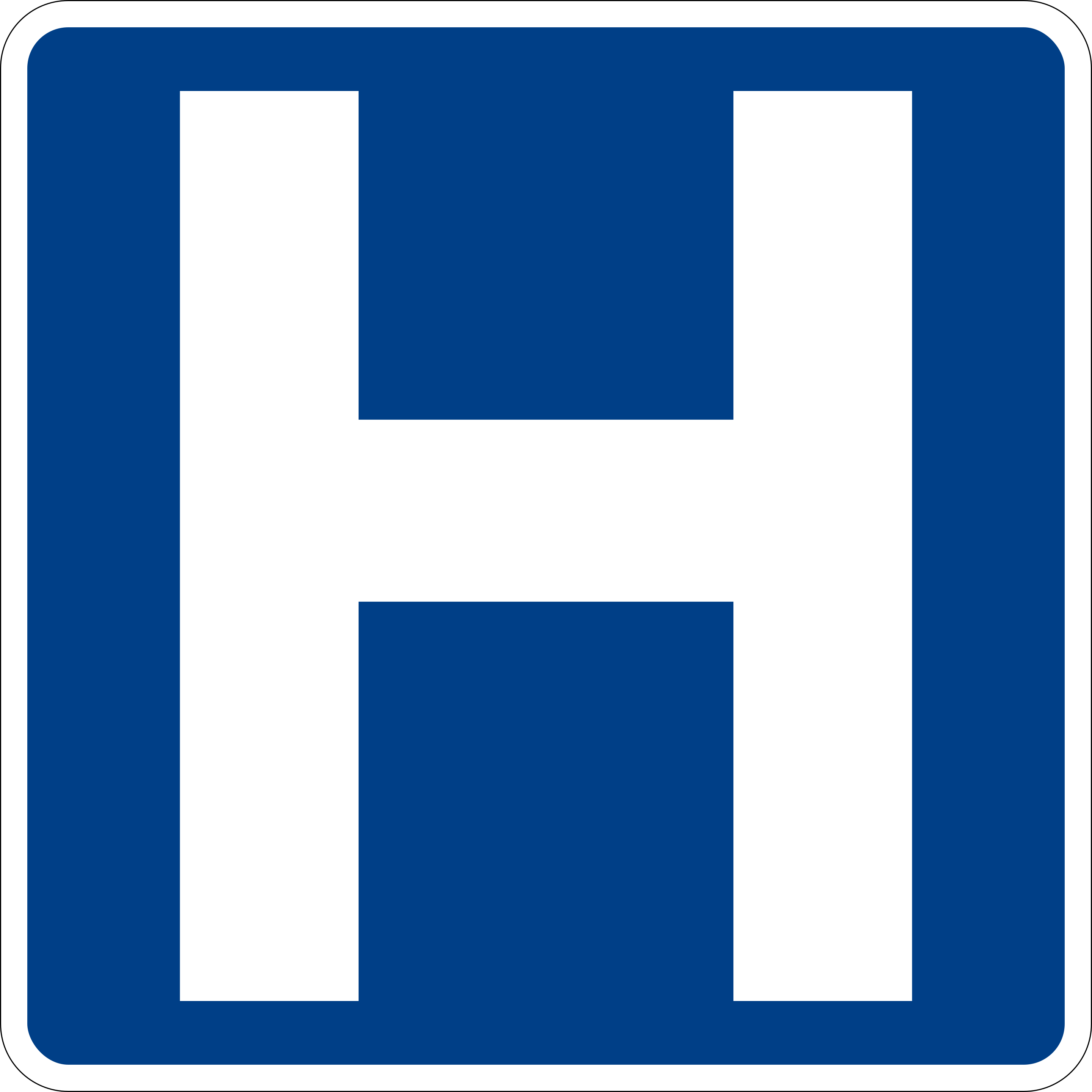
- The location of a hospital, shown on a service sign
- A warning that emergency vehicles may cross the road
- A rule requiring drivers to stop for ambulances
- The distance to the next city, shown on a destination sign
Show answer
The location of a hospital, shown on a service sign. Service signs are blue, square or rectangular, with white lettering or symbols. They show the location of various services such as rest areas, gas stations, hotels, or hospitals. A white H on blue shows where a hospital is, so it gives information and is not a rule or a warning. Guide signs in general are green, brown, or blue, and they give information on intersecting roads, direct you to towns, and show points of interest along the highway.
Study this in the handbook: Work zone, guide and incident signs
10. When is driving on a Kansas sidewalk ever allowed?
- For short trips under two blocks
- When delivering packages to homes
- Only to cross it, such as at a driveway
- On sidewalks wider than a car lane
Show answer
Only to cross it, such as at a driveway. Sidewalks belong to people on foot. Driving on one is illegal, with a single narrow allowance: crossing it, as you do when entering or leaving a driveway. Delivery work, short distances, and wide concrete change nothing. Before crossing, yield to any pedestrian using that sidewalk, since your vehicle is the guest in their space. Creeping across slowly with a clear view both ways turns a legal crossing into a safe one as well.
Study this in the handbook: Right of way at intersections
11. For a two-point turnabout on a Kansas two-lane road, which method is safest?
- Drive into the driveway and back out into the street
- Do it from the middle of a wide multi-lane highway
- Stop across both lanes while you reposition
- Back into the driveway so you leave facing traffic
Show answer
Back into the driveway so you leave facing traffic. A two-point turnabout uses a driveway or alley to reverse direction. Backing into the driveway is safest because leaving then faces forward, with a clear view of traffic in both directions. Backing out into the street instead pushes your blind rear into moving lanes. The maneuver belongs on two-lane roadways where blocks cannot be circled. Even done well, it deserves low traffic and generous sight lines in both directions before you commit.
12. A Kansas lane is signed and marked for Transit or bus use. Who may travel there?
- Any vehicle with two or more occupants
- Vehicles turning right within one block
- Buses only, since the lane is reserved for bus use
- Motorcycles during rush hour periods
Show answer
Buses only, since the lane is reserved for bus use. Reserved lanes dedicate pavement to specific vehicles, announced by signs and often a white diamond on the road or at the roadside. A lane marked Transit or bus serves buses only. Carpools belong in lanes marked for high occupancy vehicles with a stated number of people. Turning access and driveways follow local markings, not a general one block permission. Reading the exact reservation words before entering keeps you out of transit priority space and out of a citation.
Study this in the handbook: Lane markings and special lanes
13. A vehicle pulls out directly in front of you in Kansas and braking alone cannot avoid it. Why consider steering instead?
- Steering always works better than braking at highway speed
- Braking is useless once another driver makes a mistake
- In most cases you can steer the vehicle quicker than you can stop it
- Steering lets you ignore what is beside your vehicle
Show answer
In most cases you can steer the vehicle quicker than you can stop it. At most speeds a vehicle changes direction faster than it sheds speed, so an escape lane can save you when stopping distance cannot. Grip the wheel with both hands, steer toward open space, and be ready to recover control once clear. Belt wear keeps you positioned behind the wheel during the swerve. Steering demands a checked escape path, since trading one collision for another helps nobody. Braking still matters before or after the steer in many emergencies.
Study this in the handbook: Emergency braking, skids and vehicle failures
14. How do alcohol and impairing drugs threaten a Kansas driver reading of signs and signals?
- They improve color contrast at night for drivers
- They blunt color distinction that signs and signals rely on
- Colors matter only to commercial truck drivers
- They affect color vision only above a .15 BAC
Show answer
They blunt color distinction that signs and signals rely on. Roadways speak in color: red octagons, yellow warnings, green guidance, and painted lines all assume you can tell them apart. Alcohol and other impairing drugs reduce the ability to distinguish colors, which the handbook calls very dangerous for exactly this reason. The loss joins blurred vision, double vision, poor distance and speed judgment, and slowed processing. No BAC threshold protects color reading, since impairment starts with the first drink. A driver misreading the palette misreads the road itself.
Study this in the handbook: How alcohol and drugs affect driving
15. After parking a Kansas vehicle with an automatic transmission, in what order should you secure it?
- Set the parking brake, then place the transmission in park
- Place it in neutral and set the parking brake
- Place the transmission in neutral and rely on the parking brake only
- Leave it in drive with the brake held by a passenger
Show answer
Set the parking brake, then place the transmission in park. Securing starts with the parking brake, every time you park. Then place an automatic transmission in park, or a manual transmission in gear. Only after that should headlights and the engine go off and the key come out. Check mirrors and traffic before opening the door, and shut it promptly. This little ritual prevents rollaways and forgotten lights. Skipping the brake because the transmission has a park position trusts a single small part with the whole vehicle.
Study this in the handbook: Where not to park and parking on hills
16. A Kansas pedestrian steps off the curb mid-block between parked cars, clearly jaywalking. What must you do?
- Keep your speed, since jaywalkers forfeit all protection
- Honk and steer around them at your current pace today
- Yield only if they reach the center of your lane first
- Stop for the pedestrian even though the crossing is unlawful
Show answer
Stop for the pedestrian even though the crossing is unlawful. Kansas states the pedestrian rule without an obedience condition: you must yield to pedestrians always, and even when they jaywalk or cross where they should not, you must stop for them. The same duty covers crosswalks marked and unmarked, mid-block crossings, and green light scenes where walkers linger. Their violation becomes a police matter after everyone survives your stop. Speed maintenance and horn blasts gamble a life against your schedule. Children near schools and playgrounds deserve the same stop with even less warning expected.
Study this in the handbook: Right of way at intersections
17. Why is the pavement extra slippery in the first minutes of rain on a hot Kansas day?
- Hot rain melts the top layer of asphalt into a slick film on lanes
- Tires soften and spread oil across lanes
- Rain washes gravel dust into deep ruts
- Heat brings road oil up, and rain spreads it
Show answer
Heat brings road oil up, and rain spreads it. Heat draws oil out of asphalt toward the surface. A sudden rain on a hot day floats that oil, along with dirt and road grime, into a slick film for the first few minutes until traffic washes it away. Reduce speed at the first sign of rain, snow, or sleet for exactly this reason. The opening minutes of any storm deserve the deepest caution. Grip returns gradually as water rinses the surface clean.
Study this in the handbook: Safe speed and stopping distance
18. Late at night in a Kansas city, this arrow sign points right on a street you entered. Which way may traffic flow?

- In either direction once the streets empty late at night
- Against the arrow if your destination is just one block away
- Only in the direction the arrow points on that street
- Whichever way your navigation app suggests first
Show answer
Only in the direction the arrow points on that street. One-way signs assign the street a single lawful direction, shown by the arrow. Turning against the arrow or cruising the wrong way, even for a block, even at night, courts a head-on with a driver who reasonably expects an empty lane ahead. Do Not Enter and Wrong Way signs reinforce the same system at ramps and entries. Navigation software errs about restrictions often enough that posted signs always win. If the street flows the wrong way for your trip, circle the block with right turns.
Study this in the handbook: Regulatory signs
19. A rear tire blows out on a Kansas highway. What will the vehicle most likely do?
- Wobble, shake, and pull toward the side of the blowout
- Pull sharply toward the blowout like a front tire failure
- Stop instantly without any steering pull
- Lean safely away from the failed tire side
Show answer
Wobble, shake, and pull toward the side of the blowout. Front and rear blowouts announce themselves differently. A front failure yanks the vehicle sharply toward that side. A rear failure makes the vehicle wobble and shake, pulling somewhat toward the blowout without the same violent tug. Either way, grip the wheel firmly, keep the vehicle straight, slow gradually off the accelerator, and avoid braking hard. Pull fully off the road where possible, set flashers, and have the tire changed rather than limping onward.
Study this in the handbook: Emergency braking, skids and vehicle failures
20. A Kansas driver slows and appears to stop for you as you start to cross a street. What does the handbook tell pedestrians to do?
- Cross at once, because the driver has clearly seen you
- Wave and look away to save time
- Wait until the driver has passed, then cross behind the car
- Make eye contact and never assume the driver will stop
Show answer
Make eye contact and never assume the driver will stop. Pedestrians are hard for drivers to see, and a driver who slows may not actually be yielding. The handbook tells pedestrians to establish eye contact with drivers who slow down or stop, to make sure the driver is giving up the right-of-way. A pedestrian should not assume the driver will stop. Even with a WALK signal or green light, make sure all drivers see you and stop before you step into the road.
Every question is written from the official Kansas Driving Handbook. Need paper? Printable KS practice test with answer key.
Last verified 2026-10-05. How we check every question · Study all 500 as flashcards
Frequently asked questions
How many questions are on this Kansas practice test?
This fixed set has 20 questions. It is test 15 of 25 from the 500 question Kansas bank. The real KS exam asks 25 questions and you need 20 correct.
What is the passing score for the real Kansas test?
You must score an 80% to pass the knowledge test That figure comes from the official Kansas source cited on the DMV facts page.
How does this fixed test relate to the full Kansas bank?
Each numbered test is a fixed set of questions in a fixed order, so you can retake the same test later and compare. Every test mixes road signs and the other topics in about the same proportion as the full bank. Tests 1 to 25 together cover every question in the Kansas bank once. The full practice page mixes the whole bank at random.
Last verified 2026-10-05. See the Kansas DMV facts page for sourced state details.