
Test 4 of 10 · 20 questions · Free 2026
KS Permit Practice Test 4
Jump to the test ↓A fixed 20 question set from the Kansas bank with answers and plain English explanations. The real KS exam is 25 questions, 80 percent to pass; take the full length version on the main practice page.
Question 1 of 20 · 0 right so far
All 20 questions in test 4
Every question below comes from the Kansas question bank on this page. Open a question to see the correct answer and the explanation. Nothing here is hidden behind a signup.
1. A Kansas driver's license expired 14 months ago. What testing does renewal require?
- Only a vision screening
- Full testing: the vision, written, and driving examinations
- Only the written examination
- No testing, just a late penalty
Show answer
Full testing: the vision, written, and driving examinations. Once a Kansas license has been expired for more than one year, full testing is required, and full testing means the vision, written, and driving examinations. A vision screening alone is what an ordinary renewal includes, so it falls short here. The written test by itself also leaves out the driving exam. There is a $1.00 penalty for an expired license, but paying it does not replace testing after more than a year.
Study this in the handbook: License tests, renewal and losing your license
2. What score must an applicant reach to pass the Kansas knowledge test?
- 70%
- 75%
- 80%
- 90%
Show answer
80%. The handbook requires a score of 80% on the knowledge test, which on the 25 question exam means at least 20 correct answers. Seventy and 75 percent are below the passing mark, and 90 percent is higher than required. Passing the knowledge test is what makes an applicant eligible for the skills tests. The test is not timed and generally takes 15 to 20 minutes, and it covers traffic signs, pavement markings, and Kansas laws and driving practices.
3. What does a round yellow sign with an X and RR letters warn a driver about?

- A highway-railroad grade crossing
- A hospital entrance
- A temporary detour
- A school-zone speed change
Show answer
A highway-railroad grade crossing. The round yellow sign with an X and RR letters is placed before a highway-railroad grade crossing. It warns the driver to slow down, look, and listen for a train or railroad vehicle, while being ready to stop. A hospital, detour, or school-speed sign has a different purpose and sign treatment. The railroad cue is the paired X and RR marking, which should trigger a search for tracks and an expectation that a train may be present even when none is immediately visible.
Study this in the handbook: Railroad crossing signs and safety
4. If a solid yellow line is on your side of the centerline, what does the Kansas handbook say about passing?
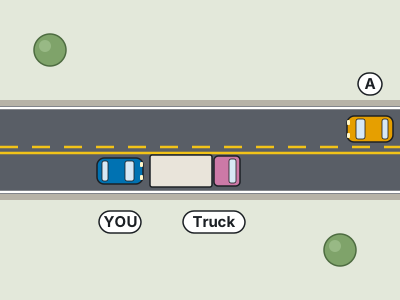
- Do not pass from that side
- Pass whenever the road is dry
- Pass only after sounding the horn
- Cross the line for any lane change
Show answer
Do not pass from that side. When a solid yellow line is on your side of the centerline, you should not pass. The marking separates opposing traffic and indicates that passing from your side is prohibited in that arrangement. Dry pavement does not override the line, and a horn does not create permission. Crossing for an ordinary lane change is also not the handbook's instruction. Watch which side carries the solid line, because a dashed line on your side can allow passing only when a safe gap and clear lane exist.
Study this in the handbook: Turn signals, U turns and passing
5. What does the pennant-shaped No Passing Zone sign mark?
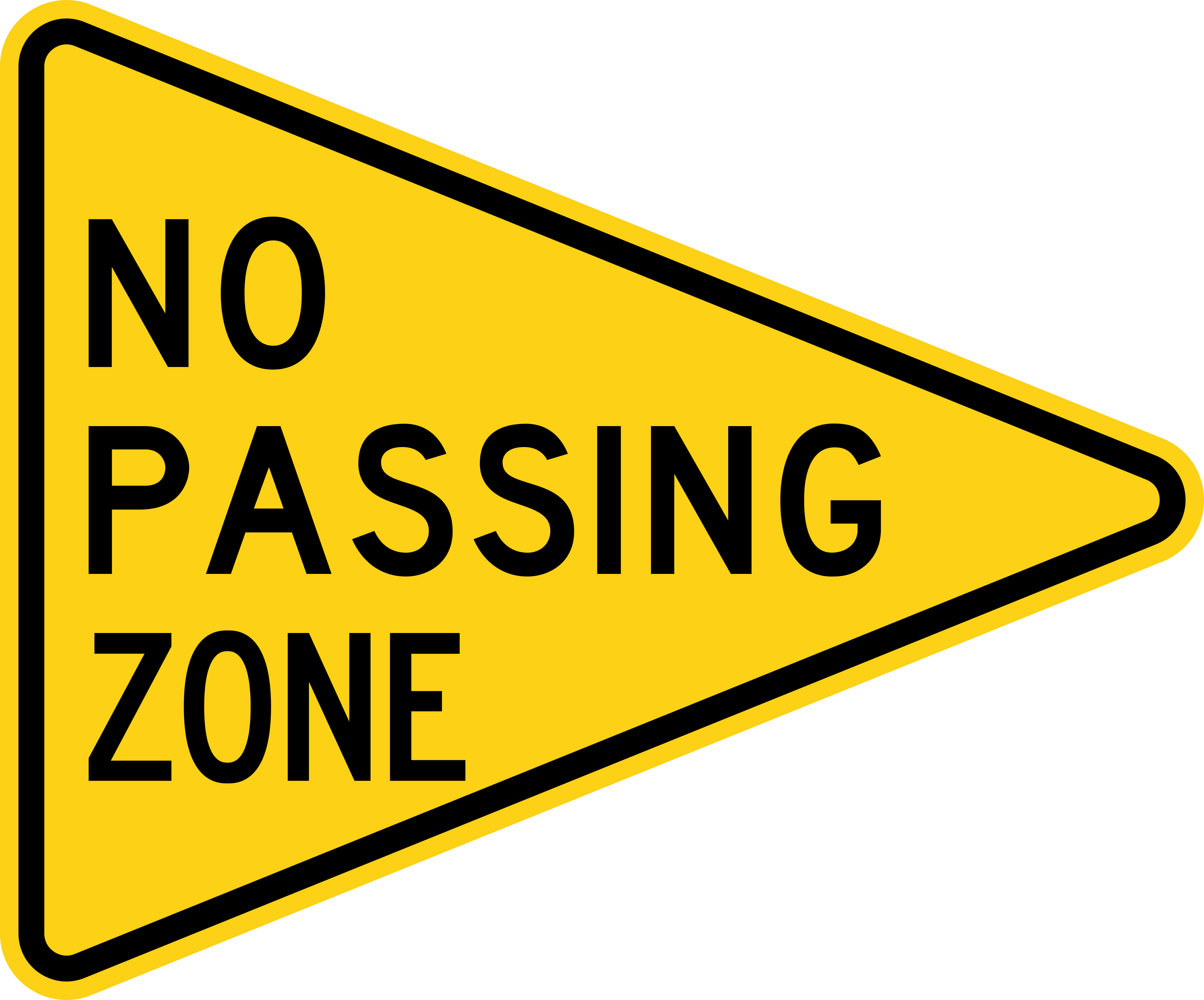
- A lane change area where opposing traffic must stop
- The end of a no-passing zone, posted on the right side facing you
- A general warning that passing is encouraged on the shoulder
- The beginning of a no-passing zone, posted on the left side facing you
Show answer
The beginning of a no-passing zone, posted on the left side facing you. Kansas identifies the No Passing Zone as the only pennant-shaped warning sign. It marks the beginning of a no-passing zone and faces the driver from the left side of the road. The other choices reverse the sign's location or invent permission to use the shoulder. Treat the unusual pennant silhouette as an immediate cue to remain behind the vehicle ahead until passing is legal and safe again.
Study this in the handbook: Turn signals, U turns and passing
6. Which consideration is part of Kansas's basic speed law?
- Road, weather, vehicle, and personal physical conditions
- Only the posted number and the vehicle's engine size
- The speed of the fastest vehicle behind you
- Whether the trip is on a weekday or weekend
Show answer
Road, weather, vehicle, and personal physical conditions. Kansas's basic speed law connects safe speed to the conditions that exist at the time. The handbook names the road, weather, vehicle condition, and the driver's physical condition as factors to consider. A posted limit is not permission to ignore rain, poor pavement, a mechanical problem, or fatigue. The fastest vehicle behind you is not the legal measuring stick. Reassess the environment as it changes and lower speed when the conditions make the posted maximum unreasonable.
Study this in the handbook: Kansas speed limits
7. After an emergency vehicle passes, how much distance must you keep behind it?
- No minimum distance if the emergency lights remain on
- At least 50 feet
- At least 500 feet
- Close enough to use the same cleared path
Show answer
At least 500 feet. Once an emergency vehicle has passed, the driver should check behind, return to the roadway only when safe, and stay at least 500 feet away from it. The distance protects the emergency response from a civilian vehicle following too closely and gives the driver time to react to sudden stops or changes. Fifty feet is too short, and flashing lights do not create an exception. Let the emergency vehicle build space before resuming ordinary travel, even if traffic appears clear.
Study this in the handbook: Emergency vehicles, move over and traffic stops
8. Why is fatigue dangerous when operating a motor vehicle?
- It improves concentration after several hours without rest
- It impairs vision and judgment, slows decisions, and can lead to falling asleep
- It affects comfort only and has no effect on crash risk
- It can be fully cancelled by turning up the radio
Show answer
It impairs vision and judgment, slows decisions, and can lead to falling asleep. Kansas compares fatigue with alcohol and drugs because it impairs vision and judgment. It can increase errors involving speed and distance, lengthen decision time, raise crash risk, and cause a driver to fall asleep behind the wheel. Turning up the radio is listed as a warning sign, not a cure. The dependable response is to stop driving, rest, and sleep rather than trying to force alertness through noise or willpower.
Study this in the handbook: Fatigue, distractions and driver responsibility
9. How far from a curb may a vehicle be parked in Kansas?
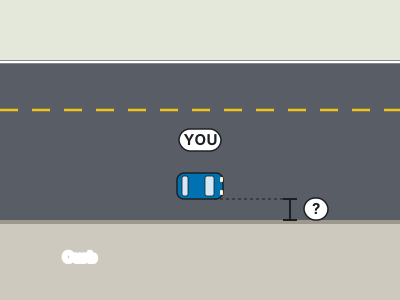
- No more than 12 inches
- No more than 18 inches
- No more than 24 inches
- No more than 36 inches
Show answer
No more than 12 inches. The Kansas list of illegal parking places includes parking more than 12 inches from a curb, along with parking within 15 feet of a fire hydrant, in front of a driveway, on a bridge or in a tunnel, in No Parking zones, and double parking along the curb. Eighteen, 24, and 36 inches all leave more space than the handbook allows. When parking downhill, stop parallel to and within 12 inches of the curb or road edge and turn the wheels toward it.
Study this in the handbook: Where not to park and parking on hills
10. What type of information do Kansas regulatory signs provide?
- Advance warnings of every possible roadway hazard
- Specific laws that drivers must obey
- Tourist directions only
- Weather forecasts for the route ahead
Show answer
Specific laws that drivers must obey. Regulatory signs communicate enforceable requirements involving traffic direction, lane use, turns, speed, parking, and other special situations. A warning sign serves a different purpose by alerting drivers to hazards or changing conditions ahead. Tourist guidance and weather information are not the defining function described here. When a sign gives an instruction such as a speed limit or turn restriction, treat it as a rule governing your movement and plan the maneuver before reaching the sign.
Study this in the handbook: Kansas speed limits
11. Under Kansas child-restraint law, how must a child younger than four be protected?
- With no restraint on trips under five miles
- With an adult belt only, regardless of the child's size
- In the front seat beside the driver whenever an air bag is present
- In a federally approved child safety seat
Show answer
In a federally approved child safety seat. Kansas requires every child under age four to ride in a federally approved child safety seat. An adult belt alone is not the rule for this age group, and neither a front-seat air bag nor a short trip creates an exemption. The driver is responsible for making sure children in a passenger car are properly protected. Use the seat according to its instructions and place a rear-facing infant seat away from an active passenger air bag.
Study this in the handbook: Kansas speed limits
12. When a Kansas road has a posted speed limit different from the statutory maximum, which limit must you follow?
- The posted limit
- The higher statutory maximum
- The average speed of surrounding traffic
- The limit selected by the driver before entering the road
Show answer
The posted limit. Kansas lists its statutory maximum speeds as applying unless otherwise posted. A posted limit therefore controls when it differs from the general maximum for that road type. Choosing the higher number defeats the purpose of the sign, and surrounding traffic cannot authorize a faster speed. Before relying on a familiar default, scan for the sign and also adjust below that limit when road, weather, traffic, vehicle, or personal conditions make the posted speed unsafe.
Study this in the handbook: Kansas speed limits
13. A driver turns left while an opposing vehicle goes straight through the intersection. Who has priority?
- The left-turning driver
- The vehicle with the larger engine
- The opposing vehicle going straight
- The vehicle that signals first
Show answer
The opposing vehicle going straight. Kansas requires the driver turning left to yield to vehicles approaching from the opposite direction. If both vehicles enter at the same time, the vehicle going straight through has the right-of-way. The left-turn choice reverses the required yield. Vehicle size and engine power have no role in this intersection rule. Signaling communicates an intention but does not give the signaling vehicle priority, so the choice “The vehicle that signals first” is also wrong. Before beginning a left turn, scan the opposing lane and wait for the through vehicle to pass, even if your signal has been on for the entire approach.
Study this in the handbook: Right of way at intersections
14. Which Kansas children must use a federally approved child safety seat?
- Any child under age 12
- Only children under age 1
- All children under age 8
- All children under age 4
Show answer
All children under age 4. Kansas requires every child under age four to be restrained in a federally approved child safety seat. The under-one choice sets the age cutoff too low. The under-eight choice overlooks the handbook's separate rule for children ages four through eight, who generally use a child safety seat or booster unless they meet the height or weight exception. The under-twelve choice is not the stated boundary. Keep the age bands separate: under four means a federally approved child seat, ages four through eight involve a seat or booster with an exception, and age eight or older requires a seatbelt.
Study this in the handbook: Seat belts, child seats and air bags
15. When turning left at an intersection, which road user generally has priority over the turning driver?
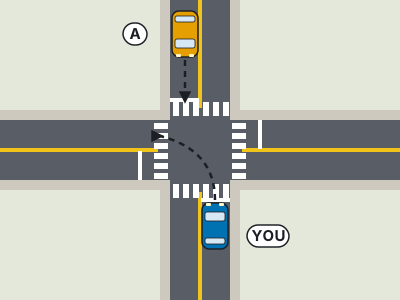
- Only an oncoming truck or bus
- An oncoming vehicle traveling straight or turning right
- The left-turning vehicle in every case
- No one, because a green light ends yielding duties
Show answer
An oncoming vehicle traveling straight or turning right. A driver turning left must yield to oncoming vehicles that are going straight or turning right. Those movements cross the left-turn path, so entering first could cause a collision. Vehicle size does not decide priority, and a left turn does not automatically win simply because its driver arrived first. A green light also does not erase the need to yield to oncoming traffic and pedestrians. Before turning, look through the gap, wait for the opposing path to clear, and turn only when it is safe.
Study this in the handbook: Right of way at intersections
16. What are pavement markings used to do on the roadway?
- Record the vehicle owner's license information
- Give directions or warnings through lines, arrows, words, or symbols
- Replace every traffic signal at an intersection
- Identify only locations where fuel is sold
Show answer
Give directions or warnings through lines, arrows, words, or symbols. Pavement markings use lines, arrows, words, and symbols to give roadway directions or warnings. They can divide lanes, show when passing or changing lanes is allowed, identify turn lanes, define pedestrian walkways, and mark where drivers must stop. The license-information choice describes a vehicle record, not a roadway marking. Markings support traffic signals rather than replacing them, and they cover far more than fuel locations. Read the paint together with signs and signals, then use its pattern and position to choose a lane, turn, pass, or stopping point safely.
Study this in the handbook: Work zone, guide and incident signs
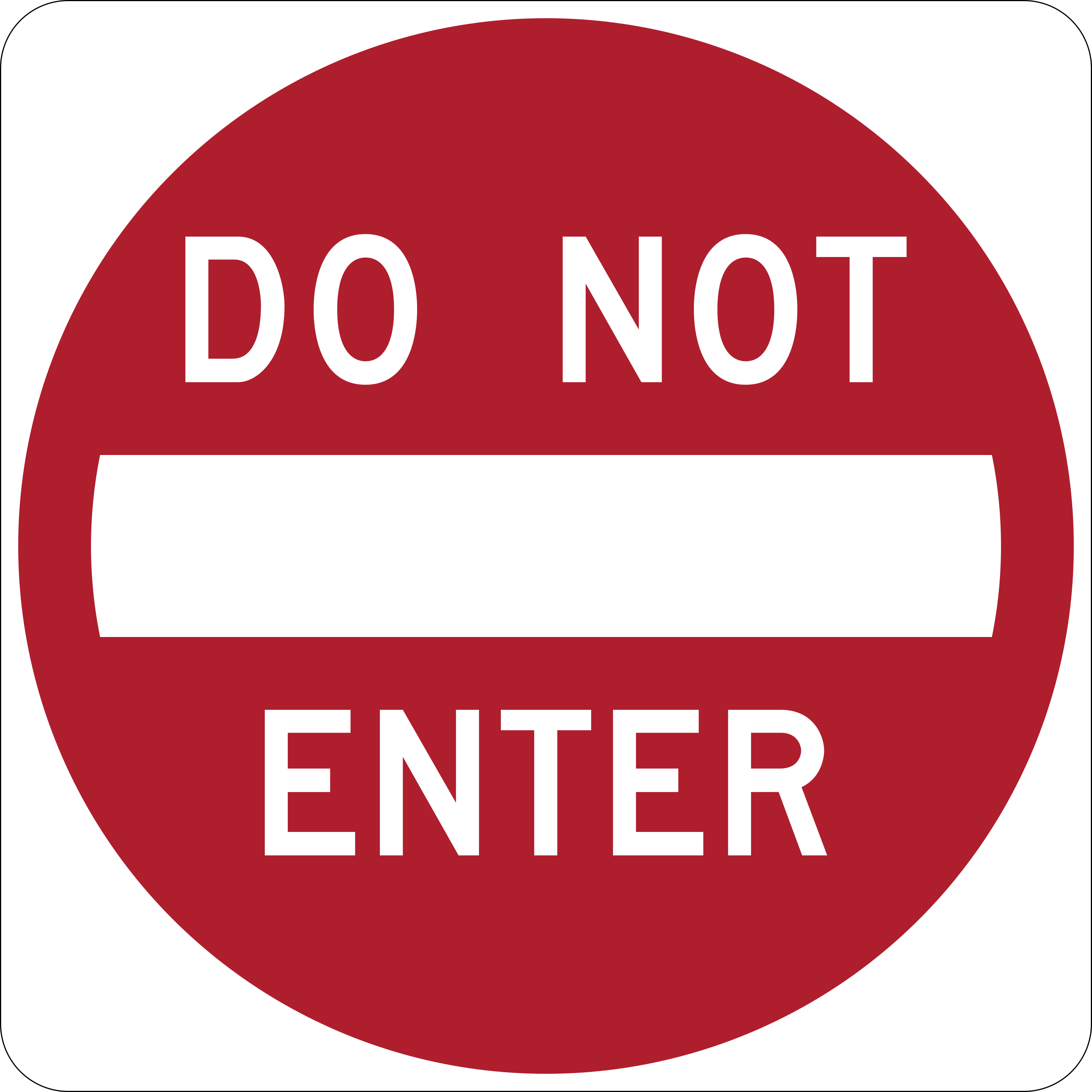
17. What does the square sign with a white horizontal bar in a red circle mean?
- Parking is allowed only on the shoulder
- The lane is reserved for buses entering
- You cannot enter the roadway opening
- A railroad crossing is immediately ahead
Show answer
You cannot enter the roadway opening. The white bar inside the red circle identifies a Do Not Enter sign. It marks an opening that the driver may not use, including an exit ramp approached in the wrong direction, a divided-road crossover, or some one-way street entrances. It is not a parking instruction or a bus designation. Seeing it calls for staying out of that opening and finding a lawful route rather than continuing into opposing traffic.
Study this in the handbook: Regulatory signs
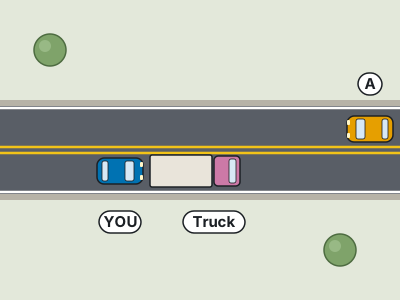
18. When two solid yellow lines separate opposing lanes, what passing rule applies?
- Both directions may pass when drivers signal
- Passing is permitted for the side nearest the shoulder
- Only trucks may cross to overtake
- Neither side may pass
Show answer
Neither side may pass. Two solid yellow lines separate opposing traffic and prohibit passing from either direction. A driver may cross a solid yellow line for a turn when a safe gap exists, but that exception does not turn the marking into a passing lane. Signaling does not override the restriction, and vehicle type does not create a special privilege. Read the lines as a barrier between opposing flows. If overtaking would require crossing them, remain in lane and wait for a permitted passing area.
Study this in the handbook: Lane markings and special lanes
19. What suspension period does the handbook associate with a BAC of .08 or more?
- 10 days
- 90 days
- 30 days
- Two years
Show answer
30 days. The handbook says a BAC of .08 or more may lead to a 30-day suspension of the driver's license and driving privileges, along with possible criminal penalties. Ten days and 90 days change the stated duration, while two years is not the period given in this passage. The phrase may be suspended describes a possible consequence in the handbook's summary, not permission to drive at that level. Use the memory cue .08 paired with 30 days, while under-21 impairment is separately identified at .02.
Study this in the handbook: How alcohol and drugs affect driving
20. If the accelerator pedal is stuck down, what is the safest sequence?
- Turn off the vehicle before shifting or steering
- Pump the accelerator until it returns to normal
- Turn the steering wheel sharply and keep accelerating
- Shift to neutral, steer smoothly, brake gently, and pull off the roadway
Show answer
Shift to neutral, steer smoothly, brake gently, and pull off the roadway. A stuck accelerator is treated as an accelerator failure. Shift to neutral first so the engine no longer drives the wheels, then search for a safe escape path. Keep steering smoothly, use gentle braking, and pull off the roadway. Turning the vehicle off immediately is not the handbook sequence, because control and a safe path come first. Pumping the pedal can waste time while the vehicle continues moving. Once stopped, the vehicle should be turned off and the pedal repaired at a service center before driving again.
Study this in the handbook: Emergency braking, skids and vehicle failures
QualitySpace is expanding to Kansas
We are a California-based independent insurance brokerage working on licensing in more states. We cannot help with Kansas insurance yet. Leave your email and we will let you know when we can.
Every question is written from the official Kansas Driving Handbook. Need paper? Printable KS practice test with answer key.
Last verified 2026-10-05. How we check every question · Study all 211 as flashcards
Frequently asked questions
How many questions are on this Kansas practice test?
This fixed set has 20 questions. It is test 4 of 10 from the 211 question Kansas bank. The real KS exam asks 25 questions and you need 20 correct.
What is the passing score for the real Kansas test?
You must score an 80% to pass the knowledge test That figure comes from the official Kansas source cited on the DMV facts page.
How does this fixed test relate to the full Kansas bank?
Each numbered test is a fixed set of questions in a fixed order, so you can retake the same test later and compare. Every test mixes road signs and the other topics in about the same proportion as the full bank. Tests 1 to 10 together cover 200 of the 211 questions in the Kansas bank, each once. The full practice page mixes the whole bank at random.
Last verified 2026-10-05. See the Kansas DMV facts page for sourced state details.