
Test 5 of 10 · 20 questions · Free 2026
KS Permit Practice Test 5
Jump to the test ↓A fixed 20 question set from the Kansas bank with answers and plain English explanations. The real KS exam is 25 questions, 80 percent to pass; take the full length version on the main practice page.
Question 1 of 20 · 0 right so far
All 20 questions in test 5
Every question below comes from the Kansas question bank on this page. Open a question to see the correct answer and the explanation. Nothing here is hidden behind a signup.
1. What following interval should a driver use under adverse conditions?
- One second
- Two seconds
- Three seconds
- Four seconds
Show answer
Four seconds. Adverse conditions call for the four-second following rule. Rain, poor visibility, traffic, or a slippery surface can make stopping take longer, so the ordinary two-second interval is not enough. One or three seconds also provide less margin than the handbook specifies. Use a fixed roadside reference and count four seconds after the vehicle ahead passes it. If conditions worsen or the vehicle ahead stops often, add even more space instead of trying to maintain a close pace.
Study this in the handbook: Turn signals, U turns and passing
2. In Kansas, how close to a traffic signal, stop sign, or flashing beacon may you park on the approach?
- No closer than 15 feet
- No closer than 30 feet
- No closer than 20 feet
- No closer than 50 feet
Show answer
No closer than 30 feet. Kansas bars parking within the 30 feet approaching any traffic control signal, stop sign or flashing beacon at the side of the roadway, and within 30 feet of the curb points opposite the ends of a safety zone. Fifteen feet is the hydrant distance, 20 feet applies to a fire station driveway, and 50 feet applies to the nearest rail at a railroad crossing. A car parked in that space hides the sign from approaching drivers.
Study this in the handbook: Where not to park and parking on hills
3. What is the default maximum speed on a designated and posted separated, multilane Kansas highway?
- 55 mph
- 65 mph
- 70 mph
- 75 mph
Show answer
75 mph. Kansas lists 75 miles per hour for a separated, multilane highway when it has been designated and posted by the Secretary of Transportation. The 55 mph choice is the county or township road figure, and 65 mph is the state or federal highway figure. Although 70 mph may sound plausible, it is not the handbook's listed maximum here. The designation and posting are essential: the 75 mph value does not automatically apply to every multilane road. Before relying on it, confirm both the road type and the posted authorization.
Study this in the handbook: Kansas speed limits
4. What is the youngest age for a Kansas farm permit, and who can get one?
- 12, for any child in a farming family
- 16, for any resident of a rural county
- 14, for someone who lives on a farm or is paid to work on one
- 15, for anyone who has finished driver education
Show answer
14, for someone who lives on a farm or is paid to work on one. The farm permit starts at age 14 and ends before 17, and the applicant must either live on a farm or be employed for pay on one. Twelve is below the minimum age. Living in a rural county is not enough, since the rule turns on the farm itself, and the handbook defines a farm as at least 20 acres used in agricultural operations. Driver education alone does not qualify anyone for this permit; the farm connection is the requirement.
Study this in the handbook: Instruction permit, farm permit and the 15 year old restricted license
5. During what hours may a 16-year-old drive under the Kansas less-restricted rules?
- 6 a.m. to 10 p.m.
- 5 a.m. to 9 p.m.
- 7 a.m. to 11 p.m.
- Any hour without conditions
Show answer
5 a.m. to 9 p.m.. The less-restricted 16-year-old rules list driving from 5 a.m. to 9 p.m. as a permitted time window. The later windows shift both boundaries and therefore do not reproduce the handbook's schedule. Unrestricted, all-hour driving is also inaccurate because the passage lists additional permitted purposes and supervision conditions. Remember the pair as five in the morning through nine at night. School, religious, employment, and licensed-adult trips are separately named situations, but they do not change the stated general time window.
Study this in the handbook: Restricted license at 16 and the unrestricted license
6. When driving above 40 mph, how far ahead should you signal before a turn or lane change?
- 50 feet or 1 second before
- 100 feet or 1 to 2 seconds before
- 500 feet or 10 seconds before
- 200 feet or 3 to 5 seconds before
Show answer
200 feet or 3 to 5 seconds before. At speeds above 40 mph, the handbook says to signal 200 feet or 3 to 5 seconds before turning or changing lanes. In urban areas the figure is 100 feet or 3 to 5 seconds, and 100 feet is the legal minimum for any signal, so 100 feet is too short at highway speed. Fifty feet with one second is below every figure given, and 500 feet or 10 seconds is not a handbook standard.
Study this in the handbook: Emergency braking, skids and vehicle failures
7. An applicant fails the Kansas written test. When can it be retaken, and what does that cost?
- The next working day, after paying a $1.50 re-exam fee
- The same day, at no cost
- After seven days, at no cost
- After 30 days, after paying a $25 fee
Show answer
The next working day, after paying a $1.50 re-exam fee. Kansas lets an applicant who fails the written or driving test try again the next working day after paying a $1.50 re-exam fee. A same day retest is not offered, and the retest is not free. Seven and 30 day waits are not required, although an applicant may choose to wait longer to study. The $25 amount has no basis in the handbook.
Study this in the handbook: License tests, renewal and losing your license
8. At a flashing yellow traffic light, what action is required?
- Stop and wait for a green signal
- Slow down and proceed cautiously, ready to stop
- Accelerate before cross traffic enters
- Treat the light as a four-way stop in every case
Show answer
Slow down and proceed cautiously, ready to stop. A flashing yellow light permits movement, but it is a warning to reduce speed and approach carefully. The driver must be prepared to stop if traffic is entering the intersection. Waiting for green would treat the signal more restrictively than the handbook requires, while accelerating removes the time needed to respond. Use the flashing signal as a cue to scan for vehicles and pedestrians before continuing through the intersection.
Study this in the handbook: Traffic lights and arrows
9. Two vehicles enter an uncontrolled intersection from different roads at about the same time. Who yields?
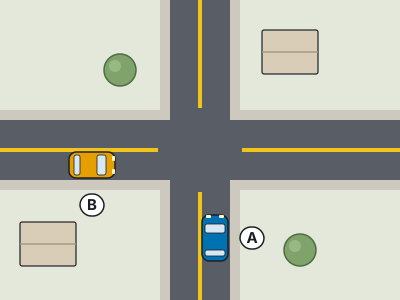
- The vehicle turning right always yields
- The driver on the right yields to the driver on the left
- The faster vehicle goes first
- The driver on the left yields to the driver on the right
Show answer
The driver on the left yields to the driver on the right. At an uncontrolled intersection, Kansas gives priority to the vehicle on the right when vehicles enter at approximately the same time. The driver on the left must yield. The reverse-right choice swaps the rule. Speed does not decide the encounter, so the faster vehicle has no special privilege. The turning choice also invents a blanket rule that is not in this passage. A simple visual cue helps: if you are looking across the intersection and another vehicle is on your right, you yield. Reduce speed early and make sure the other driver's movement is clear before proceeding.
Study this in the handbook: Right of way at intersections
10. On a multilane road, what should a driver do when approaching a stopped emergency vehicle with flashing warning lights?
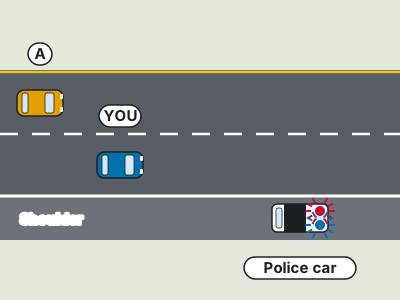
- Stay in the adjacent lane at the same speed
- Move to a lane that is not next to it, if possible
- Stop beside the emergency vehicle in the travel lane
- Pass on the shoulder without reducing speed
Show answer
Move to a lane that is not next to it, if possible. When a stopped emergency vehicle displays flashing warning lights on a road with at least two lanes in each direction, move into a lane that is not next to it if that change is possible. If a lane change cannot be made, reduce speed and proceed with due caution. Staying alongside at normal speed gives the emergency workers less protection, and the shoulder is not a shortcut. Scan early, signal the lane change, and leave a full buffer around the stopped vehicle.
Study this in the handbook: Right of way at intersections
11. Where should a driver stop at a red octagonal stop sign when no stop line is marked?
- Only beside the signpost
- Past the crosswalk at the center of the intersection
- Before entering the near-side crosswalk, if one is present
- After crossing the intersecting roadway
Show answer
Before entering the near-side crosswalk, if one is present. The stop-sign sequence uses the nearest available stopping reference. If there is no marked stop line, stop before entering the crosswalk on the near side of the intersection. Moving past that crosswalk risks entering the pedestrian space and reduces the driver's ability to see or yield. The signpost is not the stopping line, and crossing the roadway is far too late. Look for a line first, then the crosswalk, and only then the nearest point to the intersecting roadway.
Study this in the handbook: Right of way at intersections
12. What does a Kansas yield sign require when traffic with the right-of-way is approaching?
- Always stop even when the roadway is empty
- Slow down and allow that traffic to cross before entering
- Speed up so the other driver must yield
- Ignore pedestrians if the vehicle lane looks clear
Show answer
Slow down and allow that traffic to cross before entering. A yield sign is a red and white downward-pointing triangle. Its instruction is to slow and let traffic that has the right-of-way cross before entering. A complete stop may be needed, but the sign does not demand a stop every time the approach is empty. Pedestrians are part of the traffic you must consider. Reduce speed early, scan both directions, and stop if necessary rather than forcing another road user to brake for your entry.
Study this in the handbook: Kansas speed limits
13. What hazard is identified by the fluorescent pentagonal school sign?

- A hospital entrance with pedestrian priority
- A school area or school crossing
- A railroad crossing outside a town
- A recreational park with no roadway crossing
Show answer
A school area or school crossing. The fluorescent pentagonal sign identifies a school or school crossing, where children may be entering or crossing the roadway. The handbook lists school zones and school crossings among warning signs, not as hospital, railroad, or park designations. Reduce attention to distractions, scan for children and crossing activity, and follow any separate school speed or traffic-control instruction posted at the location.
Study this in the handbook: Traffic lights and arrows
14. What is the best way to reduce traction loss from hydroplaning on a wet roadway?
- Slow down when rain or pooled water is present
- Brake hard while turning through the puddle
- Accelerate to push the water aside
- Keep the same speed if the tires appear inflated
Show answer
Slow down when rain or pooled water is present. Hydroplaning occurs when the steering tires ride up on pooled water and lose contact with the roadway. The handbook identifies slowing down in rain or around puddles as the best way to avoid that traction loss. Hard braking while turning can worsen instability, and acceleration increases the speed at which the tires meet the water. Tire inflation alone does not make a high-speed puddle safe. Spot pooled water early, release pressure smoothly, and choose a slower path through the wet area.
Study this in the handbook: Slippery roads and hydroplaning
15. What does the Kansas handbook say is illegal for anyone under 21 regarding alcohol?
- Only buying alcohol for others
- Only driving after drinking
- Purchasing, possessing, or drinking alcoholic beverages
- Nothing if a parent consents
Show answer
Purchasing, possessing, or drinking alcoholic beverages. If you are under 21 in Kansas it is illegal to purchase, possess or drink alcoholic beverages at all, not only to drive after drinking. Alcohol and other impairing drugs affect a person's ability to perceive their surroundings, react to emergencies and operate a vehicle, and the effects are greater for new drivers still learning complex skills. Parental consent does not create an exception under the rule the handbook states.
Study this in the handbook: How alcohol and drugs affect driving
16. If the brake pedal stops working, what should a driver try first?
- Rapidly pump the brake pedal several times
- Turn off the engine and remove the key immediately
- Pull the parking brake fully and lock the rear wheels
- Continue driving until the brakes restore themselves
Show answer
Rapidly pump the brake pedal several times. The first listed response to brake failure is to pump the brake pedal rapidly several times. That action may rebuild enough hydraulic pressure to permit a stop. If it does not work, the handbook moves to careful parking-brake use, then finding a safe place to slow off the roadway. Pulling the parking brake at full force can lock the rear wheels and cause a skid. Keep the vehicle controlled, warn others with flashers when possible, and never continue normal travel with failed brakes.
Study this in the handbook: Emergency braking, skids and vehicle failures
17. What do Kansas yellow diamond warning signs generally tell a driver?
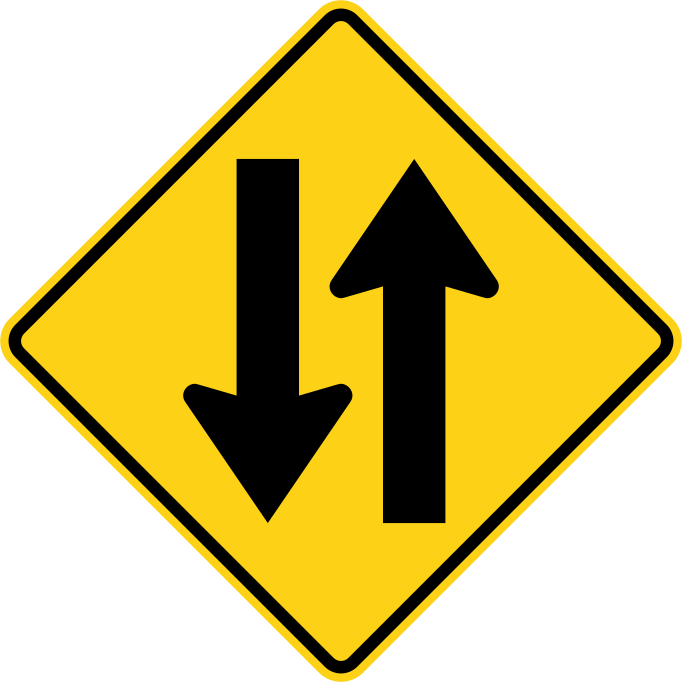
- All traffic controls end at the sign
- The maximum legal speed for every road ahead
- A service facility is located immediately beside the road
- A possible danger or special roadway situation may be ahead
Show answer
A possible danger or special roadway situation may be ahead. Kansas warning signs provide advance notice of a possible danger or special roadway situation ahead. Their yellow diamond design tells you to pay attention, consider slowing, and be prepared to stop if needed. The speed-limit choice describes a regulatory sign, while the service-facility choice belongs to guide or service information. The statement that all traffic controls end is not a warning-sign function. With the pictured opposing arrows, expect a roadway condition requiring extra attention, then follow the lane markings and any later signs or signals.
Study this in the handbook: Warning signs
18. How much should you add to your following distance when driving at night on an unfamiliar road?
- Nothing; night following is the same as day
- Half a second
- At least two additional seconds
- At least five additional seconds
Show answer
At least two additional seconds. Add at least one second for night driving and at least two additional seconds on an unfamiliar road at night. Keeping your daytime gap ignores how much headlights limit what you can see. Half a second is less than even the basic night adjustment, and five seconds is not the handbook's figure. Slowing to match your headlight distance matters just as much.
Study this in the handbook: Night driving, fog and floods
19. What kind of roadway information does the pictured traffic signal warning sign provide?
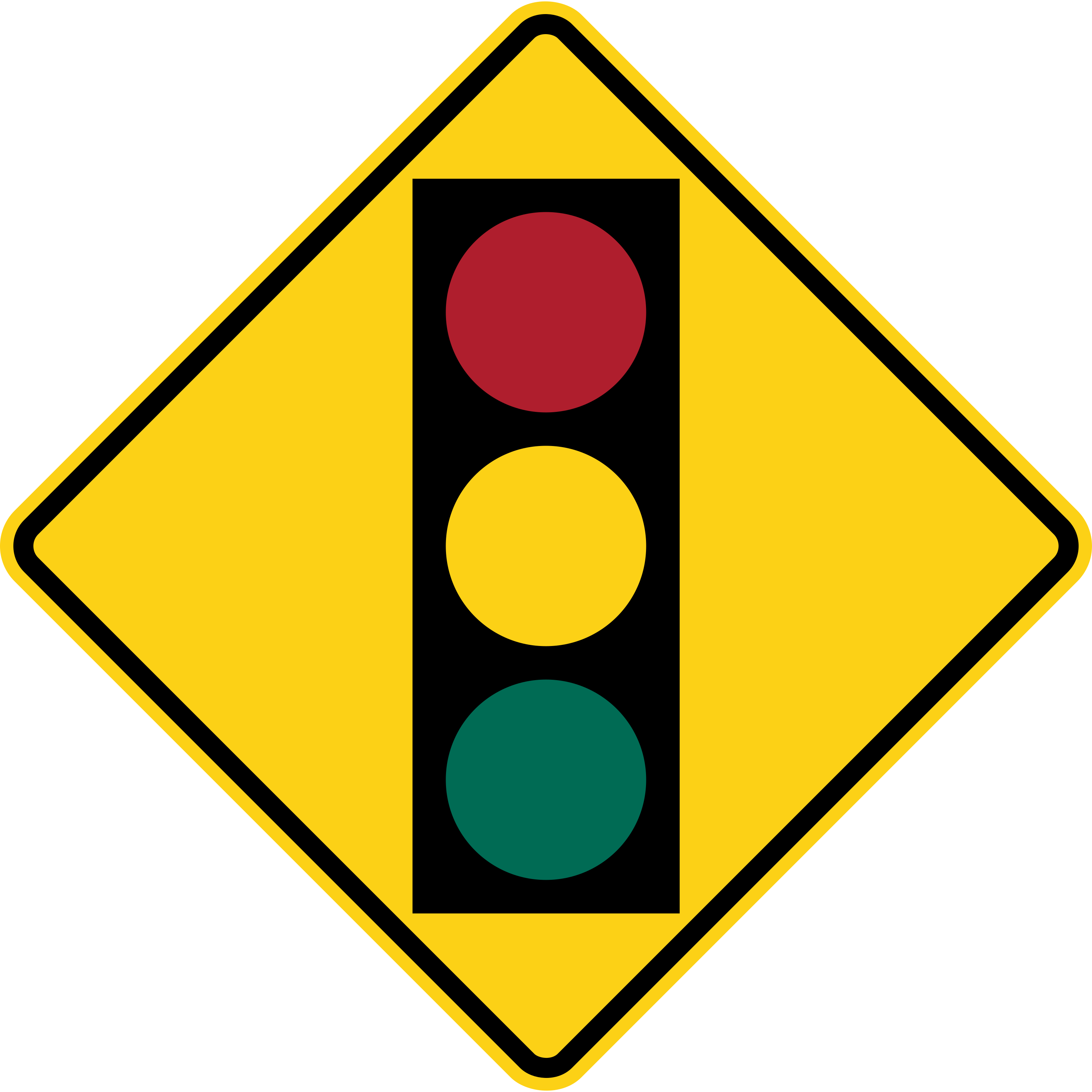
- It warns of a possible danger or special roadway situation ahead
- It gives the speed limit for the next roadway segment
- It identifies a service facility located beside the road
- It marks the end of all traffic controls ahead
Show answer
It warns of a possible danger or special roadway situation ahead. The yellow diamond with a traffic signal symbol is a warning that a signal is ahead, not a posted speed or service marker. Kansas describes warning signs as yellow with black lettering or symbols and diamond shaped. Begin looking beyond the sign for the signal, adjust speed as needed, and be ready to stop when the light or traffic requires it. The sign does not end traffic controls or grant permission to continue without checking. Its purpose is to provide advance notice so the approach can be controlled smoothly.
Study this in the handbook: Traffic lights and arrows
20. On a road with two or more lanes traveling in the same direction, where should a driver normally travel?
- In the left lane except when turning
- On the shoulder to avoid merging traffic
- In the right lane except when passing
- In whichever lane has the fewest vehicles
Show answer
In the right lane except when passing. Kansas directs drivers on a road with at least two same-direction lanes to stay in the right lane except when passing. The left lane is not the ordinary cruising lane, and the shoulder is not a routine escape route. Choosing the lane with fewer vehicles also ignores the stated rule. Move left only for a lawful pass, then return when safe. This habit leaves the passing lane available and makes entering or exiting traffic easier to anticipate.
QualitySpace is expanding to Kansas
We are a California-based independent insurance brokerage working on licensing in more states. We cannot help with Kansas insurance yet. Leave your email and we will let you know when we can.
Every question is written from the official Kansas Driving Handbook. Need paper? Printable KS practice test with answer key.
Last verified 2026-10-05. How we check every question · Study all 211 as flashcards
Frequently asked questions
How many questions are on this Kansas practice test?
This fixed set has 20 questions. It is test 5 of 10 from the 211 question Kansas bank. The real KS exam asks 25 questions and you need 20 correct.
What is the passing score for the real Kansas test?
You must score an 80% to pass the knowledge test That figure comes from the official Kansas source cited on the DMV facts page.
How does this fixed test relate to the full Kansas bank?
Each numbered test is a fixed set of questions in a fixed order, so you can retake the same test later and compare. Every test mixes road signs and the other topics in about the same proportion as the full bank. Tests 1 to 10 together cover 200 of the 211 questions in the Kansas bank, each once. The full practice page mixes the whole bank at random.
Last verified 2026-10-05. See the Kansas DMV facts page for sourced state details.