
Test 3 of 10 · 20 questions · Free 2026
KS Permit Practice Test 3
Jump to the test ↓A fixed 20 question set from the Kansas bank with answers and plain English explanations. The real KS exam is 25 questions, 80 percent to pass; take the full length version on the main practice page.
Question 1 of 20 · 0 right so far
All 20 questions in test 3
Every question below comes from the Kansas question bank on this page. Open a question to see the correct answer and the explanation. Nothing here is hidden behind a signup.
1. When must Kansas drivers turn on headlights because of weather?
- Only after complete darkness begins
- Whenever the vehicle wipers are being used
- Only during snowfall at highway speed
- Only when another driver flashes headlights
Show answer
Whenever the vehicle wipers are being used. Kansas is among the states identified in the handbook as requiring headlights whenever the vehicle wipers are used. The rule is tied to weather visibility, so it can apply during rain, snow, or fog before nighttime. Waiting for darkness misses the daytime visibility purpose, and limiting it to snow or a signal from another driver adds conditions the handbook does not state. Wipers on for weather means headlights on as well.
Study this in the handbook: Night driving, fog and floods
2. A school bus with its stop arm out is stopped on the far side of a road with a center turning lane. What must you do?
- Keep going, because a center turn lane counts as a median
- Slow to 20 mph and pass carefully
- Stop, even though the bus is on the opposite side
- Stop only if children are visible
Show answer
Stop, even though the bus is on the opposite side. A driver must stop for a school bus when there is a center turning lane between the roadways, whether the bus is on the driver's side or the opposite side. A center turn lane is not a median or physical barrier, which is the only situation where oncoming traffic need not stop. Slowing and passing is not allowed, and the stop is required whether or not children are visible. Wait until the red lights stop and the stop arm is no longer visible.
Study this in the handbook: School buses and required stops
3. What is the youngest age for a Kansas Class C instruction permit, and what extra step applies before 16?
- 15, with proof of driver education enrollment
- 14, with a written application from a parent or guardian
- 16, with no parent involvement
- 14, with no parent involvement
Show answer
14, with a written application from a parent or guardian. The Class C or M instruction permit is available at 14, and an applicant under 16 needs a written application by a parent or guardian, who also signs an affidavit at the licensing office. Fifteen is the minimum for the restricted license, not the permit. Sixteen is too old, and both choices without a parent ignore the required application. The applicant must also pass the vision and written exams or bring the DE99 form from a driver's education course.
Study this in the handbook: Instruction permit, farm permit and the 15 year old restricted license
4. A Kansas teen finished an online driver education course from an internet provider. Will Kansas accept it for licensing?
- Yes, if the certificate is printed and signed
- Yes, but only for the restricted license
- Yes, once a parent signs an affidavit
- No; internet courses do not meet Kansas license requirements
Show answer
No; internet courses do not meet Kansas license requirements. Kansas does not accept internet driver education courses, and a certificate of completion from one will not be accepted for licensure. Printing or signing the certificate does not change that, and there is no exception for the restricted license. The approved programs are those run through accredited school districts approved by the Department of Education, or approved private schools offering 8 hours of classroom and 6 hours of behind the wheel instruction. A parent affidavit covers supervised driving hours, not the course.
5. On dry pavement with good tires and brakes, about how far does it take to react and stop from 60 mph?
- About 359 feet
- About 60 feet
- About 123 feet
- About 1,000 feet
Show answer
About 359 feet. At 60 mph, reacting to a problem and stopping takes about 4 to 5 seconds, or about 359 feet, even with good tires, good brakes, and dry pavement. One hundred twenty three feet is the figure for 30 mph. Sixty feet ignores both reaction and braking distance, and 1,000 feet greatly overstates it. The handbook adds that at 60 mph you are driving too fast for your visibility if you cannot see at least 400 feet ahead.
Study this in the handbook: Safe speed and stopping distance
6. Fog lets you see only 100 feet ahead. What is the fastest speed the Kansas handbook says you can safely drive?
- 30 mph
- 20 mph
- 40 mph
- 45 mph
Show answer
30 mph. When rain, snow, dust, smoke, or thick fog limits your view to 100 feet, you cannot safely drive faster than 30 mph. Forty and 45 mph are too fast to stop within 100 feet, and 45 mph is the speed that matches low beam headlight range at night. Twenty mph is safe but is not the handbook's figure. If visibility gets worse, pull off the road in a safe place and wait.
Study this in the handbook: Night driving, fog and floods
7. You feel drowsy while driving. How long a nap does the Kansas handbook suggest in a safe parking area?
- 2 to 3 minutes
- 45 to 60 minutes
- 3 to 4 hours
- 15 to 20 minutes
Show answer
15 to 20 minutes. The handbook suggests finding a safe parking area for a 15 to 20 minute nap, and says caffeine taken just before a short nap gives the benefit of both. Two or three minutes is too short to help. The longer choices are not the recommended nap length; if you need real rest, stop for the night instead. The handbook also says the best way to prevent fatigue is sleep.
Study this in the handbook: Fatigue, distractions and driver responsibility
8. At a stop sign, where should a driver stop when a clearly marked stop line is present?
- At the center of the intersection
- After entering the crosswalk
- Behind the stop line
- Beside the sign, even if the line is farther ahead
Show answer
Behind the stop line. A stop sign requires a complete stop, and a clearly marked stop line sets the stopping point. Stopping after the crosswalk places the vehicle where pedestrians should have room to cross and may reduce the view of other traffic. The intersection center is much too far forward, while the sign itself does not determine the stopping position. Use the visual cue of the painted line: bring the vehicle to a full stop before it, then look in every direction and yield before entering.
Study this in the handbook: Kansas speed limits
9. At what BAC does the Kansas handbook say vision is impacted for all drivers?
- .08%
- .05%
- .10%
- .02%
Show answer
.02%. The handbook identifies .02 BAC as the point at which vision is impacted for all drivers. That is an early warning level, not the .08 figure used for the general alcohol violation described later. The .10% choice is higher than both handbook figures and therefore misses the onset of the visual effect. The .05% option also has no support in this passage. A useful study cue is to connect .02 with vision, then separately remember .08 as the standard alcohol limit. Even before a driver reaches the higher legal threshold, reduced focus, distance judgment, or lane control can make driving unsafe.
Study this in the handbook: How alcohol and drugs affect driving
10. When approaching construction workers actively engaged on the roadway, what lane action does Kansas require when possible?
- Use the shoulder to pass the work crew
- Move to a lane not next to the construction vehicles
- Keep the same lane and sound the horn continuously
- Stop in the opposite lane until workers leave
Show answer
Move to a lane not next to the construction vehicles. Kansas treats active roadway construction like an emergency scene when deciding where to travel. If the roadway has more than one lane in your direction, move into a lane that is not next to the construction vehicles when that can be done safely. The shoulder is not a normal passing lane, and sounding the horn does not create a safe buffer. Stopping in opposing traffic would create a serious new danger. Look well ahead for workers and equipment, check the lane beside you, and make the move smoothly only after confirming the space is open.
Study this in the handbook: Right of way at intersections
11. A car leaves a private driveway and enters a public street. Which vehicle has the right-of-way?
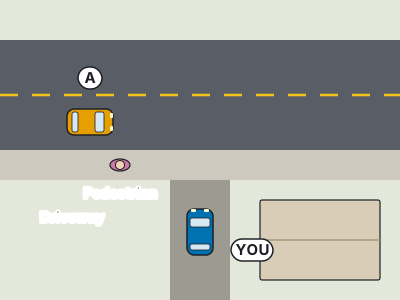
- The vehicle that is closest to the driveway
- The vehicle leaving the driveway
- The vehicle already on the public street
- The larger vehicle
Show answer
The vehicle already on the public street. Vehicles traveling on a public street or highway have the right-of-way over vehicles entering from a private drive or side road. The driveway vehicle must wait for a safe opening rather than claiming priority because it started moving first. Distance from the driveway is not the controlling test, and vehicle size does not change the rule. The useful cue is to identify who is entering the public roadway: that vehicle yields to traffic already using it. Check both directions, stop if needed, and proceed only after the street traffic can pass without interference.
Study this in the handbook: Driveways, yield signs and roundabouts
12. If a vehicle with anti-lock brakes must stop quickly, how should the driver use the brake pedal?
- Pump it repeatedly and release it after each pulse
- Press as hard as possible and keep pressing it
- Press lightly while steering sharply
- Avoid the brake and use the parking brake instead
Show answer
Press as hard as possible and keep pressing it. With ABS, the handbook directs the driver to press the brake pedal as hard as possible and keep pressure on it. The system is designed to help the vehicle stop without skidding, and the pedal may push back while it operates. Pumping the pedal can interfere with the system, while light pressure or a parking-brake maneuver reduces stopping control. In an urgent stop, keep both hands ready to steer and maintain firm pedal pressure until the vehicle stops.
Study this in the handbook: Emergency braking, skids and vehicle failures
13. When may a Kansas officer stop a passenger vehicle solely for a seatbelt violation?
- Only when the driver is unrestrained
- When any adult in a front seat is unrestrained or any child is unrestrained
- Only when a child under four is unrestrained
- Only after another traffic violation
Show answer
When any adult in a front seat is unrestrained or any child is unrestrained. Kansas treats seatbelt use as a primary violation. An officer may stop the vehicle based solely on seeing an unrestrained adult in a front seat or an unrestrained child anywhere in the vehicle. The driver-only choice is too narrow because the rule reaches front-seat adults and children in any seating position. The under-four choice confuses the separate child-seat age rule with the broader stop authority. The choice “Only after another traffic violation” incorrectly adds a prerequisite. When reviewing this rule, picture the two triggers: an unrestrained adult in front, or an unrestrained child anywhere.
Study this in the handbook: Seat belts, child seats and air bags
14. This round RR sign marks a Kansas crossing that also has a blue ENS sign. What does the ENS sign provide?

- A toll-free railroad dispatch number and a DOT number identifying the exact crossing
- The speed of approaching trains
- The train schedule
- A number for the county sheriff
Show answer
A toll-free railroad dispatch number and a DOT number identifying the exact crossing. The Emergency Notification System sign posted at crossings gives a toll-free dispatch number for the railroad, and directly below it a Department of Transportation number that identifies the exact location of the crossing. Railroad dispatchers answer the call, so a stalled vehicle or a broken gate can be reported before a train arrives. The round yellow RR sign is the advance warning that the crossing itself is ahead.
Study this in the handbook: Railroad crossing signs and safety
15. How should a driver respond to the pictured lane-ending warning?

- Move left without checking mirrors because the sign grants priority
- Accelerate onto the shoulder and pass the traffic beside you
- Stop in the lane until every other vehicle has passed
- Watch for the lane change ahead and merge when a safe gap is available
Show answer
Watch for the lane change ahead and merge when a safe gap is available. A lane-ending symbol gives advance notice of a change in the roadway, so use the time to check mirrors, signal, and select a safe opening in the continuing lane. The shoulder is not a passing lane, and stopping in a live lane creates a new hazard. The sign also does not grant automatic priority over traffic already in the destination lane. A steady scan and a measured merge turn the warning into useful preparation instead of a last-second maneuver.
Study this in the handbook: Safe speed and stopping distance
16. What is the general purpose of the pictured yellow diamond sign?

- It identifies a nearby fuel, food, or lodging service
- It establishes a minimum speed that must be maintained
- It gives advance warning of a possible danger or special roadway situation
- It authorizes a driver to ignore the next traffic signal
Show answer
It gives advance warning of a possible danger or special roadway situation. The manual classifies yellow diamond signs as warning signs. They alert drivers to possible danger or a special roadway situation ahead, so the driver has time to observe, adjust speed, and prepare for a change. A minimum-speed rule would be shown by a regulatory speed sign, and service information uses a different sign purpose. The pictured split arrows should prompt an attentive approach, but the symbol does not grant permission to disregard signals or other controls encountered after the warning.
Study this in the handbook: Traffic lights and arrows
17. What must a driver do when approaching a pedestrian in or entering a crosswalk?
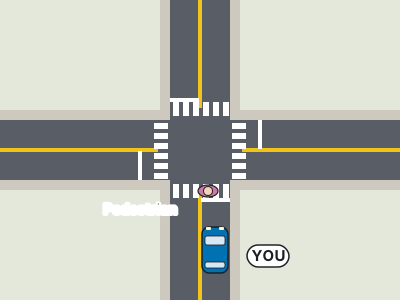
- Yield to the pedestrian
- Sound the horn and continue first
- Pass the pedestrian inside the crosswalk
- Yield only if the crosswalk has painted stripes
Show answer
Yield to the pedestrian. Drivers must yield to pedestrians entering or already in a crosswalk. The duty is not limited to striped markings because the handbook warns that not all crosswalks are marked. A horn does not replace yielding, and passing through the crossing creates the very conflict the rule is designed to prevent. Slow before the crossing, check both sides of the intersection, and wait until the pedestrian has cleared your path before continuing.
Study this in the handbook: Lane markings and special lanes
18. What are green destination signs used to show?
- Workers and equipment in a construction area
- Prohibited turns and U-turns
- Directions and distances to locations such as cities or airports
- The location of restrooms and fuel only
Show answer
Directions and distances to locations such as cities or airports. Green destination signs are guide signs that show directions and distances to places such as cities, airports, state or county lines, and special areas. They help a driver follow a route without changing the legal meaning of speed or turning signs. Blue service signs identify facilities, and orange signs mark work activity. A green sign can also identify an exit and indicate whether the ramp is on the left or right. Read the destination and lane position early so the required maneuver is smooth.
Study this in the handbook: Work zone, guide and incident signs
19. A front tire suddenly blows out. Which immediate response follows the handbook guidance?
- Accelerate hard to stabilize the damaged tire
- Stamp on the brake pedal and turn sharply off the road
- Release the wheel so the vehicle can find its path
- Grip the wheel, keep straight, and slow gradually without braking
Show answer
Grip the wheel, keep straight, and slow gradually without braking. A blowout can pull the vehicle sharply toward the failed tire, so steering control comes first. Hold the wheel firmly, keep the vehicle going straight, remove your foot from the accelerator, and let speed fall gradually. The handbook says not to brake, except for gentle braking if necessary. A hard pedal application or abrupt shoulder turn can worsen the loss of control. Once the vehicle is slow enough, move to a safe place off the roadway and use emergency flashers.
Study this in the handbook: Emergency braking, skids and vehicle failures
20. When may a driver cross a dashed yellow line between opposing lanes?
- Only after another driver waves
- Whenever the vehicle is below 25 mph
- When a safe gap in traffic is available
- Only during daylight hours
Show answer
When a safe gap in traffic is available. Dashed yellow lines between opposing lanes mean passing may occur when a safe gap in traffic is available. The line does not make passing automatic, and speed, a wave, or daylight alone does not establish a safe opportunity. The handbook also says the entered lane must be clear and road conditions must be considered. Before crossing, look far enough ahead and behind to identify approaching vehicles. Think of the dashed line as conditional permission, not a guarantee that the maneuver is safe.
Study this in the handbook: Work zone, guide and incident signs
QualitySpace is expanding to Kansas
We are a California-based independent insurance brokerage working on licensing in more states. We cannot help with Kansas insurance yet. Leave your email and we will let you know when we can.
Every question is written from the official Kansas Driving Handbook. Need paper? Printable KS practice test with answer key.
Last verified 2026-10-05. How we check every question · Study all 211 as flashcards
Frequently asked questions
How many questions are on this Kansas practice test?
This fixed set has 20 questions. It is test 3 of 10 from the 211 question Kansas bank. The real KS exam asks 25 questions and you need 20 correct.
What is the passing score for the real Kansas test?
You must score an 80% to pass the knowledge test That figure comes from the official Kansas source cited on the DMV facts page.
How does this fixed test relate to the full Kansas bank?
Each numbered test is a fixed set of questions in a fixed order, so you can retake the same test later and compare. Every test mixes road signs and the other topics in about the same proportion as the full bank. Tests 1 to 10 together cover 200 of the 211 questions in the Kansas bank, each once. The full practice page mixes the whole bank at random.
Last verified 2026-10-05. See the Kansas DMV facts page for sourced state details.