
Test 18 of 25 · 20 questions · Free 2026
KS Permit Practice Test 18
Jump to the test ↓A fixed 20 question set from the Kansas bank with answers and plain English explanations. The real KS exam is 25 questions, 80 percent to pass; take the full length version on the main practice page.
Question 1 of 20 · 0 right so far
All 20 questions in test 18
Every question below comes from the Kansas question bank on this page. Open a question to see the correct answer and the explanation. Nothing here is hidden behind a signup.
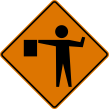
1. You see this sign on a Kansas road. What should you expect ahead?
- A person controlling traffic, whose directions you follow
- A school crossing guard helping children cross the road
- A checkpoint where every driver must show a license
- A railroad worker warning drivers about a nearby train
Show answer
A person controlling traffic, whose directions you follow. Work zone signs are orange with black symbols and warn you that people are working on or near the roadway. In work zones, traffic may be controlled by a person with a sign or flag who tells you which direction to travel, to slow down, or to stop, and you must follow their instructions. Reduce your speed, do not tailgate, and be prepared to stop suddenly, since the handbook asks drivers to give construction workers a brake.
Study this in the handbook: Kansas speed limits
2. When should you reduce speed even more before a Kansas curve?
- Only when a police officer at the curve signals you to slow down
- With poor traction, nearby traffic, or a hidden curve end
- When the curve banks steeply toward the inside
- Extra reduction is never needed below the limit
Show answer
With poor traction, nearby traffic, or a hidden curve end. Three conditions deepen the usual curve slowdown. Poor traction shrinks the grip available for turning, traffic ahead can brake mid bend, and a blind exit hides stalled vehicles or debris. In each case enter slower than the standard safe pace and keep acceleration gentle. Posted advisory plaques assume decent conditions, so worsening factors argue for less speed than the plaque. Reading the curve early turns these adjustments into calm choices rather than mid turn reactions.
Study this in the handbook: Safe speed and stopping distance
3. A bus ahead of you on a Kansas street signals a right turn but swings wide to the left first. What should you do?
- Slip between the bus and the curb to get ahead of it
- Pass the bus on the left before it starts to turn
- Wait until the bus finishes its turn, then turn
- Honk to tell the driver you are beside the bus
Show answer
Wait until the bus finishes its turn, then turn. A truck or bus making a right turn sometimes swings wide to the left so it can clear the corner of a curb or other obstruction, and it may use space from other lanes. If you try to get between the vehicle and the curb, you will be squeezed between them and could suffer a serious crash. The handbook says to give large vehicles plenty of room and not turn until the truck or bus has finished its turn.
Study this in the handbook: Pedestrians, bicycles, motorcycles and trucks
4. What is the safest way to change direction when you are headed the wrong way on a Kansas street?
- Make a U-turn wherever the street looks empty
- Back into the nearest intersection and reverse
- Turn right and go around the block
- Cross the median at the next opening
Show answer
Turn right and go around the block. Going around the block with right turns avoids most left turns across traffic, making it the safest direction change. It costs a minute and removes the riskiest crossing movements. U-turns demand wide streets, full visibility, and legality that many spots lack. Backing maneuvers expose you to traffic from several directions. Interstates solve the problem with the next exit. Boring recoveries like the block circle rarely appear in crash reports, which is precisely their virtue.
5. What is the left-most lane on a Kansas multi-lane road intended for?
- Passing slower vehicles
- Continuous cruising at any speed
- Trucks climbing long hills slowly
- Emergency parking during breakdowns
Show answer
Passing slower vehicles. On multi-lane roads the left-most lane exists to pass slower vehicles, after which you return right. Lingering there at traffic pace blocks drivers with legitimate passes to make and invites risky right side overtaking. Passing on the right is legal in defined same direction settings, yet the passing driver can vanish from mirrors and surprise the vehicle ahead. Hills send slow trucks right, not left. Breakdowns belong on shoulders or off the road entirely, never in the passing lane.
6. How much sleep do most adults need to stay properly alert for Kansas driving?
- Most adults need 4 to 5 hours of sleep
- Sleep need ends once a license is earned
- Most adults need 7 to 9 hours of sleep
- Two hours of sleep plus coffee equals rest
Show answer
Most adults need 7 to 9 hours of sleep. Trip preparation starts the night before. Most adults need seven to nine hours of sleep to maintain proper alertness during the day. After that base, long trips add their own defenses: breaks about every hundred miles or two hours, a travel companion to share driving and conversation, and avoiding alcohol plus sedating medications. Warning signs like turning up the radio, forcing windows down, heavy eyes, or lane drifting mean stop driving, not push harder. Sleep is the only true fatigue cure.
Study this in the handbook: Fatigue, distractions and driver responsibility
7. Can a Kansas driver still be convicted of driving impaired with a BAC below .08?
- Yes, impairment can support a conviction below .08
- No, .08 is an absolute minimum
- Only if the driver is under 21
- Only when a blood test is unavailable
Show answer
Yes, impairment can support a conviction below .08. Kansas describes .08 or higher as a violation, but it also warns that a driver remains impaired below .08 and can still be convicted for driving impaired. The .08 threshold is therefore not a safe harbor. The choice “No, .08 is an absolute minimum” incorrectly turns that number into an absolute minimum. The under-21 choice confuses this rule with the separate lower BAC enforcement described for younger drivers. The testing choice adds a condition the handbook does not require. Remember the distinction: .08 is the standard alcohol violation figure, while impairment can exist and lead to a conviction below it.
Study this in the handbook: How alcohol and drugs affect driving
8. You nearly turn into an expressway exit ramp in Kansas and see this sign facing you. What is it telling you?

- You cannot enter this roadway opening
- You may enter slowly if you live beyond the ramp exit
- Trucks alone are barred from entering at this opening
- Enter only when no traffic is visible on the ramp
Show answer
You cannot enter this roadway opening. A white horizontal bar inside a red circle closes the opening completely. These signs guard exit ramps where you would meet one-way traffic head on, crossovers on divided roads, and one-way street entries. Living beyond the opening or seeing no traffic creates no personal exception, and vehicle class is irrelevant. Back out of the mistake before entering, using a safe turnaround ahead. A Wrong Way sign waits a short distance beyond for drivers who ignore this first warning.
Study this in the handbook: Regulatory signs
9. What checks must you make when entering a Kansas shared center left turn lane?
- Check only the rearview mirror carefully before steering into the lane
- Check ahead, mirrors, signal left, then shoulder-check left
- Signal right first to warn drivers behind you
- Look solely at oncoming traffic during entry
Show answer
Check ahead, mirrors, signal left, then shoulder-check left. Entering the center lane safely takes a sequence: watch vehicles ahead, scan mirrors, signal left, and turn your head to clear the left blind spot before steering smoothly across. Each step catches a different threat, from a stopped turner ahead to a passing vehicle alongside. Signaling right would announce the opposite move. Once settled, choose a gap in oncoming traffic for the turn itself. Skipping the shoulder check is how drivers sideswipe vehicles they never saw.
Study this in the handbook: Lane markings and special lanes
10. A Kansas traffic light has been green for a long time as you approach. What should you expect?
- It may turn red before you arrive, so slow down and prepare to stop
- It will stay green until your vehicle crosses
- You should speed up to beat the change
- Cross traffic waiting at red will hold until you pass
Show answer
It may turn red before you arrive, so slow down and prepare to stop. A light that has been green for a long while is stale and can change to red before you reach it. Begin slowing and be ready for a complete stop rather than rushing the junction. Side street traffic waiting at their red often hurries through the moment theirs turns green. Covering the brake early protects you from both the change and impatient cross traffic. Fresh greens and stale greens deserve different levels of trust.
Study this in the handbook: Following distance, scanning and space
11. You cross a steel bridge with open grating on a Kansas rural road. What adjustment is needed?
- Speed up so tires spend less time on the grating
- Loosen your grip so the wheel can wander freely
- Slow down, grip the wheel firmly, and leave more following room
- Follow closer because traffic slows on bridges anyway
Show answer
Slow down, grip the wheel firmly, and leave more following room. Open steel grating cuts the traction available for braking and steering. Reduce speed before the deck, keep a firm grip because the tires can tug and wander on the metal, and open extra following distance. The same care suits gravel and other low grip surfaces. Once back on normal pavement, ordinary spacing can resume. Bridges can also carry ice earlier than roads in cold weather, doubling the case for a gentle crossing.
Study this in the handbook: Slippery roads and hydroplaning
12. When are deer and other large animals most active near Kansas roadways?
- At midday throughout the hottest weeks of summer
- Only while farmers plant crops in spring
- At dawn and dusk, October through December
- Equally at every hour of the day and night
Show answer
At dawn and dusk, October through December. Animal movement peaks in low light, at dawn and dusk, and the busiest season runs from October through December. Extra caution in those windows, plus attention near deer crossing signs, prevents many collisions. Scan far off both sides of the road for eye reflection near woods and water. Animals standing near the pavement can bolt without warning, and deer travel in groups, so one crossing rarely means the danger has passed. Slowing early preserves options.
Study this in the handbook: Work zone, guide and incident signs
13. A warning sign on a Kansas road alerts you to danger you cannot see yet. What is the standard response?
- Hold speed, since unseen dangers rarely materialize
- Stop immediately in the lane where you first see it
- Speed up to spend less time inside the danger area
- Slow down and be prepared to stop if necessary
Show answer
Slow down and be prepared to stop if necessary. Warning signs trade information for a standard bargain: slow down and be prepared to stop if necessary. The unseen danger, a curve, crossing, merge, or slippery patch, may or may not require the full stop, but arriving slower converts it from emergency to observation. Stopping instantly in a live lane for a warning alone creates a rear end risk. The sign gives you distance precisely so braking can be gradual. Use that gift; it is the entire design purpose of advance warning.
Study this in the handbook: Traffic lights and arrows
14. You drive 50 mph on a Kansas highway and plan a lane change. How far ahead must your signal start?
- At least 100 feet, the standard for every Kansas speed
- At least 200 feet or 3 to 5 seconds before the move
- Signal only once the lane beside you is fully clear
- One second before steering is enough at highway speed
Show answer
At least 200 feet or 3 to 5 seconds before the move. Signal distance grows with speed. The baseline duty is at least one hundred feet before slowing, turning, or changing lanes, held until the move begins. Above forty miles per hour, Kansas extends that to two hundred feet or three to five seconds before the turn or lane change. Urban guidance uses one hundred feet or three to five seconds. Your fifty mile per hour lane change therefore starts signaling two hundred feet early, ideally also three to five seconds of travel, so neighbors can plan around you.
Study this in the handbook: Emergency braking, skids and vehicle failures
15. You stopped fully at a Kansas through street, and a long truck approaches a block away at highway speed. May you pull out because you stopped first?
- No; proceed only when you can do so without interfering with that traffic
- Yes; a complete stop earns you the next turn into the street
- Yes; trucks must yield to stopped cars entering through streets
- A block of distance is always enough regardless of speed
Show answer
No; proceed only when you can do so without interfering with that traffic. Stopping at a through street is half the rule; the other half is entering without interfering with traffic already using it. Your completed stop buys no priority over a fast truck a block away, because distance without speed is meaningless. Judge the gap against your crossing or acceleration time, fifteen to eighteen seconds for a full left entry, far less for crossing straight. Trucks also need longer stopping distances and may be traveling faster than they appear. The wait ends when the maneuver fits, not when impatience peaks.
Study this in the handbook: Right of way at intersections
16. An emergency vehicle sits at its Kansas station with lights still flashing as it backs in. What must you do?
- Drive around it quickly before it finishes parking
- Drive around the apparatus quickly before it finishes backing into place
- Honk once and continue through its turning area
- Stop until the emergency vehicle is safely out of your path
Show answer
Stop until the emergency vehicle is safely out of your path. Emergency lights command the same respect entering or leaving service as they do on a call. If a vehicle is leaving or returning to its garage with lights flashing, stop and hold until it is safely clear of your path. Once one passes on the road, look behind for followers before returning, and stay at least five hundred feet behind it. During any emergency scene, directions from law enforcement or emergency personnel override your normal assumptions. Their workspace includes the roadway around the apparatus.
Study this in the handbook: Emergency vehicles, move over and traffic stops
17. After stopping safely with a stuck accelerator in Kansas, may you drive the vehicle home slowly?
- No; have the pedal repaired before driving again
- Yes, if you ride the brake pedal the whole way home
- Yes, at night when traffic is lightest
- Only on rural roads below 25 mph to a shop
Show answer
No; have the pedal repaired before driving again. A pedal that stuck once can stick again without warning. After shifting to neutral, steering off the road, and stopping, the vehicle gets switched off and repaired at a service center before any further driving. Riding the brake home converts the engine and brakes into opponents, overheating the brakes you depend on. Darkness and rural roads change nothing about the hardware risk. A tow feels expensive until compared with an uncontrolled acceleration into traffic.
Study this in the handbook: Emergency braking, skids and vehicle failures
18. Pumping the pedal and the parking brake both fail to stop your Kansas car. What is the final step?
- Keep driving slowly to the nearest town for repairs
- Use the transmission park pawl at highway speed
- Drag your door along guardrails until you halt
- Find a safe place off the roadway to slow to a stop
Show answer
Find a safe place off the roadway to slow to a stop. Brake failure escalates through stages: pump to build pressure, then the parking brake applied slowly with a hand ready to release a skid. If neither works, steer toward a safe place to scrub off speed and stop clear of the roadway, using terrain and space rather than traffic. Driving onward without brakes converts one emergency into a rolling threat for everyone. The vehicle stays parked until repaired. Practicing the sequence mentally now makes it available when panic argues otherwise.
Study this in the handbook: Emergency braking, skids and vehicle failures
19. You arrive at a Kansas roundabout at the same moment as a vehicle to your right. Who yields?
- The vehicle on your right yields to you
- You yield to the vehicle on your right
- Circulating speed decides who enters first
- You both enter and sort it out inside
Show answer
You yield to the vehicle on your right. Roundabout entry always yields to traffic already circling. When two drivers arrive together at the entry, the same right side courtesy applies: yield to the vehicle on your right. Racing to claim the gap invites a side collision at the entry point. Slow to about fifteen to twenty miles per hour on approach so yielding costs little. Pedestrians and bicyclists in or near the circle also receive your yield before you enter.
Study this in the handbook: Driveways, yield signs and roundabouts
20. How close to the nearest rail of a Kansas railroad crossing may you park?
- No closer than 15 feet from the nearest rail
- No closer than 50 feet from the nearest rail
- No closer than 30 feet from the nearest rail
- Parking beside tracks is allowed at any distance
Show answer
No closer than 50 feet from the nearest rail. Parking bans protect sight lines and escape room near hazards. The railroad figure is fifty feet from the nearest rail, keeping crossing views open and your vehicle clear of wide loads and train overhang. Fifteen feet belongs to fire hydrants, and thirty feet to signals, stop signs, and flashing beacons on the approach. Each number guards a different hazard, so they repay separate memorization. A parked car near rails also tempts its owner to cross tracks on foot in traffic.
Study this in the handbook: Where not to park and parking on hills
Every question is written from the official Kansas Driving Handbook. Need paper? Printable KS practice test with answer key.
Last verified 2026-10-05. How we check every question · Study all 500 as flashcards
Frequently asked questions
How many questions are on this Kansas practice test?
This fixed set has 20 questions. It is test 18 of 25 from the 500 question Kansas bank. The real KS exam asks 25 questions and you need 20 correct.
What is the passing score for the real Kansas test?
You must score an 80% to pass the knowledge test That figure comes from the official Kansas source cited on the DMV facts page.
How does this fixed test relate to the full Kansas bank?
Each numbered test is a fixed set of questions in a fixed order, so you can retake the same test later and compare. Every test mixes road signs and the other topics in about the same proportion as the full bank. Tests 1 to 25 together cover every question in the Kansas bank once. The full practice page mixes the whole bank at random.
Last verified 2026-10-05. See the Kansas DMV facts page for sourced state details.