
Test 22 of 25 · 20 questions · Free 2026
KS Permit Practice Test 22
Jump to the test ↓A fixed 20 question set from the Kansas bank with answers and plain English explanations. The real KS exam is 25 questions, 80 percent to pass; take the full length version on the main practice page.
Question 1 of 20 · 0 right so far
All 20 questions in test 22
Every question below comes from the Kansas question bank on this page. Open a question to see the correct answer and the explanation. Nothing here is hidden behind a signup.
1. A Kansas pedestrian crossing with a guide dog starts across the street. What must you do?
- Slow down gradually but keep rolling slowly through the crosswalk area
- Come to a complete stop and give the pedestrian the right-of-way
- Tap the horn so the pedestrian knows you are there
- Proceed if your light is green and traffic is waiting
Show answer
Come to a complete stop and give the pedestrian the right-of-way. A person guided by a dog or carrying a white cane receives the right-of-way always, and drivers must come to a complete stop. Sounding the horn can confuse or frighten both the pedestrian and the dog, so silence is part of the duty. A green light never overrides this protection. Visually impaired pedestrians cannot judge your speed or intentions the way sighted pedestrians can. Stop early enough that no part of your vehicle pressures their path.
Study this in the handbook: Pedestrians, bicycles, motorcycles and trucks
2. What does this sign tell you about the stretch of Kansas road ahead?

- Fencing keeps deer off this road
- Hunters are allowed to cross the road here
- Many deer and vehicle collisions have occurred here
- Animals have the right of way here at all times
Show answer
Many deer and vehicle collisions have occurred here. Deer crossing signs are placed in areas that have had a large number of deer and vehicle collisions, so the handbook tells you to use caution and be alert on roadways marked with them. Look well down the road and far off to each side, and scan for the reflection of your headlights in the eyes of animals, especially at night and near woods and water. Deer often travel in groups, so slow down if you see one near the road.
Study this in the handbook: Work zone, guide and incident signs
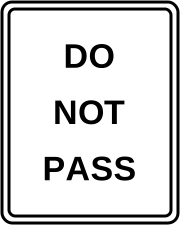
3. A Kansas highway has this sign beside the road. What does it tell you?
- Slower traffic must keep to the right here
- You may not pass another vehicle in this area
- Passing is allowed only after dark
- This is where the no passing zone ends
Show answer
You may not pass another vehicle in this area. The Do Not Pass sign tells you where you cannot pass another vehicle. Passing areas are based on how far you can see ahead, and they take into account unseen hazards such as hills and curves, intersections, driveways, and other places where a vehicle or pedestrian may enter the roadway. Where the sign stands, stay behind the vehicle ahead. A different sign, Pass with Care, marks the end of a no passing zone.
Study this in the handbook: Regulatory signs
4. How can drivers help traffic keep moving when a Kansas work zone closes a lane ahead?
- Wait until the last cone to merge at speed
- Stop on the roadway itself and wait until animals finish crossing over
- Stop and let every side street enter first
- Merge as soon as possible after the first notice of the zone
Show answer
Merge as soon as possible after the first notice of the zone. Early merging keeps a work zone flowing at its posted speed. Move to the open lane at the first notice of the approaching zone instead of racing the closing lane to its end. Late dives force braking waves and anger, while shoulder driving is both illegal and dangerous near crews. Plan for delays on known projects and leave earlier when you can. Smooth early merges protect workers and shorten everyone wait, including yours.
Study this in the handbook: Work zone, guide and incident signs
5. In the Kansas handbook, what does being sober actually mean?
- Your BAC has fallen below .08 percent
- You feel alert after coffee and fresh air
- You can walk a straight line without swaying
- No alcohol or impairing drugs left in the circulatory system
Show answer
No alcohol or impairing drugs left in the circulatory system. Sober is defined by chemistry, not confidence. It means no alcohol or other impairing drugs remain in the circulatory system of the body. A driver below .08 can still be impaired and convictable, and feeling alert after coffee changes nothing the blood carries. Field impressions like walking steadily miss the perception and judgment losses that matter at speed. If any impairing substance is still circulating, the handbook does not call you sober, whatever your self assessment says.
Study this in the handbook: How alcohol and drugs affect driving
6. Your wheels dropped off a Kansas pavement edge. Why straddle the edge before steering back?
- Straddling wears the tire smooth for more grip
- It lets you return to the road at highway speed safely
- It stops tire rubbing and sets a higher return angle
- The edge will lift the vehicle back automatically
Show answer
It stops tire rubbing and sets a higher return angle. Returning from a drop off fails when the tire scrapes along a vertical pavement lip and then lurches. First slow to twenty five miles per hour or less without hard braking. Straddling the edge keeps the inside of the tires from rubbing and sets a higher approach angle, so the tire climbs back cleanly. With gaps in all directions, turn about a quarter turn, then straighten into your lane. Panic steering at speed is the crash this sequence replaces.
Study this in the handbook: Emergency braking, skids and vehicle failures
7. You hit a deer on a Kansas road and the animal lies in the lane. What report should you make?
- No report is ever needed for animal crashes
- Report only if your vehicle cannot be driven
- Report it to police; large animal crashes require a report
- Notify the animal owner before calling anyone
Show answer
Report it to police; large animal crashes require a report. Collisions with large animals like deer or farm animals go to the police. For a domestic pet near homes, try to notify the owner if possible without entering anyone home. Prevention stays better than paperwork: slow near animals standing by the road, since they may bolt, and remember deer travel in groups. If impact is unavoidable, hold control on the roadway rather than swerving into traffic. After any strike, check your vehicle is safe before continuing.
8. A Kansas trooper sees an unrestrained child in a back seat and an unrestrained adult driver. For which occupant can the car be stopped on seat belts alone?
- Only the child, because adult belt violations in Kansas always require another traffic offense first to justify any stop
- Only the adult, because children are the responsibility of parents and never grounds for a traffic stop in Kansas
- Neither occupant alone suffices, since belt stops require a crash or a separate moving violation on the roadway
- Either one; an unrestrained child anywhere or adult in front supports the stop
Show answer
Either one; an unrestrained child anywhere or adult in front supports the stop. Kansas made seat belt use a primary violation with two triggers. An officer who sees an unrestrained adult in a front seat, or an unrestrained child anywhere in the vehicle, can stop the vehicle solely for that violation. Your scenario contains both triggers at once. The underlying duty is broader still: all occupants must use safety restraints in passenger vehicles, drivers answer for child restraints, and troopers need no additional offense to act. Primary status is precisely what separates this stop from older secondary enforcement many drivers still imagine.
Study this in the handbook: Kansas speed limits
9. This yellow sign appears before a bend on a Kansas county road. What driving change does it ask for?

- Prepare for a series of left turns through the hills
- Speed up slightly so momentum carries you through
- The road turns sharply at a right angle intersection
- Slow for a right curve ahead before you enter it
Show answer
Slow for a right curve ahead before you enter it. A curved arrow bending right warns of a right curve ahead. Reduce speed before entering, to a pace allowing slight constant acceleration through the bend, and slow more when traction is poor or the exit is hidden. It is one curve, not the winding series, and not the sharp right angle turn at an intersection. Advisory speed plaques sometimes ride below the sign with a recommended figure. Entering hot and braking mid curve can break traction and push you wide.
Study this in the handbook: Traffic lights and arrows
10. A Kansas fire hydrant stands at the curb where you want to park, and the nearest open space ends 10 feet from it. May you park there?
- Yes; hydrant clearance is only five feet, so ten feet of space satisfies the Kansas parking rule completely
- Yes, if your vehicle is small enough to leave the hydrant cap visible from the street for firefighters
- No; parking is prohibited within 15 feet of a fire hydrant
- Only trucks are bound by hydrant distances, because cars can be moved quickly during an actual fire call
Show answer
No; parking is prohibited within 15 feet of a fire hydrant. Hydrant clearance is a flat fifteen feet, and your ten foot space fails it. Fire crews need room to connect hoses and work around the hydrant without your bumper in the arc. Other parking distances guard other hazards: thirty feet approaching signals, stop signs, or beacons, and fifty feet from the nearest railroad rail. Vehicle size and moveability do not shrink any of them. The exam rotates these three numbers through scenarios precisely because confusing them carries real roadside consequences.
Study this in the handbook: Where not to park and parking on hills
11. A Kansas highway segment posts 60 mph although the statutory class maximum is 65 mph. Which number controls your speedometer?
- The posted 60 mph limit for that segment
- The statutory sixty five, because class maxima always override signs posted by local crews along Kansas highways
- Whichever number is higher, since Kansas lets drivers choose the more favorable of the two limits in conflict
- You may average them at sixty two when traffic around you travels at mixed speeds on the same highway segment
Show answer
The posted 60 mph limit for that segment. Posted limits tailor the statute to the segment. When a posted speed differs from the statutory maximum, the posted limit is the one you must follow; the sign reflects congestion, intersections, and roadway conditions engineered for that stretch. No choosing or averaging exists between the numbers. Where no special hazard or posting applies, the statutory classes supply the default instead. Driving the class maximum through a posted reduction is speeding in the eyes of the law and the physics of the curve or junction that earned the sign.
Study this in the handbook: Kansas speed limits
12. A Kansas road is wet and covered with sand near a bicyclist ahead. What should you keep in mind?
- Bicycles grip wet sand and gravel better than cars do on pavement
- The rider can brake faster than a car in these conditions
- They cannot brake as fast or turn as sharply, so allow more room
- Bicyclists avoid roads with sand or gravel, so none will be there
Show answer
They cannot brake as fast or turn as sharply, so allow more room. Wet pavement, sand, and gravel affect bicycles much more than motor vehicles. Like cars, bicycles cannot brake as quickly or turn as sharply under these conditions, and a slide is far more likely for the rider. The handbook asks drivers to be particularly careful around bicyclists when the road is wet or covered with sand or gravel. Slow down, add extra space when you pass, and expect the rider to wobble or swerve around loose material.
Study this in the handbook: Pedestrians, bicycles, motorcycles and trucks
13. A driver tailgates you on a Kansas road with no empty lane to move into. Besides slowing gradually, how can you protect yourself?
- Increase your following distance by 2 to 3 seconds
- Brake suddenly to teach the tailgater a lesson
- Match the tailgater speed when they honk
- Stop in the lane and let traffic queue behind
Show answer
Increase your following distance by 2 to 3 seconds. A close follower steals your safety margin from behind, so build extra margin in front. Adding two to three seconds to your own following distance lets you brake gently and early, which lowers the chance the tailgater rear ends you during a sudden stop. Combined with a slow gradual speed drop when the road ahead clears, this encourages a pass without provocation. Sharp braking or lane blocking converts rudeness into a crash risk you partly control.
Study this in the handbook: Following distance, scanning and space
14. When may a Kansas driver use the shoulder of the road for driving?
- Whenever the travel lane beside you is badly congested with traffic
- To pass a vehicle turning left slowly
- Only if officers direct it or local rules allow it
- On rural roads with wide gravel shoulders
Show answer
Only if officers direct it or local rules allow it. Shoulders guard the edge of the roadway for emergencies, not overflow travel. Never drive on one unless law enforcement tells you to or local regulations expressly allow it. Passing on a shoulder, paved or not, is separately forbidden because drivers pulling off never expect traffic there. Congestion changes nothing. If an officer waves you onto the shoulder at a crash scene, that direction is your permission. Otherwise the paved or gravel margin stays out of your route.
15. An aggressive Kansas driver tailgates and gestures at you. Which response does the guidance support?
- Move out of their way and avoid eye contact with them
- Hold your lane position and match their speed
- Return the gestures so they back down quickly
- Brake suddenly to teach them following distance
Show answer
Move out of their way and avoid eye contact with them. Aggressive encounters de-escalate by subtraction. Get out of their way, refuse to challenge them by speeding up or holding your path against them, and avoid eye contact, which can sometimes anger an aggressive driver further. Ignore gestures and name calling rather than returning them. Responding to negative behavior manufactures the dangerous situation both vehicles then share. If the conduct turns serious, drive away from the area and report it. Losing an argument on the road is winning the only contest that matters.
Study this in the handbook: Where not to park and parking on hills
16. How should you refuse to challenge an aggressive driver who wants your lane in Kansas?
- Speed up so they must follow behind you
- Block their lane changes until they calm down
- Do not speed up or try to hold your own in your path of travel
- Race them to the next traffic light opening
Show answer
Do not speed up or try to hold your own in your path of travel. Challenge is the fuel of road rage. When an aggressive driver presses you, do not challenge them by speeding up or attempting to hold your own in your path of travel. Yield space, let them go, and add distance. Eye contact and returned gestures pour more fuel on the same fire. Your goal is separation, not victory. Arriving two minutes later with an intact vehicle beats defending a lane position into a crash or a confrontation at the next stop.
Study this in the handbook: Where not to park and parking on hills
17. Four cars arrive at a Kansas four-way stop in a neat line one after another. How is the crossing order set?
- All four enter together once everyone has stopped fully
- The vehicle that reached the intersection first goes first, then the next arrivals
- The vehicle on the southbound approach always leads the order
- Drivers negotiate by honking in arrival sequence at the corner
Show answer
The vehicle that reached the intersection first goes first, then the next arrivals. A four-way stop runs on arrival order: the driver reaching the intersection first receives the right-of-way from the others, then subsequent arrivals follow in sequence. Simultaneous arrivals fall back to the right side rule. Direction, vehicle size, and horn negotiations assign nothing. Full stops still come first, since rolling arrivals corrupt the very order the rule reads. When courtesy waves rearrange the order, move only on unmistakable eye contact and an empty path, because the legal order remains the default everyone else expects.
Study this in the handbook: Right of way at intersections
18. A flashing yellow X glows over the center lane you occupy in Kansas. What is that lane for now?
- Turning only; through travel in the lane is no longer allowed
- Full through travel until the X turns steady red above you
- Parking while you wait for the lane to reopen fully today
- The X is decorative and the lane keeps its last assignment
Show answer
Turning only; through travel in the lane is no longer allowed. Each overhead X state carries a distinct order. Flashing yellow X demotes the lane to turning only, so through drivers must leave it to those preparing turns. Steady yellow X means the lanes assignment is changing and you should move out as soon as safe. Red X closes it completely, while a green arrow opens it fully. Treating a flashing X as continued through permission keeps you in pavement now reserved for opposing turners. Read these signals before entering any lane they govern.
Study this in the handbook: Lane markings and special lanes
19. A Kansas county blacktop shows no speed sign for miles. What is the fastest lawful speed on it?
- 65 mph, since county roads follow the state highway maximum outside towns
- 55 mph unless posted otherwise
- 75 mph whenever the county road happens to have two lanes each direction
- 30 mph, because unposted pavement defaults to the urban district speed
Show answer
55 mph unless posted otherwise. County and township roads default to fifty five miles per hour when no sign posts another limit. The state highway figure of sixty five and the designated multilane seventy five both describe grander roads. Urban thirty belongs inside towns and cities. Basic speed law can still demand less in rain, dust, or gravel washboarding common on county routes. A missing sign never means a missing limit; the statute supplies one for every road class so officers and drivers share the same expectation.
Study this in the handbook: Kansas speed limits
20. A Kansas freeway lane is marked HOV 3 during posted hours. Your car holds you and two friends. May you use it?
- No, HOV numbers count only adult licensed drivers in the car
- No, the lane requires at least four occupants by Kansas law
- Only if all three occupants are carpool members registered locally
- Yes, with three people aboard you meet the HOV 3 requirement
Show answer
Yes, with three people aboard you meet the HOV 3 requirement. HOV signs state a people count, and HOV 3 means at least three people in the vehicle. You plus two friends equals three occupants, so the lane is open to you during its posted days and hours. Bodies count, not licenses or registrations. Read the sign for both the number and the times, since the same lane may run unrestricted outside enforcement hours. Reserved lane diamonds and wording announce these lanes at the roadside and on the pavement, while bus and bicycle lanes reserve entirely different users.
Study this in the handbook: Lane markings and special lanes
Every question is written from the official Kansas Driving Handbook. Need paper? Printable KS practice test with answer key.
Last verified 2026-10-05. How we check every question · Study all 500 as flashcards
Frequently asked questions
How many questions are on this Kansas practice test?
This fixed set has 20 questions. It is test 22 of 25 from the 500 question Kansas bank. The real KS exam asks 25 questions and you need 20 correct.
What is the passing score for the real Kansas test?
You must score an 80% to pass the knowledge test That figure comes from the official Kansas source cited on the DMV facts page.
How does this fixed test relate to the full Kansas bank?
Each numbered test is a fixed set of questions in a fixed order, so you can retake the same test later and compare. Every test mixes road signs and the other topics in about the same proportion as the full bank. Tests 1 to 25 together cover every question in the Kansas bank once. The full practice page mixes the whole bank at random.
Last verified 2026-10-05. See the Kansas DMV facts page for sourced state details.