
Test 11 of 25 · 20 questions · Free 2026
KS Permit Practice Test 11
Jump to the test ↓A fixed 20 question set from the Kansas bank with answers and plain English explanations. The real KS exam is 25 questions, 80 percent to pass; take the full length version on the main practice page.
Question 1 of 20 · 0 right so far
All 20 questions in test 11
Every question below comes from the Kansas question bank on this page. Open a question to see the correct answer and the explanation. Nothing here is hidden behind a signup.
1. What does the Kansas handbook say studies show about people who use marijuana and drive?
- They drive more cautiously than other drivers overall
- Marijuana affects driving only when mixed with alcohol
- More mistakes, more glare trouble, and more traffic arrests
- No measurable driving effects have been shown
Show answer
More mistakes, more glare trouble, and more traffic arrests. Illegal drugs can impair reflexes, judgment, vision, and alertness in ways similar to or worse than alcohol. For marijuana specifically, studies show users make more mistakes, have more trouble adjusting to glare, and get arrested for traffic violations more than other drivers. A drug related driving conviction carries penalties like an alcohol one, including fines, possible jail or service, suspension, and worse for repeats. Feeling mellow is not a driving skill. Anything impairing belongs in the same never drive category.
Study this in the handbook: How alcohol and drugs affect driving
2. You need to check your phone while driving in Kansas. What is the safe way to do it?
- Hold the phone at wheel level and keep driving
- Use the phone only above 40 mph on highways
- Wait for any red light, then read in the lane
- Stop in a safe parking area before using the cell phone
Show answer
Stop in a safe parking area before using the cell phone. Phones belong to parked moments. The guidance is blunt: avoid using cell phones while driving, and if you need one, stop in a safe parking area first. Kansas separately bans writing, sending, or reading written communications while driving for everyone, and teens on restricted licenses face a total wireless ban outside emergencies. Red light reading still divides attention when the light changes. A two minute park protects the message, the driver, and everyone the vehicle would otherwise drift toward.
Study this in the handbook: Fatigue, distractions and driver responsibility
3. Why does the Kansas handbook tell drivers to back as little as possible?
- Backing wastes more fuel than forward driving
- Reverse gears are weaker on Kansas hills only
- Mirrors make backing completely safe everywhere
- Seeing behind is hard, so backing stays minimal
Show answer
Seeing behind is hard, so backing stays minimal. Your vehicle blinds you to much of what sits behind it, even with mirrors and a turned head. That limited vision is why the guidance says to do as little backing as possible, planning entries and parking choices that let you leave forward. Shopping centers and other pedestrian heavy places demand extra backing checks. When backing is unavoidable, steering still follows the simple rule: turn the wheel toward where you want the vehicle to go. Prefer pull through spots and driveways you can exit nose first.
4. Your Kansas light is green, but traffic beyond the intersection is stopped bumper to bumper. What must you do?
- Wait before entering until there is room to clear the intersection completely
- Enter and stop inside, since green protects you from tickets
- Creep to the middle so cross traffic sees your intention
- Enter if your vehicle is small enough to fit diagonally
Show answer
Wait before entering until there is room to clear the intersection completely. Green permission ends at the far bumper of queued traffic. You may not enter an intersection, even on green, unless sufficient space on the other side fits your whole vehicle, because a blocked box traps cross traffic and emergency routes. The Do Not Block Intersection sign states the same prohibition. Size tricks and intentions displayed mid-box change nothing. Waiting one cycle behind the line keeps the junction working for everyone, including the cross drivers who will face the same choice minutes later with you among the protected.
Study this in the handbook: Right of way at intersections
5. You park along a Kansas street that runs beside railroad tracks, leaving your bumper 40 feet from the nearest rail. Is that lawful?
- Yes; forty feet doubles the twenty foot clearance Kansas requires from rails near ordinary street crossings in towns
- No; parking must stay at least 50 feet from the nearest rail
- Yes, if trains on that line run only during daylight hours and your parking happens entirely after sunset falls
- Only vehicles longer than twenty feet owe the full fifty foot rail clearance; passenger cars may park closer
Show answer
No; parking must stay at least 50 feet from the nearest rail. Railroad crossings claim the widest common parking clearance in Kansas: fifty feet from the nearest rail. Your forty foot bumper sits inside the protected zone where parked vehicles block crossing sight lines and crowd wide rail loads. Schedules and sunlight do not trim the figure, and vehicle length does not graduate it. The other distances sort by hazard: fifteen feet at hydrants, thirty feet approaching signals and stop signs, twenty feet beside a fire station driveway. Fifty belongs to the hazard that cannot swerve or stop.
Study this in the handbook: Where not to park and parking on hills
6. You miss a Kansas side street and reverse down the travel lane for half a block with no traffic in sight. What does the law say?
- A half block of backing is permitted whenever the driver first confirms the lane looks empty behind the vehicle
- Backing in a travel lane is illegal and unsafe except to parallel park
- Backing to a missed street is allowed on roads posted at twenty five miles per hour or below in Kansas towns
- You may reverse if a passenger walks behind the vehicle guiding you through the maneuver with hand signals
Show answer
Backing in a travel lane is illegal and unsafe except to parallel park. Travel lanes run one logical direction, and drivers never expect a vehicle backing toward them. Kansas calls backing in any travel lane illegal and unsafe, with parallel parking as the lone exception. Missed streets are recovered forward: continue to a safe turnaround, circle the block, or use the next interstate exit. Empty appearances deceive, passenger guides add a pedestrian to the hazard, and low speed limits carve no exception. The rule protects the driver who rounds the corner mid maneuver and finds your reversing bumper filling the lane.
Study this in the handbook: Lane markings and special lanes
7. You are mid-turn on a green arrow in Kansas when the arrow switches to yellow. What is happening?
- Your turn becomes illegal halfway and you must reverse out
- Yellow arrows mean oncoming traffic now has a red light
- The green arrow is ending, so finish carefully and prepare to yield or stop
- You gain five extra seconds of protected turning time
Show answer
The green arrow is ending, so finish carefully and prepare to yield or stop. A yellow arrow closes the protected phase. Drivers still turning should clear the intersection with care, while those approaching must prepare to stop and yield the right-of-way to oncoming traffic and pedestrians as the green ball or red takes over. Nobody reverses out of a turn. The protection drains away rather than snapping off, which is why finishing smoothly matters. Watch pedestrians through the whole movement, since arrow changes confuse walkers as much as drivers.
Study this in the handbook: Traffic lights and arrows
8. On an unfamiliar Kansas road at night, your low beams light the road ahead. About how fast can you still stop inside that lit distance?
- About 65 mph, the figure Kansas guidance ties to low beam headlights on unfamiliar roads after dark in rural areas
- About 45 mph within low beam seeing distance
- About 30 mph at the very fastest, because low beams reveal only one hundred feet of Kansas roadway at night
- Night speed is unlimited by beams as long as the posted limit is obeyed on a familiar divided highway route
Show answer
About 45 mph within low beam seeing distance. Low beam headlights reveal about one hundred fifty to two hundred feet clearly. Stopping inside that lit envelope caps safe speed around forty five miles per hour, which is the figure Kansas guidance attaches to low beams. High beams extend sight to roughly three hundred fifty to four hundred feet and about sixty five miles per hour. Unfamiliar night roads also deserve at least two added following seconds. Outdriving your lights means hazards materialize already inside your stopping distance, where no reaction can save the arithmetic.
Study this in the handbook: Night driving, fog and floods
9. A Kansas officer has pulled you over at night. What should you do with your hands as the officer approaches?
- Reach under the seat to find your papers right away
- Step out of the car and walk toward the officer
- Wave the officer back to your window
- Keep them on the wheel and limit your movements
Show answer
Keep them on the wheel and limit your movements. After you move to the right and stop, remain calm and keep your safety belt fastened. The handbook says to keep your hands on the steering wheel and limit your movements so the officer does not think you are hiding or searching for something. When the officer asks for your license, proof of insurance, or registration, say where the documents are and reach for them slowly with one hand on the wheel. Stay in the vehicle unless asked to get out.
Study this in the handbook: Emergency vehicles, move over and traffic stops
10. Overhead signals govern a Kansas reversible lane. What does a steady yellow X above your lane mean?
- The lane is reserved for turning only
- You may keep using the lane until a red X appears
- Look solely at oncoming traffic during the whole entry into the lane
- Lane use is changing, so move out as soon as it is safe
Show answer
Lane use is changing, so move out as soon as it is safe. Reversible lanes flip direction with traffic demand, and the overhead X signals narrate the change. A flashing yellow X restricts the lane to turning, while a steady yellow X announces the lane is being taken away: leave it as soon as safety allows. Waiting for red treats the warning as decoration while opposing traffic may already be released toward you. Green arrows grant use, red X denies it entirely. Read the signal before entering any reversible lane.
Study this in the handbook: Lane markings and special lanes
11. A Kansas driver sees this sign at an intersection while traffic beyond it is backed up. What does it require?
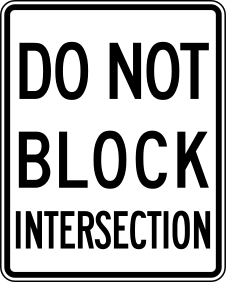
- Wait inside the intersection until cars ahead move
- Enter on any green light, whatever the traffic ahead
- Do not enter unless you can clear it completely
- Stop in the crosswalk until the signal changes
Show answer
Do not enter unless you can clear it completely. This sign tells you not to stop, stand, or park at any time in the intersection. The handbook adds that you must not enter an intersection if traffic conditions do not permit you to clear it completely, and you must not block traffic entering the intersection from any other direction. A green light does not change that. If vehicles are stopped beyond the intersection, wait behind it until there is room for your whole vehicle on the far side.
Study this in the handbook: Regulatory signs
12. A Kansas expressway posts this sign. What must drivers do?
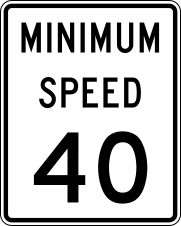
- Drive at least that fast to avoid being a hazard
- Never drive faster than the number shown
- Drive that speed only when the road is wet
- Treat the number as a suggested speed on the curves ahead
Show answer
Drive at least that fast to avoid being a hazard. Speed limit signs are black and white and show either the maximum or the minimum legal speed. Some high-speed roads have minimum speed limits, and you are legally required to travel at least that fast so you are not a hazard to other drivers. A maximum limit, by contrast, should be driven only in ideal conditions, and you must slow down for rain, snow, ice, fog, or anytime it is difficult to see the roadway clearly.
Study this in the handbook: Kansas speed limits
13. Your Kansas car has no anti-lock brakes and you must stop as quickly as possible. How should you brake?
- Brake as hard as you can without locking the wheels, easing up if a skid starts
- Lock the wheels fully so the tires dig into the pavement and stop shorter
- Pump the pedal rapidly in a steady rhythm until stopped
- Take your foot off the brake once the vehicle begins to skid
Show answer
Brake as hard as you can without locking the wheels, easing up if a skid starts. Without anti-lock brakes, maximum braking lives just below lockup. Press as hard as you can without locking the wheels. If they lock and the vehicle starts to skid, ease up on the pedal, then reapply with control, never removing your foot entirely, and repeat until stopped. Locked wheels slide and lengthen the stop while killing steering. Anti-lock equipped vehicles use the opposite technique: press hard and keep pressing while the system pulses for you.
Study this in the handbook: Emergency braking, skids and vehicle failures
14. Your Kansas vehicle steers but keeps going straight despite turning the wheel. Which tires lost traction?
- The front tires have lost traction
- The rear tires have lost traction
- All four tires still grip the road fully
- Only the spare tire affects steering response
Show answer
The front tires have lost traction. Reading a skid starts with naming which end lost grip. If the vehicle continues straight while you steer, the front tires have lost traction and cannot pull the nose around. If instead the vehicle slides sideways without extra steering input, the rear tires let go. Each loss answers differently: ease brakes to restore front grip, or steer toward your intended path for a rear slide. Looking toward open space, not fixating on the hazard, guides every version of recovery.
Study this in the handbook: Emergency braking, skids and vehicle failures
15. This sign guards a Kansas intersection where you planned a left turn. What must you do instead?

- Turn left quickly after stopping for any pedestrians
- Continue straight or turn right; left turns are barred from this approach
- Turn left only when the signal arrow turns yellow here
- Make the left from the right lane to stay unseen
Show answer
Continue straight or turn right; left turns are barred from this approach. The crossed left arrow removes the left turn from this approach entirely. Continue through or turn right and rebuild your route with legal movements, perhaps around the block. Stopping for pedestrians does not resurrect a banned turn, and signal phases never repeal a posted prohibition. Turning from a wrong lane compounds the violation with a sideswipe risk. These bans usually protect complicated junctions where lefts conflict with heavy flows, so the detour is genuinely the engineered solution, not mere inconvenience.
Study this in the handbook: Kansas speed limits
16. Thick Kansas fog cuts your view to exactly 100 feet ahead. What is the fastest you can safely drive?
- 45 mph, since low beam headlight reach supports that speed on clear dark nights without any fog present at all
- 55 mph if you switch on high beams, because brighter lights double your stopping ability in dense fog banks
- Whatever the posted limit says, because fog never changes a lawful speed ceiling on Kansas primary highways
- 30 mph when you can see only 100 feet
Show answer
30 mph when you can see only 100 feet. Visibility caps speed more honestly than any sign. When rain, snow, dust, smoke, or fog limits your view to one hundred feet, you cannot safely drive faster than thirty miles per hour, because your stopping distance must fit inside what you can see. Fog punishes high beams with reflected glare, so low beams and fog lights serve better even in daytime fog. If conditions erase even that view, pulling off the roadway to wait is the remaining safe answer. This rule is basic speed law with a number attached.
Study this in the handbook: Night driving, fog and floods
17. What does a posted No Turn on Red sign mean?
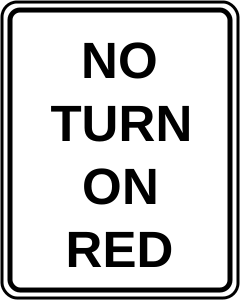
- No right or left turn may be made during the red light
- A turn is allowed only for buses
- A right turn is allowed after slowing
- The driver may turn after yielding without stopping
Show answer
No right or left turn may be made during the red light. A No Turn on Red sign prohibits both right and left turns during the red light. The sign overrides the usual possibility of turning after a stop and traffic check. Slowing without stopping is not enough, and the restriction is not limited to buses. Wait for the signal to turn green, while remaining behind the proper line or crosswalk. The important cue is the posted sign, because a red signal alone and a red signal with this sign have different turning permissions.
Study this in the handbook: Kansas speed limits
18. How should driving change on Kansas gravel or dirt roads compared with pavement?
- Reduce speed and increase following distance because stopping takes longer
- Keep highway speed since gravel grips better when loose
- Follow closer to stay out of the dust cloud
- Steer sharply to test traction at the start
Show answer
Reduce speed and increase following distance because stopping takes longer. Loose gravel and dirt give tires far less bite than concrete or asphalt. Stopping stretches out and skidding starts sooner, so slower speeds and a wider following gap are the basic adjustments. Rippled washboard sections can also shake steering control loose at speed. Dust cuts vision in dry periods, which argues for even more room. Treat every unpaved mile as low traction driving, even when the surface looks smooth and familiar.
Study this in the handbook: Slippery roads and hydroplaning
19. When should a Kansas driver wear a safety belt to get its protection?
- Only on trips longer than thirty minutes
- Only when a police officer may be watching
- All the time, on short trips and highways alike
- Belts matter only above 45 mph in Kansas
Show answer
All the time, on short trips and highways alike. Most crashes happen close to home at ordinary speeds, and belts protect in exactly those trips too. Wear a safety belt all the time, not just for long drives or highways. Correct fit matters: the shoulder harness crosses shoulder and chest with minimal slack, while the lap belt rides snug and low across the hips. Sit upright with your back against the seat. Even with air bags fitted, belts stay mandatory equipment for your body because bags are supplemental restraints.
Study this in the handbook: Seat belts, child seats and air bags
20. When the light turns green for your left turn at a Kansas intersection, how should you position to be ready?
- Wait behind the line until the whole turn is clear
- Wait behind the painted line until the entire turn looks fully clear
- Enter the intersection and wait, ready to turn when clear
- Stop in the crosswalk to see around traffic
Show answer
Enter the intersection and wait, ready to turn when clear. A waiting left turner should pull into the intersection on green and hold ready, wheels pointed generally straight, until oncoming traffic and pedestrians clear. This position commits you to finish promptly when a gap or the yellow arrives, keeping the junction flowing. Waiting behind the line can waste the cycle and tempt a rushed late turn. Charging instantly pits you against oncoming starters. The ready position balances patience with progress while keeping escape options alive.
Every question is written from the official Kansas Driving Handbook. Need paper? Printable KS practice test with answer key.
Last verified 2026-10-05. How we check every question · Study all 500 as flashcards
Frequently asked questions
How many questions are on this Kansas practice test?
This fixed set has 20 questions. It is test 11 of 25 from the 500 question Kansas bank. The real KS exam asks 25 questions and you need 20 correct.
What is the passing score for the real Kansas test?
You must score an 80% to pass the knowledge test That figure comes from the official Kansas source cited on the DMV facts page.
How does this fixed test relate to the full Kansas bank?
Each numbered test is a fixed set of questions in a fixed order, so you can retake the same test later and compare. Every test mixes road signs and the other topics in about the same proportion as the full bank. Tests 1 to 25 together cover every question in the Kansas bank once. The full practice page mixes the whole bank at random.
Last verified 2026-10-05. See the Kansas DMV facts page for sourced state details.