
Test 16 of 25 · 20 questions · Free 2026
KS Permit Practice Test 16
Jump to the test ↓A fixed 20 question set from the Kansas bank with answers and plain English explanations. The real KS exam is 25 questions, 80 percent to pass; take the full length version on the main practice page.
Question 1 of 20 · 0 right so far

All 20 questions in test 16
Every question below comes from the Kansas question bank on this page. Open a question to see the correct answer and the explanation. Nothing here is hidden behind a signup.
1. Highway traffic ahead of you in Kansas slows as this sign appears. What is joining your road?
- Merging traffic ahead that may enter your lane
- A second train track joining the highway corridor
- Your lane ends and disappears at the next milepost
- An added lane that separates traffic permanently
Show answer
Merging traffic ahead that may enter your lane. The merge warning means vehicles will enter your stream from a ramp or side road ahead. Adjust speed and lane position early to open a gap, remembering that entering drivers should match flow speed on their acceleration lane. It is not the lane ends sign, which announces your own lane vanishing, nor the added lane sign, where everyone keeps separate pavement. Smooth merges are cooperative: small speed changes early prevent brake waves and last second swerves at the gore point.
Study this in the handbook: Traffic lights and arrows
2. How does the Kansas handbook define a driver license for the person holding it?
- A license is a right that cannot be suspended
- Having a driver license is a privilege, not a right
- A license protects the holder from routine traffic stops
- Licenses renew automatically for careful drivers
Show answer
Having a driver license is a privilege, not a right. Driving sits on permission, not entitlement. Having a driver license is a privilege, not a right, and other drivers plus pedestrians expect you to follow laws and rules of the road in exchange. Passengers literally place their safety in your hands. A vehicle can cause extensive damage, injury, and death, deserving the caution owed any dangerous tool. The golden rule summarizes the ethic: treat others as you want to be treated, obey the laws, drive responsibly, and refuse unnecessary risks.
3. What does tying a white cloth to a Kansas vehicle antenna or door handle signal?
- The vehicle is for sale by its owner
- The driver surrendered the vehicle to police
- It marks a vehicle allowed to park anywhere
- A disabled vehicle is present and this is an emergency signal
Show answer
A disabled vehicle is present and this is an emergency signal. Breakdown communication uses several layers: flashers when available, flares set two hundred to three hundred feet behind, and a raised hood. A white cloth tied to the antenna, side mirror, or door handle adds a daylight signal that the vehicle is disabled. It grants no parking privileges and surrenders nothing. Stop where others can see the vehicle clearly, never just over a hill or around a curve. Never stand on the roadway or change a tire in traffic lanes while waiting.
Study this in the handbook: Emergency braking, skids and vehicle failures
4. How much space should a Kansas driver keep between chest and steering wheel center for air bag safety?
- At least 10 inches between your chest and the wheel center
- At least 2 inches for quicker steering control
- As close as possible so the bag catches you early
- Distance makes no difference to air bag safety
Show answer
At least 10 inches between your chest and the wheel center. Air bags inflate with explosive speed, so the occupant needs room for the bag to form before contact. In most vehicles adjust your seat so at least ten inches separate the center of your chest from the center of the steering wheel, and check your owner manual for the specific guidance. Raise the seat or use a cushion to aim the bag at your chest rather than your face. Hands belong on the outside of the wheel, never across it where inflation would throw them.
Study this in the handbook: Seat belts, child seats and air bags
5. In about what share of fatal crashes are alcohol or other impairing drugs involved, per the Kansas handbook?
- Approximately 5 percent of all fatal crashes
- Approximately 90 percent of all fatal crashes
- Approximately 40 percent of all fatal crashes
- Only crashes after midnight involve impairment
Show answer
Approximately 40 percent of all fatal crashes. Impairment is not a fringe cause of road death. Alcohol and other impairing drugs are involved in approximately forty percent of all fatal crashes. Even a little drinking raises collision chances far above sober driving. The figure explains the strict machinery around it: implied consent testing, license suspensions, interlock devices, and zero tolerance for young drivers. Most fatal crash risk factors a driver fully controls, and this one is chosen before the keys ever turn. Planning the ride home is the prevention.
Study this in the handbook: Fatigue, distractions and driver responsibility
6. In some Kansas cities, traffic lights hang horizontally. Where is the red light placed?
- Red is on the left, yellow in the middle, and green on the right
- Enter slowly and carefully weave through the traffic still clearing out
- Red hangs below the other two lights
- Horizontal signals reverse order weekly for maintenance
Show answer
Red is on the left, yellow in the middle, and green on the right. Vertical signals stack red on top, yellow in the middle, and green at the bottom. Horizontal heads in some metropolitan areas rotate that pattern sideways: red sits on the left, yellow in the middle, and green on the right. Position therefore carries meaning for drivers who cannot distinguish colors easily. The order never shuffles for maintenance. Learning both layouts prevents hesitation at unfamiliar city intersections where the head is mounted sideways over the lanes.
Study this in the handbook: Traffic lights and arrows
7. You are driving on a Kansas gravel road and see this sign ahead. What should you do?

- Speed up so you clear it before oncoming traffic arrives
- Be prepared to stop for oncoming traffic
- Sound your horn and hold a steady speed across
- Pull onto the shoulder and let other vehicles pass first
Show answer
Be prepared to stop for oncoming traffic. Gravel or dirt roads can be narrow and have little to no shoulder, which can be hazardous, and ditches may sit close to the road, very steep and dangerous. The handbook tells you to look for narrow bridge signs and be prepared to stop for oncoming traffic. Vehicles approaching each other on narrow bridges have narrower lanes and are closer together. These roads may also have sharp dips or unexpected turns, so slow down and increase your following distance.
Study this in the handbook: Slippery roads and hydroplaning
8. Why can flashing your headlights at a deer in the road backfire on a Kansas night drive?
- Headlight flashes always scatter deer instantly
- Deer may fixate on headlights and freeze in the road
- Deer cannot see headlights at night
- Flashing lights attract deer from fields deliberately
Show answer
Deer may fixate on headlights and freeze in the road. Deer often lock onto bright headlights and stop in the beam instead of fleeing. Flashing yours can freeze the animal exactly where you need to travel. A better sequence is to slow down, tap the brakes to warn drivers behind, and sound the horn when time allows. If a crash cannot be avoided, do not swerve into opposing traffic or off the road. Holding control through a strike is usually safer than a violent dodge.
Study this in the handbook: Work zone, guide and incident signs
9. What does the handbook say about a large truck's side No-Zone?
- If you cannot see the driver's face in the side mirror, the driver cannot see you
- Trucks can see everything alongside them because the driver sits high
- The truck's left side has the larger blind spot
- It extends only a few feet from the cab door
Show answer
Trucks can see everything alongside them because the driver sits high. Large trucks and buses have big No-Zones on both sides, much larger than the blind spots of a car, and the larger one is on the right side. The handbook gives a simple test: if you cannot see the driver's face in the side view mirror, the driver cannot see you. Avoid driving alongside a large vehicle for any longer than required, because a swerve or lane change then greatly increases the chance of a collision.
Study this in the handbook: Pedestrians, bicycles, motorcycles and trucks
10. When merging onto a Kansas highway, what speed should you reach on the acceleration lane?
- The same speed as the traffic flow before pulling onto the roadway
- About half the speed of highway traffic, then accelerate in the lane
- A full stop at the end, then highway speed
- Ten miles per hour above traffic to merge ahead
Show answer
The same speed as the traffic flow before pulling onto the roadway. Acceleration lanes exist so your vehicle can match the speed of moving traffic before joining it. Enter at the pace the flow is already traveling, using a four to six second gap, after mirror and shoulder checks. Rolling to the end and stopping strands you with no room to build speed and surprises drivers behind who are watching the highway. If a gap requires waiting, slow on the ramp itself rather than on the main roadway.
Study this in the handbook: Safe speed and stopping distance
11. How close can an oncoming vehicle get before you must dim your high beams in Kansas guidance?
- Trust the side mirrors alone whenever traffic gets heavy around you
- Dim them at half a mile in all conditions
- High beams never need dimming on divided highways
- Dim them within about a one-block distance of the oncoming vehicle
Show answer
Dim them within about a one-block distance of the oncoming vehicle. Glare can momentarily blind an oncoming driver, so dim your high beams when you come within about a block of traffic facing you. If the other driver keeps brights on, flash yours once quickly as a reminder, then look toward the right edge of the road rather than retaliating. Keeping your own beams high in revenge can blind both drivers. Low beams also fit following, heavy traffic, fog, and hard rain or snow.
Study this in the handbook: Night driving, fog and floods
12. An officer tests a 30-year-old Kansas driver of a family sedan at .09 BAC. Which statement fits the general per se rule?
- Adults in noncommercial vehicles may lawfully reach .10 before any alcohol violation can be charged in Kansas
- The per se threshold for adult drivers rises to .12 whenever no crash or injury has occurred on the trip
- At .08 or higher the driver violates the general alcohol threshold
- Sedans are exempt from per se limits because they weigh less than commercial trucks in Kansas statutes
Show answer
At .08 or higher the driver violates the general alcohol threshold. For a driver twenty one or older in a noncommercial vehicle, Kansas general per se law draws the line at .08: at that concentration or higher, driving violates the law outright, with license suspension exposure beginning at thirty days plus criminal penalties. Impairment based conviction remains possible below .08, where the debated question is effect rather than number. Younger drivers face arrest at .02. Mind the direction of the comparison whenever these figures rotate through a question: higher readings never become safer inside the statute.
Study this in the handbook: How alcohol and drugs affect driving
13. You wait to turn left across a Kansas intersection while an oncoming car signals right. Who generally goes first?
- Your left turn goes first because you arrived earlier today
- The oncoming vehicle going straight or turning right has priority over your left turn
- Right-signaling drivers always yield to left turners in Kansas
- You both turn together since your paths never intersect here
Show answer
The oncoming vehicle going straight or turning right has priority over your left turn. Left turns cross the opposing stream, so they yield to it in both its forms: vehicles traveling straight ahead and vehicles turning right. A right signal does not promote your left, because that driver may continue past, signal late, or turn into the lane your path crosses. Wait until the oncoming vehicle actually turns or a true gap exists, while checking pedestrians in your target crosswalk. First arrival organizes stop signs, not protected priority against an oncoming stream with the green and the law behind it.
Study this in the handbook: Right of way at intersections
14. Your car stalls on Kansas railroad tracks as a train approaches from your left. After everyone exits, which way do you run?
- Run in the same direction the train travels so debris from the collision falls behind your group as you flee
- Stay beside the vehicle until the train passes, because moving away from tracks wastes rescue time for crews
- Run straight down the tracks away from the train, keeping to the center of the rails for the firmest footing
- Run in the direction the train is coming from, away from the track impact
Show answer
Run in the direction the train is coming from, away from the track impact. A stalled vehicle on tracks becomes debris management. Get everyone out, move far from the tracks, and run in the direction the train is approaching from, angling away from the rails. Running with the train travel direction places you where wreckage gets thrown when impact launches your vehicle forward. Standing beside the car spectates from inside the debris field. Only cross or occupy tracks when you can fully clear them, never stop on them for traffic, and call law enforcement once safe. The train cannot brake its way out of your decision.
Study this in the handbook: Railroad crossing signs and safety
15. You consider a U-turn just past a Kansas hilltop where drivers crest at speed. Visibility each way is about 300 feet. Is the U-turn legal?
- Yes, if you signal 100 feet before starting the turn there
- Yes, because 300 feet exceeds the 200 foot return gap rule
- No; U-turns are barred where others cannot see you for at least 500 feet
- Only trucks need the full 500 feet of visibility at hilltops
Show answer
No; U-turns are barred where others cannot see you for at least 500 feet. U-turn legality starts with being seen. Kansas bars the maneuver on curves, near hilltops, and anywhere other drivers cannot see your vehicle for at least five hundred feet. Your three hundred foot crest fails that test even with perfect signaling. The two hundred foot figure governs returning to your lane before oncoming traffic during a pass, a different rule with a different job. Posted signs and local ordinances can ban more U-turns. Choose a wide, fully visible place or go around the block.
Study this in the handbook: Turn signals, U turns and passing
16. Rain starts falling on a Kansas highway posted with this sign. What does the number allow?
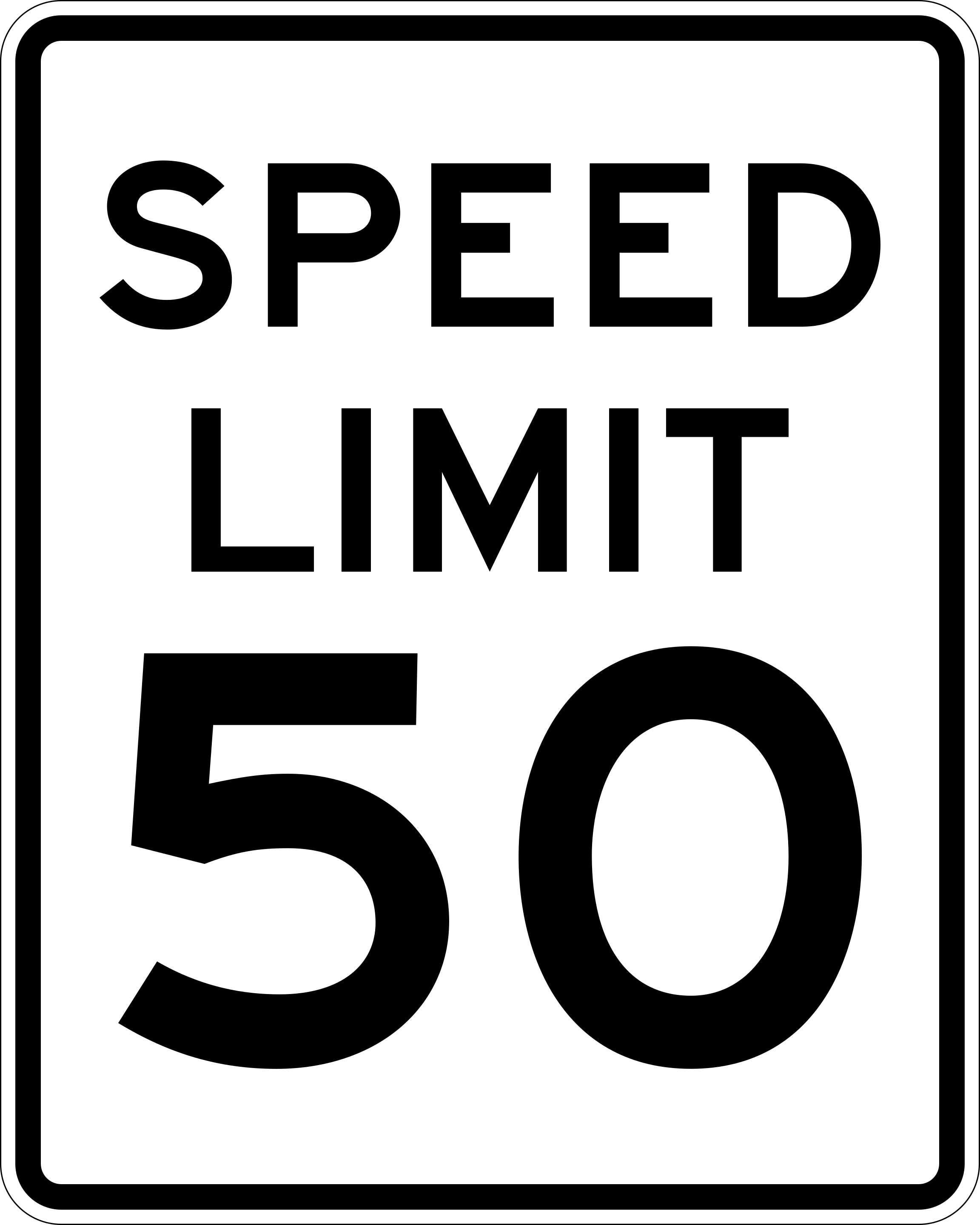
- The number stays safe in all weather because it is posted by law
- You may exceed it briefly to pass in the rain safely
- It becomes the minimum speed once the road gets wet
- It is the maximum for ideal conditions, so rain requires slowing below it
Show answer
It is the maximum for ideal conditions, so rain requires slowing below it. A black and white speed limit states the maximum legal speed under ideal conditions. Rain, snow, ice, fog, or poor visibility all demand less, because basic speed law requires a pace reasonable for conditions. Minimum speed signs exist separately on some high speed roads, and this maximum never converts into one. Passing grants no wet weather excess either. The posted number is a ceiling for perfect days, and every imperfect day lowers the real ceiling beneath it.
Study this in the handbook: Kansas speed limits
17. When may a Kansas driver back a vehicle in a travel lane?
- Whenever traffic behind you politely yields enough space to reverse
- Only to parallel park; other backing in lanes is illegal
- To return to a missed driveway quickly
- On any street posted below 25 mph
Show answer
Only to parallel park; other backing in lanes is illegal. Drivers never expect a vehicle reversing toward them in a travel lane, and many realize it too late. Backing there is illegal and unsafe, with parallel parking as the lone exception. Missed driveways and turns are solved by going around the block or turning around where it is safe, never by reversing down the lane. Even an apparently empty street can fill from a side road mid maneuver. Forward planning keeps you out of this trap entirely.
Study this in the handbook: Lane markings and special lanes
18. A tractor-trailer is passing you on a Kansas two-lane road. How should you adjust your lane position?
- Move toward the truck to draft behind it
- Hold the center line so the truck keeps its distance
- Speed up alongside the trailer to finish the pass sooner
- Move to the outside portion of your lane, away from the truck
Show answer
Move to the outside portion of your lane, away from the truck. Large trucks push air and need generous side clearance. As one passes, shift toward the outside portion of your lane, away from the trailer, and hold a steady speed. That extra cushion protects both vehicles if the trailer wanders or wind gusts push it. Crowding toward the truck or racing it prolongs the dangerous side by side interval. Once the truck clears, settle back to the center of your lane.
Study this in the handbook: Following distance, scanning and space
19. What does a Kansas lane reserved and marked Bicycle allow?
- Bicycles and cars share it equally at all speeds
- The lane is reserved for bicyclists
- Cars may park there when visiting nearby homes
- Only children on bicycles may use the lane
Show answer
The lane is reserved for bicyclists. A lane signed or surface marked for bicycles is reserved for riders. Cars must not stop, park, or drive in a designated bicycle lane except for narrow exceptions such as entering or leaving an alley or driveway, official duties, police direction, or a genuine emergency. Riders themselves may leave the lane to go straight through intersections or turn left. Respecting the reservation gives smaller, slower traffic a predictable space that drivers can anticipate instead of discovering.
Study this in the handbook: Lane markings and special lanes
20. Another vehicle is passing you on a two-lane Kansas road. What must you do?
- Move onto the shoulder to give it room
- Speed up so the pass ends sooner
- Stay in your lane and do not increase your speed
- Slow down sharply and stop
Show answer
Stay in your lane and do not increase your speed. When your car is being overtaken, Kansas says to stay in your lane and not increase your speed. Holding a steady lane position and speed lets the other driver finish quickly. Pulling onto the shoulder is not the answer either: Kansas says never to drive on the shoulder unless law enforcement officials tell you to or local regulations allow it. A sudden stop is not called for. Let the passing driver complete the move and return to the right lane.
Study this in the handbook: Turn signals, U turns and passing
Every question is written from the official Kansas Driving Handbook. Need paper? Printable KS practice test with answer key.
Last verified 2026-10-05. How we check every question · Study all 500 as flashcards
Frequently asked questions
How many questions are on this Kansas practice test?
This fixed set has 20 questions. It is test 16 of 25 from the 500 question Kansas bank. The real KS exam asks 25 questions and you need 20 correct.
What is the passing score for the real Kansas test?
You must score an 80% to pass the knowledge test That figure comes from the official Kansas source cited on the DMV facts page.
How does this fixed test relate to the full Kansas bank?
Each numbered test is a fixed set of questions in a fixed order, so you can retake the same test later and compare. Every test mixes road signs and the other topics in about the same proportion as the full bank. Tests 1 to 25 together cover every question in the Kansas bank once. The full practice page mixes the whole bank at random.
Last verified 2026-10-05. See the Kansas DMV facts page for sourced state details.