
Test 7 of 11 · 20 questions · Free 2026
OR Permit Practice Test 7
Jump to the test ↓A fixed 20 question set from the Oregon bank with answers and plain English explanations. The real OR exam is 35 questions, 80 percent to pass; take the full length version on the main practice page.
Question 1 of 20 · 0 right so far

All 20 questions in test 7
Every question below comes from the Oregon question bank on this page. Open a question to see the correct answer and the explanation. Nothing here is hidden behind a signup.
1. What condition does the Slippery When Wet warning sign identify?
- A required tire-chain inspection area
- A road closed during heavy rain
- Pavement that is unusually slick when wet
- A bridge that floods whenever it rains
Show answer
Pavement that is unusually slick when wet. This warning identifies pavement that becomes unusually slick when wet, so a driver should reduce speed and leave extra room for braking. The choice about a road closure confuses a hazard warning with a prohibition, and the tire-chain choice adds a requirement the sign does not announce. Think of the sign as a traction cue: rain can make the surface slippery even when the roadway looks clear. Smooth steering, gentle braking, and a larger following gap help prevent a sudden loss of control.
Study this in the handbook: Warning, Guide and Service Signs
2. A new Oregon resident is surrendering a license from another state. When may DMV waive the drive test for this driver?
- When that license is valid or expired less than one year
- Only when the license came from a neighboring state
- When the license expired less than five years ago
- Never, because every new resident must take a drive test
Show answer
When that license is valid or expired less than one year. DMV may skip the drive test for a new resident who surrenders an out of state license that is still valid or that expired less than one year ago. The rule does not depend on which state issued the license, so a neighboring state is not required. Five years is far outside the stated window, and a driver whose license lapsed that long ago should expect to test. Saying every new resident must drive for DMV ignores this waiver. A separate waiver covers proof of an ODOT approved driver education course completed within two years.
Study this in the handbook: The Knowledge and Drive Tests
3. What fines does Oregon list for parking in a disabled person space without a Disabled Person Parking Permit?
- From $50 up to $250
- From $250 up to $2,500
- A flat $100 fine
- From $165 up to $1,000
Show answer
From $165 up to $1,000. Oregon warns that parking in a space reserved for persons with disabilities without a valid permit is expensive: fines start at $165 and can reach $1,000. The manual stresses that this applies even when a driver parks there for just a few minutes. A $50 to $250 range and a flat $100 fine both understate the penalty, and $2,500 is not the listed maximum. Such spaces may have the disabled symbol on the ground as well as a sign with the symbol at the front of each space, so look for it before pulling in.
4. What are Oregon's minimum Uninsured Motorist Coverage amounts?
- $15,000 per person and $30,000 per collision
- $20,000 per collision for property only
- $25,000 per person and $50,000 per collision for bodily injury
- $50,000 per person and $100,000 per collision
Show answer
$25,000 per person and $50,000 per collision for bodily injury. Oregon requires Uninsured Motorist Coverage of at least $25,000 per person and $50,000 per collision for bodily injury. These match the liability minimums for bodily injury. The $15,000 figure belongs to Personal Injury Protection, and $20,000 per collision is the property damage limit, not uninsured motorist protection. Doubling the numbers to $50,000 and $100,000 overstates the legal minimum, though a driver may choose higher limits. Keep the three coverage types separate when reading a policy so the per person and per collision numbers stay attached to the right one.
Study this in the handbook: Insurance, Collisions and Reports
5. What do Oregon variable speed limit signs change based on?
- Whether the road is inside a city boundary
- The speed selected by most drivers on the road
- The number of lanes that remain open ahead
- Driving conditions such as heavy traffic or poor weather
Show answer
Driving conditions such as heavy traffic or poor weather. Variable speed limit signs respond to driving conditions, including heavy traffic, poor weather, or a slippery road. They are not calculated from the speed most drivers prefer, the number of open lanes, or the location inside a city. Treat the displayed limit as current information that may change as conditions change. Then apply the basic rule as well, because poor visibility or traction may require going slower than the number shown. The useful habit is to read electronic signs each time you approach them instead of relying on the limit seen earlier.
Study this in the handbook: The Basic Rule and Variable Speed Signs
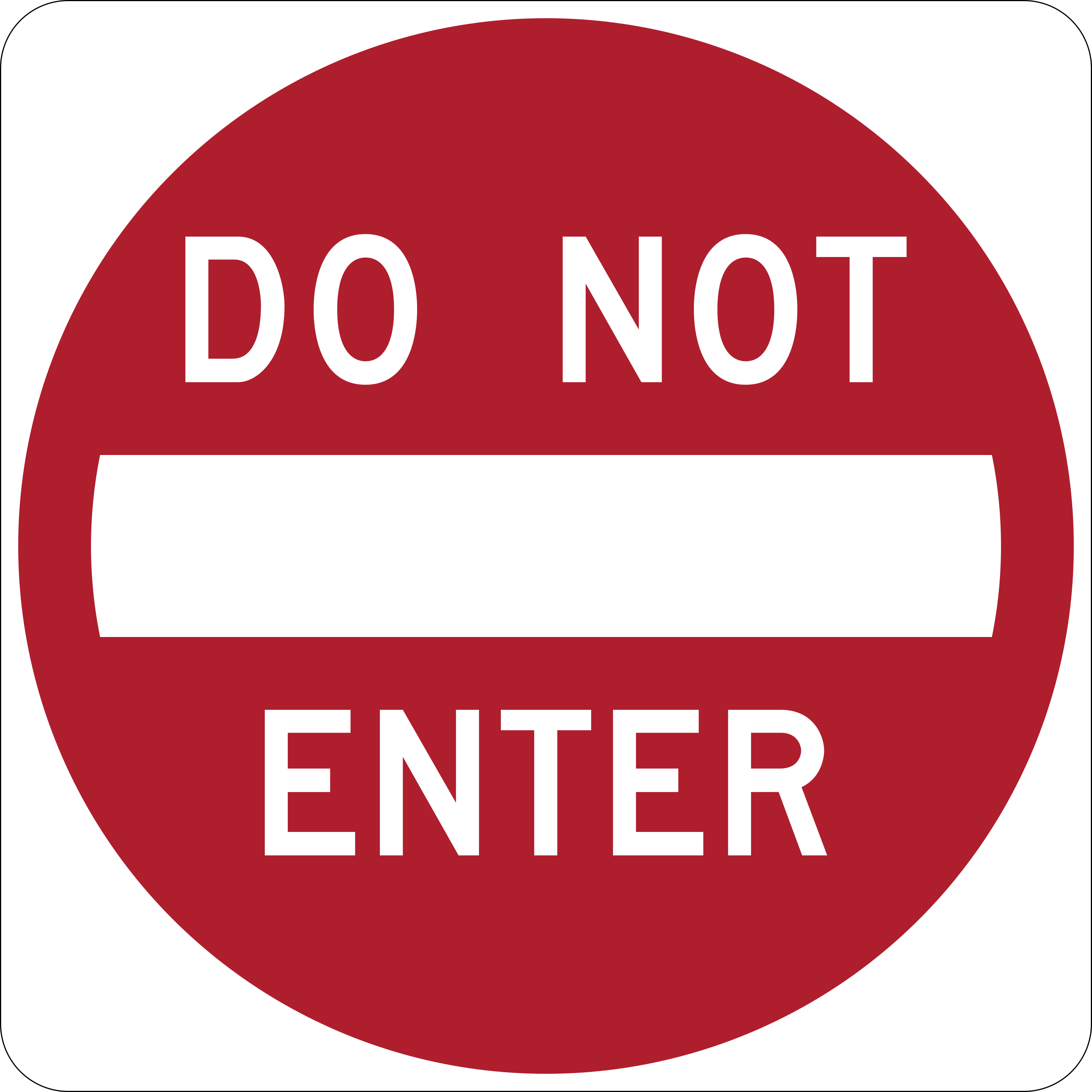
6. What does a Do Not Enter sign warn a driver not to do?
- Pass a slow vehicle on a two-way road
- Turn right at the next intersection
- Enter a road or freeway when traveling the wrong way
- Stop at a marked crosswalk
Show answer
Enter a road or freeway when traveling the wrong way. The Oregon Do Not Enter sign warns a driver not to enter a road or freeway, especially when the vehicle would be traveling the wrong way. It is not a passing restriction, a turn instruction, or a crosswalk command. If the sign faces you, do not proceed into that roadway even if the pavement appears open. Stop and reassess the route, look for the lawful entrance, and watch for one-way arrows or other regulatory signs that clarify the intended direction.
Study this in the handbook: Regulatory Signs
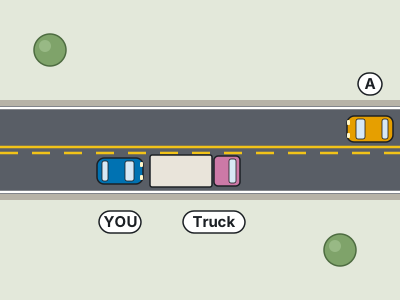
7. On a double center line, what does a broken yellow line on your side indicate?
- You are forbidden to pass in every circumstance
- You are allowed to pass when the maneuver is safe and legal
- Only oncoming traffic may pass
- The lane is reserved for left turns
Show answer
You are allowed to pass when the maneuver is safe and legal. With a double center line made of one solid and one broken yellow line, the broken line on your side indicates that passing is allowed. That permission still requires a clear path, a legal passing location, and compliance with the speed limit. The solid-line and left-turn choices confuse the marking with other restrictions. Look ahead for hills, curves, intersections, railroads, and crosswalks where passing is unsafe or prohibited, then return to your lane promptly after passing.
Study this in the handbook: Passing and Freeway Driving
8. How far behind an emergency vehicle must an Oregon driver remain after it passes?
- No distance is specified
- At least 100 feet
- At least 250 feet
- At least 500 feet
Show answer
At least 500 feet. After an emergency vehicle passes, Oregon requires the driver to stay at least 500 feet behind it. Following more closely can interfere with the emergency response and reduces the space available for the vehicle to maneuver. The 100 and 250 foot choices understate the stated minimum, while no distance ignores the explicit rule. First pull safely to the right and stop when the warning is approaching, then resume only after it passes while preserving the full following distance.
Study this in the handbook: Emergency Vehicles, Stopped Vehicles and Work Zones
9. At a signalized intersection, how far must a pedestrian be from the lane you are turning into before you begin the turn?
- Three feet or more
- Six feet or more
- Ten feet or more
- The pedestrian must leave the intersection
Show answer
Six feet or more. At a signalized intersection, the pedestrian must be six feet or more from the lane you are turning into before the turn begins. Three feet and ten feet are different measurements, so neither supplies the manual's threshold. The pedestrian does not have to leave the whole intersection when the six-foot condition is met. Check the lane your vehicle will enter, not merely the lane you are leaving. This rule works with the broader duty to watch for pedestrians and yield during a turn, even when the traffic signal permits the vehicle movement.
Study this in the handbook: Pedestrians and Bicycles
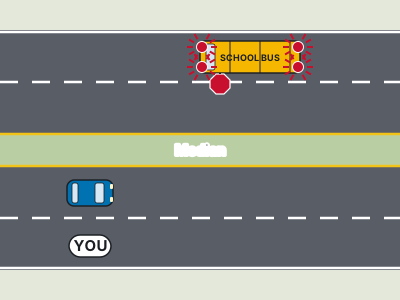
10. A school bus displays flashing red lights on the other side of a divided highway separated by a barrier. What must you do?
- Stop only when the divider is a painted turn lane
- Stop in every lane on both sides of the divided highway
- Continue only if the bus driver waves you through
- Stop only if you are traveling on the same side as the bus
Show answer
Stop only if you are traveling on the same side as the bus. On a divided highway with separate roads divided by an unpaved median or barrier, the stop duty applies only to traffic on the bus's side. The all-lanes choice would be correct for a painted median or turn lane, which does not create two separate roads. A driver should watch the roadway design as well as the bus lights, stop before reaching the bus when required, and remain stopped until the flashing red lights are turned off.
Study this in the handbook: School Buses and Railroad Crossings
11. At a four-way stop, who should normally proceed first when drivers arrive at different times?
- The driver who stopped first
- The driver in the largest vehicle
- The driver turning left regardless of arrival time
- The driver who accelerates first
Show answer
The driver who stopped first. At an intersection with stop signs in all four directions, Oregon describes it as common courtesy to let the driver who stops first go first. Vehicle size and acceleration do not establish priority, and a left turn does not automatically outrank an earlier arrival. If drivers stop at nearly the same time or the order is unclear, the manual says to yield to the driver on your right. Make eye contact only as a supplement, never as a substitute for a complete stop and careful scanning.
Study this in the handbook: Right of Way at Intersections
12. What should you do if a person riding horseback raises a hand near the road?
- Stop unless stopping would cause a collision
- Honk twice to warn the rider
- Accelerate past before the animal moves
- Rev the engine so the animal sees you
Show answer
Stop unless stopping would cause a collision. A raised hand from a person riding horseback or leading an animal means the animal is frightened. Stop unless stopping would cause a collision, and do not use the horn or make other loud, sudden noises nearby. Honking or revving can intensify the animal's reaction and create danger for the rider and passing traffic. Ease off early, leave plenty of room, and wait calmly until the person and animal are no longer threatened by your vehicle.
Study this in the handbook: Avoiding Collisions and Equipment Failures
13. What is the statutory maximum speed in an Oregon business district when no different limit is posted?
- 15 mph
- 20 mph
- 25 mph
- 30 mph
Show answer
20 mph. The manual assigns business districts a 20 mph maximum unless a different limit is posted. Twenty five miles per hour belongs to residential districts, public parks, and permitted vehicle travel on ocean shores. Fifteen mph applies in alleys and narrow residential areas, not a general business district. Thirty mph is not the statutory business figure identified in this section. The basic rule remains active at every speed, so heavy foot traffic, deliveries, limited sight distance, or a slippery surface can require driving below the posted or statutory maximum.
Study this in the handbook: Oregon Speed Limits
14. After how many total online Oregon knowledge-test attempts must an applicant test at a DMV office?
- Two attempts
- Three attempts
- Four attempts
- Six attempts
Show answer
Four attempts. The online knowledge test may be taken four times total. After the fourth attempt, the applicant must test at a DMV office. Two tests in a 24 hour period describes the online frequency after a failure, not the lifetime online total. Three and six attempts do not match the stated limit. This distinction matters when planning a retest: counting the permitted daily tries does not create a new four-attempt allowance. If an applicant reaches the online maximum, the next testing location changes even though the knowledge subject is the same.
Study this in the handbook: The Knowledge and Drive Tests
15. At what BAC does Oregon law presume a driver is impaired?
- 0.05 percent or more
- 0.10 percent or more
- 0.08 percent or more
- Only a result above 0.12 percent
Show answer
0.08 percent or more. Oregon law presumes impairment at a blood alcohol concentration of 0.08 percent or more. The 0.05 and 0.10 choices change the threshold, while a result above 0.12 would miss the lower point at which the presumption begins. A BAC below 0.08 does not guarantee that a driver cannot be arrested, because alcohol may still affect mental or physical ability and the manual says impairment can exist below that number. Remember the figure as a legal presumption, not as a safe amount to drink before driving.
Study this in the handbook: Alcohol, Drugs and DUII
16. When must a driver dim high beams for an oncoming vehicle?
- When the oncoming vehicle is within 500 feet
- When the oncoming vehicle is within 100 feet
- Only after the other driver dims first
- Only when the road has a high-speed designation
Show answer
When the oncoming vehicle is within 500 feet. Dim high beams when an oncoming vehicle is within 500 feet. This distance prevents glare from interfering with the other driver's view before the vehicles become close. Waiting until 100 feet is too late, and the other driver's action is not the trigger. The road's classification does not change the requirement. Begin the change as the oncoming vehicle reaches the 500-foot cue, and remember that following another vehicle within 350 feet also requires dimmed lights. Avoid auxiliary glare when the high beams must be lowered.
Study this in the handbook: Headlights and Hazardous Conditions
17. For an Oregon driver age 18 or older, what must a hands free accessory require to activate or deactivate a mobile device?
- Two hands and a voice command together
- Only minimal use of a finger
- At least five seconds of continuous touch
- No activation method because mobile devices are prohibited
Show answer
Only minimal use of a finger. Drivers 18 and older may use a mobile device through a hands free accessory, but the accessory must require only minimal use of a finger to activate or deactivate the device. The rule does not demand two hands or a prolonged touch, and it does not ban every possible hands free use for adults. The under 18 prohibition is a different age based rule. Set up the device before moving and let a passenger handle it when possible, so the driver is not distracted by activation.
Study this in the handbook: Seat Belts, Child Seats and Distracted Driving
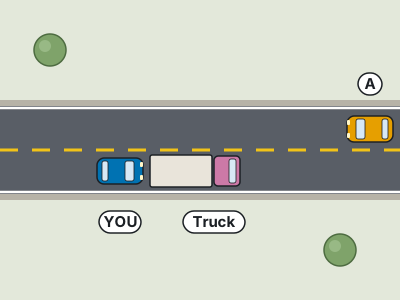
18. What does a broken yellow center line indicate on a two-way road?
- The center lane is reserved for left turns
- Passing is prohibited in both directions
- Traffic travels in the same direction on both sides
- Passing is allowed for both directions of travel
Show answer
Passing is allowed for both directions of travel. A broken yellow center line separates traffic moving in opposite directions and permits passing for both directions of travel. Permission still depends on a clear view, adequate space, and a safe maneuver. The no-passing choice describes double solid yellow lines, while same-direction lanes are separated by white markings. Before crossing the center line, check ahead, mirrors, and blind spots, then complete the pass without exceeding the speed limit. Treat the broken line as a conditional opportunity, not a command to pass whenever the marking is visible.
Study this in the handbook: Pavement Markings
19. In what direction does traffic move in an Oregon roundabout?
- Counterclockwise around the center island
- Clockwise around the center island
- Straight across the center island
- In either direction chosen by the entering driver
Show answer
Counterclockwise around the center island. Oregon roundabouts carry traffic counterclockwise around a center island. The clockwise choice reverses the established flow and would place a vehicle into opposing movement. Driving straight across the island is not a roundabout path, and entering drivers do not choose the direction. Approach slowly, follow the lane-use signs, and keep the center island to your left as you circulate. The direction cue is especially useful when visibility is limited or when a driver is unfamiliar with the intersection's layout.
Study this in the handbook: Turns, U-Turns and Roundabouts
20. A flashing yellow arrow points left at an intersection. What is the driver's obligation?
- Make the left turn without slowing because the arrow is permissive
- Make the indicated turn only after yielding to pedestrians and oncoming traffic
- Wait for a solid green arrow before making any left turn
- Stop and remain stopped until the flashing arrow becomes red
Show answer
Make the indicated turn only after yielding to pedestrians and oncoming traffic. This signal allows the movement shown by the arrow, but the permission is conditional. Before turning, check the crosswalk and the opposing approach, then yield to pedestrians and oncoming vehicles. Those opposing drivers have a steady green signal, so they may be moving through the intersection. The choice “Make the left turn without slowing because the arrow is permissive” treats the flashing display like an exclusive protected arrow and skips the required yield. A useful cue is flashing yellow means a permitted movement with a safety check first, not a free pass through the junction.
Study this in the handbook: Traffic Signals
QualitySpace is expanding to Oregon
We are a California-based independent insurance brokerage working on licensing in more states. We cannot help with Oregon insurance yet. Leave your email and we will let you know when we can.
Every question is written from the official Oregon Driver Manual. Need paper? Printable OR practice test with answer key.
Last verified 2026-10-05. How we check every question · Study all 220 as flashcards
Frequently asked questions
How many questions are on this Oregon practice test?
This fixed set has 20 questions. It is test 7 of 11 from the 220 question Oregon bank. The real OR exam asks 35 questions and you need 28 correct.
What is the passing score for the real Oregon test?
28 of 35 correct to receive a passing score That figure comes from the official Oregon source cited on the DMV facts page.
How does this fixed test relate to the full Oregon bank?
Each numbered test is a fixed set of questions in a fixed order, so you can retake the same test later and compare. Every test mixes road signs and the other topics in about the same proportion as the full bank. Tests 1 to 11 together cover every question in the Oregon bank once. The full practice page mixes the whole bank at random.
Last verified 2026-10-05. See the Oregon DMV facts page for sourced state details.