
Key points
Yield to emergency vehicles approaching from any direction with a light or siren.
Source: Handbook p. 58
“You must yield right of way to emergency vehicles, such as fire trucks, police vehicles, and ambulances, when they approach from any direction using a light or siren.”
Oregon Driver Manual, Handbook p. 58Pull as far right as safely possible and stop, but not in an intersection.
Source: Handbook p. 58
“you must immediately drive as close as you safely can to the right side of the road and stop. Do not stop in an intersection.”
Oregon Driver Manual, Handbook p. 58After an emergency vehicle passes, stay at least 500 feet behind it.
Source: Handbook p. 58
“After the emergency vehicle passes, you must stay at least 500 feet behind the vehicle.”
Oregon Driver Manual, Handbook p. 58On a road with two or more lanes your way, change lanes away from a stopped vehicle with flashing lights; you may also slow at least 5 mph below the limit.
Source: Handbook p. 57
“If you are on a road with two or more lanes of traffic going the same direction and you approach any motor vehicle that is stopped with lights flashing, you must change lanes so you do not drive next to the stopped vehicle. You may also slow down by at least 5 miles per hour under the posted speed limit.”
Oregon Driver Manual, Handbook p. 57Do not drive over fire hoses unless officials at the scene tell you to.
Source: Handbook p. 57
“Do not drive over fire hoses unless told to do so by officials at the scene.”
Oregon Driver Manual, Handbook p. 57Traffic fines are doubled in all work zones.
Source: Handbook p. 59
“Traffic fines are doubled in all work zones.”
Oregon Driver Manual, Handbook p. 59Posted work zone speeds apply at all times, even if no workers are visible.
Source: Handbook p. 59
“The temporary speed posted in a work zone applies at all times, even if workers are not visible.”
Oregon Driver Manual, Handbook p. 59At an automated flagger, stop when the light is red and the arm is down; go when yellow flashes and the arm is up.
Source: Handbook p. 59
“Stop when the red light is on and the arm is down. Proceed when the yellow light is flashing and the arm is up.”
Oregon Driver Manual, Handbook p. 59
Numbers to know
| Number | What it means | Manual |
|---|---|---|
| 500 feet | minimum distance behind a passing emergency vehicle | Handbook p. 58 |
| 5 mph | minimum slowdown below the limit near a stopped vehicle with flashing lights | Handbook p. 57 |
Recognize these signs
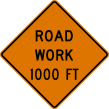
Road work ahead 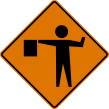
Flagger ahead
3 questions from the Oregon practice test
1. How far behind an emergency vehicle must an Oregon driver remain after it passes?
- No distance is specified
- At least 100 feet
- At least 250 feet
- At least 500 feet
Show answer
At least 500 feet. After an emergency vehicle passes, Oregon requires the driver to stay at least 500 feet behind it. Following more closely can interfere with the emergency response and reduces the space available for the vehicle to maneuver. The 100 and 250 foot choices understate the stated minimum, while no distance ignores the explicit rule. First pull safely to the right and stop when the warning is approaching, then resume only after it passes while preserving the full following distance.
2. What must you do when an emergency vehicle approaches using a light or siren?
- Speed up to stay ahead of the emergency vehicle
- Move as close as safely possible to the right side and stop
- Stop in the intersection so the vehicle can go around
- Continue driving until the next traffic signal
Show answer
Move as close as safely possible to the right side and stop. When an emergency vehicle approaches with a light or siren, Oregon requires the driver to move immediately as close as safely possible to the right side of the road and stop. Stopping in an intersection can block the route, while speeding up or continuing to the next signal delays the emergency response. Remain stopped until the vehicle passes or an officer tells you to move. The practical cue is light or siren: check mirrors, signal if needed, clear the intersection when possible, and make room without creating a second hazard.
3. What is an allowed response when approaching a stopped vehicle with flashing lights on a road with two or more lanes going the same direction?
- Change lanes only when the stopped vehicle is a police car
- Keep the posted speed if a clear path is visible
- Stop in the adjacent lane until someone waves you through
- Slow at least 5 mph below the posted speed limit
Show answer
Slow at least 5 mph below the posted speed limit. On a road with two or more lanes moving in the same direction, Oregon says a driver approaching a vehicle stopped with flashing lights must change lanes so as not to drive next to it, and may also slow down by at least 5 miles per hour under the posted speed limit. The rule covers any motor vehicle stopped with lights flashing, not only police cars. Keeping the posted speed or stopping in the adjacent lane is not a listed response. Look ahead for flashing lights and allow the stopped vehicle as much room as safely possible.
Practice this topic
Lock it in with emergencies questions from the free Oregon practice test. Every answer comes with a plain English explanation.
Source: the Oregon Driver Manual, Sharing the Road: Emergency Vehicles and Work Zones. This lesson is a plain English summary, not the law itself; where it differs, the manual and the statute govern. Last checked 2026-09-27.