
Key points
When a school bus flashes red lights, stop before reaching it and stay stopped until the lights are turned off.
Source: Handbook p. 55
“When the red lights flash, stop before reaching the bus and remain stopped until the driver turns off the flashing red lights.”
Oregon Driver Manual, Handbook p. 55On a divided highway separated by an unpaved median or barrier, stop only if you are on the bus's side.
Source: Handbook p. 55
“If you are on a divided highway with two roads separated by an unpaved median strip or barrier, you must stop only if you are on the same side of the road as the bus.”
Oregon Driver Manual, Handbook p. 55A painted median or turn lane does not make separate roads, so all lanes must stop.
Source: Handbook p. 55
“A painted median strip or turn lane does not create two separate roads. In this case, all lanes of traffic must stop.”
Oregon Driver Manual, Handbook p. 55When required to stop at a crossing, stop at the stop line, or at least 15 feet from the nearest rail.
Source: Handbook p. 64
“When required to stop, do so at the stop line. If there is no stop line, stop at least 15 feet from the nearest rail.”
Oregon Driver Manual, Handbook p. 64Stop before the tracks when a train is clearly visible or so close that crossing would be hazardous.
Source: Handbook p. 64
“An approaching train is clearly visible or is so close to the crossing that it would be hazardous for you to try to cross.”
Oregon Driver Manual, Handbook p. 64School buses, hazmat vehicles and some school activity vehicles must stop at railroad tracks.
Source: Handbook p. 63
“All school buses, hazmat vehicles and some school activity vehicles must stop at railroad tracks.”
Oregon Driver Manual, Handbook p. 63Driving around or under a crossing gate is against the law.
Source: Handbook p. 64
“It is against the law to drive around or under a crossing gate”
Oregon Driver Manual, Handbook p. 64If a train approaches while you are stuck, move away at a 45 degree angle from the tracks toward the train so debris does not hit you.
Source: Handbook p. 64
“If a train approaches, move at a 45 degree angle from the tracks in the direction of the train so you are not hit with debris.”
Oregon Driver Manual, Handbook p. 64
Numbers to know
| Number | What it means | Manual |
|---|---|---|
| 15 feet | minimum stop distance from the nearest rail | Handbook p. 64 |
| 45 degree | angle to move away from the tracks toward the train | Handbook p. 64 |
Recognize these signs
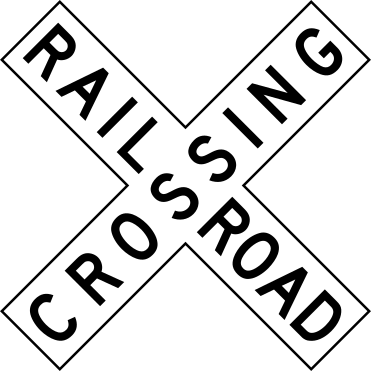
Railroad crossbuck 
Railroad crossing ahead 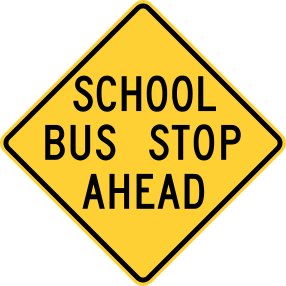
School bus stop ahead
3 questions from the Oregon practice test
1. A school bus displays flashing red lights on the other side of a divided highway separated by a barrier. What must you do?
- Stop only when the divider is a painted turn lane
- Stop in every lane on both sides of the divided highway
- Continue only if the bus driver waves you through
- Stop only if you are traveling on the same side as the bus
Show answer
Stop only if you are traveling on the same side as the bus. On a divided highway with separate roads divided by an unpaved median or barrier, the stop duty applies only to traffic on the bus's side. The all-lanes choice would be correct for a painted median or turn lane, which does not create two separate roads. A driver should watch the roadway design as well as the bus lights, stop before reaching the bus when required, and remain stopped until the flashing red lights are turned off.
2. If an approaching train is clearly visible at a railroad crossing, when must a driver stop?
- Before the railroad tracks
- Only after the train reaches the crossing signal
- After crossing the first track
- Only if a gate is fully lowered
Show answer
Before the railroad tracks. A clearly visible approaching train is one of Oregon's listed reasons to stop before the tracks, even if gates or lights are not active. The gate-only choice ignores crossings without gates, while waiting for the train to reach a signal would leave too little margin. Never try to beat a train, and never stop on the rails. If a stop is required and no stop line exists, the manual gives a separate minimum distance from the nearest rail, so plan the stop before entering the crossing area.
3. Which vehicles must stop at railroad tracks even when no train is immediately visible?
- Only buses carrying children during school hours
- All school buses, hazmat vehicles, and some school activity vehicles
- All passenger vehicles towing a trailer
- Only farm vehicles displaying a slow-moving emblem
Show answer
All school buses, hazmat vehicles, and some school activity vehicles. Oregon specifically requires all school buses, hazmat vehicles, and some school activity vehicles to stop at railroad tracks. The rule is based on the vehicle category, not only on whether children are aboard or whether the driver sees a train. Passenger vehicles towing trailers and farm vehicles are not the listed group. If you are following one of these vehicles, expect it to stop and leave room behind it. Slow down, look and listen, and remember that one train can hide another on a nearby track.
Practice this topic
Lock it in with emergencies questions from the free Oregon practice test. Every answer comes with a plain English explanation.
Source: the Oregon Driver Manual, Sharing the Road and Railroad Crossings. This lesson is a plain English summary, not the law itself; where it differs, the manual and the statute govern. Last checked 2026-09-27.