
Key points
Stop for pedestrians at any marked or unmarked crosswalk.
Source: Handbook p. 46
“You must stop for pedestrians crossing the road at any marked or unmarked crosswalk.”
Oregon Driver Manual, Handbook p. 46Stay stopped when the pedestrian is in your lane, the next lane (including a bike lane) or the lane you are turning into.
Source: Handbook p. 46
“Stop and remain stopped for a pedestrian crossing in a crosswalk when the pedestrian is: • In your lane of travel, • In a lane next to your lane of travel, including a bike lane, or • In the lane you are turning into.”
Oregon Driver Manual, Handbook p. 46Turning at a signal, the pedestrian must be 6 feet or more from the lane you are turning into before you turn.
Source: Handbook p. 47
“before you begin to turn, the pedestrian must be six feet or more from the lane you are turning into.”
Oregon Driver Manual, Handbook p. 47An unmarked crosswalk is at least 6 feet wide and exists even if there is no sidewalk or shoulder.
Source: Handbook p. 47
“An unmarked crosswalk is at least six feet wide and exists even if there is no sidewalk or shoulder.”
Oregon Driver Manual, Handbook p. 47Passing a vehicle stopped at a crosswalk is against the law.
Source: Handbook p. 47
“Do not pass a vehicle stopped at a crosswalk, it is against the law.”
Oregon Driver Manual, Handbook p. 47Stop for a pedestrian who is blind and carries a white cane or uses a guide dog, and stay stopped until they cross the entire road, even on green.
Source: Handbook p. 48
“any pedestrian who is blind or deaf and blind carrying a white cane or using a guide dog. Stop if the person is about to cross or is crossing the road. Remain stopped until the person has crossed the entire road, even if you have a green light.”
Oregon Driver Manual, Handbook p. 48Yield to bicyclists in a bike lane or on a sidewalk before turning across it.
Source: Handbook p. 50
“You must yield to people riding bicycles in a bike lane or on a sidewalk before you turn across the lane or sidewalk.”
Oregon Driver Manual, Handbook p. 50Motorized wheelchairs, scooters and mobility devices may use bike lanes; yield to them as you would to bicyclists.
Source: Handbook p. 51
“Operators of motorized wheelchairs, scooters, and personal assistive mobility devices are permitted to use bike lanes and paths. You must yield to these operators as you would a person riding a bicycle.”
Oregon Driver Manual, Handbook p. 51When stopping for a traffic signal, stop behind the bike box, never inside it.
Source: Handbook p. 51
“As a driver, you must stop for a traffic signal behind the bike box. Do not stop in the box.”
Oregon Driver Manual, Handbook p. 51
Numbers to know
| Number | What it means | Manual |
|---|---|---|
| 6 feet | distance a pedestrian must be from your turning lane at a signal | Handbook p. 47 |
| 6 feet | minimum width of an unmarked crosswalk | Handbook p. 47 |
Recognize these signs

Pedestrian crossing 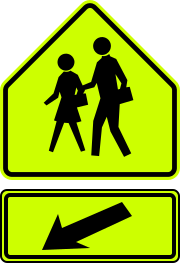
School crossing
3 questions from the Oregon practice test
1. At what types of crosswalks must an Oregon driver stop for pedestrians?
- Only at a painted crosswalk with a signal
- At any marked or unmarked crosswalk
- Only when the pedestrian reaches the road center
- Only when the person is directly in front of the bumper
Show answer
At any marked or unmarked crosswalk. Oregon requires drivers to stop for pedestrians crossing at both marked and unmarked crosswalks. Painted lines and a traffic signal are not prerequisites for the duty to stop. Waiting until a pedestrian reaches the center of the road or the front bumper leaves too little space and ignores the protection given at an unmarked crossing. Scan every approach before moving through a crosswalk, including one without paint. The practical cue is the crossing itself, not whether road crews have added visible stripes or a signal at that location.
2. At a signalized intersection, how far must a pedestrian be from the lane you are turning into before you begin the turn?
- Three feet or more
- Six feet or more
- Ten feet or more
- The pedestrian must leave the intersection
Show answer
Six feet or more. At a signalized intersection, the pedestrian must be six feet or more from the lane you are turning into before the turn begins. Three feet and ten feet are different measurements, so neither supplies the manual's threshold. The pedestrian does not have to leave the whole intersection when the six-foot condition is met. Check the lane your vehicle will enter, not merely the lane you are leaving. This rule works with the broader duty to watch for pedestrians and yield during a turn, even when the traffic signal permits the vehicle movement.
3. An operator of a motorized wheelchair is using an Oregon bike lane. What must a driver do?
- Sound the horn so they move to the sidewalk
- Nothing, wheelchairs may not use bike lanes
- Yield as you would to a person riding a bicycle
- Pass closely at normal speed
Show answer
Yield as you would to a person riding a bicycle. Operators of motorized wheelchairs, scooters and personal assistive mobility devices are permitted to use Oregon bike lanes and paths, and you must yield to these operators as you would to a person riding a bicycle. The rules for passing other vehicles apply to passing them; if you cannot pass safely, slow down and remain behind until it is safe. A horn does not move them out of the bike lane, and passing closely at normal speed ignores the duty to yield.
Practice this topic
Lock it in with right of way questions from the free Oregon practice test. Every answer comes with a plain English explanation.
Source: the Oregon Driver Manual, Sharing the Road: Pedestrians and Bicycles. This lesson is a plain English summary, not the law itself; where it differs, the manual and the statute govern. Last checked 2026-09-27.