
Test 3 of 11 · 20 questions · Free 2026
OR Permit Practice Test 3
Jump to the test ↓A fixed 20 question set from the Oregon bank with answers and plain English explanations. The real OR exam is 35 questions, 80 percent to pass; take the full length version on the main practice page.
Question 1 of 20 · 0 right so far
All 20 questions in test 3
Every question below comes from the Oregon question bank on this page. Open a question to see the correct answer and the explanation. Nothing here is hidden behind a signup.
1. Your car stalls on railroad tracks and you see a train approaching. After getting out, which way should you move?
- Along the tracks, running away from the train
- Straight across to the far side of the tracks and wait there
- Back into the car with your seat belt fastened
- Away from the tracks at a 45 degree angle, toward the approaching train
Show answer
Away from the tracks at a 45 degree angle, toward the approaching train. Oregon's steps are to get out of the vehicle, get away from the tracks even if no train is visible, and, if safe, use the Emergency Notification System sign posted at the crossing to alert the railroad. If a train approaches, move away at a 45 degree angle in the direction of the train so you are not hit with debris. Running along the tracks keeps you in the debris path, standing just across the tracks is too close, and staying in the car risks your life.
Study this in the handbook: School Buses and Railroad Crossings
2. A bus from a place of worship stops ahead of you and turns on flashing red lights. How should you respond?
- Ignore them, because only school buses require a stop
- Treat the lights the same as you would a school bus
- Slow to 20 mph and pass carefully
- Stop only if you can see children getting off
Show answer
Treat the lights the same as you would a school bus. Oregon permits places of worship and worker transport buses to use flashing amber and red lights. When such a bus turns them on, drivers must respond exactly as they would for a school bus, so flashing red means stopping as the school bus rules require. Ignoring the lights is wrong, and slowing to 20 mph to pass applies nowhere in this rule. Whether you can see passengers does not change the duty, because the rule is triggered by the lights themselves.
Study this in the handbook: Motorcycles, Large Vehicles and Other Road Users
3. How far may a load on an Oregon passenger vehicle extend beyond the right fenders?
- No more than 12 inches
- No more than 6 inches
- No more than 4 feet
- Not at all, the same as on the left side
Show answer
No more than 6 inches. Passenger vehicles may carry a load that sticks out no more than 6 inches beyond the right fenders. The left side is stricter: loads must not extend beyond the left fenders at all, so treating the right side the same way misstates the rule. Four feet is the limit for how far a load may extend in front of any vehicle, and 12 inches is the minimum size of the red flag for a rear overhang. Check both sides before driving off with a wide load.
Study this in the handbook: Motorcycles, Large Vehicles and Other Road Users
4. The red slash crosses a U-shaped arrow in the image. Which movement is barred?
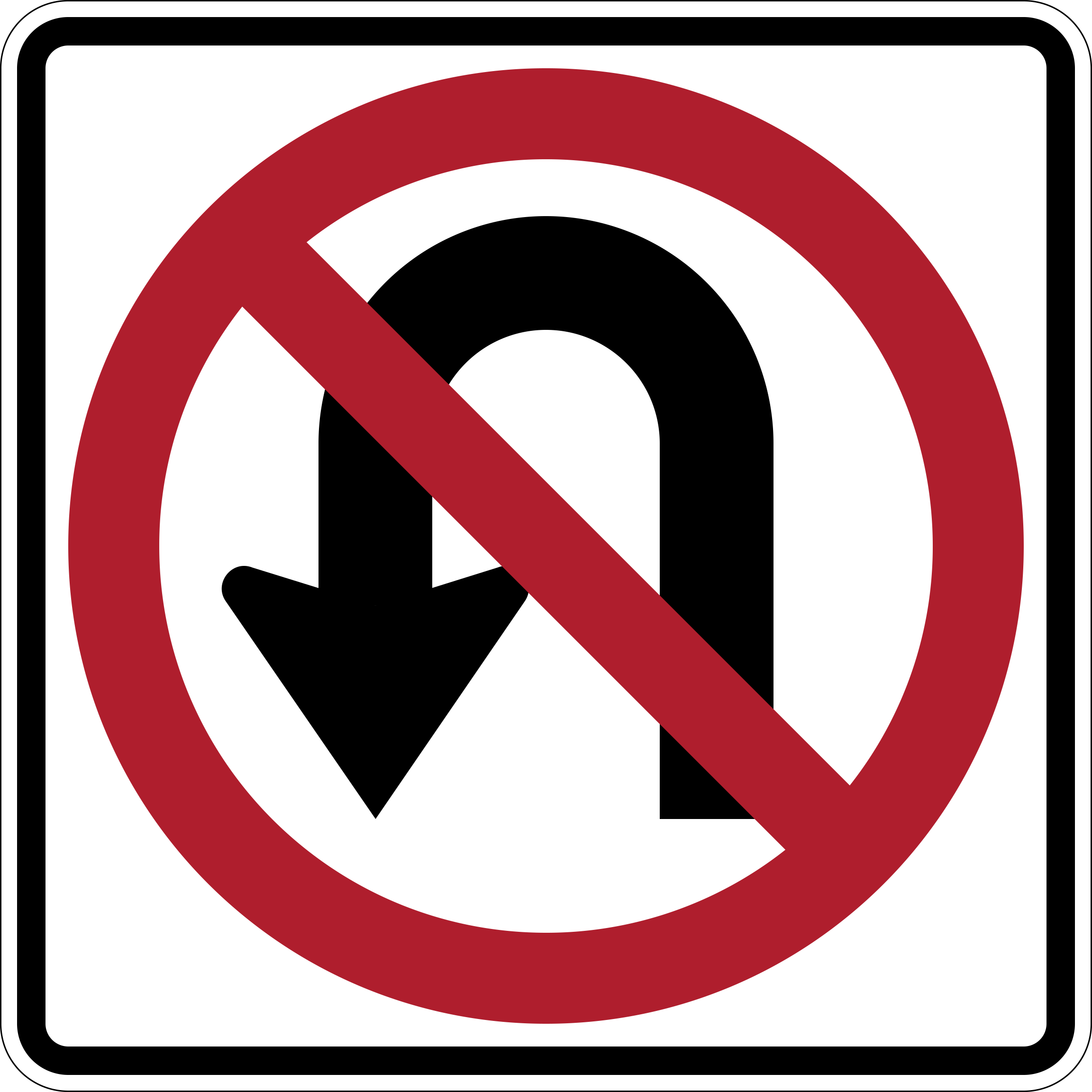
- Changing from the right lane to the left lane
- Turning right at the next intersection
- Passing a slow vehicle on a straight roadway
- Reversing direction in a U-turn
Show answer
Reversing direction in a U-turn. A red circle and slash over a movement symbol means the pictured action is prohibited. Here the curved U-shaped arrow represents reversing direction, so the driver may not make a U-turn at that location. The choice “Turning right at the next intersection” names a right turn, which would use a right-turn symbol rather than the U-shaped arrow. Keep traveling in the authorized direction and use a legal route to turn around when one is available. Check nearby signs for additional intersection restrictions before changing course.
Study this in the handbook: Regulatory Signs
5. What speed limit does Oregon law set on an ocean shore where vehicles are permitted, when no other speed is posted?
- 15 mph
- 20 mph
- 25 mph
- 35 mph
Show answer
25 mph. Oregon's statutory 25 mph limit covers residential districts, public parks, and ocean shores where vehicles are allowed. It applies whether or not a sign is posted, unless a different speed is posted. Fifteen mph is for alleys and narrow residential areas, and 20 mph is for business districts and school speed zones. There is no statutory 35 mph category on the list. Beach driving still falls under the basic rule, so soft sand, people walking, and poor visibility can require a speed well below 25.
Study this in the handbook: Oregon Speed Limits
6. What hazard does the round yellow RXR warning sign announce?

- A railroad crossing ahead where a stop may be necessary
- A circular intersection with traffic entering from the left
- A bicycle route that crosses the roadway
- A reduced speed zone ending immediately
Show answer
A railroad crossing ahead where a stop may be necessary. The round yellow RXR symbol is an advance warning for railroad tracks ahead. It gives the driver time to reduce speed, look for trains, and prepare to stop if the crossing controls or train require it. The choice “A circular intersection with traffic entering from the left” confuses the round shape with a roundabout, but the RXR letters identify rail service. Begin scanning before reaching the tracks, and avoid stopping on them or entering when the roadway beyond cannot hold the vehicle.
Study this in the handbook: Warning, Guide and Service Signs
7. What does the regulatory SPEED LIMIT sign in the image establish?
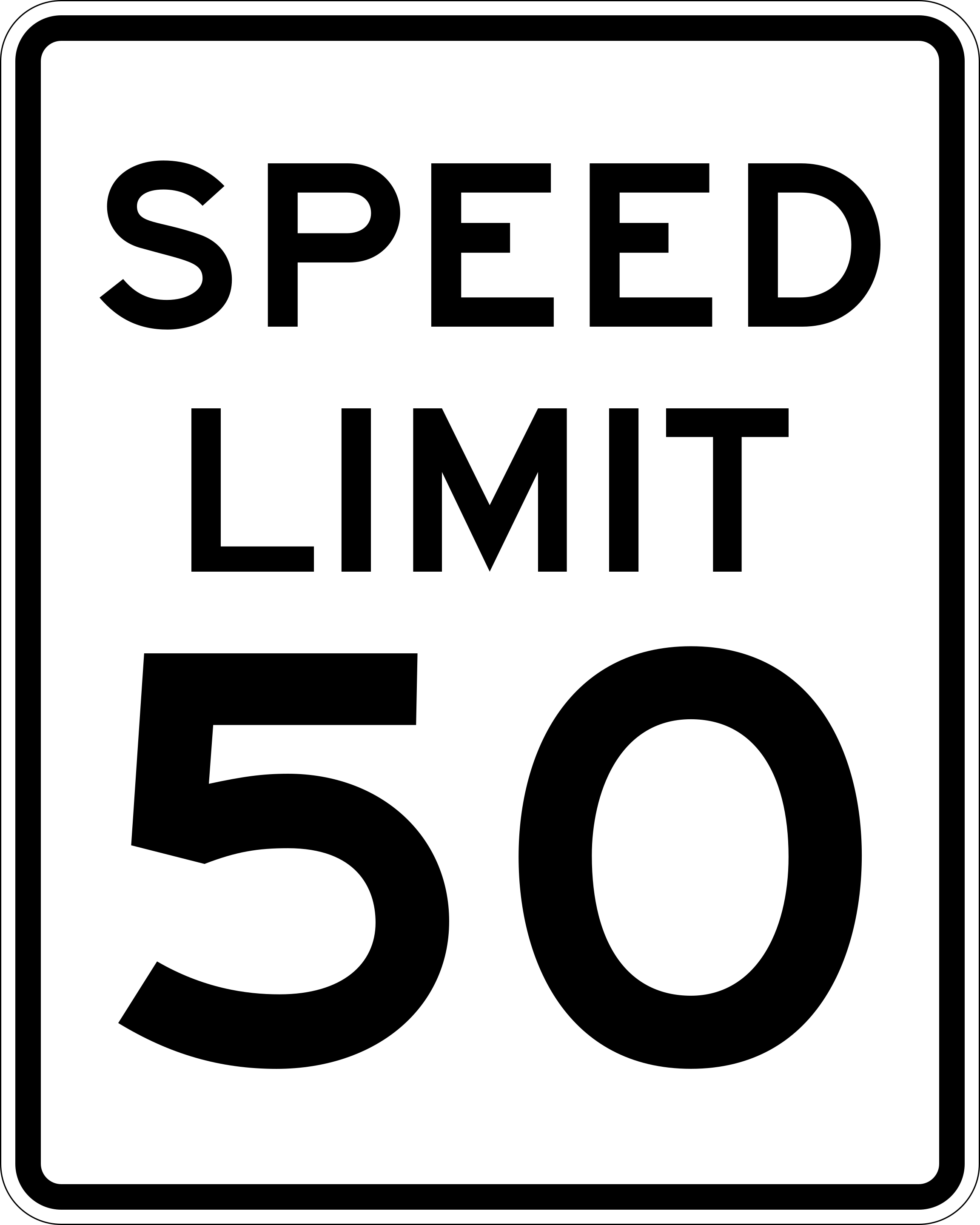
- The maximum speed in miles per hour for the signed condition
- A recommended speed that may be exceeded whenever traffic is light
- A minimum speed required in every lane of the roadway
- A truck-only speed that does not apply to passenger vehicles
Show answer
The maximum speed in miles per hour for the signed condition. A posted speed limit gives the maximum speed in miles per hour for that roadway condition. It is a regulatory requirement, not a casual recommendation that can be ignored when the road looks empty. The choice “A recommended speed that may be exceeded whenever traffic is light” would turn a legal maximum into an advisory value. Drivers still need to reduce speed below the posted number when weather, traffic, visibility, or another hazard makes that necessary. Read the number, then match speed to the actual conditions ahead rather than treating the sign as a target.
Study this in the handbook: Regulatory Signs
8. What does a solid yellow line on your side of a double center line indicate?
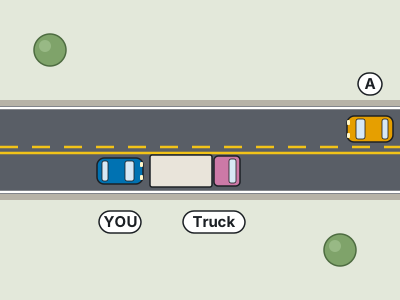
- The broken line permits passing in both directions
- Passing is allowed only for vehicles behind you
- Passing is not allowed on your side
- The center line may be crossed whenever the road is dry
Show answer
Passing is not allowed on your side. A solid yellow line on your side of a double center line marks a no-passing restriction for your direction. The broken-line rule applies to the side with the broken marking, not automatically to both directions. Dry pavement does not cancel a solid-line restriction, and the line does not grant a special privilege to vehicles behind you. Check the marking nearest your lane before considering an overtake. If it is solid yellow, remain behind the slower vehicle until the center marking changes or another legal passing opportunity appears.
Study this in the handbook: Passing and Freeway Driving
9. At an Oregon roundabout entrance, what should a driver do after yielding?
- Stop at the entrance until the roundabout is completely empty
- Yield only to vehicles approaching from the left
- Enter in the lane nearest the center island regardless of the exit
- Wait for a gap and merge into circulating traffic
Show answer
Wait for a gap and merge into circulating traffic. At a roundabout entrance, yield to traffic already inside and to traffic exiting, then wait for a gap and merge. The roundabout does not need to be completely empty, and yielding only to traffic from one direction overlooks vehicles already circulating. Lane choice should follow the exit signs and pavement markings rather than an automatic preference for the inside lane. Slow before the crosswalk, watch for pedestrians, and enter when the opening allows a smooth merge. Once inside, maintain your lane and continue around the circle until the selected exit.
Study this in the handbook: Turns, U-Turns and Roundabouts
10. How may an Oregon driver 18 or older use a cell phone while driving?
- Only with a hands-free accessory that needs minimal use of a finger to activate
- Held in the hand on rural roads
- Held in the hand while stopped at a light
- Freely, at any age
Show answer
Only with a hands-free accessory that needs minimal use of a finger to activate. Oregon bars drivers under 18 from using a cell phone or other mobile electronic device at all while driving. Drivers 18 or older must use a hands-free accessory, and that accessory must require only minimal use of a finger to activate or deactivate a function. Holding the phone in the hand does not meet the hands-free requirement, on rural roads or anywhere else. Turning the phone off or putting it in the back seat is the manual's advice.
Study this in the handbook: Seat Belts, Child Seats and Distracted Driving
11. What does a steady green arrow indicate?
- You have the right of way and may make the movement shown by the arrow
- You must stop before making the movement shown
- You may turn only after yielding to every vehicle behind you
- The movement shown is prohibited until the next signal cycle
Show answer
You have the right of way and may make the movement shown by the arrow. A steady green arrow gives the driver the right of way to make the movement indicated by the arrow. It is more specific than a circular green because the arrow identifies the permitted direction. The stop choice treats the signal like a red or yellow indication, while the prohibition choice says the opposite of what the arrow communicates. Even with an arrow, scan the intended path for people or hazards and follow lane markings. Use the arrow as permission for that movement, not as a reason to ignore safe vehicle control or road users.
Study this in the handbook: Traffic Signals
12. At two-way stop signs across from each other, who should yield when turning left?
- The driver who arrived first must always turn left
- The driver going straight yields in every case
- The driver turning left yields to oncoming traffic going straight
- Neither driver needs to check the other direction
Show answer
The driver turning left yields to oncoming traffic going straight. When opposing approaches are controlled by stop signs, the left-turning driver must yield to approaching or oncoming traffic traveling straight. The straight-through driver does not automatically give up priority, and arriving first does not remove the need to stop and check. Both vehicles should confirm that the intersection is clear before moving. The useful cue is the crossing path created by the left turn: wait for the oncoming vehicle to pass, then complete the turn smoothly while staying in the proper lane.
Study this in the handbook: Right of Way at Intersections
13. If your accelerator sticks, what should you do?
- Keep pressing the accelerator until it releases
- Shift to neutral, steer smoothly while braking, and pull off when safe
- Shift directly into reverse while moving forward
- Let go of the steering wheel so the vehicle can slow itself
Show answer
Shift to neutral, steer smoothly while braking, and pull off when safe. A stuck accelerator requires the driver to regain control of the vehicle's power and direction. Oregon's sequence is to search for an escape path, shift to neutral with an open palm, steer smoothly while braking, and leave the road when safe. Continuing to press the pedal increases speed. Reverse is not a normal emergency stopping gear and can create a second loss of control. Releasing the wheel abandons steering precisely when an escape path is needed. The cue is neutral first, then controlled braking and a safe pull-off.
Study this in the handbook: Avoiding Collisions and Equipment Failures
14. You are next to a double center line, and the broken yellow line is on your side. What is permitted?
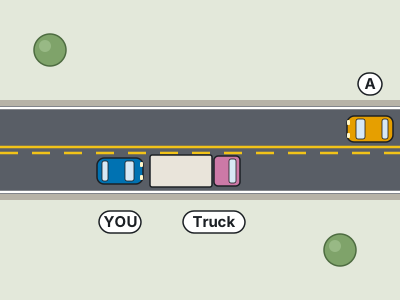
- No passing under any circumstances on that side
- Passing only after crossing into the opposing lane without checking
- Passing when the roadway is clear and the maneuver is safe
- Driving on the yellow line until the next intersection
Show answer
Passing when the roadway is clear and the maneuver is safe. A broken yellow line on the driver's side of a double center line indicates that passing is allowed, but only after the driver checks that the maneuver is safe and legal. The solid line on the opposite side restricts that direction, not yours. The choice “Passing only after crossing into the opposing lane without checking” skips the required safety check, while the choice “No passing under any circumstances on that side” ignores the meaning of the broken line. Driving on the marking is not a passing rule and can place the vehicle between opposing streams. The cue is broken on your side means evaluate a pass, never assume one.
Study this in the handbook: Pavement Markings
15. What should you expect when you see the SLOW MOVING VEHICLE emblem on farm equipment?
- The equipment can travel at freeway speed
- You should slow down or adjust your position
- The equipment must leave the highway immediately
- You may pass without checking for traffic
Show answer
You should slow down or adjust your position. Farm equipment and other slow-moving vehicles use a reflective red-and-orange emblem on a public highway. Seeing that emblem is a warning to reduce speed or adjust your position because the vehicle ahead may move much more slowly than surrounding traffic. The emblem does not grant permission to pass without checking, and it does not mean the equipment must leave the road. Spot the bright triangular marking early, ease off the accelerator, and wait for a safe passing opportunity with a clear view.
Study this in the handbook: Motorcycles, Large Vehicles and Other Road Users
16. After stopping at a red light, when may you turn left onto a one-way road?
- Only after the signal turns green
- After stopping and yielding to traffic and pedestrians
- Whenever the cross street has no parked vehicles
- Only when a police officer waves you through
Show answer
After stopping and yielding to traffic and pedestrians. Oregon permits a left turn on red onto a one-way road from either a one-way or a two-way road, after stopping and yielding, unless a sign or police officer prohibits it. A left turn onto a two-way road against a red light remains illegal. An empty curb does not replace the required checks for traffic and pedestrians. Stop completely, confirm the turn is permitted and the way is clear, then turn into the proper lane.
Study this in the handbook: Turns, U-Turns and Roundabouts
17. What does an Oregon deer warning sign tell a driver to do?
- Sound the horn continuously
- Stop and wait for deer to cross
- Be alert and slow down if you see deer or other wildlife
- Speed up to clear the area
Show answer
Be alert and slow down if you see deer or other wildlife. The deer crossing sign means deer often cross the road in that area. The manual's instruction for this sign is to be alert and to slow down if you see deer or other wildlife. The sign warns about the area rather than about one animal, so stay alert through the whole stretch even when no deer is visible yet. Speeding up to clear the area works against the instruction to slow down, and the sign does not tell you to sound the horn or to stop and wait for deer.
Study this in the handbook: Warning, Guide and Service Signs
18. After an Oregon collision, when must a driver remain at the scene until police arrive?
- Whenever vehicle damage is over $2,500
- In every collision, however minor
- Only when the other driver has no insurance
- When a person is killed or unconscious
Show answer
When a person is killed or unconscious. Oregon requires drivers to stay at the scene until police arrive if someone has been killed or is unconscious. In other crashes, the manual tells drivers to move vehicles out of travel lanes when no one is hurt and they can be moved safely, then exchange information away from the scene, so waiting for police in every minor crash is not required. The $2,500 figure decides whether a DMV report is due, not whether you must wait. Insurance status of the other driver does not change the duty.
Study this in the handbook: Insurance, Collisions and Reports
19. When may you carry a dog in the bed of your pickup truck in Oregon?
- Only when a framework, carrier, or other device keeps it from falling
- Any time, because the external passenger rule covers only people
- Only on roads with a speed limit of 35 mph or less
- Never, because dogs must always ride inside the cab
Show answer
Only when a framework, carrier, or other device keeps it from falling. The external passenger rule reaches animals too. A dog may not ride on an external part of the vehicle, including the pickup bed, unless it is protected by a framework, carrier, or other device that keeps it from falling out. That means an unsecured dog in the bed is not allowed, and no speed limit makes it acceptable. Riding in the bed is not banned outright either, so the claim that dogs must always ride in the cab goes too far. Inside the vehicle, the manual adds that you should not hold an animal in your lap while driving.
Study this in the handbook: Avoiding Collisions and Equipment Failures
20. What does Oregon say about speed limits on interstate highways?
- Every interstate has the same fixed limit
- Only weather determines the interstate limit
- Interstates have no maximum limit
- Interstate limits vary by highway and posting
Show answer
Interstate limits vary by highway and posting. The manual states that speed limits vary on interstate highways. A driver must therefore read the applicable posting instead of assuming one statewide interstate number. Interstates still have maximum limits, so the no-limit choice is incorrect, and weather alone does not establish the posted figure. The statement that every interstate shares one fixed limit is also too broad. Once the sign is identified, the basic rule remains relevant: poor visibility, traffic, or a slick surface can require a speed below that posted maximum.
Study this in the handbook: Oregon Speed Limits
QualitySpace is expanding to Oregon
We are a California-based independent insurance brokerage working on licensing in more states. We cannot help with Oregon insurance yet. Leave your email and we will let you know when we can.
Every question is written from the official Oregon Driver Manual. Need paper? Printable OR practice test with answer key.
Last verified 2026-10-05. How we check every question · Study all 220 as flashcards
Frequently asked questions
How many questions are on this Oregon practice test?
This fixed set has 20 questions. It is test 3 of 11 from the 220 question Oregon bank. The real OR exam asks 35 questions and you need 28 correct.
What is the passing score for the real Oregon test?
28 of 35 correct to receive a passing score That figure comes from the official Oregon source cited on the DMV facts page.
How does this fixed test relate to the full Oregon bank?
Each numbered test is a fixed set of questions in a fixed order, so you can retake the same test later and compare. Every test mixes road signs and the other topics in about the same proportion as the full bank. Tests 1 to 11 together cover every question in the Oregon bank once. The full practice page mixes the whole bank at random.
Last verified 2026-10-05. See the Oregon DMV facts page for sourced state details.