
Test 1 of 11 · 20 questions · Free 2026
OR Permit Practice Test 1
Jump to the test ↓A fixed 20 question set from the Oregon bank with answers and plain English explanations. The real OR exam is 35 questions, 80 percent to pass; take the full length version on the main practice page.
Question 1 of 20 · 0 right so far
All 20 questions in test 1
Every question below comes from the Oregon question bank on this page. Open a question to see the correct answer and the explanation. Nothing here is hidden behind a signup.
1. Where does Oregon prohibit U-turns in a city?
- Only on one-way streets
- Between intersections, and at signal-controlled intersections unless a sign permits the turn
- Nowhere, U-turns are always legal in cities
- Only near schools
Show answer
Between intersections, and at signal-controlled intersections unless a sign permits the turn. Oregon prohibits U-turns at intersections controlled by a traffic signal unless a sign permits the turn, between intersections in a city, at any location within city limits where the vehicle cannot be seen by traffic from either direction within 500 feet, and at locations outside city limits where it cannot be seen within a longer distance. One way streets and schools are not the manual's tests. Find a legal turnaround such as a side street.
Study this in the handbook: Turns, U-Turns and Roundabouts
2. How many hours of supervised driving must an Oregon applicant under 18 have before applying for a driver license?
- 20 hours
- 100 hours, or 50 hours plus an ODOT-approved traffic safety education course
- There is no hour requirement
- 30 hours, all at night
Show answer
100 hours, or 50 hours plus an ODOT-approved traffic safety education course. An Oregon applicant under 18 must have 100 hours of supervised driving experience, or 50 hours plus an ODOT-approved traffic safety education course, and DMV must receive proof of course completion. The hours count only when supervised by someone at least 21 years old who has had valid driving privileges for at least three years. The applicant must also have held an instruction permit for at least six months. Twenty and thirty hours fall far short, and there is no all night requirement.
Study this in the handbook: Permits and Teen Licenses
3. Under Oregon's zero-tolerance rule, at what BAC will a driver under 21 fail the alcohol test?
- Any amount of alcohol
- 0.04 percent or more
- 0.08 percent or more
- Only a result above 0.10 percent
Show answer
Any amount of alcohol. A driver under 21 fails Oregon's alcohol test with any amount of alcohol in the blood. That is the state's zero tolerance rule for this age group. The manual does not list a 0.04 threshold at all, and 0.08 percent is the failing level for drivers 21 and over, not the under 21 rule. A result above 0.10 is also too narrow because the rule starts at any amount. A useful memory cue is the age boundary: under 21 means zero alcohol for the test, so do not treat the adult threshold as a safe starting point.
Study this in the handbook: Alcohol, Drugs and DUII
4. What does the Crossroad warning sign indicate?

- The road ends at a railroad crossing
- A four-way intersection is ahead, and cross-traffic may enter
- Traffic must merge into the left lane
- A roundabout is already in the roadway
Show answer
A four-way intersection is ahead, and cross-traffic may enter. Crossroad warns that a four-way intersection is ahead and vehicles may enter from the crossing road. The merge, railroad, and roundabout choices each describe a different roadway feature. Treat the sign as an early scan point: check for traffic approaching from both sides, adjust speed, and be prepared to yield or stop as the controls require. A warning sign does not assign the right of way by itself, so the intersection signs, signals, and traffic conditions still govern your movement.
Study this in the handbook: Warning, Guide and Service Signs
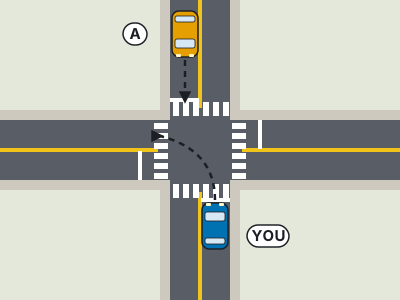
5. When turning left on a round green signal, you should:
- Yield only to vehicles behind you
- Turn immediately because a green circle protects the turn
- Wait for the next red signal before turning
- Yield to oncoming traffic and pedestrians, then turn when it is safe
Show answer
Yield to oncoming traffic and pedestrians, then turn when it is safe. A round green signal permits a left turn, but the driver must first yield to pedestrians and oncoming traffic. Wait for a suitable gap and complete the turn without forcing another road user to change speed or direction, and do not enter the intersection unless there is room for your vehicle on the other side. Turning immediately treats a permissive green as a protected arrow. Waiting for red is not required, and watching only behind ignores the main conflict. The cue is round green equals permission to look and yield, not permission to claim the path.
Study this in the handbook: Traffic Signals
6. At an intersection with a stop sign and a marked stop line, where must the driver stop?
- Beside the sign, even if that is past the line
- After the crosswalk, inside the intersection
- Before the marked stop line
- Only where the driver can see cross traffic best
Show answer
Before the marked stop line. Oregon places the required stop before the marked stop line when an intersection has one. If there is no line, the driver uses the crosswalk or the unmarked crossing area as the stopping reference. Stopping after the crosswalk can block pedestrians, while stopping beside the sign may put the vehicle beyond the legal point. Scan for traffic only after stopping correctly; if the view is blocked, inch forward carefully rather than rolling through the initial stop.
Study this in the handbook: Right of Way at Intersections
7. In Oregon, how far from railroad or light rail tracks must you keep a stopped or parked vehicle if being closer would interfere with the train?
- 3 feet
- 7 and a half feet
- 50 feet
- 15 feet
Show answer
7 and a half feet. Oregon bars parking within 7 and a half feet of railroad or light rail tracks when it interferes with the train, on top of the 50 foot rule for the nearest rail of a crossing. Three feet is closer than that limit allows when the vehicle would interfere with the train. Fifteen feet is the stopping distance from the nearest rail at a crossing with no stop line.
8. If emergency vehicles approach while you are already inside an Oregon roundabout, where should you stop?
- Inside the circle immediately
- At the center island
- After exiting, at the right shoulder
- At the entry line blocking traffic
Show answer
After exiting, at the right shoulder. Do not enter a roundabout when emergency vehicles are approaching. If already inside, keep moving through and exit rather than stopping in the circle. After exiting, pull to the right shoulder and allow the emergency vehicles to pass. Stopping inside or at the entry can block the path they need through the intersection. Watch the approach, keep the roundabout moving, and clear the circular roadway before yielding to the emergency response.
Study this in the handbook: Turns, U-Turns and Roundabouts
9. Which Oregon agency publishes the driver manual?
- Oregon Department of Transportation, Driver and Motor Vehicle Services
- Oregon State Police
- Oregon Department of Justice
- Oregon Secretary of State
Show answer
Oregon Department of Transportation, Driver and Motor Vehicle Services. The publication identifies the Oregon Department of Transportation's Driver and Motor Vehicle Services as the publisher. The State Police, Department of Justice, and Secretary of State are separate agencies and are not named as the publisher on the manual's publication page. This is a source-identification question, so distinguish the agency named under Published by from agencies that may enforce laws, prosecute cases, or maintain other state records. The manual's cover and publication information provide the agency name in full.
10. When must Oregon headlights be turned on under the manual's ordinary time of day rule?
- From sunrise to sunset
- Only between midnight and dawn
- From sunset to sunrise
- Only when another driver flashes headlights
Show answer
From sunset to sunrise. Oregon requires headlights from sunset to sunrise. That timing rule applies even when the road seems familiar or traffic is light. The manual also requires lights when conditions make it difficult to see people or vehicles 1,000 feet ahead, so the sunset rule is not the only trigger. Midnight to dawn is too narrow, daylight reverses the interval, and another driver's signal is not the legal test. Turn the lights on as darkness begins and keep them on until sunrise.
Study this in the handbook: Headlights and Hazardous Conditions
11. What does the Oregon manual tell drivers to do when approaching a stopped vehicle with flashing lights?
- Drive over any fire hose at the scene without permission
- Pass closely because the stopped vehicle is not moving
- Stop beside the vehicle until its lights turn off
- Allow as much room as safely possible and slow down when needed
Show answer
Allow as much room as safely possible and slow down when needed. When approaching a stopped vehicle with flashing lights, Oregon tells drivers to allow it as much room as safely possible, and at emergency scenes to slow down and be prepared to stop. Passing closely is the opposite of that advice. Stopping beside the vehicle is not what the manual describes; on a road with two or more lanes in your direction, it says to change lanes so you do not drive next to the stopped vehicle. Fire hoses must not be crossed unless officials at the scene tell you to.
Study this in the handbook: Emergency Vehicles, Stopped Vehicles and Work Zones
12. What does a warning sign labeled Curve tell a driver?

- The road becomes a one-way street
- A curve is ahead
- A sharp turn is required at the next intersection
- A passing lane begins immediately
Show answer
A curve is ahead. The word Curve on this warning sign means that a curve is ahead. It gives the driver advance notice of a change in the road, not an instruction to turn at an intersection or a promise of a new passing lane. A one-way road is a different traffic arrangement, while a sharp turn has its own warning description. Use the sign as an early cue: reduce speed before entering the bend, stay in the middle of your lane, and look through the curve toward the path you intend to follow.
Study this in the handbook: Warning, Guide and Service Signs
13. What does an Oregon flashing school speed limit sign indicate when its yellow light is flashing?
- A crossing guard has stopped all pedestrians
- The school zone is closed to all vehicles
- The speed limit has increased for school traffic
- Children are arriving at or leaving school
Show answer
Children are arriving at or leaving school. A flashing yellow light on a school speed sign indicates that children are arriving at or leaving school. It is a cue to obey the reduced 20 mph school speed limit and actively watch for children. The beacon does not close the road, raise the speed, or prove that a crossing guard has stopped everyone. Slow before entering the signed zone, scan both sides of the roadway, and be prepared to stop for a child entering the crosswalk.
Study this in the handbook: Oregon Speed Limits
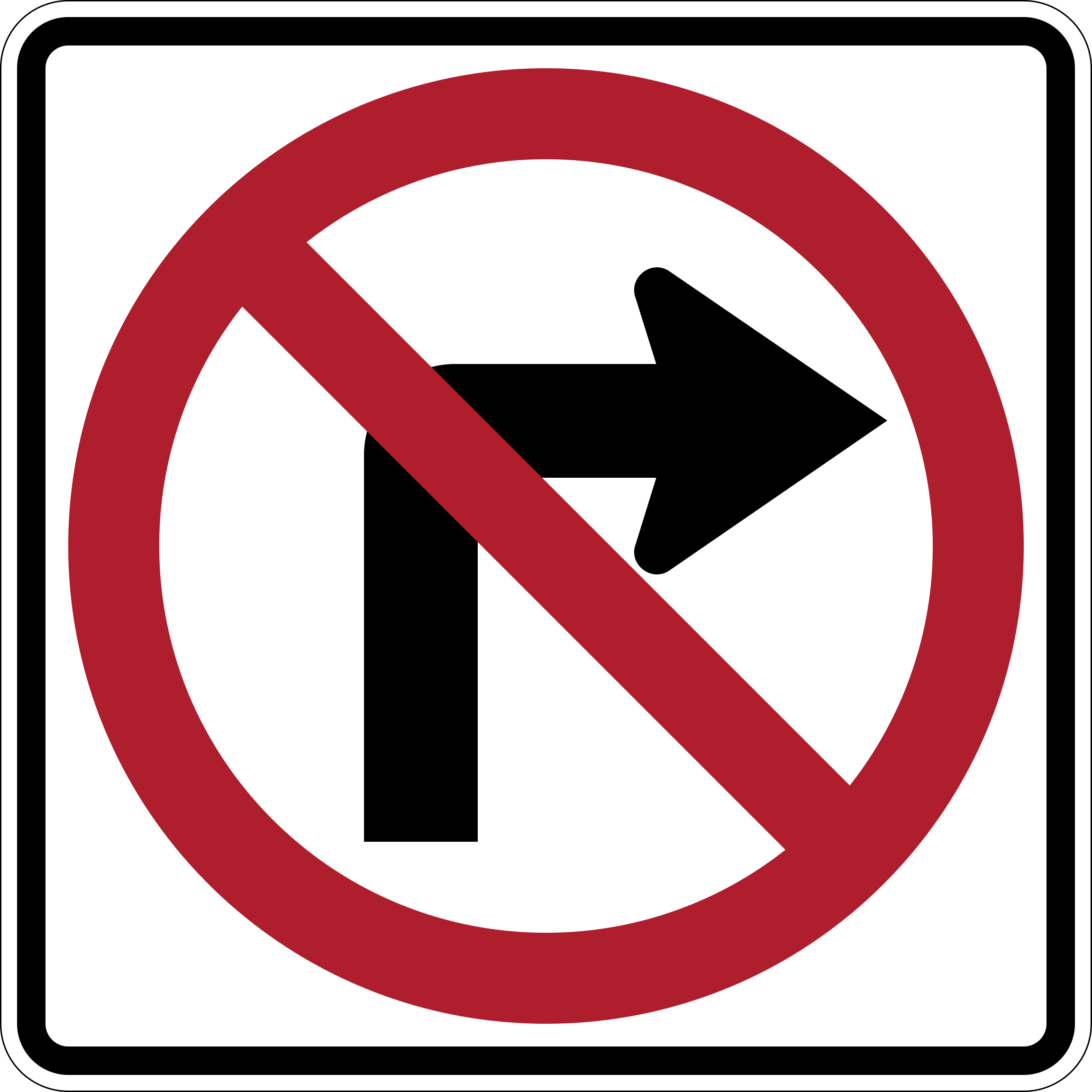
14. The sign displays a right-turn arrow crossed by a red slash. What must you avoid?
- Driving straight through the intersection
- Using the left lane to continue forward
- Yielding to traffic before entering the roadway
- Turning right at the location covered by the sign
Show answer
Turning right at the location covered by the sign. The slash marks the movement represented by the arrow, which is a right turn. Do not make that turn at the signed location, even if the traffic signal would otherwise allow movement. The choice “Driving straight through the intersection” invents a straight-ahead restriction that is not shown by this symbol. Continue only in a direction that remains permitted, and look for a later legal turn if your destination requires going right. A sign can restrict one maneuver while leaving other lanes or approaches governed by ordinary signals.
Study this in the handbook: Regulatory Signs
15. While moving in traffic, how far before a turn or lane change must you turn on your signal in Oregon?
- At least 100 feet
- At least 50 feet
- At least 200 feet
- At least 300 feet
Show answer
At least 100 feet. Oregon requires a moving driver to signal at least 100 feet before turning or changing lanes, giving others time to react. Fifty feet is too short a warning. The 200 and 300 foot choices are not the stated minimum. A driver pulling away from a curb follows a different standard: signal long enough to alert traffic that you are moving into the lane. Always check ahead, behind, and to the side before the move.
Study this in the handbook: Turns, U-Turns and Roundabouts
16. According to the FHWA chart in the Oregon manual, what risk of death does a pedestrian face when hit by a vehicle traveling 42 mph?
- A 50% risk of death
- A 10% risk of death
- A 25% risk of death
- A 90% risk of death
Show answer
A 50% risk of death. The chart shows how quickly pedestrian survival drops as vehicle speed rises. A pedestrian struck at 23 mph faces about a 10% risk of death, at 42 mph the risk is 50%, and at 58 mph it climbs to 90%. So 10% belongs to the slowest speed, 90% to the fastest, and 25% is not a figure on the chart. The lesson is that a modest drop in speed near people walking makes a large difference in whether a struck pedestrian survives.
Study this in the handbook: The Basic Rule and Variable Speed Signs
17. Under the Oregon manual's Park Your Phone fine schedule, how much can a second mobile device offense cost?
- Up to $500
- Up to $1,000
- Up to $2,000
- Up to $5,000
Show answer
Up to $2,000. Penalties rise with each offense on this schedule. The second offense tops out at $2,000, twice the $1,000 ceiling for a first offense. A $500 cap is below even the first offense figure, and $5,000 is higher than anything the panel lists. Only the third offense adds jail time, with a fine of up to $2,500 and six months in jail. The panel's own advice is the simplest way to avoid all three: park your phone before you start your car.
18. You are turning at an intersection with no traffic signal while a pedestrian crosses the street you are entering. Where must the pedestrian be before you begin the turn?
- Past the lane you are turning into, plus the next lane
- At least six feet from the lane you are turning into
- Past the center line of the road
- At least 20 feet from your vehicle
Show answer
Past the lane you are turning into, plus the next lane. Oregon sets two different clearance rules for turning drivers. At an intersection without a traffic signal, the pedestrian must be past the lane you are turning into plus the next lane before you begin to turn. The six foot distance applies only at signalized intersections. Being past the center line does not guarantee the pedestrian has cleared both lanes, and a fixed 20 feet from your vehicle is not the test. Wait for the full clearance before starting the turn.
Study this in the handbook: Pedestrians and Bicycles
19. What special right-of-way rule applies to vehicles in an Oregon funeral procession?
- Only the lead vehicle receives priority
- The procession must yield at every signal
- Other vehicles must yield to the procession
- Drivers may pass between procession vehicles
Show answer
Other vehicles must yield to the procession. Oregon funeral processions are exempt from certain road rules, and other vehicles must yield the right of way to them. The procession is not limited to priority for only its lead vehicle, and ordinary drivers may not treat the line like normal traffic to be passed or split. Slow down, wait for the procession to clear, and avoid entering its path. This courtesy also prevents a vehicle from breaking the group into unpredictable gaps at an intersection.
Study this in the handbook: Emergency Vehicles, Stopped Vehicles and Work Zones
20. When may you cross railroad tracks in Oregon?
- When your vehicle can stop on the tracks
- Whenever the warning lights are not flashing
- As soon as the first train passes
- Only when you are sure you can completely clear the crossing
Show answer
Only when you are sure you can completely clear the crossing. Cross railroad tracks only when you are sure the vehicle can completely clear the crossing. A quiet signal does not guarantee that another train is absent, and one train can block the view of another. Never stop on the tracks or try to beat a train. Look, listen, slow down, and check for room beyond the rails before entering. If traffic ahead leaves no exit space, wait before the crossing rather than stopping in its path.
Study this in the handbook: School Buses and Railroad Crossings
QualitySpace is expanding to Oregon
We are a California-based independent insurance brokerage working on licensing in more states. We cannot help with Oregon insurance yet. Leave your email and we will let you know when we can.
Every question is written from the official Oregon Driver Manual. Need paper? Printable OR practice test with answer key.
Last verified 2026-10-05. How we check every question · Study all 220 as flashcards
Frequently asked questions
How many questions are on this Oregon practice test?
This fixed set has 20 questions. It is test 1 of 11 from the 220 question Oregon bank. The real OR exam asks 35 questions and you need 28 correct.
What is the passing score for the real Oregon test?
28 of 35 correct to receive a passing score That figure comes from the official Oregon source cited on the DMV facts page.
How does this fixed test relate to the full Oregon bank?
Each numbered test is a fixed set of questions in a fixed order, so you can retake the same test later and compare. Every test mixes road signs and the other topics in about the same proportion as the full bank. Tests 1 to 11 together cover every question in the Oregon bank once. The full practice page mixes the whole bank at random.
Last verified 2026-10-05. See the Oregon DMV facts page for sourced state details.