
Test 4 of 11 · 20 questions · Free 2026
OR Permit Practice Test 4
Jump to the test ↓A fixed 20 question set from the Oregon bank with answers and plain English explanations. The real OR exam is 35 questions, 80 percent to pass; take the full length version on the main practice page.
Question 1 of 20 · 0 right so far
All 20 questions in test 4
Every question below comes from the Oregon question bank on this page. Open a question to see the correct answer and the explanation. Nothing here is hidden behind a signup.
1. What is the legal status of an Oregon variable advisory speed sign?
- It recommends a speed based on current conditions
- It permanently replaces every posted speed limit
- It permits travel above the statutory maximum
- It applies only when a police officer is present
Show answer
It recommends a speed based on current conditions. A variable advisory speed sign recommends a speed for conditions such as heavy traffic, poor weather, or a slippery road. The manual distinguishes that recommendation from a variable speed limit sign, which changes the legal limit and can be enforced like another speed limit sign. An advisory display does not replace every permanent limit or authorize travel above a maximum. Police may still enforce the basic rule, so the driver should choose a reasonable and cautious speed for the conditions shown.
Study this in the handbook: The Basic Rule and Variable Speed Signs
2. A low speed Oregon crash leaves only $400 of vehicle damage, but the other driver is injured. Is a DMV collision report required?
- No, because damage is under the $2,500 threshold
- No, the injured driver is the one who must report
- Yes, any injury or death makes the collision reportable
- Only if the injured driver goes to a hospital that day
Show answer
Yes, any injury or death makes the collision reportable. Oregon's reporting list includes any collision that results in injury or death, regardless of the dollar amount of damage. The $2,500 figure applies to the damage conditions, not to injury crashes, so a small repair bill does not excuse the report. Every driver involved has a duty to report, not just the person who was hurt. The manual sets no hospital visit condition. File the report within 72 hours, and remember that a police report at the scene does not replace the one owed to DMV.
Study this in the handbook: Insurance, Collisions and Reports
3. What should you do when a traffic signal is dark because of a power failure?
- Treat it as stop signs in all directions
- Wait for a police officer before moving
- Treat it as a yield sign
- Proceed if no vehicle is approaching
Show answer
Treat it as stop signs in all directions. A dark signal is not permission to continue through the intersection. Oregon directs drivers to stop as though every approach had a stop sign, then proceed only after yielding and checking for traffic and pedestrians. Waiting for an officer is unnecessary unless one is present directing traffic. Treating the outage like a yield sign skips the required stop, while simply checking for an approaching vehicle overlooks people or vehicles that may enter from another direction. The practical cue is simple: no lights means four-way stop behavior, even if the signal normally controls a busy intersection.
Study this in the handbook: Traffic Signals
4. When does Oregon's school speed zone limit of 20 mph apply under a School Speed Limit Sign for When Children Are Present?
- Only between 7 a.m. and 5 p.m. on a school day
- Any day and at any time children are present
- Only when a police officer is directing traffic
- Only after a school bus begins flashing red lights
Show answer
Any day and at any time children are present. This school speed sign activates the reduced 20 mph limit whenever children are present, regardless of the day or clock time. The 7 a.m. to 5 p.m. choice belongs to a different school-hours sign. Children count as present when they are waiting at a crosswalk, occupying or walking within one, or when a traffic patrol member assists them there. The key cue is the sign type, not a bus or officer: look for children and be ready to slow to the marked limit.
Study this in the handbook: Oregon Speed Limits
5. Who may supervise the driving experience that counts toward an Oregon applicant's under 18 license?
- A driving instructor of any age with a current permit
- Any licensed driver at least 18 who has held a license for 1 year
- Only a parent or legal guardian who is at least 25
- Someone at least 21 who has held valid driving privileges for at least 3 years
Show answer
Someone at least 21 who has held valid driving privileges for at least 3 years. The supervised hours count only when the accompanying person meets both experience conditions in the manual: that person must be at least 21 years old and must have had valid driving privileges for at least three years. Age alone is not enough, and the rule does not limit supervision to parents. A recently licensed 18 year old therefore cannot make the hours count, even if that person is careful and present for every trip. Check both the supervisor's age and driving history before logging practice time.
Study this in the handbook: Permits and Teen Licenses
6. Which supervised driving combination satisfies Oregon's under 18 license requirement?
- 50 hours for every applicant, with no course alternative
- 75 hours, or 25 hours plus a school attendance record
- 100 hours, or 50 hours plus an ODOT-approved traffic safety education course
- 25 hours, or 10 hours with a licensed adult passenger
Show answer
100 hours, or 50 hours plus an ODOT-approved traffic safety education course. An applicant under 18 can qualify through either of two documented paths. The first is 100 hours of supervised driving experience. The second is 50 hours of supervised driving experience combined with an ODOT-approved traffic safety education course. The 75 hour option invents a middle requirement, while 50 hours alone is insufficient under this rule. Before relying on the reduced hour total, the applicant needs proof that the approved course was completed, not merely proof of school enrollment or attendance.
Study this in the handbook: Permits and Teen Licenses
7. A yellow warning sign shows a small stop sign. What should the driver do?

- Assume the stop sign applies only to cross traffic
- Prepare to stop for a stop sign farther ahead
- Continue at the current speed because the warning is advisory
- Park before the next intersection to avoid the stop
Show answer
Prepare to stop for a stop sign farther ahead. The image warns that a stop sign is ahead, so it is time to reduce speed and prepare for the required stop. The warning appears before the actual control point, giving the driver room to manage following distance and sight lines. The choice “Continue at the current speed because the warning is advisory” treats the sign as optional, but the stop sign ahead will still require a complete stop. Look beyond the warning for the red octagon, identify the stopping position, and be ready for traffic or pedestrians at that intersection.
Study this in the handbook: Warning, Guide and Service Signs
8. When a railroad crossbuck assembly includes another sign, how should the driver respond?
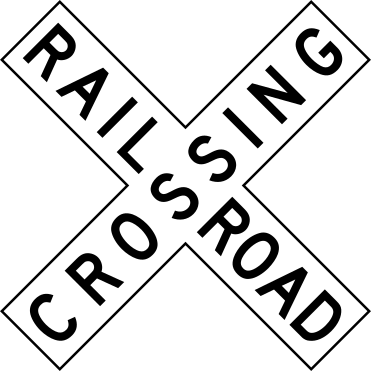
- Use the crossing without checking for trains
- Treat the crossbuck as a construction warning
- Assume horns are prohibited at the crossing
- Obey the yield or stop sign included with the crossbuck assembly
Show answer
Obey the yield or stop sign included with the crossbuck assembly. An Oregon railroad crossbuck assembly includes a yield or stop sign, and the driver must obey whichever sign is posted with it. The crossbuck identifies a rail crossing, but the accompanying sign supplies the immediate control at that location. A construction warning does not explain the assembly, and neither horn restrictions nor an unchecked crossing follows from the marking. Slow down, look and listen for trains, and stop when the posted sign requires it. If a lower sign gives the number of tracks, use that information to check for another train before proceeding.
Study this in the handbook: School Buses and Railroad Crossings
9. What does the arrow on the pictured ONE WAY sign identify?
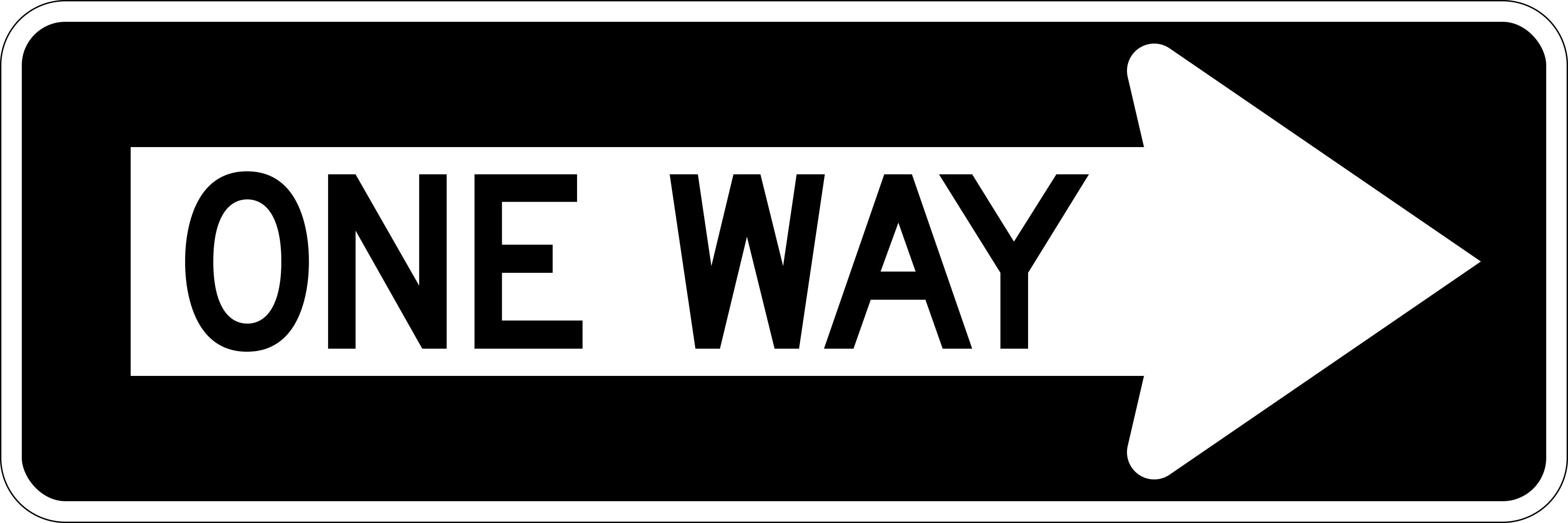
- The only direction a pedestrian may cross the street
- The direction in which traffic on the street may flow
- A temporary detour that applies only to buses
- A lane where vehicles may reverse during congestion
Show answer
The direction in which traffic on the street may flow. The arrow on a ONE WAY sign describes the permitted flow for traffic on that street. Drivers entering or traveling along it should align with that direction and should not turn into opposing movement. The choice “A lane where vehicles may reverse during congestion” confuses a directional rule with a reversible lane instruction, which would require different markings or signs. Before turning onto a one-way street, read the arrow and confirm that your planned route follows it, especially where several lanes meet near an intersection.
Study this in the handbook: Regulatory Signs
10. In daylight you are hauling lumber that extends 5 feet past the rear of your vehicle. What does Oregon require at the end of the load?
- A white flag at least 6 inches square
- Nothing, unless the load extends 10 feet or more
- A flashing amber light at all times
- A red flag at least 12 inches square
Show answer
A red flag at least 12 inches square. Any load that extends 4 feet or more beyond the rear of the vehicle must carry a red flag at least 12 inches square at its end, so a 5 foot overhang needs one. A white flag or a 6 inch size does not meet the rule, and the threshold is 4 feet, not 10. A light is required only when limited visibility conditions exist: then a red light visible for 500 feet to the rear and sides replaces the flag, and the manual does not call for an amber light.
Study this in the handbook: Motorcycles, Large Vehicles and Other Road Users
11. A pedestrian using a white cane starts crossing in front of you, and your light is green. What must you do?
- Stay stopped until the person has crossed the entire road
- Go once the person has cleared your lane
- Go, because the green light gives you the right of way
- Tap the horn so the person knows you are there
Show answer
Stay stopped until the person has crossed the entire road. Oregon requires drivers to give the right of way to a pedestrian with limited vision, or anyone who is blind or deaf and blind carrying a white cane or using a guide dog. Stop if the person is about to cross or is crossing, and remain stopped until the person has crossed the entire road, even on a green light. Leaving once your own lane is clear is too soon, and a green signal does not override this duty. A horn does nothing to meet the duty to stop and wait.
Study this in the handbook: Pedestrians and Bicycles
12. What does an Oregon octagonal STOP sign require?
- A yield without stopping
- A rolling slowdown if cross traffic is absent
- A stop only when a pedestrian is visible
- A complete stop, followed by yielding as required
Show answer
A complete stop, followed by yielding as required. The octagonal STOP sign requires a complete stop. After stopping, yield to other vehicles and stop and stay stopped for pedestrians crossing in marked or unmarked crosswalks. The sign does not permit a rolling slowdown when the intersection looks empty, and it is broader than a pedestrian-only instruction. Use the stop line when one is present, check all approaches and both crosswalks, then enter only when the intersection is safe.
Study this in the handbook: Regulatory Signs
13. Your car breaks down on a highway shoulder just past a blind curve, where approaching drivers cannot see it. Where should warning flags or flares go?
- At least 50 feet behind the vehicle only
- Directly beside the vehicle
- At least 200 feet from the vehicle in each direction
- At least 500 feet ahead of the vehicle only
Show answer
At least 200 feet from the vehicle in each direction. If a disabled vehicle on the shoulder cannot be seen from 200 feet in each direction, Oregon says approaching traffic must be warned with flags, flares, signs, signals, or flaggers placed at least 200 feet from the vehicle in each direction. Fifty feet behind gives far too little notice, and warnings beside the car do nothing for drivers still around the curve. Placing them only ahead ignores traffic from the other direction. Turn on your hazard lights as well, and if you leave, stop the engine, take the key, and set the brakes.
14. For the vehicle used in the Oregon drive test, what equipment does the manual require when weather conditions demand it?
- Fog lights and a roof rack
- A CB radio
- Traction tires or chains, windshield wipers, headlights, taillights, and a window defroster
- Studded tires year round
Show answer
Traction tires or chains, windshield wipers, headlights, taillights, and a window defroster. In its list of requirements for the drive test vehicle, the manual says that if weather conditions require, your vehicle must have traction tires or chains, windshield wipers, headlights, taillights and a window defroster. The manual also says you may see signs that require you to carry or use chains or traction tires. Fog lights, radios and roof racks are not on that list, and studded tires are generally allowed only from November 1 through March 31, not year round. Check road and weather conditions before the test so the vehicle has what the conditions call for.
15. If a front tire blows out, what may happen to the vehicle?
- Steering may become difficult and the vehicle may pull strongly to one side
- The rear of the vehicle will always weave from side to side
- The steering wheel will lock while the engine stops immediately
- The vehicle will automatically brake in a straight line
Show answer
Steering may become difficult and the vehicle may pull strongly to one side. A front-tire blowout can make steering difficult and may create a strong pull toward one side. The rear-weave choice describes the manual’s warning about a rear blowout, not a front tire. A locked steering wheel and automatic braking are not stated effects and could cause a driver to wait for a vehicle response that will not occur. Grip the steering wheel firmly, reduce speed gradually, and pull off the road when possible. The practical cue is a sudden steering change or pull, followed by calm control rather than a sharp correction.
Study this in the handbook: Avoiding Collisions and Equipment Failures
16. At an intersection with no signs or signals, to whom must you yield?
- Only vehicles approaching from the left
- No one if you arrived first
- The vehicle traveling fastest
- Any vehicle in the intersection or approaching from your right
Show answer
Any vehicle in the intersection or approaching from your right. At an uncontrolled intersection, Oregon says to yield to any vehicle already in the intersection and to a vehicle approaching from the right. Looking left first is part of scanning for cross traffic, but it does not erase the right-side yield rule. Speed does not establish priority, and arriving first is not a license to enter without checking. Reduce speed, inspect both directions, and be prepared to stop. That routine handles both the vehicle already occupying the crossing and the one coming from your right.
Study this in the handbook: Right of Way at Intersections
17. What does a solid white line used as an edge or fog line help drivers do?
- Cross into opposing traffic to pass
- Stay on the road
- Change lanes without checking nearby traffic
- Identify a two-way left-turn lane
Show answer
Stay on the road. Oregon uses a solid white edge or fog line to help drivers stay on the road. It is not a center line separating opposing traffic, so it does not authorize a pass into the other direction. It also does not replace a mirror and shoulder check before a lane movement. A two-way left-turn lane is identified by different markings and arrows. When the line appears at the roadway edge, use it as a visual boundary, especially in darkness, rain, or fog, and keep the vehicle inside that boundary.
Study this in the handbook: Pavement Markings
18. How long does a reduced work-zone speed limit remain in effect in Oregon?
- Only until the next intersection
- Only until workers leave the driver's view
- Until an End Work Zone Speed Limit sign or another posted speed limit sign
- Until the driver has passed the first orange cone
Show answer
Until an End Work Zone Speed Limit sign or another posted speed limit sign. Oregon keeps a reduced work-zone speed limit in effect until the driver sees an End Work Zone Speed Limit sign or another posted speed limit sign. Worker visibility, the next intersection, or the first cone does not end the restriction. Construction areas can continue to have narrowed lanes, shifting traffic, and equipment after the crew is out of sight. Look beyond the immediate work area for the ending sign, maintain the posted temporary speed, and continue scanning for flaggers and changing lane markings.
Study this in the handbook: Emergency Vehicles, Stopped Vehicles and Work Zones
19. Before making a left turn on a steady circular green signal, to whom must a driver yield?
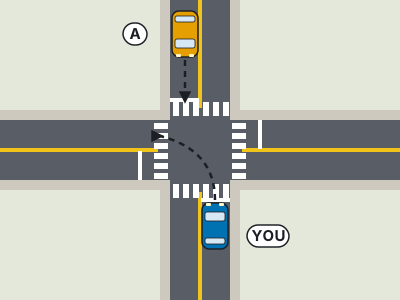
- Only vehicles behind the turning driver
- Pedestrians and oncoming traffic
- Only pedestrians waiting on the sidewalk
- No one, because a green signal gives an unconditional right of way
Show answer
Pedestrians and oncoming traffic. A steady circular green signal permits a left turn, but the driver must first yield to pedestrians and oncoming traffic. The signal allows the movement; it does not remove conflicts already in the intersection or crossing. Yielding only to people waiting on the sidewalk misses pedestrians in the crosswalk, while ignoring oncoming traffic risks a direct collision. Check the crosswalk and opposing approach before turning, keep the intersection clear, and proceed only when the permitted movement can be completed without conflicting with another road user.
Study this in the handbook: Traffic Signals
20. How should you handle lane position inside a multi-lane Oregon roundabout?
- Maintain your lane position until you exit
- Change lanes whenever another vehicle is nearby
- Stop beside a truck before choosing an exit
- Use either lane regardless of the intended exit
Show answer
Maintain your lane position until you exit. In a multi-lane roundabout, Oregon advises drivers to maintain lane position until they exit and avoid lane changes inside when possible. Changing lanes whenever another vehicle appears is the opposite of that advice. Stopping beside a truck is also wrong, because it is illegal to pass or drive beside a truck within the roundabout. Before entering, use the exit and lane use signs and the pavement markings to choose the appropriate lane for your exit, then hold that lane through the circle.
Study this in the handbook: Turns, U-Turns and Roundabouts
QualitySpace is expanding to Oregon
We are a California-based independent insurance brokerage working on licensing in more states. We cannot help with Oregon insurance yet. Leave your email and we will let you know when we can.
Every question is written from the official Oregon Driver Manual. Need paper? Printable OR practice test with answer key.
Last verified 2026-10-05. How we check every question · Study all 220 as flashcards
Frequently asked questions
How many questions are on this Oregon practice test?
This fixed set has 20 questions. It is test 4 of 11 from the 220 question Oregon bank. The real OR exam asks 35 questions and you need 28 correct.
What is the passing score for the real Oregon test?
28 of 35 correct to receive a passing score That figure comes from the official Oregon source cited on the DMV facts page.
How does this fixed test relate to the full Oregon bank?
Each numbered test is a fixed set of questions in a fixed order, so you can retake the same test later and compare. Every test mixes road signs and the other topics in about the same proportion as the full bank. Tests 1 to 11 together cover every question in the Oregon bank once. The full practice page mixes the whole bank at random.
Last verified 2026-10-05. See the Oregon DMV facts page for sourced state details.