
Test 13 of 25 · 20 questions · Free 2026
OR Permit Practice Test 13
Jump to the test ↓A fixed 20 question set from the Oregon bank with answers and plain English explanations. The real OR exam is 35 questions, 80 percent to pass; take the full length version on the main practice page.
Question 1 of 20 · 0 right so far
All 20 questions in test 13
Every question below comes from the Oregon question bank on this page. Open a question to see the correct answer and the explanation. Nothing here is hidden behind a signup.
1. A moped is riding near the right edge of your lane at 25 mph. Could you pass it while staying in the same lane?
- Yes, a moped needs only part of the lane
- Yes, if you leave three feet of space
- Yes, if the rider waves you by
- No, you must give it a full lane
Show answer
No, you must give it a full lane. It is against the law to share a lane with a person riding a motorcycle or moped. When passing, you must allow them a full lane, which means moving completely into the next lane where passing is legal and safe. Mopeds and motorcycles are hard to see and can be pushed around by wind or road surfaces, so give them room.
Study this in the handbook: Motorcycles, Large Vehicles and Other Road Users
2. You suddenly notice your exit is to the right, but a double solid white line separates your lane from the exit lane. What should you do?
- Cross the lines quickly if no one is there
- Signal, slow down, and cross the lines
- Stay in your lane and take the next exit
- Stop and wait for a gap to cross over
Show answer
Stay in your lane and take the next exit. A double solid white line means you are not allowed to change lanes; stay in your lane. It is usually paired with a sign prohibiting lane changes for a certain distance. If you miss an exit because of it, go on to the next exit. Oregon says never to stop or back up on a freeway, and a last-moment lane change across solid lines invites a collision.
Study this in the handbook: Pavement Markings
3. A driveway is on the far side of a double solid yellow center line. May you turn left across the lines into it?
- No, those lines cannot be crossed for any reason
- Yes, after oncoming traffic has cleared
- Yes, if a broken yellow line is on your side
- Yes, once you have come to a full stop
Show answer
Yes, after oncoming traffic has cleared. Double solid yellow lines mean no passing for traffic in either direction, but they do not wall off driveways and side roads. Oregon lets you turn left across them to enter or leave a roadway once oncoming traffic has cleared. Signal, slow down, and wait in your lane for a safe gap instead of nosing toward the oncoming lane. The lines still forbid using that lane to get around slower vehicles.
Study this in the handbook: Pavement Markings
4. What can happen when your tires hydroplane on a wet road?
- You may lose steering and braking
- Your tires grip better as they warm up
- Only your rear brakes may lock up
- Water in the engine may make it stall
Show answer
You may lose steering and braking. Hydroplaning happens when tires skim or float on top of water on the road instead of gripping the pavement. Oregon warns that your ability to steer and stop can then be reduced or lost. The way to prevent it is to slow down when roads are wet. Do not confuse it with driving through flooded areas, which the manual says can cause loss of control or engine stalling.
Study this in the handbook: Headlights and Hazardous Conditions
5. Your car has broken down on the shoulder, and you must walk away to get help. What should you do before leaving it?
- Leave it running with the doors locked and radio off
- Stop the engine, take the key, set the brakes, and use hazards
- Turn off the engine but leave the key for a tow driver
- Set the brakes and turn off all lights to save power
Show answer
Stop the engine, take the key, set the brakes, and use hazards. Oregon lists four steps for leaving a vehicle unattended: turn off the engine, remove the key, set the brakes, and turn on your hazard lights. The hazard lights keep warning other drivers while you are gone. Remember that if police find a vehicle parked where it is not allowed, or where it creates a hazard, the officer may have it removed, and you pay for towing and storage.
6. It has just started to rain after a long dry spell. How should you brake?
- Harder, so the tires grip through the water
- The same as usual, since the road is barely wet
- Later, once you are sure you need to stop
- Sooner and more gently than usual
Show answer
Sooner and more gently than usual. Rain reduces how far you can see and increases the distance you need to stop. Oregon says that when roads are wet, you should apply the brakes sooner and more gently than usual. Even a summer shower can make the road slippery when rain mixes with oil and dirt on the pavement. Slow down, leave more following distance, and do not use cruise control in wet conditions.
Study this in the handbook: Headlights and Hazardous Conditions
7. When is an icy road likely to be at its most slippery?
- When it is near freezing
- When it is far below freezing
- When it has just been plowed
- When the sun has been on it all day
Show answer
When it is near freezing. Many drivers assume the coldest days are the most dangerous. Oregon's manual says the road is likely to be most slippery when the temperature is near the freezing point rather than below freezing. On those days, drive at slower speeds, leave more room, press the gas and brakes gently, and watch for bridges and shaded spots that freeze first. Stay off the road when officials say driving is very hazardous.
Study this in the handbook: Headlights and Hazardous Conditions
8. Besides your eyes and mirrors, what can tell you that another vehicle may be in your blind spot?
- A change in how the steering wheel feels
- Sounds from a vehicle right beside you
- A warning light that comes on the dashboard
- The brake pedal feeling softer than usual
Show answer
Sounds from a vehicle right beside you. Oregon says being able to hear is important when driving. Sound can tell you when another vehicle may be in your blind spot, and a difference in your engine sound may warn you of a problem. You also need to hear an approaching emergency vehicle, so do not use headphones that may reduce your hearing. Hearing adds to your mirrors and head checks, and it does not replace them.
Study this in the handbook: Alcohol, Drugs and DUII
9. You are coming down an on-ramp and see this sign as your ramp joins the highway. What does it mean for you?

- Your ramp becomes its own lane; no merge needed
- You must merge left before the ramp ends
- You must stop and wait for a gap
- You must yield to all cars on the right
Show answer
Your ramp becomes its own lane; no merge needed. The Add Lane sign shows two roadways joining side by side. Oregon explains that you do not need to merge, because the joining road continues as its own lane. That is different from a Merge sign, where traffic must fit into an existing lane, and from a Lane Reduction sign, where a lane ends. Still check your mirrors, since drivers already on the highway may move into the new lane.
Study this in the handbook: Warning, Guide and Service Signs
10. You start seeing traffic signs, cones, and barrels of one particular color ahead. Which color tells you that you are entering a work zone?
- Yellow
- Brown
- Blue
- Orange
Show answer
Orange. Oregon defines work zones by orange traffic control devices. Orange signs warn you what to expect ahead, and orange cones guide you away from the construction. Once you see orange, slow down and stay alert: lanes may shift, workers and equipment may be close to traffic, and the posted temporary speed applies at all times, even when no workers are visible.
Study this in the handbook: Emergency Vehicles, Stopped Vehicles and Work Zones
11. Right after you pass this sign, you catch up to a slow farm truck. What may you do?
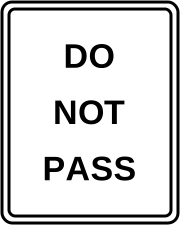
- Pass if you see no oncoming traffic
- Pass quickly while under the limit
- Stay behind it until passing is allowed
- Pass it using the right shoulder
Show answer
Stay behind it until passing is allowed. A white DO NOT PASS sign is a regulatory sign: it means you may not pass. A slow vehicle ahead does not create an exception, and neither does a road that looks clear. Stay behind it and leave a safe following distance until signs and markings show a passing zone. Then pass only where you can see far enough ahead and can finish before the next no-passing zone.
Study this in the handbook: Regulatory Signs
12. At a stop sign with no stop line and no painted crosswalk, where must you stop?
- With your front bumper even with the stop sign
- Wherever you can see cross traffic, even if in the intersection
- At the edge of the cross street's first travel lane
- Before the unmarked crossing area at the corner
Show answer
Before the unmarked crossing area at the corner. With a stop sign, steady red, or flashing red signal, stop before the marked stop line or crosswalk if there is one. If there is neither, stop before the unmarked crossing area, before entering the intersection. Every intersection has a crosswalk even when no lines are painted; picture the sidewalk or shoulder extending across the road. After stopping, if you still cannot see traffic, you may pull forward slightly to look.
Study this in the handbook: Right of Way at Intersections
13. Inside city limits, Oregon bans U-turns where traffic from either direction cannot see your vehicle within what distance?
- 1,000 feet
- 200 feet
- 500 feet
- 300 feet
Show answer
500 feet. Oregon bans U-turns anywhere your vehicle cannot be seen by traffic coming from either direction within a set distance. Inside city limits that distance is 500 feet, and outside city limits it doubles to 1,000 feet. U-turns are also banned at intersections with traffic signals unless a sign allows them, between intersections in a city, and at or on a railroad crossing. Check for signs before you try one.
Study this in the handbook: Turns, U-Turns and Roundabouts
14. Near the end of a freeway on-ramp, you see a gap in the traffic. What does the Oregon manual advise?
- Stop at the end of the ramp and wait for a big gap
- Match freeway speed and keep moving if you can
- Slow down so all freeway traffic passes first
- Turn on your hazard lights while you merge
Show answer
Match freeway speed and keep moving if you can. In most situations you slow down before entering a busy road, but a freeway is the opposite. Use the on-ramp to speed up so you can merge with fast-moving traffic. Adjust your speed to match the traffic already on the freeway and keep moving if at all possible. Drivers behind you on the ramp expect you to speed up, so a sudden stop can cause a rear-end crash. Still, yield to freeway traffic.
Study this in the handbook: Passing and Freeway Driving
15. In which of these places does Oregon say not to cross the center line to pass another vehicle?
- On a straight road with a clear view
- When the car ahead is under the limit
- When approaching a railroad crossing
- On a road posted at 45 mph or more
Show answer
When approaching a railroad crossing. Oregon lists places where you should not cross the center line to pass, and one is when you are approaching, at, or in an intersection or a railroad crossing. Vehicles may turn in front of you at an intersection, and some vehicles, such as school buses and hazmat trucks, must stop at railroad tracks. Other listed situations include a hill or curve blocking your view and a vehicle stopped at a crosswalk for a pedestrian.
Study this in the handbook: Passing and Freeway Driving
16. A yellow digital sign reading ADVISORY SPEED 40 is lit because of heavy fog. Can police cite you for driving faster than 40?
- No, a yellow advisory number can never be enforced
- Only if a black and white sign also shows 40
- Yes, because a lit advisory sign becomes the limit
- Yes, under the basic rule, though it is not a limit
Show answer
Yes, under the basic rule, though it is not a limit. Oregon's yellow variable advisory speed signs recommend a speed for conditions such as fog, ice, or heavy traffic and are switched on and off as needed. They are not speed limits. Police can still enforce them through the basic rule law, which requires a speed that is reasonable and cautious for existing conditions. So driving faster than a lit advisory speed in thick fog can lead to a citation even when you are below the posted limit.
Study this in the handbook: The Basic Rule and Variable Speed Signs
17. You park facing uphill next to a curb. Which way should your front wheels point?
- Toward the curb
- Toward the travel lane
- Straight ahead
- Toward the sidewalk
Show answer
Toward the travel lane. Facing uphill against a curb, Oregon says to turn your wheels toward the travel lane. This is the reverse of the downhill rule, where the wheels point toward the curb, so the two are easy to mix up. The purpose of both is to keep the vehicle from rolling downhill if the brake fails. Always set your parking brake as well, and leave an automatic in park. With no curb, turn the wheels toward the edge of the road.
18. A friend used marijuana an hour ago and says they feel only a little slower than usual. What does Oregon call the safest choice?
- Driving only on quiet side streets
- Driving below the posted speed limit
- Not driving after using it
- Driving with a sober passenger watching
Show answer
Not driving after using it. Oregon's manual is direct: the safest choice is not to drive after using any drug that affects your reaction time or physical abilities. Marijuana impairment has contributed to many collisions in Oregon, and using alcohol and marijuana together reduces your ability to drive even more. If you drive while affected, you can be arrested for DUII. Leave the driving to someone else if you have used drugs of any kind.
Study this in the handbook: Alcohol, Drugs and DUII
19. Which of these can make a person riding a motorcycle suddenly change speed or direction?
- Gravel, pavement seams, or manhole covers
- A car's headlights on in the daytime
- A white edge line along the road
- A posted speed limit sign ahead
Show answer
Gravel, pavement seams, or manhole covers. Weather and road conditions affect people riding motorcycles and mopeds more than other vehicles. Oregon notes that strong winds can push a rider out of the lane, and road surfaces such as gravel, debris, pavement seams, grooved pavement, and manhole covers may cause the rider to change speed or direction. When you see these conditions, increase your following distance so a sudden move does not leave you too close.
Study this in the handbook: Motorcycles, Large Vehicles and Other Road Users
20. Which warning sign tells you a four-way intersection is ahead, where vehicles from both sides may enter your road?
- Crossroad
- Side Road
- Roundabout Ahead
- Two-Way Traffic Ahead
Show answer
Crossroad. The Crossroad sign, shaped like a plus sign on a yellow diamond, warns of a four-way intersection ahead where cross traffic may enter the road. It does not tell you who must stop, so watch for vehicles coming from both sides. A Side Road sign is different: it warns of a T intersection, where traffic may enter from the left or right but the side road ends.
Study this in the handbook: Warning, Guide and Service Signs
Every question is written from the official Oregon Driver Manual. Need paper? Printable OR practice test with answer key.
Last verified 2026-10-05. How we check every question · Study all 500 as flashcards
Frequently asked questions
How many questions are on this Oregon practice test?
This fixed set has 20 questions. It is test 13 of 25 from the 500 question Oregon bank. The real OR exam asks 35 questions and you need 28 correct.
What is the passing score for the real Oregon test?
28 of 35 correct to receive a passing score That figure comes from the official Oregon source cited on the DMV facts page.
How does this fixed test relate to the full Oregon bank?
Each numbered test is a fixed set of questions in a fixed order, so you can retake the same test later and compare. Every test mixes road signs and the other topics in about the same proportion as the full bank. Tests 1 to 25 together cover every question in the Oregon bank once. The full practice page mixes the whole bank at random.
Last verified 2026-10-05. See the Oregon DMV facts page for sourced state details.