
Test 23 of 25 · 20 questions · Free 2026
OR Permit Practice Test 23
Jump to the test ↓A fixed 20 question set from the Oregon bank with answers and plain English explanations. The real OR exam is 35 questions, 80 percent to pass; take the full length version on the main practice page.
Question 1 of 20 · 0 right so far
All 20 questions in test 23
Every question below comes from the Oregon question bank on this page. Open a question to see the correct answer and the explanation. Nothing here is hidden behind a signup.
1. Two lanes are turning left side by side at a signal, and you are in the outer turn lane. How should you complete the turn?
- Cut toward the inner lane to shorten the turn
- Move into any open lane on the new street
- Follow the markings and stay in your own lane
- Wait until the inner car has finished turning
Show answer
Follow the markings and stay in your own lane. Dual left or right turn lanes let several lanes turn in the same direction at once when signs or pavement markings allow it. The danger is a car drifting into the lane beside it partway through the turn. Follow the pavement markings and stay in your lane from start to finish, especially when the road you are entering has more lanes than the one you left. Change lanes later, after signaling and checking your mirrors.
Study this in the handbook: Turns, U-Turns and Roundabouts
2. You are driving slowly up a two-lane mountain road, and a line of cars has formed behind you. What should you do?
- Speed up past the limit until the line breaks up
- Wave the cars around you with your arm
- Keep going, since they can pass where it is legal
- Pull off at the first safe area to let them pass
Show answer
Pull off at the first safe area to let them pass. Driving below the normal speed is allowed, but Oregon expects you to watch your mirrors. If traffic is building up behind you, pull off the road at the first safe area and let the line pass. On two-lane roads, a long queue tempts drivers to pass in unsafe places. Do not speed up past the limit to get rid of them, and do not wave them by, because Oregon law forbids signaling other drivers when to pass.
Study this in the handbook: The Basic Rule and Variable Speed Signs
3. You are driving in city traffic and will turn right at a corner 300 feet ahead. By how far before the turn must your signal be on?
- At least 50 feet
- At least 200 feet
- At least 100 feet
- Just as you start turning
Show answer
At least 100 feet. When your vehicle is moving in traffic, Oregon requires your turn signal at least 100 feet before a turn or lane change. Turning on the signal earlier is fine as long as it does not confuse drivers about where you will turn. When you are parked at a curb and pulling into traffic, signal long enough to alert drivers that you are moving into the lane.
Study this in the handbook: Turns, U-Turns and Roundabouts
4. Oregon has a special rule for passing a bicyclist in your lane: leave enough distance to avoid contact if the rider falls. Above what speed does it apply?
- 35 mph
- 25 mph
- 45 mph
- 55 mph
Show answer
35 mph. At speeds greater than 35 mph, Oregon allows you to pass a person on a bicycle traveling in your lane only if you leave enough distance to prevent contact if the rider were to fall. The same rules for passing other vehicles apply to bicycles, so you also need a legal place to pass. If you cannot pass safely, slow down and stay behind the rider.
Study this in the handbook: Pedestrians and Bicycles
5. You are turning right on a green light at a signal. A pedestrian in the crosswalk you will cross is about three feet from your lane. Can you turn now?
- Yes, since you have the green light
- No, wait until they are six feet or more away
- Yes, if you pass behind them carefully
- Yes, once they are past your bumper
Show answer
No, wait until they are six feet or more away. At an intersection with a traffic signal, Oregon requires the pedestrian to be six feet or more from the lane you are turning into before you begin your turn. At three feet the person is still too close. Wait for them to move farther, then turn. At an intersection without a signal, the rule is stricter: the pedestrian must be past your lane plus the next lane.
Study this in the handbook: Pedestrians and Bicycles
6. An oncoming car is drifting over the center line into your lane. What should you do?
- Swerve into the oncoming lane to go around it
- Hold your lane and speed up to get past it
- Stop in your lane and wait for it to correct
- Move right, slow down, and use horn or lights
Show answer
Move right, slow down, and use horn or lights. When an oncoming vehicle drifts into your lane, Oregon says to pull to the right as far as possible, slow down, and warn the other driver with your horn or lights. Never pull into the opposing lane, because the other driver may turn back sharply into it at the last moment. Moving right and slowing down buys time and space for both of you.
Study this in the handbook: Avoiding Collisions and Equipment Failures
7. After everyone is safely away from a car stuck on the tracks, what can you use to warn the railroad about it?
- The ENS sign posted at the crossing
- The crossing gate's emergency lever
- A flare placed between the rails
- The red light on the crossing signal
Show answer
The ENS sign posted at the crossing. Railroad crossings have an Emergency Notification System sign on a post near the tracks. If a vehicle, person, or object is stuck on the tracks, and it is safe to do so, use the information on that sign to notify the railroad of the obstruction so it can alert incoming trains. Do this only after you have gotten out of the vehicle and away from the tracks. Never go back onto the rails to deal with the problem.
Study this in the handbook: School Buses and Railroad Crossings
8. A traffic signal is malfunctioning and flashing yellow in your direction. How should you treat it?
- As a flashing yellow: slow down with caution
- As a stop sign in every direction
- As a green light, since it is broken
- As a red light until it is repaired
Show answer
As a flashing yellow: slow down with caution. Oregon separates two kinds of signal trouble. If a signal is dark, such as during a power failure, stop as if there were stop signs in all directions. If a signal is out of order but flashing yellow or red, obey it as that signal is normally defined. A flashing yellow means slow down and proceed with caution, and a flashing red is treated the same as a stop sign.
Study this in the handbook: Traffic Signals
9. Does the sign shown mean you are required to drive at 50 mph?
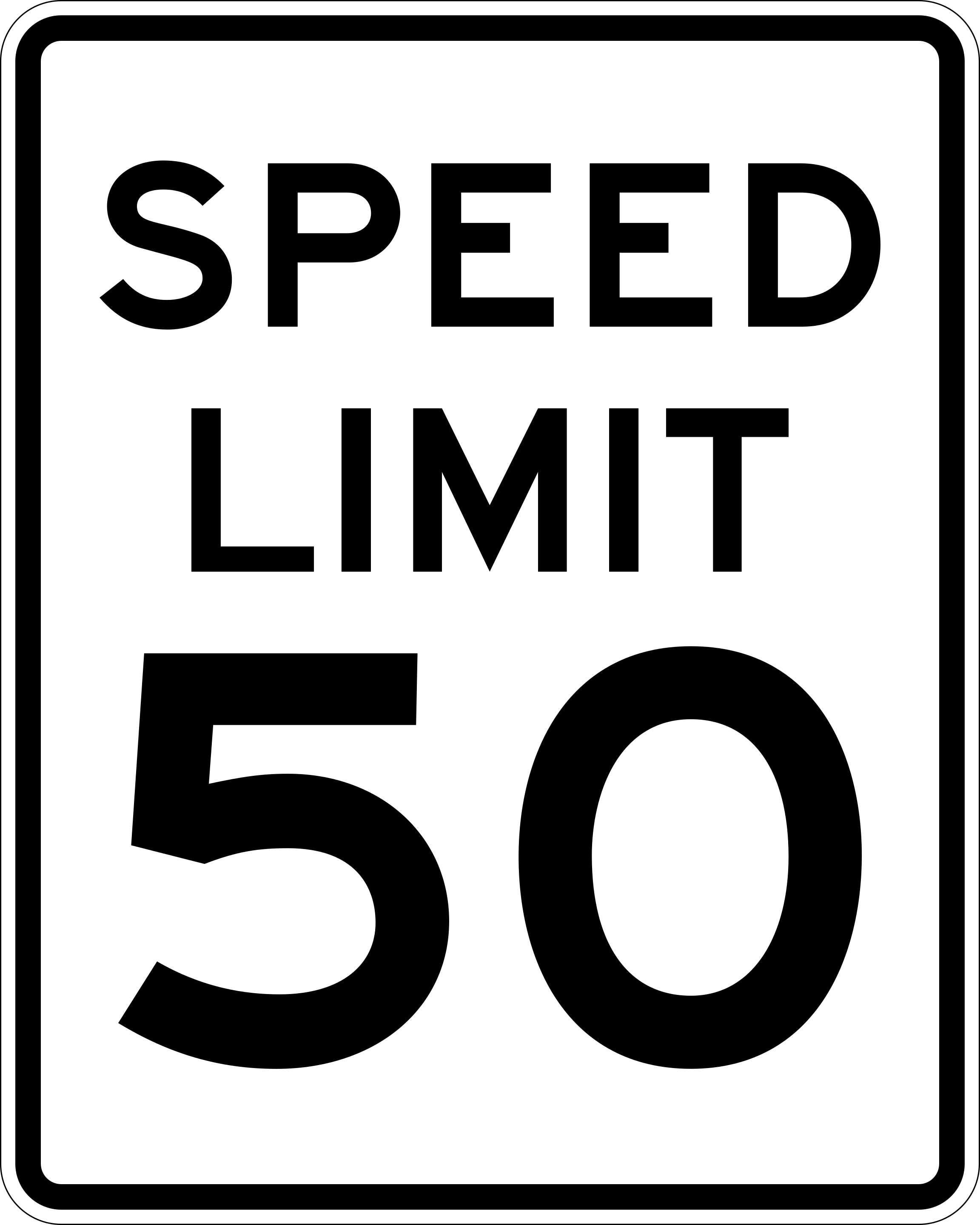
- Yes, 50 is the speed you must keep
- No, 50 is the most you may drive there
- No, it is only a suggested speed
- Yes, unless traffic is heavy
Show answer
No, 50 is the most you may drive there. A white SPEED LIMIT sign gives the maximum speed in miles per hour for that stretch of road. It does not require you to drive that fast. In poor weather, heavy traffic, or low visibility, the basic rule may require you to go slower. Some Oregon speed limit signs are electronic and change with conditions, and police enforce those like any other limit.
Study this in the handbook: Regulatory Signs
10. Why does the Oregon manual warn about passing at dawn or dusk?
- Oncoming cars may lack headlights
- Passing zones close at sunset by law
- Your high beams must be off to pass
- Your mirrors do not work in low light
Show answer
Oncoming cars may lack headlights. Dawn and dusk are tricky times to pass. Oregon warns that oncoming vehicles may not have their headlights on, and you may not see one until it is too late. Before you pull out, make sure you have a clear view of the road ahead, and if you are not sure it is clear, stay in your lane. Also be alert for people riding bicycles and pedestrians, who are harder to see at those times.
Study this in the handbook: Headlights and Hazardous Conditions
11. Police and highway officials announce that driving is very hazardous because of an ice storm. What does Oregon advise?
- Drive slowly with your hazard lights on
- Drive only on main highways and freeways
- Stay off the road until it improves
- Follow closely behind a snowplow
Show answer
Stay off the road until it improves. Snow and ice make it harder to see and increase the distance you need to stop. Oregon says to pay attention to weather forecasts and warnings, and when police or highway officials say driving is very hazardous, to stay off the road. If you must drive on snow and ice, slow down, leave more room, press the gas and brakes gently, and do not use cruise control.
Study this in the handbook: Headlights and Hazardous Conditions
12. Coming down a long mountain grade, you see smoke coming from the wheels of a truck ahead. What should you do?
- Pass it quickly to get away from danger
- Leave more space and do not pass it
- Follow closely so its driver can see you
- Flash your lights to warn its driver
Show answer
Leave more space and do not pass it. Large vehicles cannot hold their speed climbing hills and must go slowly downhill to stay in control. On a long downgrade, smoking wheels or a truck picking up high speed can be a sign of brake loss. Oregon's instruction is to leave more space and not to pass. Dropping back keeps you out of the truck's way if its driver cannot slow down, while passing would put your vehicle directly in front of it.
13. A row of white triangles is painted across your lane, with the points aimed at your car. What does it mark?
- A speed hump just ahead
- The start of a passing zone
- A spot where you must stop every time
- The point where you must yield
Show answer
The point where you must yield. A yield line is a row of triangles across your lane, pointing toward your vehicle. It shows the point where you must yield, often before a crosswalk or at a roundabout entry. Yielding means slowing or stopping as needed so another vehicle or a pedestrian can continue safely. It does not demand a stop every time the way a solid white stop line does, but you must stop there if someone has the right of way.
Study this in the handbook: Pavement Markings
14. A driver behind you wants to pass, and you can see the road ahead is clear. What does Oregon law say about signaling that it is safe?
- Flash your right signal to show it is clear
- Wave them around with your left arm
- You may not flash signals to tell them when to pass
- Tap your brakes twice so they know to go
Show answer
You may not flash signals to tell them when to pass. It can feel helpful to wave someone past, but Oregon law prohibits flashing any of your signals at drivers to tell them when to pass, and the manual also says not to use your hands for it. The passing driver must judge the road alone. What you can do is stay to the right, check oncoming traffic, and adjust your speed so the other vehicle can move back into the lane as soon as possible.
Study this in the handbook: Passing and Freeway Driving
15. You are merging onto an Oregon freeway from an on-ramp. Who has the right of way?
- Traffic already on the freeway
- You, as the merging driver
- Whichever driver is going faster
- The driver of the larger vehicle
Show answer
Traffic already on the freeway. Entering a freeway is different from most intersections because you speed up instead of slowing down, but the right of way still belongs to traffic already on the freeway. You must yield to it. Use the on-ramp to build up speed, check your mirrors and blind spots, and merge into a gap that fits. Freeway drivers may move over to help you, but they are not required to, so plan your own gap.
Study this in the handbook: Passing and Freeway Driving
16. Which warning sign tells you that the one-way road you are on will soon have oncoming traffic?
- Divided Highway Begins
- Lane Reduction
- Keep Right
- Two-Way Traffic Ahead
Show answer
Two-Way Traffic Ahead. The Two-Way Traffic Ahead sign shows two arrows pointing in opposite directions. It means the one-way road you are on joins a two-way road ahead and you will be facing oncoming traffic. Move to the right side of the road, watch the center line, and stop treating the left side as your space. Passing is allowed only where markings and conditions permit it.
Study this in the handbook: Warning, Guide and Service Signs
17. A 19-year-old drinks one beer at a party, waits an hour, and then drives. A test finds a small amount of alcohol. What is the result?
- A pass, since it is below 0.08%
- A pass, since an hour has gone by
- A failed test, since any amount fails
- A warning only, on a first offense
Show answer
A failed test, since any amount fails. Oregon has a zero tolerance law for drivers under 21. If you are under 21, you will fail the test if you have a blood alcohol concentration of any amount. The 0.08 percent figure applies to drivers 21 and older. By driving, you have also agreed to take a breath, blood, or urine test when asked by police. Waiting an hour does not change the result if alcohol is found.
Study this in the handbook: Alcohol, Drugs and DUII
18. You are looking for an electric vehicle charging station or a rest area off the highway. Which sign color should you watch for?
- Green
- Blue
- Brown
- Orange
Show answer
Blue. Oregon's blue motorist service signs tell you about services or facilities along the highway. They may show that gas, food, and lodging are available at the next exit, that a rest area is ahead, or that an electric vehicle charging station is available. They can also mark accessible facilities and the road to a hospital. Green signs, by contrast, give exit and direction information.
Study this in the handbook: Warning, Guide and Service Signs
19. As you drive through a curve on a two-lane road, where should your vehicle be?
- Close to the center line to straighten it
- In the middle of your lane, right of center
- On the inside edge to shorten the curve
- Partly on the shoulder for extra room
Show answer
In the middle of your lane, right of center. In a curve, Oregon says to look through the curve to where you want to go, then check where approaching vehicles are in their lane. Stay to the right of the center line and in the middle of your lane. Cutting the curve or drifting toward the center line brings you close to oncoming traffic you may not see until late. Slow down before the curve and be alert for bicycles, pedestrians, or slow vehicles around it.
Study this in the handbook: Space Cushion and Following Distance
20. On the freeway, you notice traffic slowing well ahead of you. What can you do to warn the drivers behind you?
- Flash your high beams a few times
- Sound your horn twice as you slow
- Switch on your right turn signal early
- Lightly tap your brake pedal several times
Show answer
Lightly tap your brake pedal several times. Freeway traffic can slow suddenly, and drivers behind you may not see what you see. Oregon advises staying alert for any hint that traffic ahead is not moving normally, and when you spot it, lightly tapping your brake pedal several times. The flashing brake lights alert the drivers behind you early, giving them more time to slow. Then slow down smoothly and keep a safe following distance from the vehicle ahead of you.
Study this in the handbook: Passing and Freeway Driving
Every question is written from the official Oregon Driver Manual. Need paper? Printable OR practice test with answer key.
Last verified 2026-10-05. How we check every question · Study all 500 as flashcards
Frequently asked questions
How many questions are on this Oregon practice test?
This fixed set has 20 questions. It is test 23 of 25 from the 500 question Oregon bank. The real OR exam asks 35 questions and you need 28 correct.
What is the passing score for the real Oregon test?
28 of 35 correct to receive a passing score That figure comes from the official Oregon source cited on the DMV facts page.
How does this fixed test relate to the full Oregon bank?
Each numbered test is a fixed set of questions in a fixed order, so you can retake the same test later and compare. Every test mixes road signs and the other topics in about the same proportion as the full bank. Tests 1 to 25 together cover every question in the Oregon bank once. The full practice page mixes the whole bank at random.
Last verified 2026-10-05. See the Oregon DMV facts page for sourced state details.