
Test 19 of 25 · 20 questions · Free 2026
OR Permit Practice Test 19
Jump to the test ↓A fixed 20 question set from the Oregon bank with answers and plain English explanations. The real OR exam is 35 questions, 80 percent to pass; take the full length version on the main practice page.
Question 1 of 20 · 0 right so far
All 20 questions in test 19
Every question below comes from the Oregon question bank on this page. Open a question to see the correct answer and the explanation. Nothing here is hidden behind a signup.
1. Your right wheels drift off the pavement onto a gravel shoulder. What should you do first?
- Slow down without braking hard
- Brake hard to stop as fast as you can
- Steer sharply back onto the road
- Speed up so you can climb back on
Show answer
Slow down without braking hard. If you drive off the road, the wrong reaction can cause a collision. Oregon's steps are: do not panic or brake hard, and slow down until you can get back on the road safely. Grip the steering wheel firmly and keep a straight course while you slow. Then turn the front wheels just enough to get back onto the pavement, because turning sharply could carry you across the road into oncoming traffic.
Study this in the handbook: Avoiding Collisions and Equipment Failures
2. At night, bright headlights are coming toward you. Where should you look?
- Right at the lights to judge their distance
- Down at your dashboard until they pass
- Toward the center line to hold your lane
- A little to the right, at the road edge
Show answer
A little to the right, at the road edge. At night you can only see as far as your headlights, and glare from oncoming lights can blind you for a moment. Oregon's tip is to look a little to the right of oncoming lights and watch the road edge or fog line. That keeps you in your lane while you avoid staring into the glare. Keep your own headlights, taillights, and turn signals clean and working, too.
Study this in the handbook: Headlights and Hazardous Conditions
3. You want to reach a store on the left side of the cross street, but this sign is posted at the corner. What should you do?
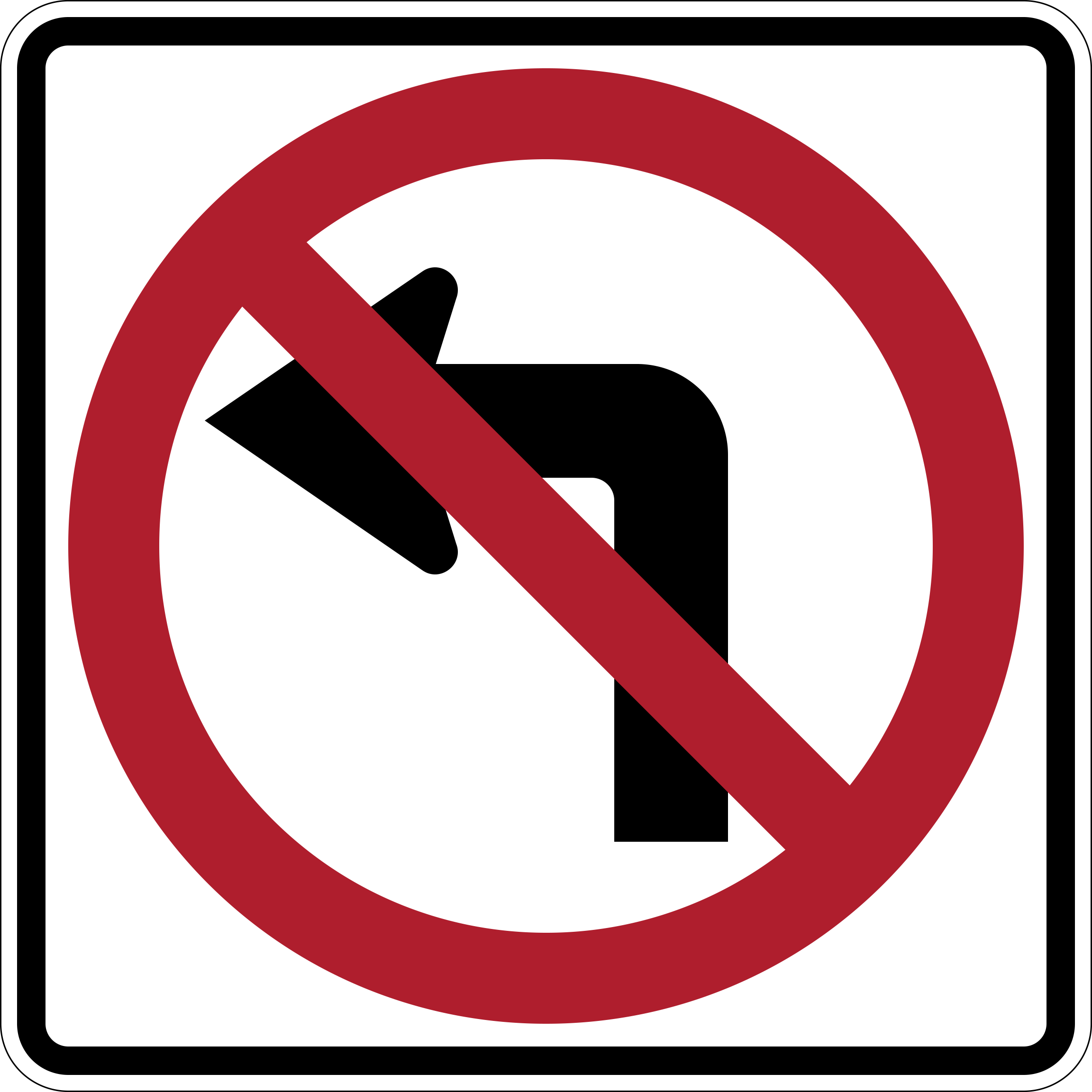
- Go on and find a legal route, like around the block
- Turn left if no oncoming cars are near
- Turn left after a complete stop
- Use the next driveway to make a quick U-turn
Show answer
Go on and find a legal route, like around the block. This sign prohibits left turns from your approach. The store being on the left does not change that, and neither does an empty intersection or a full stop. Continue through and find a legal way to get there, such as turning at a later intersection or driving around the block. Oregon's turning advice makes the same point: it is safer to go around the block than to risk a collision with a last-minute move.
Study this in the handbook: Regulatory Signs
4. What color does Oregon use for warning signs that alert you to possible hazards ahead?
- Green
- Blue
- Brown
- Yellow
Show answer
Yellow. Oregon's warning signs are yellow. They alert you to known possible hazards or changes in road conditions ahead, such as curves, intersections, merges, or slippery pavement. Work zones use orange signs and devices instead. Even with these signs, you are ultimately responsible for recognizing and reacting correctly to changing conditions, whether or not a warning sign is posted for them.
Study this in the handbook: Warning, Guide and Service Signs
5. You are driving 55 mph on a highway behind another car. What following distance does Oregon recommend?
- 2 seconds
- 4 seconds or more
- 3 seconds
- 1 second per 10 mph
Show answer
4 seconds or more. Oregon defines a safe following distance as 2 to 4 seconds, but at speeds greater than 30 mph it should be 4 seconds or more. To check, note when the vehicle ahead passes a sign or pole and count the seconds until you reach it. Increase the gap further on wet roads, at night, behind motorcycles or large vehicles, or when towing.
Study this in the handbook: Space Cushion and Following Distance
6. You are about to enter a roundabout when an ambulance with its siren on approaches. What should you do?
- Enter quickly and stop inside the circle
- Enter and keep circling until it passes
- Stop in the crosswalk at the entry
- Stay out and pull over to the right
Show answer
Stay out and pull over to the right. Oregon has a specific plan for emergency vehicles at roundabouts. If you have not entered yet, do not enter; pull over to the right and let other vehicles clear the intersection so the emergency vehicle can move through. If you are already inside, never stop in the circle; keep going, exit, and then pull over to the right shoulder. In both cases the goal is to leave the roundabout empty for the emergency vehicle.
Study this in the handbook: Turns, U-Turns and Roundabouts
7. At a crosswalk, a woman moves the front wheels of her wheelchair off the curb ramp and onto the road. When does Oregon say she is crossing?
- When she reaches the center of your lane
- Once her whole body is past the curb
- Only when a walk signal is lit for her
- Now, as part of her chair is on the road
Show answer
Now, as part of her chair is on the road. Oregon defines the moment a pedestrian starts crossing: it happens when any part or extension of the person, such as a cane, wheelchair, or bicycle, moves onto the road. That matters because your duty to stop begins then, not when the person reaches your lane. Watch the curb edges at crosswalks and be ready to stop as soon as a wheel, a foot, or a cane comes off the curb.
Study this in the handbook: Pedestrians and Bicycles
8. Why does the Oregon manual tell drivers to give people on bicycles plenty of room?
- Riders must stay in the middle of the lane
- Riders must signal every move with their arms
- Potholes, glass, or grates may make them swerve
- Bicycles are allowed to ignore stop signs
Show answer
Potholes, glass, or grates may make them swerve. People on bicycles often react to road hazards differently than drivers do. Oregon lists potholes, glass, litter, storm grates, railroad tracks, and opened doors of parked cars as things that can make a rider move into your path or slow down. Give riders plenty of room to move around these hazards, be ready to slow down when you approach, and remember that you may not be able to predict what a rider will do next.
Study this in the handbook: Pedestrians and Bicycles
9. As you drive down a freeway on-ramp, the ramp meter signal is dark. What should you do?
- Stop as if it were a stop sign
- Keep going without stopping at it
- Stop and wait for it to turn green
- Slow to a crawl and yield to all cars
Show answer
Keep going without stopping at it. Ramp meters only operate during certain times of the day and appear dark when they are not in use. Oregon says not to stop at a dark ramp meter. This is different from a dark traffic signal at an intersection, which you treat as stop signs in all directions. Stopping at an unused meter surprises the drivers behind you on the ramp. Keep moving, build speed, and merge into freeway traffic.
Study this in the handbook: Passing and Freeway Driving
10. A storm has knocked out power, and the traffic signals at a busy four-lane intersection are completely dark. Who must stop?
- Every driver, from every direction
- Only drivers on the smaller street
- Nobody, if traffic seems light
- Only drivers who want to turn
Show answer
Every driver, from every direction. When a signal appears dark, such as during a power failure, Oregon says to stop as if there were stop signs in all directions. That applies to drivers on the main road as well as the side street. After stopping, the usual four-way stop courtesy applies: the driver who stopped first goes first, and when in doubt, yield to the driver on your right.
Study this in the handbook: Traffic Signals
11. On an Oregon two-way road, what does a yellow center line tell you about the traffic on the other side of it?
- It is moving the same way you are
- It is a lane for buses and bicycles
- It is moving in the opposite direction
- It is a lane for passing only
Show answer
It is moving in the opposite direction. Color is the quickest clue to which way traffic is going. Yellow markings separate traffic moving in opposite directions and mark the left edge of one-way roads and ramps. White markings separate lanes going the same direction and mark the right edge of the road. So if a yellow line is on your left, the traffic beyond it is coming toward you, and if you see a yellow line on your right, you are going the wrong way.
Study this in the handbook: Pavement Markings
12. When does the Oregon manual say you should pick up speed on a curve?
- Halfway through, once you can see the exit
- Gradually, as you come out of the curve
- Right as you enter, to hold the car steady
- Not until you reach the next speed sign
Show answer
Gradually, as you come out of the curve. Oregon's curve routine is to slow down before you enter, look through the curve to where you want to go, and stay right of the center line in the middle of your lane. Be alert for bicycles, pedestrians, or slow vehicles hidden around the bend. Only as you come out of the curve should you increase your speed, and then gradually. Braking or speeding up hard in the middle of a curve can cost you control.
Study this in the handbook: Space Cushion and Following Distance
13. What speed limit applies when you drive through an Oregon public park and no other speed is posted?
- 15 mph
- 20 mph
- 25 mph
- 35 mph
Show answer
25 mph. Public parks share the 25 mph statutory limit with residential districts and with ocean shores where vehicles are allowed. The limit applies whether or not it is posted, unless a sign gives a different speed. Oregon's manual asks drivers to be extra careful in places where children are likely to be, such as a park, and to watch for children who may run out unexpectedly. The basic rule may require a speed below 25 mph.
Study this in the handbook: Oregon Speed Limits
14. When must a tractor or other slow farm machine display this emblem?

- Whenever it is used on a public highway
- At night or in poor visibility
- When it travels slower than 15 mph
- While it is towing a trailer
Show answer
Whenever it is used on a public highway. Slow moving vehicles, such as farm equipment, must show this emblem whenever they use a public highway. It has a reflective red border and a fluorescent orange center so you can spot it from a distance in daylight or in your headlights. When you see it, expect to close on the vehicle quickly and be prepared to slow down or adjust your lane position. Pass only where passing is legal and you can see far enough ahead.
Study this in the handbook: Motorcycles, Large Vehicles and Other Road Users
15. An Oregon school speed sign says its 20 mph limit applies during school hours. When does that limit apply?
- 7 a.m. to 4 p.m. on any weekday of the year
- 7 a.m. to 5 p.m. on days school is in session
- 8 a.m. to 3 p.m. while classes are held
- Only while a yellow light on the sign flashes
Show answer
7 a.m. to 5 p.m. on days school is in session. Oregon uses several school speed signs. The School Hours Speed Limit sign makes the 20 mph limit apply between 7 a.m. and 5 p.m. on a day school is in session. That window is wider than class time, so expect it to be in force early in the morning and late in the afternoon. A different sign has a yellow light that flashes when children are arriving or leaving, and another applies whenever children are present.
Study this in the handbook: Oregon Speed Limits
16. You are waiting to turn left, and an oncoming car is blinking its right turn signal. What does the Oregon manual advise?
- Turn now, since that car will leave your path
- Wait until you see it actually begin to turn
- Flash your headlights so the driver knows you are going
- Go as soon as the car starts to slow down
Show answer
Wait until you see it actually begin to turn. A turn signal shows what a driver intends, not what the driver will do. Oregon warns not to rely only on another driver's signal, because someone may signal right and then turn left, or turn without signaling at all. When you are waiting to turn across that car's path, wait until you can see it really turning before you pull out. The same caution applies to a motorcycle whose signal may not cancel by itself.
Study this in the handbook: Turns, U-Turns and Roundabouts
17. You have just passed a long truck on a highway and want to move back into its lane. When is it safe to pull in front of it?
- As soon as your front bumper passes the truck's cab
- When you can see its headlights in your left side mirror
- After you flash your lights so the driver notices you
- When the entire front of the truck shows in your rearview mirror
Show answer
When the entire front of the truck shows in your rearview mirror. Large vehicles take longer to pass, and the driver cannot see you when you are in a blind spot beside the truck. Oregon says to complete your pass as quickly as possible and not to stay alongside, because it is dangerous to stay in a blind spot too long. Before you pull in front, look for the entire front of the vehicle in your rearview mirror. When all of it is visible, you are far enough ahead to move over.
Study this in the handbook: Motorcycles, Large Vehicles and Other Road Users
18. You are approaching a roundabout, and a person is walking in the crosswalk across your entry lane. What should you do?
- Keep going, since roundabouts keep traffic moving
- Enter and pass behind the person
- Stop for the person before you enter
- Honk so the person speeds up
Show answer
Stop for the person before you enter. As you approach a roundabout, Oregon says to slow down, look for signs showing your exit, and watch for people riding bicycles, who may merge into traffic or use the sidewalk. When you reach the crosswalk, stop for pedestrians using the crosswalk in your lane. Then yield to traffic inside the roundabout and to vehicles leaving it, and merge into a gap. Watch the exit crosswalk too.
Study this in the handbook: Turns, U-Turns and Roundabouts
19. You are about to pull away from the curb into traffic. What does Oregon say you must do?
- Signal, then pull out, since others must let you in
- Check your mirrors only, then pull out quickly
- Signal, check mirrors and blind spots, and yield
- Honk once, then ease out into the lane
Show answer
Signal, check mirrors and blind spots, and yield. Pulling away from a curb is a common moment for crashes. Oregon says that when leaving a parked or stopped position, you should check your blind spots and mirrors and yield to all other traffic. Use your turn signal long enough to let traffic know you are moving into the lane. Drivers already in the lane have the right of way, so wait for a gap instead of forcing your way in.
20. A streetcar in your lane stops to let passengers on and off. What should you do?
- Stay behind it until it moves or riders are clear
- Pass it right away while riders are boarding
- Honk so riders know that you are passing
- Pass on the right between it and the curb
Show answer
Stay behind it until it moves or riders are clear. Streetcars and light rail trains share some downtown lanes with cars and stop often to pick up and drop off passengers, much like buses. When one stops, Oregon says to stay behind it until it moves again or the people are safely away. Passengers getting off may walk across your lane, and others may run to catch the car. Let streetcars and trains go first, and pass only when it is safe.
Every question is written from the official Oregon Driver Manual. Need paper? Printable OR practice test with answer key.
Last verified 2026-10-05. How we check every question · Study all 500 as flashcards
Frequently asked questions
How many questions are on this Oregon practice test?
This fixed set has 20 questions. It is test 19 of 25 from the 500 question Oregon bank. The real OR exam asks 35 questions and you need 28 correct.
What is the passing score for the real Oregon test?
28 of 35 correct to receive a passing score That figure comes from the official Oregon source cited on the DMV facts page.
How does this fixed test relate to the full Oregon bank?
Each numbered test is a fixed set of questions in a fixed order, so you can retake the same test later and compare. Every test mixes road signs and the other topics in about the same proportion as the full bank. Tests 1 to 25 together cover every question in the Oregon bank once. The full practice page mixes the whole bank at random.
Last verified 2026-10-05. See the Oregon DMV facts page for sourced state details.