
Test 11 of 11 · 20 questions · Free 2026
OR Permit Practice Test 11
Jump to the test ↓A fixed 20 question set from the Oregon bank with answers and plain English explanations. The real OR exam is 35 questions, 80 percent to pass; take the full length version on the main practice page.
Question 1 of 20 · 0 right so far
All 20 questions in test 11
Every question below comes from the Oregon question bank on this page. Open a question to see the correct answer and the explanation. Nothing here is hidden behind a signup.
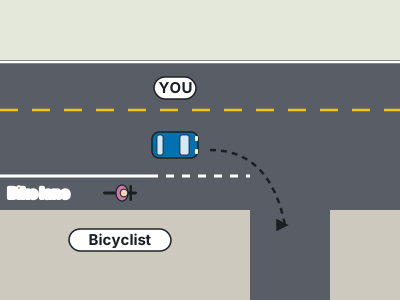
1. When preparing to turn across a bicycle lane, what should a driver do?
- Yield to people riding bicycles before crossing the lane
- Move into the bicycle lane early and wait there
- Sound the horn so bicyclists must stop
- Turn without checking because bicycles must yield
Show answer
Yield to people riding bicycles before crossing the lane. A driver may cross a bicycle lane to make a turn, but must first check the blind spot and yield to a person riding there or on the sidewalk. Moving into that lane early is specifically unsafe because it places the vehicle in a space intended for bicycle travel. A horn does not transfer the right of way, and bicyclists do not automatically yield to a turning vehicle. The reliable cue is shoulder check plus mirror check immediately before crossing the lane.
Study this in the handbook: Turns, U-Turns and Roundabouts
2. Who may be in the vehicle during an Oregon drive test?
- Only the applicant and the examiner
- The applicant, the examiner, and a translator
- The applicant, the examiner, and one parent
- Anyone, as long as pets stay in a carrier
Show answer
Only the applicant and the examiner. Only you and the examiner are allowed in the vehicle during an Oregon drive test; translators, family, friends and pets are not allowed. You must also remove weapons from the vehicle and show current registration and valid proof of insurance or the test is rescheduled. Drive tests are by appointment only, and DMV suggests scheduling at least three weeks ahead.
Study this in the handbook: The Knowledge and Drive Tests
3. In an Oregon work zone, when do temporary posted speed limits apply?
- Only while workers are visible
- Only during daylight hours
- Only when traffic is stopped
- At all times
Show answer
At all times. A temporary speed posted in a work zone applies at all times, even when workers are not visible. The roadway may still have shifted lanes, narrow passages, equipment, or other hazards after the crew leaves. Limiting the rule to daylight, stopped traffic, or visible workers would make the warning disappear precisely when a driver may be less alert to the changed layout. Slow to the temporary limit when entering the zone and continue at that speed until an End Work Zone Speed Limit sign or another posted limit appears.
Study this in the handbook: Emergency Vehicles, Stopped Vehicles and Work Zones
4. A traffic signal flashes red at an intersection. How must the driver treat it?
- As a stop sign
- As a green light with priority over cross traffic
- As a yield sign without a required stop
- As a flashing yellow signal requiring caution only
Show answer
As a stop sign. Oregon treats a flashing red signal the same as a stop sign, so the driver must stop and then proceed only after yielding and confirming the movement is safe. The yield-only option omits the required stop. A flashing yellow signal has a different meaning, and a green light does not describe a red indication. Use the marked stop line or crosswalk when present, then check for pedestrians, bicycles, and traffic before entering the intersection.
Study this in the handbook: Traffic Signals
5. When parallel parking, how close must the vehicle be to the curb?
- No more than 6 inches
- No more than 18 inches
- No more than 12 inches
- No more than 24 inches
Show answer
No more than 12 inches. Oregon's parallel parking rule places the vehicle no more than 12 inches from the curb. The same section says to park in the direction traffic is moving and, where there is no curb, as close as possible to the edge of the shoulder. Six inches is not the stated limit, while 18 and 24 inches leave the vehicle farther into the roadway than the rule allows. After settling into the space, check that the car is aligned with traffic and close enough to avoid obstructing passing vehicles.
6. What must a driver do at an octagonal Stop sign?
- Stop only when a pedestrian is visible
- Slow down and continue if the intersection looks empty
- Come to a complete stop and yield before entering
- Yield without stopping unless another sign is posted
Show answer
Come to a complete stop and yield before entering. An octagonal Stop sign requires a complete stop, followed by yielding to other vehicles and pedestrians before entering when it is safe. The empty-intersection choice wrongly turns a stop requirement into a yield rule. Waiting for a pedestrian is also too narrow because cross traffic may have priority. Use the stop line or crosswalk as the stopping reference, scan both directions, and proceed only after the intersection is clear and your movement is allowed.
Study this in the handbook: Regulatory Signs
7. May operators of motorized wheelchairs and scooters use Oregon bike lanes and paths?
- Only when escorted by a bicycle rider
- No, they must always use the roadway center
- Only during daylight hours
- Yes, and drivers must yield to them as they would to a bicyclist
Show answer
Yes, and drivers must yield to them as they would to a bicyclist. Oregon permits operators of motorized wheelchairs, scooters, and personal assistive mobility devices to use bike lanes and paths. Drivers must yield to those operators as they would to a person riding a bicycle. The manual does not restrict the permission to daylight, an escort, or roadway-center travel. Treat these users as part of the vulnerable traffic sharing the lane or path. Slow before crossing their line of travel, check the intended movement, and leave enough room for them to proceed safely.
Study this in the handbook: Pedestrians and Bicycles
8. At an intersection with a green bike box, may you turn right while the traffic signal is red?
- No, right turns are not allowed there on a red signal
- Yes, after coming to a complete stop
- Yes, if no bicyclist is waiting in the box
- Yes, but only from inside the bike box
Show answer
No, right turns are not allowed there on a red signal. Bike box intersections carry their own rule: no right turns are allowed when the signal is red. The usual Oregon right turn after a full stop does not apply here, and an empty box does not create an exception. Drivers must stop for the signal behind the bike box and must never stop inside it, so turning from the box is doubly wrong. When the light turns green and you turn right, signal and yield to people riding bicycles on your right.
Study this in the handbook: Pedestrians and Bicycles
9. If an Oregon applicant under 18 applying for a first-time driving privilege is enrolled in or attending school, who must certify that status?
- The school principal
- A parent or legal guardian
- A licensed driving instructor
- The applicant's employer
Show answer
A parent or legal guardian. For an applicant younger than 18 who is enrolled in or attending school, Oregon places the certification duty on a parent or legal guardian. The school principal and driving instructor choices name people who may know the student's situation but are not identified as the certifying party. An employer has no role in this requirement. The rule has a separate path for someone no longer in school, who must present a high school diploma or GED certificate. First identify the applicant's school status, then gather the document or certification that matches it.
Study this in the handbook: Permits and Teen Licenses
10. What response does Oregon recommend when visibility is reduced or the road is wet, snowy, or icy?
- Follow the vehicle ahead more closely to see its path
- Keep the posted speed and shorten the following gap
- Use cruise control to maintain a steady pace
- Use slower speeds and increase the following distance
Show answer
Use slower speeds and increase the following distance. Hazardous conditions call for slower travel and more space behind the vehicle ahead because visibility and traction can deteriorate while braking distance grows. Keeping the posted speed may violate the basic rule when conditions make it unsafe. Cruise control is especially inappropriate on wet or snow-covered roads, and a close following gap leaves no recovery time if the lead vehicle stops. Reduce speed smoothly, keep windows clear, and preserve a cushion that allows gentle braking and steering.
Study this in the handbook: Space Cushion and Following Distance
11. Before entering an intersection on a green light, what must you confirm?
- You can stop in the intersection if traffic backs up
- The signal will remain green for at least one minute
- A vehicle behind you is ready to follow
- There is room for your vehicle on the other side
Show answer
There is room for your vehicle on the other side. A green light does not permit a driver to enter an intersection that cannot be cleared. Oregon says to wait until there is room for the vehicle on the other side. The choice allowing a stop in the intersection creates a blockage and can trap cross traffic or pedestrians. Signal timing and the readiness of a following vehicle do not establish a clear exit. Before crossing the line, look beyond the intersection, judge whether your lane will remain open, and wait behind the stop line if congestion leaves no space ahead.
Study this in the handbook: Right of Way at Intersections
12. What penalties can a third Oregon mobile-electronic-device driving offense carry?
- Up to $100
- Up to $2,500 and six months in jail
- Up to $1,000
- No fine, only a warning
Show answer
Up to $2,500 and six months in jail. The Park Your Phone fine schedule in the Oregon manual lists up to $1,000 for a first offense, up to $2,000 for a second offense, and up to $2,500 plus six months in jail for a third offense. These penalties concern unlawful phone or other mobile device use while driving. A $100 cap or a warning badly understates them, and $1,000 is only the ceiling for a first offense. The penalties climb with each offense, so a repeat offender risks jail time as well as a larger fine.
13. When visibility makes it difficult to see people or vehicles 1,000 feet ahead, what must Oregon drivers do?
- Use high beams in every condition
- Use parking lights only
- Wait until sunset before using lights
- Turn on their headlights
Show answer
Turn on their headlights. Oregon requires lights whenever conditions make it difficult to see people or vehicles 1,000 feet ahead. This requirement can apply during the day in fog, smoke, heavy rain, or another visibility problem. Parking lights alone are not the required response, and waiting for sunset ignores the visibility trigger. High beams are not mandatory in every condition and may create glare. Use the headlights appropriate for the conditions, slow down, and increase the space around the vehicle.
Study this in the handbook: Headlights and Hazardous Conditions
14. In ideal conditions at 60 mph, how does the Oregon manual describe the distance you travel from spotting a hazard to a full stop?
- About two car lengths
- Greater than the length of a football field
- About 60 feet, one foot for each mph
- About half the length of a football field
Show answer
Greater than the length of a football field. Oregon points out that stopping takes longer than drivers expect. At 60 mph, the distance from recognizing a hazard and braking to coming to a stop is greater than the length of a football field, even in ideal conditions. Two car lengths and 60 feet are wildly short, and half a football field still understates it. Road and weather conditions, vehicle weight, reaction time, and braking ability can all make the distance longer, and the manual separately recommends four seconds or more of following distance above 30 mph.
Study this in the handbook: Space Cushion and Following Distance
15. What does Oregon say about the unmarked crosswalk at an intersection that has no sidewalk?
- It does not exist without painted lines
- It exists only where there are sidewalks on both corners
- It still exists and is at least six feet wide
- It is at least twelve feet wide
Show answer
It still exists and is at least six feet wide. Oregon treats every intersection as having a crosswalk, whether or not lines are painted. To locate an unmarked one, imagine the sidewalk or shoulder at the corner extending across the road. The manual says an unmarked crosswalk is at least six feet wide and exists even with no sidewalk or shoulder, so painted lines and sidewalks are not conditions. Twelve feet is not the stated minimum. Drivers must stop for pedestrians at marked and unmarked crosswalks alike.
Study this in the handbook: Pedestrians and Bicycles
16. When is an alcohol container considered open under Oregon's open container rule?
- Only when a passenger is holding it
- Only when the bottle has no cap at all
- When its seal is broken, even if it has been reclosed
- Only after the container has been opened twice
Show answer
When its seal is broken, even if it has been reclosed. Oregon treats an alcohol container as open once its seal is broken, even if someone puts the cap back on afterward. Reclosing the bottle does not restore the original sealed condition. The passenger's location and the number of times it was opened do not change that definition. The manual also says open bottles or containers should be in the trunk, so a driver should store the container there before travel instead of relying on a replacement cap or the presence of a passenger.
Study this in the handbook: Alcohol, Drugs and DUII
17. How far away must a vehicle's sound system be audible to violate the Oregon manual's noise rule?
- 50 feet from the vehicle
- 25 feet from the vehicle
- 75 feet from the vehicle
- 100 feet from the vehicle
Show answer
50 feet from the vehicle. The manual identifies 50 feet as the distance for this sound system restriction. It is illegal to play a radio or other sound system loud enough to be heard 50 feet away from the vehicle. The point is not only comfort for nearby people; excessive sound can mask horns, screeching tires, and sirens. The 25, 75, and 100 foot choices change the stated distance. Keep the volume low enough to preserve awareness of important sounds around the vehicle.
Study this in the handbook: Seat Belts, Child Seats and Distracted Driving
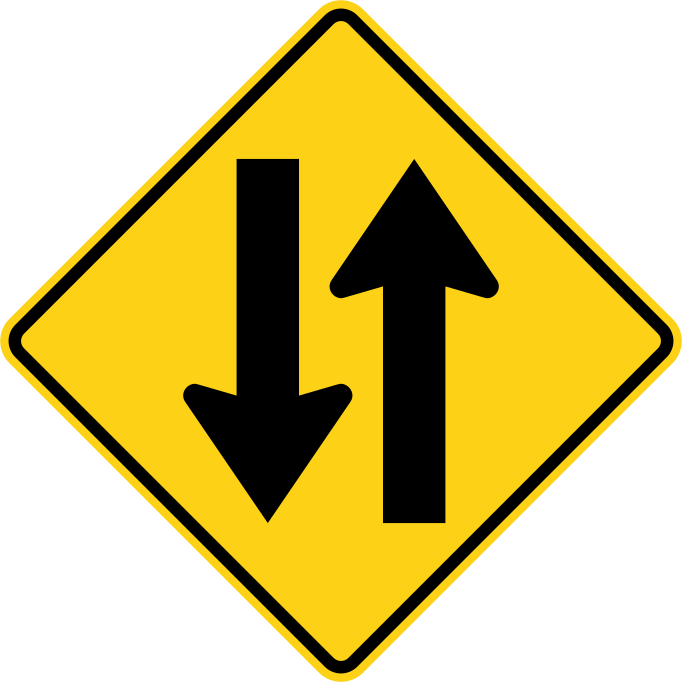
18. What roadway change is represented by the two opposing arrows?
- A divided highway begins and traffic remains separated by a median
- Passing is allowed simultaneously on both sides of the roadway
- A one-way road is joining a two-way road with opposing traffic ahead
- The road becomes one-way in the direction of the upper arrow
Show answer
A one-way road is joining a two-way road with opposing traffic ahead. The opposing arrows warn that the current one-way arrangement will join a two-way road. Oncoming vehicles will then be present, so the driver must keep a proper position and watch for the change in traffic pattern. The choice “Passing is allowed simultaneously on both sides of the roadway” mistakes the arrows for a passing instruction and ignores the approaching opposing stream. Reduce speed if needed, stay on the correct side, and expect vehicles facing you after the transition. This sign is about roadway direction, not permission to pass.
Study this in the handbook: Warning, Guide and Service Signs
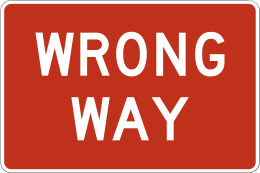
19. If a WRONG WAY sign warns you on a freeway ramp, what should you do?
- Continue slowly until the next intersection
- Pull off to the side, stop, turn on hazard lights, and cautiously correct course
- Reverse direction in the travel lane without stopping
- Accelerate so you can clear the ramp before opposing traffic arrives
Show answer
Pull off to the side, stop, turn on hazard lights, and cautiously correct course. A WRONG WAY sign means the vehicle has begun entering a freeway ramp against the permitted direction. Oregon advises the driver to pull off to the side immediately, stop, and turn on hazard lights to warn other vehicles. The driver should then cautiously turn around or back off the ramp. Continuing to the next intersection or accelerating increases the chance of meeting opposing traffic. Reversing in the travel lane without first stopping also creates a needless conflict. The safety cue is to leave the active path before correcting the mistake.
Study this in the handbook: Passing and Freeway Driving
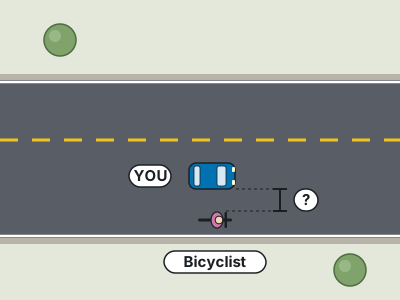
20. At speeds greater than 35 mph, when may you pass a bicyclist traveling in your lane?
- Whenever the center line is broken and traffic is light
- When you leave enough distance to prevent contact if the rider falls
- When you sound the horn and remain close to the rider
- Only after the bicyclist moves onto the shoulder
Show answer
When you leave enough distance to prevent contact if the rider falls. Above 35 mph, passing a bicyclist in the same lane is permitted only when there is enough distance to prevent contact if the rider falls. A broken center line and light traffic do not guarantee that space, and a horn does not replace safe clearance. Waiting for the rider to reach the shoulder is also not the condition stated by the rule. Reduce speed, judge the full lateral gap, and remain behind when the available room is not sufficient. The key cue is the possible fall path beside the vehicle, not merely the pavement marking.
Study this in the handbook: Motorcycles, Large Vehicles and Other Road Users
QualitySpace is expanding to Oregon
We are a California-based independent insurance brokerage working on licensing in more states. We cannot help with Oregon insurance yet. Leave your email and we will let you know when we can.
Every question is written from the official Oregon Driver Manual. Need paper? Printable OR practice test with answer key.
Last verified 2026-10-05. How we check every question · Study all 220 as flashcards
Frequently asked questions
How many questions are on this Oregon practice test?
This fixed set has 20 questions. It is test 11 of 11 from the 220 question Oregon bank. The real OR exam asks 35 questions and you need 28 correct.
What is the passing score for the real Oregon test?
28 of 35 correct to receive a passing score That figure comes from the official Oregon source cited on the DMV facts page.
How does this fixed test relate to the full Oregon bank?
Each numbered test is a fixed set of questions in a fixed order, so you can retake the same test later and compare. Every test mixes road signs and the other topics in about the same proportion as the full bank. Tests 1 to 11 together cover every question in the Oregon bank once. The full practice page mixes the whole bank at random.
Last verified 2026-10-05. See the Oregon DMV facts page for sourced state details.