
Test 21 of 25 · 20 questions · Free 2026
OR Permit Practice Test 21
Jump to the test ↓A fixed 20 question set from the Oregon bank with answers and plain English explanations. The real OR exam is 35 questions, 80 percent to pass; take the full length version on the main practice page.
Question 1 of 20 · 0 right so far
All 20 questions in test 21
Every question below comes from the Oregon question bank on this page. Open a question to see the correct answer and the explanation. Nothing here is hidden behind a signup.
1. You face a steady red right-turn arrow where you would turn onto a two-way street. No sign prohibits turning on red. What may you do?
- Wait for a green arrow before you turn
- Turn right without stopping if it is clear
- Turn only if an officer waves you through
- Stop fully, then turn right after yielding
Show answer
Stop fully, then turn right after yielding. A steady red arrow means stop and stay stopped until the signal changes, except for turns that are allowed on red. Oregon allows the same turns on a red arrow as on a steady red circle. Entering a two-way road, that means a right turn after a complete stop, as long as no sign or officer forbids it. Before turning, yield to pedestrians in the crosswalk and to traffic in the street you are entering.
Study this in the handbook: Traffic Signals
2. You plan to move one lane to the left. After signaling and checking your mirrors, what else should you do?
- Glance over your left shoulder
- Glance over your right shoulder
- Tap your brakes to warn drivers behind
- Sound your horn to warn the next lane
Show answer
Glance over your left shoulder. Before changing lanes, Oregon lists three steps: use your turn signal, check your side and rearview mirrors for traffic coming from behind, and glance over your shoulder in the direction you are moving. For a move to the left, that is your left shoulder. The glance covers the blind spot your mirrors miss, where a car, motorcycle, or bicycle can sit unseen. Change lanes only when you can do it safely.
Study this in the handbook: Space Cushion and Following Distance
3. Your light is a steady green circle and you are turning right. A pedestrian steps into the crosswalk of the street you are entering. What must you do?
- Turn first, since the green light is yours
- Yield to the pedestrian before turning
- Turn if there is room to pass behind them
- Yield only if they have a walk signal
Show answer
Yield to the pedestrian before turning. A steady green circle allows straight, left, and right movements unless a sign prohibits one, but each turn carries a duty. Right turns must first yield to pedestrians, and left turns must yield to pedestrians and oncoming traffic. A person entering the crosswalk of the street you are turning into is directly in your path. Wait until they are far enough away under Oregon's crosswalk rules, then make the turn.
Study this in the handbook: Traffic Signals
4. Ice is forming on a shaded curve, but no warning sign has been posted there. Under the Oregon Driver Manual, who is responsible for reacting to that hazard?
- Road crews, until they post a warning sign
- You, but only once a warning sign is posted
- You are, whether or not a sign warns of it
- Nobody, as long as you stay under the limit
Show answer
You are, whether or not a sign warns of it. Warning signs alert you to known hazards, but Oregon does not let drivers depend on them. The manual says the driver is ultimately responsible for recognizing and reacting correctly to changing conditions, signed or not. A shaded curve can freeze before the rest of the road, and no sign may be posted. Staying under the limit is not enough either, because the basic rule requires a speed that is reasonable for the conditions you actually face.
Study this in the handbook: Warning, Guide and Service Signs
5. As you prepare to make a right turn, where should your vehicle be?
- Slightly left first, to swing wide into the turn
- In the middle of your lane, away from the curb
- Inside the bike lane along the curb
- As near as you can to the right curb or edge
Show answer
As near as you can to the right curb or edge. For a right turn, get as near as you can to the right curb or edge of the road. That keeps vehicles from slipping into the gap on your right while you turn. A bike lane is the exception: you may turn across it, but you must not move into it in preparation for a turn, and you must yield to anyone riding in it. Just before the turn, look left, ahead, right, and left again.
Study this in the handbook: Turns, U-Turns and Roundabouts
6. How can you help the driver behind you keep a safe distance?
- Brake hard now and then so they stay back
- Speed up whenever they get close to you
- Flash your hazard lights while you drive
- Keep a steady speed and brake gently early
Show answer
Keep a steady speed and brake gently early. The space behind you is partly in your control. Oregon says you can help the driver behind keep a safe distance by keeping a steady speed and signaling ahead of time by gently pressing the brake when you have to slow down or stop. Your brake lights alert drivers behind you that you are slowing. If someone still follows too closely, move to the right lane if there is one, or slowly reduce your speed.
7. Which of these is a warning sign that you may be falling asleep at the wheel?
- Feeling hungry on a long trip
- Drifting out of your lane
- Wanting to turn up the radio
- Feeling cold inside the car
Show answer
Drifting out of your lane. Oregon lists warning signs that you may be falling asleep at the wheel: a lot of yawning, head nodding, heavy eyelids, blurred vision, and not staying in your lane. When you are tired, you react more slowly and notice less about changing road and traffic conditions. If you notice these signs, find a safe place to stop and rest rather than trying to push through to your destination.
8. What does this yellow warning sign tell Oregon drivers?
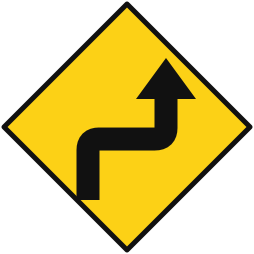
- A winding road with many turns
- One sharp turn, then a straight road
- A side road joins from the left
- The road curves right, then left
Show answer
The road curves right, then left. The Reversing Curves sign warns that the road ahead curves to the right, then left. It is easy to confuse with the Winding Road sign, which warns of a series of turns or curves, and with the Curve sign, which warns of one curve. If a speed is posted below a curve sign, use that speed as a guide. Slow down before you enter the first curve so you can steer smoothly through both.
Study this in the handbook: Warning, Guide and Service Signs
9. A 17-year-old driver wants to use a phone's map app through a hands-free car mount. Is that allowed in Oregon?
- No, under 18 may not use phones while driving
- Yes, hands-free use is allowed for anyone
- Yes, for navigation only
- Yes, if a parent is in the car
Show answer
No, under 18 may not use phones while driving. It is illegal for drivers under 18 to use a cell phone or other mobile electronic device while operating a vehicle. The hands-free option is only for drivers 18 or older. Oregon's advice for younger drivers is to turn the phone off or put it in the back seat and ignore it. Drivers 18 and older must use a hands-free accessory, and the manual suggests letting a passenger handle the device.
Study this in the handbook: Seat Belts, Child Seats and Distracted Driving
10. You are behind a slow car on a two-lane road. The center line is solid on your side now, and a passing zone starts in a quarter mile. When may you begin passing?
- Now, if you can finish inside the zone
- Now, if no oncoming car is visible
- After you reach the start of the passing zone
- Now, if you stay under the speed limit
Show answer
After you reach the start of the passing zone. On a two-lane road, your pass may not begin before the start of a passing zone, and it must be completed before you enter a no-passing zone. Wait until the line on your side becomes broken, then check for a clear path, check your mirrors and blind spot, signal, and complete the pass as soon as possible without exceeding the speed limit.
Study this in the handbook: Passing and Freeway Driving
11. You are in a marked no-passing zone. When may you cross the center line?
- If the car ahead is 10 mph under the limit
- If your side is blocked or you are turning left
- If you can see no oncoming traffic at all
- If a bicyclist is riding ahead of you in your lane
Show answer
If your side is blocked or you are turning left. A no-passing zone allows only two reasons to cross the center line: the right side of the road is blocked, or you are turning left. A slow car, a clear-looking road, or a person on a bicycle ahead does not make passing legal there. Oregon applies the same passing rules to bicyclists, so if you cannot pass safely and legally, slow down and stay behind until you reach a place where passing is allowed.
Study this in the handbook: Passing and Freeway Driving
12. You are driving behind a pilot vehicle that is following a wide load. What does the Oregon manual advise?
- Increase your following distance
- Follow closely so you can pass both at once
- Pass the pilot vehicle right away
- Turn on your hazard lights while you follow
Show answer
Increase your following distance. When you follow a pilot vehicle, Oregon asks you to increase your following distance. Pilot vehicles lead or follow a vehicle carrying an especially large load, so expect slow speeds and sudden changes ahead. If you decide to pass the pilot vehicle or the vehicle with the large load, the manual says to be cautious. Passing any long or large vehicle takes more time and road than passing a car.
13. The limit is 55 mph, and you are driving 50 mph in thick fog where you can see only a short way ahead. Could you be breaking Oregon law?
- No, any speed under the posted limit is legal
- Yes, if 50 mph is unsafe for the conditions
- Only if a digital sign has lowered the limit
- Only if you are going faster than other cars
Show answer
Yes, if 50 mph is unsafe for the conditions. Oregon's basic rule requires a speed that is reasonable and cautious for existing conditions, and it applies on all roads at all times. Driving below the posted limit does not protect you. If 50 mph is unsafe in thick fog, you are violating the basic rule even though 55 is posted. Think about visibility, the road surface, traffic, and people walking or biking when you choose your speed, then slow down until you can stop within what you can see.
Study this in the handbook: The Basic Rule and Variable Speed Signs
14. You want to parallel park on the left side of a two-way street, facing oncoming traffic. Does the Oregon manual allow that?
- No, park facing the way that lane's traffic moves
- Yes, if the space is open and clear
- Yes, for stops of 15 minutes or less
- Yes, if your wheels are within 12 inches
Show answer
No, park facing the way that lane's traffic moves. When parallel parking, Oregon says to park in the direction vehicles are moving in the lane. On a two-way street, that means a car on the left side facing oncoming traffic is parked the wrong way. Park parallel to and no more than 12 inches from the curb, or, if there is no curb, as close as possible to the edge of the shoulder. When leaving, check your blind spots and mirrors and yield to traffic.
15. Your vehicle has a problem on a highway and you must leave it on the shoulder. What must be true about passing traffic?
- No other traffic may be on that road for a mile
- You must stay in the car with the lights off
- A police officer must give you permission first
- Passing traffic must have enough room to get by
Show answer
Passing traffic must have enough room to get by. If your vehicle breaks down and you have no choice, Oregon lets you temporarily stop or park where it is usually not allowed, as long as the vehicle does not create a hazard. You may park on the shoulder of a highway if passing traffic has enough room to get by. Turn on your hazard lights, and if your vehicle cannot be seen from 200 feet in each direction, warn approaching traffic.
16. At a rural crossing, this crossbuck has a yield sign mounted on the same post. No train is in sight. What does that require of you?

- Stop every time before you cross
- Cross at your normal speed without looking
- Slow down, look, and stop if a train is near
- Wait for a flagger to wave you across
Show answer
Slow down, look, and stop if a train is near. Oregon's crossbuck assemblies include either a yield sign or a stop sign, and you obey the one posted. With a yield sign, slow down, look both ways along the tracks, listen, and be ready to stop if a train is approaching. With a stop sign, you must stop even if no train is coming. Either way, cross only when you are sure you can completely clear the tracks.
Study this in the handbook: School Buses and Railroad Crossings
17. Just past this sign, you spot a deer standing at the edge of the road. What should you do?

- Honk and keep your speed
- Swerve into the other lane early
- Slow down and be ready to brake
- Flash your high beams at it
Show answer
Slow down and be ready to brake. Animals can be unpredictable. Oregon says to watch for signs warning of animal crossings and to be prepared to brake or slow down as you pass an animal. The deer warning sign marks an area where deer often cross the road. Slow down and keep your vehicle under control in your own lane rather than making a sudden swerve, and avoid using your horn or making loud, sudden noises near an animal.
Study this in the handbook: Avoiding Collisions and Equipment Failures
18. You are stopped behind a school bus with flashing red lights. The children have crossed and reached the sidewalk. When may you go?
- As soon as the children reach the sidewalk
- When the driver turns the red lights off
- After 30 seconds with no children in sight
- When the bus driver waves you on
Show answer
When the driver turns the red lights off. When a school bus's red lights flash, Oregon requires you to stop before reaching the bus and remain stopped until the driver turns off the flashing red lights. The rule is tied to the lights, not to your own judgment that the children are clear, and not to a wave from anyone. Once the red lights go off, start slowly and keep watching for children near the bus and along the road.
Study this in the handbook: School Buses and Railroad Crossings
19. Which description fits Oregon's regulatory signs, such as SPEED LIMIT and KEEP RIGHT?
- Diamond shaped, with black on yellow
- Rectangular, with white on a green background
- Rectangular, with black on a white background
- Five sided, with black on yellow
Show answer
Rectangular, with black on a white background. Oregon's regulatory signs are rectangular with black words or symbols on a white background, and they tell you what you must do, such as obey a speed limit or keep right of an island. Yellow diamonds are warnings, green signs guide you to exits and cities, and blue signs show services. Regulatory signs that prohibit a movement, like Stop and Do Not Enter, use red.
Study this in the handbook: Regulatory Signs
20. The sun has just set, but the sky is still bright and you can see clearly. Must your headlights be on?
- Yes, they are required from sunset
- No, not until it is fully dark
- No, parking lights are enough until dark
- Only if you drive on a highway
Show answer
Yes, they are required from sunset. Oregon requires headlights from sunset to sunrise, so the requirement starts when the sun sets even if the sky is still light. Headlights also must be on any time conditions make it hard to see people or vehicles 1,000 feet ahead. Using headlights helps other drivers see you at all times of day, and driving with only parking lights on at night or in bad weather is illegal.
Study this in the handbook: Headlights and Hazardous Conditions
Every question is written from the official Oregon Driver Manual. Need paper? Printable OR practice test with answer key.
Last verified 2026-10-05. How we check every question · Study all 500 as flashcards
Frequently asked questions
How many questions are on this Oregon practice test?
This fixed set has 20 questions. It is test 21 of 25 from the 500 question Oregon bank. The real OR exam asks 35 questions and you need 28 correct.
What is the passing score for the real Oregon test?
28 of 35 correct to receive a passing score That figure comes from the official Oregon source cited on the DMV facts page.
How does this fixed test relate to the full Oregon bank?
Each numbered test is a fixed set of questions in a fixed order, so you can retake the same test later and compare. Every test mixes road signs and the other topics in about the same proportion as the full bank. Tests 1 to 25 together cover every question in the Oregon bank once. The full practice page mixes the whole bank at random.
Last verified 2026-10-05. See the Oregon DMV facts page for sourced state details.