
Test 14 of 25 · 20 questions · Free 2026
OR Permit Practice Test 14
Jump to the test ↓A fixed 20 question set from the Oregon bank with answers and plain English explanations. The real OR exam is 35 questions, 80 percent to pass; take the full length version on the main practice page.
Question 1 of 20 · 0 right so far
All 20 questions in test 14
Every question below comes from the Oregon question bank on this page. Open a question to see the correct answer and the explanation. Nothing here is hidden behind a signup.
1. On an Oregon highway you see a brown sign with white lettering. What kind of place does it usually point to?
- Gas, food, or lodging at the next exit
- A detour around road construction
- A park, scenic area, or historic site
- The direction of nearby cities
Show answer
A park, scenic area, or historic site. Sign color tells you what kind of information to expect. Brown signs point to historic and cultural locations, and also to scenic areas, picnic grounds, and parks. Blue signs list services such as gas, food, lodging, or a hospital. Green guide signs give exit information and the direction of roads and cities, and orange devices mark work zones. Learning the colors lets you read a sign at a glance before you are close enough to see the words.
Study this in the handbook: Warning, Guide and Service Signs
2. On a two-lane road, a slow car ahead is driving near the right edge, beside a wide paved shoulder. On which side should you pass it?
- On the right, using the paved shoulder
- On whichever side has more room
- On the right, if it is going under 25 mph
- On the left, within a legal passing zone
Show answer
On the left, within a legal passing zone. On a two-lane road, Oregon says to pass only to the left of the other vehicle. Your pass may not begin before the start of a passing zone and must be finished before a no-passing zone. A wide shoulder is not an extra lane, and the driver ahead does not expect to be passed on the right. Passing on the right is limited to narrow cases, such as a car that is turning left.
Study this in the handbook: Passing and Freeway Driving
3. Your car breaks down and you pull onto the right shoulder of a freeway. Where does Oregon say it is better to wait?
- Walking along the shoulder to the next exit
- In or near the car, on the side away from traffic
- Standing behind the car to wave at traffic
- In the median, across the lanes from your car
Show answer
In or near the car, on the side away from traffic. If your vehicle has trouble on a freeway, move to the right shoulder or an emergency stopping area and turn on your hazard lights. Then, if possible, stay in or near your vehicle on the side away from traffic. Oregon warns that walking along a freeway is dangerous. Standing between your car and passing traffic, or crossing lanes on foot, exposes you to vehicles moving at high speed.
Study this in the handbook: Passing and Freeway Driving
4. This sign hangs over the lane you are in as you approach an intersection. What does it tell you?
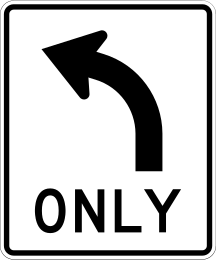
- Vehicles in this lane must turn left
- Left turns are allowed from any lane here
- The left lane ends and traffic must merge right
- You may turn left only after a full stop
Show answer
Vehicles in this lane must turn left. Lane-use control signs show which turns are required or permitted from each lane. A left arrow with the word ONLY over your lane means traffic in that lane has to turn left at the intersection, so if you plan to go straight, move out of the lane well before you arrive. The sign does not open left turns from other lanes, and it does not warn of a lane ending. If you end up in the wrong lane at the last moment, go on to the next intersection.
Study this in the handbook: Regulatory Signs
5. The chart in the Oregon manual shows a pedestrian's risk of death rising with vehicle speed. At what speed does that risk reach 90%?
- 58 mph
- 42 mph
- 23 mph
- 35 mph
Show answer
58 mph. The Oregon manual includes a chart adapted from the Federal Highway Administration showing how speed affects a pedestrian's chance of dying when hit by a vehicle. At 23 mph the risk of death is 10 percent. At 42 mph it rises to 50 percent, and at 58 mph it reaches 90 percent. The jump from 23 to 58 mph takes the risk from one in ten to nine in ten.
Study this in the handbook: The Basic Rule and Variable Speed Signs
6. Which warning sign tells you a T intersection is ahead, where traffic may enter your road from the left or right?
- Crossroad
- Side Road
- Merge
- Add Lane
Show answer
Side Road. The Side Road sign warns that a T intersection is ahead and traffic may enter your road from the left or right. Drivers coming from the side road must yield to you, because a driver on a road that ends at a T intersection with no signs or signals yields to traffic on the through road. Still, watch for vehicles pulling out, and be ready to slow down.
Study this in the handbook: Warning, Guide and Service Signs
7. Before you enter a two-lane roundabout, how should you choose which lane to use?
- Use the signs and markings for your exit
- Pick whichever lane has the shorter line
- Enter on the right, then move left inside
- Use the inside lane for every exit
Show answer
Use the signs and markings for your exit. In a multi-lane roundabout, the lane you enter decides which exits you can safely use. Oregon says to pay close attention to exit and lane use signs and pavement markings before entering, and to enter using the appropriate lane for your exit. Once inside, keep your lane position until you exit and avoid lane changes if possible. Never try to pass, and never drive beside a truck within the roundabout.
Study this in the handbook: Turns, U-Turns and Roundabouts
8. Your adult passenger wants to drink an open can of beer while you drive on an Oregon highway. Is that legal?
- Yes, if the passenger is 21 or older
- No, open alcohol is illegal in the vehicle
- Yes, as long as the driver does not drink
- Yes, if the can stays in a cup holder
Show answer
No, open alcohol is illegal in the vehicle. Oregon's Open Container law makes it illegal to have an open bottle or other container with alcohol in it while you are in a vehicle on any road. It does not matter who is drinking or how old they are. A container counts as open if its seal is broken, even if it has been closed again, and any open containers should be carried in the trunk.
Study this in the handbook: Alcohol, Drugs and DUII
9. This sign is posted on the cross street you are about to turn onto. Which way may you turn?

- Either way, if no traffic is coming
- Against the arrow, so you face traffic
- Only in the direction the arrow points
- Right only, whatever the arrow shows
Show answer
Only in the direction the arrow points. A ONE WAY sign means traffic on that street flows only in the direction of the arrow. Before turning onto the street, check the arrow and turn that way. Oregon also lets you turn left or right on red onto a one-way road in the direction of traffic after a complete stop, unless a sign forbids it. If you ever see a DO NOT ENTER sign or yellow line on your right, you are headed the wrong way.
Study this in the handbook: Regulatory Signs
10. A road has a marked left turn lane, but it is backed up with cars. Can you make your left turn from the through lane next to it?
- Yes, if you signal at least 100 feet ahead
- Yes, whenever the turn lane is full
- Yes, if no oncoming traffic is in sight
- No, you must turn from the left turn lane
Show answer
No, you must turn from the left turn lane. When a left turn lane is provided, Oregon requires you to turn from that lane. Turning from the through lane cuts across the drivers waiting in the turn lane and surprises traffic behind you. If the turn lane is full or you missed it, continue on and go to the next intersection. Driving around the block is safer than a last-minute lane change, and it keeps you from swinging across a line of stopped cars.
Study this in the handbook: Turns, U-Turns and Roundabouts
11. Traffic is backed up at a red light, and the car ahead has stopped just past a crosswalk. Where should you stop?
- Partly in it, as long as people can step around
- Inside it, if the light will turn green soon
- As close as possible to the car ahead of you
- Behind it, with no part of your car over it
Show answer
Behind it, with no part of your car over it. Oregon says not to stop with any part of your vehicle hanging over the crosswalk area. A car blocking the crosswalk forces pedestrians to go around it, which puts them in a dangerous situation. In slow traffic, leave the crosswalk clear even if that means a gap in front of you. The same thinking is behind the rule that you should not enter an intersection on green unless there is room for your car on the other side.
Study this in the handbook: Pedestrians and Bicycles
12. At night you enter a freeway ramp and notice a solid yellow line on your right side. What does that tell you?
- You are in the correct lane
- You are going the wrong way
- The ramp is about to merge left
- A bike lane is to your right
Show answer
You are going the wrong way. A solid yellow line marks the left edge of one-way roads and ramps. When you are going the right way, it is on your left. If it is on your right, you are traveling against traffic. Oregon's instructions for entering a ramp the wrong way are to pull off to the side and stop, turn on your hazard lights, and cautiously turn around or back off the ramp.
Study this in the handbook: Pavement Markings
13. Two cars reach an uncontrolled intersection at about the same time, and the other car is to your right. Who goes first?
- You, since you are on the left
- Whoever is going faster
- Whoever honks first
- The other car goes first
Show answer
The other car goes first. At an intersection with no signs or signals, Oregon says to yield the right of way to any vehicle already in the intersection or approaching from your right. Look left first to make sure cross traffic is yielding, then look ahead and to the right, and be prepared to stop. As you enter, check again for unusual or unexpected actions.
Study this in the handbook: Right of Way at Intersections
14. Which three actions does Oregon list for avoiding a collision or reducing its impact?
- Slowing down, checking mirrors, and stopping
- Speeding up, honking, and changing lanes
- Stopping quickly, turning quickly, and speeding up
- Braking hard, steering left, and honking
Show answer
Stopping quickly, turning quickly, and speeding up. Oregon gives drivers three tools for avoiding a collision or lessening its impact: stopping quickly, turning quickly, and speeding up. Stop if you have enough distance. Turn if you cannot stop in time, since in most cases you can turn faster than you can stop. Speed up when another vehicle is about to hit you from the side or behind and there is room ahead to get out of danger.
Study this in the handbook: Avoiding Collisions and Equipment Failures
15. Which of these does the Oregon manual call dangerous while driving because it takes your eyes off the road?
- Checking your mirrors every few seconds
- Eating, applying makeup, or reading
- Scanning the road far ahead of you
- Glancing at your speedometer
Show answer
Eating, applying makeup, or reading. Being alert is an essential part of safe driving. Oregon warns that any activity that takes your eyes off the road is dangerous, naming examples such as removing clothing, applying makeup, texting, reading, eating, or drinking. Quick mirror checks and scanning ahead keep you aware of traffic, but tasks that pull your eyes and mind away should wait until you are parked.
Study this in the handbook: Seat Belts, Child Seats and Distracted Driving
16. You stop beside a fire hydrant to wait for a friend, staying in the driver's seat with the engine running. Do Oregon's no parking rules apply?
- No, it is not parking if you stay inside
- No, as long as the engine keeps running
- Yes, they apply even with you inside
- Only if you wait more than five minutes
Show answer
Yes, they apply even with you inside. Many drivers believe that sitting in the car makes a stop legal. Oregon's manual says the rules about parking and stopping apply whether you are in your vehicle or not. You cannot stop or park within 10 feet of a fire hydrant, in front of a driveway, in a crosswalk, or in the other listed places. The only exception is a breakdown where you cannot get the vehicle out of the traffic lanes or off the road.
17. The shoulder strap of your seat belt rubs against your neck. What does Oregon say about tucking it under your arm?
- It is fine if the lap belt stays snug
- It is fine on short trips around town
- It is fine if you leave a little slack
- Do not; keep it over your shoulder
Show answer
Do not; keep it over your shoulder. Oregon requires safety belts for all drivers and passengers in all available seating positions, and the manual also explains how to wear one. Do not leave slack in the lap or shoulder portion, and never put the shoulder strap under your arm or behind your back. A properly worn belt reduces the chance of injury in a collision. A belt that is worn wrong does not give that protection, on short trips or long ones.
Study this in the handbook: Seat Belts, Child Seats and Distracted Driving
18. After a heavy storm, water is covering the road ahead of you. What does Oregon advise?
- Drive through slowly in a low gear
- Speed up so you get through quickly
- Do not drive through it
- Follow a bigger vehicle through it
Show answer
Do not drive through it. Oregon's advice on flooded roads is short: do not drive through flooded areas. High water may cause you to lose control of the vehicle or stall the engine. Find another route or wait for the water to go down. If you do drive through standing water and your brakes get wet, gently apply them while driving slowly until they begin to work normally again.
Study this in the handbook: Headlights and Hazardous Conditions
19. Why does Oregon warn drivers about the turn signal of an oncoming motorcycle?
- It may not cancel and could be on by mistake
- Motorcycle signals are too dim to see in daylight
- Riders are not allowed to use turn signals
- A blinking signal means the rider is about to stop
Show answer
It may not cancel and could be on by mistake. On some motorcycles the turn signal does not cancel automatically, and the rider may forget to switch it off. So a blinking signal on an oncoming motorcycle does not prove the rider is turning. Before you turn in front of it, make sure the rider is actually slowing to turn. You must yield to an oncoming motorcycle just as you would to any other vehicle, and it can be hard to judge how far away or how fast it is.
Study this in the handbook: Motorcycles, Large Vehicles and Other Road Users
20. At a freeway ramp meter, the light for your lane turns green. How many vehicles from your lane may go?
- One vehicle per green light
- Two vehicles per green light
- Every car until the light turns red
- Up to three vehicles at a time
Show answer
One vehicle per green light. Ramp meters are signals on some freeway on-ramps that release traffic a little at a time during certain hours. On a multi-lane ramp each lane has its own meter. Only one vehicle can go each time the green light comes on, so if the car ahead of you just went, wait for your own green. When it comes, speed up and merge with freeway traffic. A dark meter means it is not in use.
Study this in the handbook: Passing and Freeway Driving
Every question is written from the official Oregon Driver Manual. Need paper? Printable OR practice test with answer key.
Last verified 2026-10-05. How we check every question · Study all 500 as flashcards
Frequently asked questions
How many questions are on this Oregon practice test?
This fixed set has 20 questions. It is test 14 of 25 from the 500 question Oregon bank. The real OR exam asks 35 questions and you need 28 correct.
What is the passing score for the real Oregon test?
28 of 35 correct to receive a passing score That figure comes from the official Oregon source cited on the DMV facts page.
How does this fixed test relate to the full Oregon bank?
Each numbered test is a fixed set of questions in a fixed order, so you can retake the same test later and compare. Every test mixes road signs and the other topics in about the same proportion as the full bank. Tests 1 to 25 together cover every question in the Oregon bank once. The full practice page mixes the whole bank at random.
Last verified 2026-10-05. See the Oregon DMV facts page for sourced state details.