
Test 16 of 25 · 20 questions · Free 2026
OR Permit Practice Test 16
Jump to the test ↓A fixed 20 question set from the Oregon bank with answers and plain English explanations. The real OR exam is 35 questions, 80 percent to pass; take the full length version on the main practice page.
Question 1 of 20 · 0 right so far
All 20 questions in test 16
Every question below comes from the Oregon question bank on this page. Open a question to see the correct answer and the explanation. Nothing here is hidden behind a signup.
1. On a two-lane freeway, you are in the right lane and see a tow truck with flashing lights stopped on the shoulder. The left lane is clear. What should you do?
- Stay in your lane at the same speed
- Change to the left lane before you reach it
- Stop behind the tow truck
- Speed up to get past it quickly
Show answer
Change to the left lane before you reach it. On a road with two or more lanes going your way, if you approach any vehicle stopped with lights flashing, Oregon says you must change lanes so you do not drive next to it. If you cannot change lanes safely, you may slow down by at least 5 mph under the posted limit. Either way, give the stopped vehicle as much room as safely possible.
Study this in the handbook: Emergency Vehicles, Stopped Vehicles and Work Zones
2. You are in a left turn lane, and your green arrow changes to a steady yellow arrow. You can stop safely before the intersection. What should you do?
- Speed up to finish the turn
- Turn after yielding, as on a flashing arrow
- Keep turning, since arrows protect you
- Stop before entering the intersection
Show answer
Stop before entering the intersection. A steady yellow arrow works like a steady yellow circle for the turn it shows: it warns that the signal is about to turn red. If you can stop safely, stop before entering the intersection. Only if you cannot stop safely should you drive carefully through it. Do not confuse it with a flashing yellow arrow, which allows the turn after yielding to pedestrians and oncoming traffic.
Study this in the handbook: Traffic Signals
3. Your car stalls on a railroad crossing, and no train is in sight. What should you do first?
- Stay inside and keep trying to restart it
- Push the car off the tracks by yourself
- Phone for help from the driver's seat
- Get out and move away from the tracks
Show answer
Get out and move away from the tracks. Oregon's steps for a vehicle stuck on the tracks start with your own safety. First, get out of the vehicle. Second, get away from the tracks, even if you do not see a train. Then, if it is safe, look for the Emergency Notification System sign posted at the crossing so the railroad can warn incoming trains. If a train approaches, move at a 45 degree angle away from the tracks in the direction of the train.
Study this in the handbook: School Buses and Railroad Crossings
4. It is noon, but heavy rain makes it hard to see cars more than about 800 feet ahead. Must your headlights be on?
- No, headlights are needed only after sunset
- Yes, visibility is under 1,000 feet
- No, as long as your wipers are on
- Only on freeways and highways
Show answer
Yes, visibility is under 1,000 feet. Headlights must be on from sunset to sunrise, and also at any time conditions make it difficult to see people or vehicles 1,000 feet ahead. Heavy rain at noon that cuts your view to 800 feet triggers the rule. Oregon also advises turning on headlights whenever your windshield wipers are on, and it is illegal to drive in bad weather with only parking lights on.
Study this in the handbook: Headlights and Hazardous Conditions
5. At a stop sign, a white stop line is painted several feet before a marked crosswalk. Where should the front of your car stop?
- At the edge of the crosswalk
- Even with the stop sign post
- Where you can see cross traffic
- Before the stop line
Show answer
Before the stop line. At a stop sign, steady red signal, or flashing red signal, Oregon requires you to stop before the marked stop line or crosswalk if there is one. When both are painted, the stop line comes first. Stopping there leaves the crosswalk clear for pedestrians. After stopping, if you cannot see traffic from the left and right, pull forward slightly and scan before entering the intersection.
Study this in the handbook: Right of Way at Intersections
6. On a five-lane road with a center turn lane, a school bus on the other side stops with flashing red lights. You are going the opposite way. What must you do?
- Stop, because a turn lane does not divide the road
- Keep going, since the bus is across the road
- Slow down and pass with care
- Stop only if children are in the road
Show answer
Stop, because a turn lane does not divide the road. Oregon says a painted median strip or turn lane does not create two separate roads, so when a school bus stops with flashing red lights, traffic in all lanes must stop. Only a divided highway with an unpaved median strip or barrier lets traffic on the opposite side keep going. Stay stopped until the driver turns off the flashing red lights.
Study this in the handbook: School Buses and Railroad Crossings
7. Which warning sign tells you that the road ahead has a series of turns or curves?
- Curve
- Chevron
- Winding Road
- Advisory Speed
Show answer
Winding Road. A Winding Road sign shows a snaking arrow and warns that the road contains a series of turns or curves. A plain Curve sign warns of one curve, and a chevron marks a sharp change in direction right at the sign. On a winding road, slow down before each curve, stay to the right of the center line, and do not pass where curves block your view of oncoming traffic.
Study this in the handbook: Warning, Guide and Service Signs
8. You are on a rural Oregon highway outside any city, district, or park, and you have not seen a speed sign. What is the limit?
- 55 mph
- 65 mph
- 45 mph
- 50 mph
Show answer
55 mph. When a road does not fit any other statutory definition, such as an alley, business or residential district, park, or school zone, Oregon's limit is 55 mph unless a different speed is posted. Interstate limits vary and are posted. Remember that 55 is a maximum for ideal conditions, and the basic rule may require you to drive slower in rain, fog, or traffic.
Study this in the handbook: Oregon Speed Limits
9. On a wet highway, you are about to drive alongside a large truck throwing up spray. What does Oregon advise?
- Drive close behind it, out of the spray
- Stay right beside it until the road dries
- Keep as far from it as your lane allows
- Move onto the shoulder to avoid the spray
Show answer
Keep as far from it as your lane allows. On a wet road, spray from a large vehicle can seriously reduce your vision. Oregon says to keep as far away from the vehicle as you can while staying in your lane. Do not linger beside it, since large vehicles have big blind spots on both sides; pass as quickly as you safely can or drop back. Turning on your headlights with your wipers also helps others see you.
Study this in the handbook: Motorcycles, Large Vehicles and Other Road Users
10. May you drive while wearing headphones that block outside sound?
- Yes, if the volume is kept low
- Yes, if you only listen to directions
- No, you need to hear things like sirens
- Yes, on freeways but not in town
Show answer
No, you need to hear things like sirens. Hearing is part of safe driving. A change in the sound of your tires warns of a change in the road surface, a change in your engine's sound may warn of a problem, and sound can tell you a vehicle is in your blind spot. Above all, you need to hear an approaching emergency vehicle. Oregon says not to use headphones that may reduce your hearing while driving.
Study this in the handbook: Alcohol, Drugs and DUII
11. On a long road trip, which of these does Oregon list as something that may help you stay awake?
- Driving faster to finish the trip sooner
- Taking turns driving so each driver can rest
- Turning the heat up to stay comfortable
- Skipping breaks to keep a steady rhythm
Show answer
Taking turns driving so each driver can rest. Oregon lists several things that may help you stay awake on a trip: find a safe place to stop and rest or take a brisk walk, drink water because dehydration can cause fatigue, talk with your passenger, take turns driving so each driver can rest, and beware of medicines that cause drowsiness. Never try to push through to your destination. Be well rested before you start and take breaks when you feel tired.
12. You are about to pass a person riding a horse along the edge of the road. What should you avoid doing?
- Slowing down as you approach
- Giving the horse extra room
- Using your horn or making loud noises
- Waiting until you can pass safely
Show answer
Using your horn or making loud noises. Animals can be unpredictable, and sudden noise can frighten them. Oregon says not to use your horn or make other loud, sudden noises near an animal. If a person riding on horseback or leading an animal raises a hand, the animal is frightened, and you should stop unless stopping would cause a collision. Pass slowly, give extra room, and avoid revving your engine as you go by.
Study this in the handbook: Avoiding Collisions and Equipment Failures
13. Your headlights suddenly stop working on a dark Oregon road. What should you try first?
- Turn the headlight switch off and back on
- Stop right where you are in the lane
- Keep driving and follow the car ahead
- Turn on the inside dome light to see
Show answer
Turn the headlight switch off and back on. If your headlights stop working, Oregon says to first turn the headlight switch off and on. If that does not work, try other lights such as high beams, driving lights, or hazard lights, which may give you enough light to guide you off the road. Then slow down and ease onto the shoulder. Stopping in the travel lane at night leaves you hard for others to see.
Study this in the handbook: Avoiding Collisions and Equipment Failures
14. Your car is parked on the shoulder of a rural road at dusk in thick fog. What lights must it show?
- At least its parking lights
- None, since it is not moving
- Just the inside dome light
- Its high beams, so others see it
Show answer
At least its parking lights. Oregon requires a vehicle stopped or parked on a road or shoulder to have its parking lights on in limited visibility conditions, such as fog or dusk. Parking lights are for a stopped vehicle only: it is illegal to drive at night or in bad weather with only the parking lights on. If the car has broken down, use your hazard lights as well, and set out warning devices if it cannot be seen from 200 feet.
Study this in the handbook: Headlights and Hazardous Conditions
15. At a four-way stop, you and the driver on your right stop at about the same moment. What should you do?
- Go first, since you are on the left
- Yield to the driver on your right
- Let the larger vehicle go first
- Go first if you are going straight
Show answer
Yield to the driver on your right. At a four-way stop, common courtesy lets the driver who stopped first go first. When it is unclear who was first, Oregon's tiebreaker is to yield to the driver on your right. The manual also warns never to assume another driver will yield the right of way to you, so be ready to wait even when you think it is your turn. Neither the size of the vehicles nor the direction of travel decides a tie.
Study this in the handbook: Right of Way at Intersections
16. You are driving on a mountain highway in Oregon and pass this yellow sign. What should you expect ahead?

- A steep grade in the road
- Trucks entering from a side road
- A road that is slick when wet
- A truck weigh station on the right
Show answer
A steep grade in the road. The hill sign warns that a steep grade is ahead. The truck is drawn on a slope to show the road climbing or dropping, not to announce trucks crossing. Check your speed before the grade and keep it under control on the way down. Expect large vehicles to move slowly here, because they cannot hold their speed while climbing hills and must go slowly downhill to stay under control. Leave extra room around them.
Study this in the handbook: Warning, Guide and Service Signs
17. A curve warning sign has a yellow 35 MPH plaque mounted under it, as shown. What does the 35 tell you?
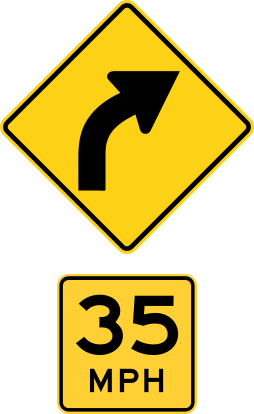
- The lowest speed allowed on the curve
- The new speed limit for the rest of the road
- The speed at which trucks must gear down
- The advised safe speed for that curve
Show answer
The advised safe speed for that curve. An advisory speed plaque gives the safe speed for a curve or freeway ramp, and it is often mounted under another warning sign such as a curve sign. Oregon's curve advice says to slow down before you enter the curve and to use the speed shown below the curve sign as a guide. It is not a minimum, and it does not set a new limit for the rest of the road. Coming out of the curve, increase your speed gradually.
Study this in the handbook: Warning, Guide and Service Signs
18. You are circling an Oregon roundabout and your exit is next. How should you signal?
- Keep your left signal on until you leave the circle
- Do not signal, since all traffic flows one way
- Use your right turn signal to show you are exiting
- Turn on your hazard lights as you leave
Show answer
Use your right turn signal to show you are exiting. Leaving a roundabout is a turn, and Oregon lists exiting a roundabout among the moves that need a signal. Use your right turn signal as you approach your exit so drivers waiting to enter can tell you are leaving the circle and may use the gap. As you exit, watch for pedestrians in the crosswalk and be prepared to stop for them. A missing signal is a common reason entering drivers misjudge a gap.
Study this in the handbook: Turns, U-Turns and Roundabouts
19. You are on a one-way street and will turn left onto another one-way street. Which lane should you start the turn from?
- The lane just right of the center
- The lane nearest the left curb
- Whichever lane has the least traffic
- The lane nearest the right curb
Show answer
The lane nearest the left curb. For a left turn from one one-way road onto another, approach in the lane nearest the left curb. Then turn into the nearest left lane of the road you are entering. This follows the general rule of turning from the nearest lane to the nearest lane, so you do not cut across other traffic. Oregon also allows this turn against a red light after you stop and yield to traffic and pedestrians, unless a sign prohibits it.
Study this in the handbook: Turns, U-Turns and Roundabouts
20. Your left turn is a quarter mile ahead, and the road has a two-way center turn lane. May you drive in that lane until you reach your turn?
- Yes, it is meant for slow drivers
- Yes, if no one else is using it
- Yes, if you turn on your signal
- No, enter it just before you turn
Show answer
No, enter it just before you turn. It is illegal to travel in a two-way left turn lane. Enter it just before you want to make the turn, then wait there until traffic clears. The lane is shared by left-turning drivers from both directions, so it is not a place to travel. If a two-way left turn lane is provided, do not turn left from any other lane.
Study this in the handbook: Pavement Markings
Every question is written from the official Oregon Driver Manual. Need paper? Printable OR practice test with answer key.
Last verified 2026-10-05. How we check every question · Study all 500 as flashcards
Frequently asked questions
How many questions are on this Oregon practice test?
This fixed set has 20 questions. It is test 16 of 25 from the 500 question Oregon bank. The real OR exam asks 35 questions and you need 28 correct.
What is the passing score for the real Oregon test?
28 of 35 correct to receive a passing score That figure comes from the official Oregon source cited on the DMV facts page.
How does this fixed test relate to the full Oregon bank?
Each numbered test is a fixed set of questions in a fixed order, so you can retake the same test later and compare. Every test mixes road signs and the other topics in about the same proportion as the full bank. Tests 1 to 25 together cover every question in the Oregon bank once. The full practice page mixes the whole bank at random.
Last verified 2026-10-05. See the Oregon DMV facts page for sourced state details.