
Test 15 of 25 · 20 questions · Free 2026
OR Permit Practice Test 15
Jump to the test ↓A fixed 20 question set from the Oregon bank with answers and plain English explanations. The real OR exam is 35 questions, 80 percent to pass; take the full length version on the main practice page.
Question 1 of 20 · 0 right so far
All 20 questions in test 15
Every question below comes from the Oregon question bank on this page. Open a question to see the correct answer and the explanation. Nothing here is hidden behind a signup.
1. At 2 p.m. on a weekday in early summer, you pass a School Hours speed sign and cannot tell whether school is in session. What should you do?
- Keep the regular limit unless children are in view
- Slow to 25 mph, the usual residential limit
- Slow to 20 mph through the school zone
- Drive the normal speed, since it is summer
Show answer
Slow to 20 mph through the school zone. A School Hours sign sets a 20 mph limit from 7 a.m. to 5 p.m. on days school is in session. Drivers often cannot know a district's calendar, so Oregon settles the question: if you are unsure whether it is a school day, slow down to 20 mph. Early summer, teacher work days, and summer programs make guessing risky. Going slower costs only a few seconds, while children near a school may step out suddenly.
Study this in the handbook: Oregon Speed Limits
2. You are stopped behind another car on a steep uphill street. Why does Oregon tell you to leave extra space?
- The car ahead may roll back as it starts
- Brakes hold less well when facing uphill
- Cars behind you may need room to back up
- The car ahead may stall and need a push
Show answer
The car ahead may roll back as it starts. Stopping on a hill is one of the situations where Oregon asks for more space between you and the vehicle in front. When that vehicle starts to move, it may roll back before it pulls forward, especially if the driver is slow on the pedals. A larger gap gives it room to roll without touching your bumper. The same idea applies behind a large vehicle stopped on a grade, which may roll back slightly when starting.
3. On a cold morning, the road looks clear and dry. Where are you most likely to find ice first?
- On a sunny straight stretch
- In the middle of an intersection
- On an uphill grade in the sun
- On a bridge or in a shaded area
Show answer
On a bridge or in a shaded area. Snow and ice can be hard to see, so Oregon tells drivers to watch for danger spots. A bridge or shaded area freezes first and may be icy even when the rest of the road is free of ice. Ease off the gas before these spots, avoid sudden braking or steering on them, and make turns at a reduced, steady speed. Leave extra following distance whenever ice is possible.
Study this in the handbook: Headlights and Hazardous Conditions
4. You pumped your brakes, but they still are not working. What else does Oregon tell you to try?
- Shift into reverse to stop the wheels
- Turn off the engine to cut the power
- Shift down and ease on the parking brake
- Yank the parking brake on as hard as you can
Show answer
Shift down and ease on the parking brake. If your brakes stop working, Oregon's steps are: pump the brakes to try to build up pressure, shift to a lower gear so the engine helps slow you down, slowly apply the parking brake, and use your horn or lights to warn others that you are out of control. Once you have slowed down, ease onto the shoulder. Reversing, shutting off the engine, or yanking the parking brake are not on the list.
Study this in the handbook: Avoiding Collisions and Equipment Failures
5. Which of these does Oregon list as a way to let other drivers know what you plan to do?
- Flashing high beams to tell them to pass
- Waving drivers through the intersection
- Honking whenever you change lanes
- Using brake lights to show you are slowing
Show answer
Using brake lights to show you are slowing. Collisions often happen when one driver does not see another or does something unexpected. Oregon lists ways to tell others what you plan to do or where you are: signaling before changing direction or lanes, using your brake lights to show you are slowing or stopping, turning on your headlights, using your horn as a reasonable warning, and using your hazard lights when needed.
Study this in the handbook: Avoiding Collisions and Equipment Failures
6. You are driving slower than traffic on a four-lane road, and your left turn is two blocks ahead. May you move into the left lane?
- No, slow drivers must keep right the whole way
- Yes, when preparing to make a left turn
- No, not until you match the speed of traffic
- Yes, but you must first stop and wait for a gap
Show answer
Yes, when preparing to make a left turn. Oregon requires slower drivers to use the right lane or stay as close as possible to the right curb or edge of the road. The rule has one exception: when you are preparing to make a left turn. Move left in time to get into position, signal at least 100 feet before the lane change, and check your mirrors and blind spot. After the turn, return to the right lane if you are still going slower than traffic.
Study this in the handbook: The Basic Rule and Variable Speed Signs
7. You are driving 55 mph on a two-lane road and pass this sign. When should you slow down?

- Before you reach the curve
- In the middle of the curve
- Only if the curve looks tight
- After you exit the curve
Show answer
Before you reach the curve. A Curve warning sign tells you a curve is ahead. Oregon's advice for curves is to slow down before you enter, using any advisory speed posted below the sign as a guide. Look through the curve to where you want to go, stay right of the center line in the middle of your lane, and watch for bicycles, pedestrians, or slow vehicles hidden around it. Increase speed gradually as you come out.
Study this in the handbook: Warning, Guide and Service Signs
8. Oregon uses two kinds of digital speed signs. What do the ones you must obey as a true speed limit look like?
- Yellow, and say advisory speed
- Orange, and say work zone speed
- Green, and show the next exit
- Black and white, and say speed limit
Show answer
Black and white, and say speed limit. Oregon has replaced some standard speed signs with digital ones that use road, weather, traffic, and visibility sensors. Variable speed limit signs are black and white and say speed limit. They change the limit for conditions such as heavy traffic, fog, ice, or snow, and police enforce them like any other limit. Yellow variable advisory signs recommend a speed but are not limits.
Study this in the handbook: The Basic Rule and Variable Speed Signs
9. You are following a person riding a motorcycle. Compared with following a car, how much space should you leave?
- Less space, since motorcycles stop quickly
- The same space as for any other vehicle
- Just enough to see its taillight clearly
- More space than behind a car
Show answer
More space than behind a car. Oregon asks drivers to leave more distance behind a motorcycle than behind another car. Riders can be moved out of their lane by strong winds, and gravel, debris, pavement seams, grooved pavement, and manhole covers can make them change speed or direction suddenly. A motorcycle is also harder to see and its speed is harder to judge. Extra room gives you time to react if the rider slows or swerves.
Study this in the handbook: Motorcycles, Large Vehicles and Other Road Users
10. Next to a red transit lane, the solid red paint changes to red stripes just before a driveway. What do the stripes show?
- Where the transit lane ends for good
- Where cars may enter the lane to turn or park
- Where cars may pass a slow bus
- Where bicycles must leave the lane
Show answer
Where cars may enter the lane to turn or park. A solid red lane is reserved for transit and is not for cars. Striped red lines mark the places where a driver may enter that lane to turn, to park, or to reach a driveway. Move in only where the stripes appear and only for those purposes. Before you enter, yield to buses, trains, and people riding bicycles in the lane, and merge in behind them after they pass.
Study this in the handbook: Pavement Markings
11. You are at an intersection and realize you are in the wrong lane for the turn you want to make. What does Oregon say to do?
- Change lanes quickly before you reach the turn
- Go on to the next intersection and turn there
- Stop in your lane until drivers let you over
- Turn from the lane you are in, with caution
Show answer
Go on to the next intersection and turn there. If you are at an intersection and in the wrong lane to turn, Oregon says to go to the next intersection. The manual explains that it is safer to drive around the block than to risk a collision from a last-minute lane or direction change. Lane use control signs or pavement markings may direct you into the correct lane before the turn, so look for them early and check for traffic behind and beside you well before you turn.
Study this in the handbook: Turns, U-Turns and Roundabouts
12. Late in a long drive, you notice you have been driving on autopilot, not really aware of what is around you. What does Oregon say?
- Open a window and keep on going
- Speed up so you get there sooner
- Turn up the music to stay focused
- It is time to stop for a rest
Show answer
It is time to stop for a rest. Driving requires your full attention, and fatigue, illness, anger, or worry can make you an unsafe driver. Oregon says that if you find yourself just going through the motions of driving, without really being aware of what you are doing or what is around you, it is time to stop for a rest or maybe quit for the day. Do not try to push through to your destination.
Study this in the handbook: Seat Belts, Child Seats and Distracted Driving
13. When you park near a railroad crossing in Oregon, how far from the nearest rail must your car be?
- At least 50 feet
- At least 15 feet
- At least 7 and a half feet
- At least 25 feet
Show answer
At least 50 feet. Oregon bans parking within 50 feet of the nearest rail of a railroad or light rail crossing. Do not confuse this with two nearby numbers. When you must stop at a crossing without a stop line, stop at least 15 feet from the nearest rail. And a parked car must stay at least 7 and a half feet from tracks if it would interfere with a train. The 50 foot rule is for parking near the crossing.
14. You approach this sign with a clear view in both directions and no traffic or pedestrians anywhere near. Must you come to a full stop?
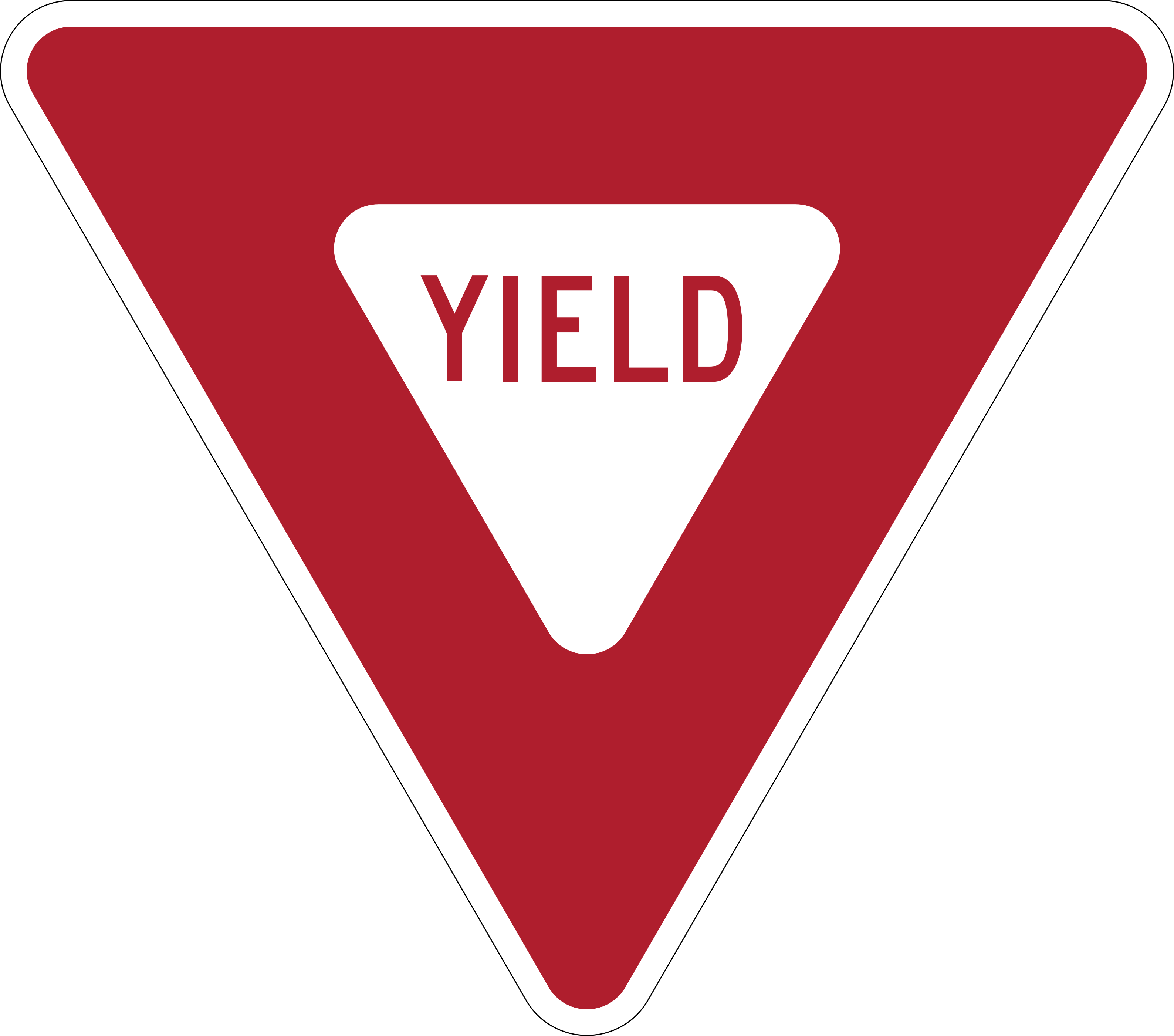
- Yes, every time, as at a stop sign
- No, slow down, but stop only if needed
- Yes, but only for a count of three
- No, and you do not need to slow down
Show answer
No, slow down, but stop only if needed. The yield sign tells you to reduce speed and yield the right of way. A full stop is required only when needed, such as when traffic or a pedestrian has the right of way, in which case you stop the same as you would for a stop sign. With a clear view and no one around, slow down, check carefully, and continue. Never treat it as permission to go through at full speed.
Study this in the handbook: Regulatory Signs
15. The red lights are flashing at a railroad crossing, but you look both ways and see no train. What must you do?
- Stop before the tracks anyway
- Cross carefully, since no train is near
- Slow down, then cross if it looks clear
- Cross only if the gate has not come down
Show answer
Stop before the tracks anyway. Oregon lists situations when you must stop before railroad tracks, and the first is when flashing red lights are activated. You must stop even if you cannot see a train, because the train you see is closer than it seems and one train can hide another. Stop at the stop line, or at least 15 feet from the nearest rail, and wait until it is safe.
Study this in the handbook: School Buses and Railroad Crossings
16. The center line has a solid yellow line and a broken yellow line. The broken line is on your side. What does that mean for you?
- You may never pass on this road
- Only drivers on the other side may pass
- You may pass when it is safe
- Both directions are barred from passing
Show answer
You may pass when it is safe. On a double center line made of one solid and one broken yellow line, the line closest to you decides. A broken yellow line on your side means you are allowed to pass. Drivers facing the solid line on their side may not. Even where passing is allowed, check for a clear path, do not exceed the speed limit, and finish before a no-passing zone begins.
Study this in the handbook: Pavement Markings
17. You are driving on the through road at an uncontrolled T intersection. A car is waiting on the road that ends there. Who has to yield?
- You, since that car is on your right
- Whichever driver got there first
- The driver on the road that ends
- The larger vehicle
Show answer
The driver on the road that ends. If you are the driver on a road that ends at a T intersection with no signs or signals, you must yield to drivers on the through road. So the waiting car must let you pass. Even so, slow down and be ready, because the other driver may pull out anyway. Never assume another driver will yield the right of way to you.
Study this in the handbook: Right of Way at Intersections
18. You are pulling out of a driveway, and a sidewalk crosses the driveway before the street. Where must you first stop?
- At the curb, after crossing the sidewalk
- Before you reach the sidewalk
- At the edge of the street itself
- Nowhere, if no one is walking nearby
Show answer
Before you reach the sidewalk. When your path crosses a sidewalk, such as entering or leaving a parking lot, alley, or driveway, Oregon requires you to stop before reaching the sidewalk and yield to pedestrians and people riding bicycles. That first stop protects people on the sidewalk. Then, before entering the street, stop again if needed and yield to approaching traffic. Backing out of a driveway calls for the same care, since children may be behind your vehicle.
Study this in the handbook: Pedestrians and Bicycles
19. A person on a bicycle has merged into the lane ahead of you inside a single-lane roundabout. What should you do?
- Pass once you have a few feet of room
- Honk so the rider moves onto the sidewalk
- Stay behind and give the rider the lane
- Pass on the inside apron of the circle
Show answer
Stay behind and give the rider the lane. When approaching a roundabout, people on bicycles will either merge into traffic or use the sidewalk. If a rider merges into the lane, Oregon says to allow them the full travel lane and not to pass them within the roundabout. Follow at a safe distance until you exit, and signal with your right turn signal when you leave. Watch the crosswalks at each exit, where the same rider may also cross as a pedestrian.
Study this in the handbook: Turns, U-Turns and Roundabouts
20. On a two-lane road marked with a broken yellow center line, you are nearing the top of a hill behind a slow car. Should you pass?
- No, your view of oncoming traffic is blocked
- Yes, a broken line means passing is allowed
- Yes, if you speed up and pass quickly
- Yes, if you honk to warn oncoming drivers
Show answer
No, your view of oncoming traffic is blocked. Signs and pavement markings help you find passing zones, but Oregon adds its own limits. Do not cross the center line to pass when a hill or curve blocks your view of oncoming traffic. Near the crest of a hill, a car coming the other way can appear with almost no warning. Wait until you are over the hill and can see a long, clear stretch of road before you pull out.
Study this in the handbook: Passing and Freeway Driving
Every question is written from the official Oregon Driver Manual. Need paper? Printable OR practice test with answer key.
Last verified 2026-10-05. How we check every question · Study all 500 as flashcards
Frequently asked questions
How many questions are on this Oregon practice test?
This fixed set has 20 questions. It is test 15 of 25 from the 500 question Oregon bank. The real OR exam asks 35 questions and you need 28 correct.
What is the passing score for the real Oregon test?
28 of 35 correct to receive a passing score That figure comes from the official Oregon source cited on the DMV facts page.
How does this fixed test relate to the full Oregon bank?
Each numbered test is a fixed set of questions in a fixed order, so you can retake the same test later and compare. Every test mixes road signs and the other topics in about the same proportion as the full bank. Tests 1 to 25 together cover every question in the Oregon bank once. The full practice page mixes the whole bank at random.
Last verified 2026-10-05. See the Oregon DMV facts page for sourced state details.