
Test 2 of 11 · 20 questions · Free 2026
OR Permit Practice Test 2
Jump to the test ↓A fixed 20 question set from the Oregon bank with answers and plain English explanations. The real OR exam is 35 questions, 80 percent to pass; take the full length version on the main practice page.
Question 1 of 20 · 0 right so far
All 20 questions in test 2
Every question below comes from the Oregon question bank on this page. Open a question to see the correct answer and the explanation. Nothing here is hidden behind a signup.
1. When driving slower than the normal flow of traffic in Oregon, where should you drive?
- In the right lane or as close as possible to the right curb or edge
- In the left lane to make faster traffic pass on the shoulder
- On the center line so both lanes remain visible
- In whichever lane has the highest posted limit
Show answer
In the right lane or as close as possible to the right curb or edge. A driver traveling slower than normal traffic must use the right lane or drive as close as possible to the right curb or edge, unless preparing for a left turn. The left lane choice interferes with faster traffic and does not authorize shoulder travel. The center line is not a lane for ordinary slow travel, and lane selection is not based on finding a higher posted limit. Watch for congestion building behind you, then pull off at the first safe area when needed to let traffic pass.
Study this in the handbook: The Basic Rule and Variable Speed Signs
2. What should a driver anticipate after seeing the pedestrian crossing warning?

- A vehicle checkpoint ahead
- A roadway where pedestrians are forbidden
- A sidewalk repair zone with no crossing activity
- People crossing the driver's path
Show answer
People crossing the driver's path. The walking figure warns that people may cross the vehicle's path. It calls for active observation and readiness to yield, not for treating the area as a no-pedestrian zone. The choice “A sidewalk repair zone with no crossing activity” misses the purpose of the warning because construction is not what the symbol communicates. Reduce speed when needed, search both sides of the roadway, and watch for a person who is already in or about to enter the crossing. A flashing beacon, when present, can reinforce that a crossing movement is occurring.
Study this in the handbook: Warning, Guide and Service Signs
3. What road situation is associated with the five-sided school sign?

- An adult-only crosswalk outside a school area
- A recreation area where pedestrians are prohibited
- A school zone or school crossing requiring extra attention
- A park entrance where vehicles have priority
Show answer
A school zone or school crossing requiring extra attention. The distinctive five-sided shape is used for school-related warnings, including a school zone or school crossing. Drivers should slow as required by the roadway, watch carefully for children, and be prepared for people to enter the crossing unexpectedly. The choice “A park entrance where vehicles have priority” reverses the safety message by suggesting that vehicles have priority near a park or school. Keep scanning sidewalks, curb lines, and crossing points, and do not let a clear moment make you stop looking for a child who may be approaching.
Study this in the handbook: Oregon Speed Limits
4. Which vehicles does Oregon allow a passenger vehicle to tow at one time?
- Two trailers if the total weight is low
- None, towing requires a commercial license
- Any number with a permit
- A maximum of one boat, trailer, or other vehicle
Show answer
A maximum of one boat, trailer, or other vehicle. Oregon law allows you to tow a maximum of one boat, general utility trailer, or other vehicle behind a passenger or recreational vehicle, and you cannot tow a second trailer or vehicle. Total weight and a permit do not change that limit. The manual also notes that vehicles towing a trailer take longer to accelerate and stop and need more room to turn, so check your speed and traffic behind you often and pull off at the first safe turnout when traffic stacks up.
5. Which vehicles must stop at railroad tracks even when no train is immediately visible?
- Only buses carrying children during school hours
- All school buses, hazmat vehicles, and some school activity vehicles
- All passenger vehicles towing a trailer
- Only farm vehicles displaying a slow-moving emblem
Show answer
All school buses, hazmat vehicles, and some school activity vehicles. Oregon specifically requires all school buses, hazmat vehicles, and some school activity vehicles to stop at railroad tracks. The rule is based on the vehicle category, not only on whether children are aboard or whether the driver sees a train. Passenger vehicles towing trailers and farm vehicles are not the listed group. If you are following one of these vehicles, expect it to stop and leave room behind it. Slow down, look and listen, and remember that one train can hide another on a nearby track.
Study this in the handbook: School Buses and Railroad Crossings
6. Which minimum liability amount covers property damage to others under Oregon's required insurance?
- $20,000 per collision
- $15,000 per collision
- $10,000 per collision
- $25,000 per collision
Show answer
$20,000 per collision. Oregon’s minimum required coverage for damage to another person’s property is $20,000 per collision. The $25,000 figure belongs to bodily injury for one person, and $50,000 applies to bodily injury or death involving two or more people. $10,000 and $15,000 are below the property-damage minimum described in the manual. When reviewing an insurance policy, separate property damage from personal injury protection and bodily-injury limits so a familiar number is not assigned to the wrong category.
Study this in the handbook: Insurance, Collisions and Reports
7. When must you stop before Oregon railroad tracks even if no train is visible?
- Only when another vehicle stops first
- Only when a crossing gate is fully lowered
- When a stop sign is posted
- Never if the warning lights are off
Show answer
When a stop sign is posted. Oregon requires a driver to stop before railroad tracks when a stop sign is posted, even if no train can be seen. The absence of a visible train or flashing lights does not cancel a posted stop. Waiting for another vehicle is also unsafe because each driver has an independent duty to obey the sign. Stop at the marked line or, if there is no stop line, at least 15 feet from the nearest rail. Look carefully for trains in both directions before crossing.
Study this in the handbook: School Buses and Railroad Crossings
8. In Oregon, at what blood alcohol concentration does a driver 21 or older fail a chemical test?
- 0.05 percent or more
- 0.10 percent or more
- 0.02 percent or more
- 0.08 percent or more
Show answer
0.08 percent or more. For drivers 21 and over, Oregon sets the failing level at a blood alcohol concentration of 0.08 percent or more. Drivers under 21 fail with any amount under the zero tolerance law, and refusing the test may bring a fine and a suspension of driving privileges. The 0.05 and 0.02 figures are not the adult threshold, and 0.10 is above it. A driver can still be arrested for DUII even when the BAC is lower than 0.08 percent.
Study this in the handbook: Alcohol, Drugs and DUII
9. What speed applies in an Oregon school speed zone?
- 15 miles per hour
- 30 miles per hour
- 25 miles per hour
- 20 miles per hour
Show answer
20 miles per hour. A school speed zone has a reduced limit of 20 mph, and the zone begins at the SCHOOL SPEED LIMIT 20 sign. It ends at the END SCHOOL ZONE sign or another posted speed sign. The 15 mph, 25 mph, and 30 mph choices confuse this special zone with other area limits or an ordinary roadway. When a school sign is present, look for the stated beginning and ending points rather than assuming the restriction ends at the school property line.
Study this in the handbook: Oregon Speed Limits
10. When must headlights be turned on in Oregon?
- From sunset to sunrise and when visibility is limited
- Only after midnight
- Only during rain
- Only when another driver flashes headlights
Show answer
From sunset to sunrise and when visibility is limited. Headlights must be on from sunset to sunrise. Oregon also requires them whenever conditions make it difficult to see people or vehicles 1,000 feet ahead. Rain is one example of a condition that can reduce visibility, but it is not the only trigger, and nighttime use does not begin at midnight. Turn the lights on before visibility drops, keep the vehicle visible to others, and use low beams when glare or weather makes high beams unsafe.
Study this in the handbook: Headlights and Hazardous Conditions
11. What does a wide solid white line mark on an Oregon road, and may you cross it?
- It is a barrier that may never be crossed
- It directs traffic into specific lanes and separates bike lanes; crossing is permitted but discouraged
- It separates opposing traffic
- It marks a shoulder that may be used for passing
Show answer
It directs traffic into specific lanes and separates bike lanes; crossing is permitted but discouraged. A wide solid white line is used to direct traffic into specific lanes, such as turn lanes, and to separate bike lanes from other traffic lanes. Crossing a wide solid white line is permitted but discouraged, so it is not an absolute barrier. A regular solid white line marks the edge or fog line, a broken white line separates lanes going the same direction, and yellow lines separate opposing traffic. Nothing about this marking turns a shoulder into a passing lane.
Study this in the handbook: Pavement Markings
12. A driver faces the pictured DO NOT ENTER sign at the end of a ramp. What does it indicate?
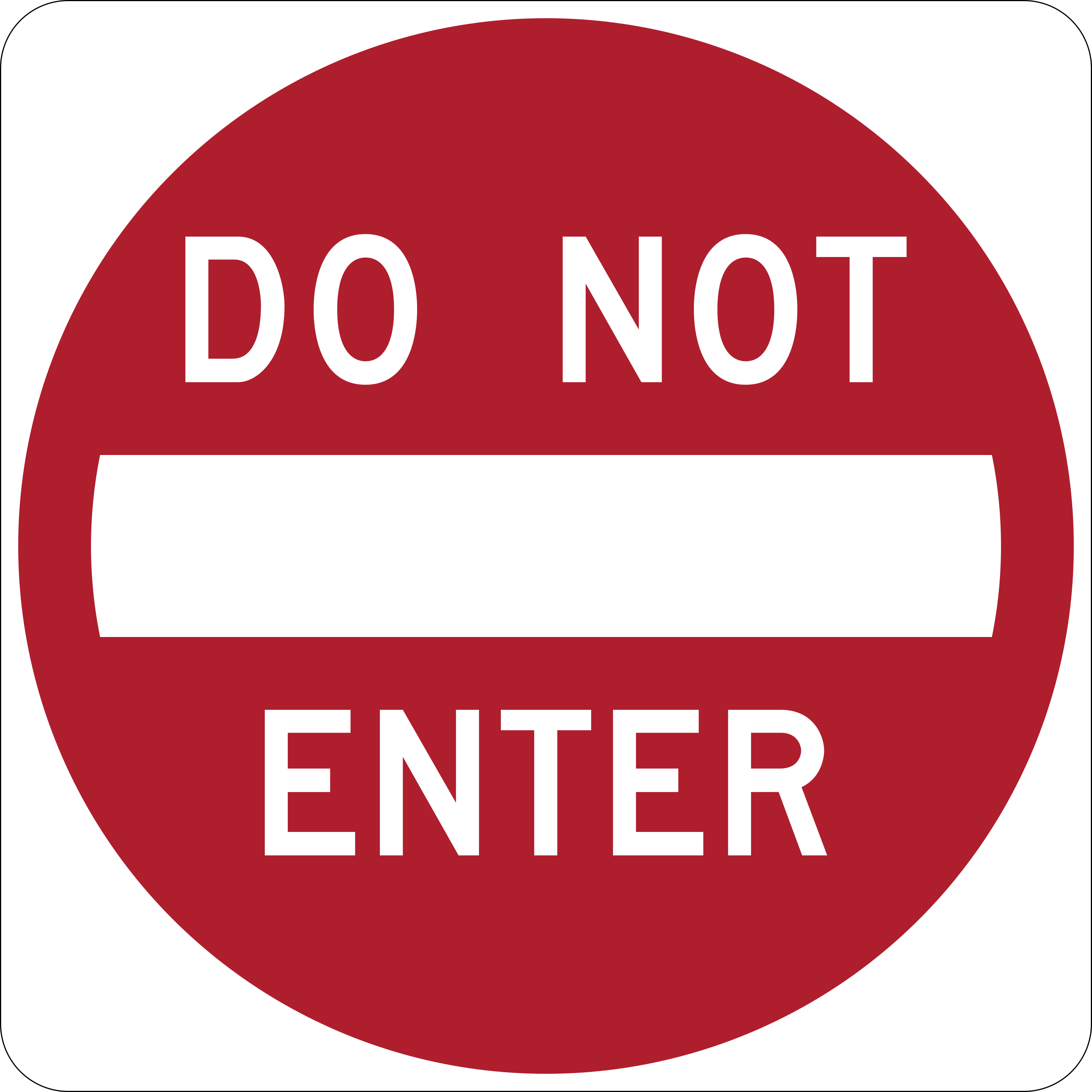
- The ramp is reserved for buses during daytime hours
- The driver may enter after yielding to freeway traffic
- The driver must not enter that road or freeway
- Parking is prohibited beside the ramp
Show answer
The driver must not enter that road or freeway. This square regulatory sign marks an entrance that a driver must not take. It commonly appears where a road or freeway is being entered from the wrong direction, so continuing would put the vehicle into conflict with normal traffic. The choice “The driver may enter after yielding to freeway traffic” is especially risky because yielding cannot make an illegal entry safe. Stop before committing to the ramp, check for a safe way to leave the area, and follow a route that uses the proper entrance. Never treat the sign as a parking instruction.
Study this in the handbook: Regulatory Signs
13. At what age may someone apply for an Oregon Class C instruction permit?
- 18 years of age
- 14 years of age
- 16 years of age
- 15 years of age
Show answer
15 years of age. For an Oregon Class C noncommercial driving privilege, the minimum age to apply for an instruction permit is 15. That threshold is separate from the minimum age to apply for a license, which is 16. Choosing 14 moves the permit age below the stated minimum, while 16 and 18 confuse license eligibility with permit eligibility. A new applicant should first identify whether the question concerns the instruction permit or the full license because the manual gives those two ages separately.
Study this in the handbook: Permits and Teen Licenses
14. For what limited purposes may a car briefly use a signed transit-only lane?
- To turn into a driveway, turn at the next intersection, or pull over to park
- To pass a queue of slower cars
- To travel straight until traffic clears
- To enter the lane whenever a bus is not nearby
Show answer
To turn into a driveway, turn at the next intersection, or pull over to park. A car may briefly use the transit lane for three listed purposes: turning into a driveway, turning at the next intersection, or pulling over to park along the curb where allowed. Passing congestion and traveling straight are not included. The absence of a nearby bus also does not convert a transit lane into an ordinary travel lane. Drivers should read the lane-use sign, enter only for the permitted movement, and leave the lane promptly. This preserves the continuous path intended for transit vehicles and any people biking identified by the sign.
Study this in the handbook: Regulatory Signs
15. What does a double center line with one solid and one broken yellow line indicate?
- Passing is prohibited in both directions at all times
- Passing is allowed according to which line is on your side
- Only left turns are permitted across the center
- The roadway has traffic moving in one direction
Show answer
Passing is allowed according to which line is on your side. Oregon uses a solid and broken yellow pair to show that passing depends on the line beside your lane. A broken line on your side permits passing when the roadway and traffic make the maneuver safe, while a solid line on your side prohibits it. The all-times ban describes double solid yellow lines, not this combination. The marking also does not convert the road to one-way travel. Identify your side of the center line first, then check sight distance and oncoming traffic before moving out.
Study this in the handbook: Pavement Markings
16. Two drivers at a red light see who can accelerate faster when it turns green, while staying under the speed limit. Under Oregon's definition, is that racing?
- No, racing requires exceeding the speed limit
- No, racing only counts on a closed course
- Yes, any acceleration or speed contest counts as racing
- Only if the drivers bet money on the result
Show answer
Yes, any acceleration or speed contest counts as racing. Oregon makes racing illegal on any road and defines it broadly: any acceleration or speed contest, or an attempt to make a speed record. A contest to see who pulls away from a light faster fits that definition even if neither car goes over the limit, so speeding is not an element. The rule applies on public roads, so the closed course idea misreads it, and whether money changes hands does not matter. Pull away from a light at a normal pace.
Study this in the handbook: The Basic Rule and Variable Speed Signs
17. The car in the lane beside you has stopped at a crosswalk. What does Oregon law say about passing it?
- You may pass if you sound your horn first
- Passing it is against the law
- You may pass at 10 mph or less
- You may pass if you cannot see a pedestrian
Show answer
Passing it is against the law. Oregon makes it illegal to pass a vehicle that is stopped at a crosswalk. The stopped driver may be waiting for a pedestrian who is hidden from your view by that vehicle, so failing to see anyone is exactly the danger, not a reason to go. A horn warning or a slow speed does not make the pass legal. Be ready to stop yourself, and never stop with any part of your vehicle overhanging the crosswalk.
Study this in the handbook: Pedestrians and Bicycles
18. What information do green guide signs generally provide?
- Warnings about slippery pavement
- Exit information or the direction of roads and cities
- Rules prohibiting lane changes
- Locations where fuel and lodging are available
Show answer
Exit information or the direction of roads and cities. Green guide or information signs help drivers navigate by showing exit information and the direction of roads or cities. They are different from yellow warning signs, which announce hazards, and white regulatory signs, which impose requirements. Blue signs point to motorist services such as fuel or lodging. A driver should read the route name, arrow, and exit number early enough to choose a lane safely. The cue is green for guidance: it helps you decide where to go, rather than warning or commanding a maneuver.
Study this in the handbook: Warning, Guide and Service Signs
19. What does a broken white line separate?
- A parking area from a railroad track
- Traffic moving in opposite directions
- Lanes of traffic going in the same direction
- A lane where changing position is never allowed
Show answer
Lanes of traffic going in the same direction. A broken white line separates lanes carrying traffic in the same direction. Oregon permits crossing that line with caution, so it guides lane separation without creating the no-change restriction associated with double solid white lines. Yellow center markings, not broken white lines, separate opposing traffic. A driver should signal, check mirrors and blind spots, and cross only when the lane change is safe. The color and pattern work together: white generally organizes same-direction lanes, while a broken pattern indicates a cautious crossing may be possible.
Study this in the handbook: Pavement Markings
20. What advice does the Oregon manual give about letting a driver signaling for a lane change move over?
- Help by slowing down or speeding up a little if needed
- Speed up to close the gap
- Hold your speed exactly
- Flash the high beams
Show answer
Help by slowing down or speeding up a little if needed. Sharing space means adjusting for others. The manual says to help other drivers signaling for a lane change make the move safely by slowing down or speeding up a little if needed, to move over a lane for vehicles entering a freeway when no one is beside you, and to keep extra space from parked cars because a door may open in your path. Closing the gap or refusing to adjust invites a sideswipe.
QualitySpace is expanding to Oregon
We are a California-based independent insurance brokerage working on licensing in more states. We cannot help with Oregon insurance yet. Leave your email and we will let you know when we can.
Every question is written from the official Oregon Driver Manual. Need paper? Printable OR practice test with answer key.
Last verified 2026-10-05. How we check every question · Study all 220 as flashcards
Frequently asked questions
How many questions are on this Oregon practice test?
This fixed set has 20 questions. It is test 2 of 11 from the 220 question Oregon bank. The real OR exam asks 35 questions and you need 28 correct.
What is the passing score for the real Oregon test?
28 of 35 correct to receive a passing score That figure comes from the official Oregon source cited on the DMV facts page.
How does this fixed test relate to the full Oregon bank?
Each numbered test is a fixed set of questions in a fixed order, so you can retake the same test later and compare. Every test mixes road signs and the other topics in about the same proportion as the full bank. Tests 1 to 11 together cover every question in the Oregon bank once. The full practice page mixes the whole bank at random.
Last verified 2026-10-05. See the Oregon DMV facts page for sourced state details.