
Test 22 of 25 · 20 questions · Free 2026
OR Permit Practice Test 22
Jump to the test ↓A fixed 20 question set from the Oregon bank with answers and plain English explanations. The real OR exam is 35 questions, 80 percent to pass; take the full length version on the main practice page.
Question 1 of 20 · 0 right so far
All 20 questions in test 22
Every question below comes from the Oregon question bank on this page. Open a question to see the correct answer and the explanation. Nothing here is hidden behind a signup.
1. Some Oregon lanes are painted a solid color. Which color may a bike lane be painted?
- Green
- Red
- Blue
- Orange
Show answer
Green. Oregon identifies a bike lane by a wide white line with a bicycle symbol or a bike lane sign, and bike lanes may be painted green. Do not drive or park in one; you may cross it only to turn or to enter or leave an alley, driveway, or private road, after yielding to riders. Do not mix green up with red, which marks lanes where transit vehicles travel and cars are not allowed.
Study this in the handbook: Pavement Markings
2. You are leaving a store parking lot onto a street, and there is no sign or signal at the exit. What must you do?
- Slow down and merge if the lane looks clear
- Pull out, since street traffic must let you in
- Stop only if someone is already crossing
- Stop, then yield to vehicles and pedestrians
Show answer
Stop, then yield to vehicles and pedestrians. When you come out of an alley, driveway, or parking lot that has no sign or signal, Oregon requires you to stop before entering or crossing the road. Then yield to approaching vehicles and to pedestrians. Drivers on the street have the right of way, so wait for a gap instead of expecting them to let you in. If a sidewalk crosses the exit, the stop comes before you reach the sidewalk.
Study this in the handbook: Right of Way at Intersections
3. Oregon requires you to drive on the right side of the road, with a few exceptions. Which of these is one of them?
- A two-lane road where traffic is very light
- A three-lane road whose center lane is a passing lane
- A road with a speed limit of 25 mph or less
- A country road you know has little oncoming traffic
Show answer
A three-lane road whose center lane is a passing lane. Oregon's basic lane rule is to drive on the right side of the road. The exceptions are passing a vehicle going your way, going left of center to get around an obstruction, a road marked for one-way traffic, a road with three marked lanes where the center lane is a passing lane, and following directions from emergency personnel or others directing traffic. Light traffic or a low speed limit is not on that list.
Study this in the handbook: Right of Way at Intersections
4. You have come to a full stop at this sign. A man is walking across the street in front of you, where no crosswalk lines are painted. What now?
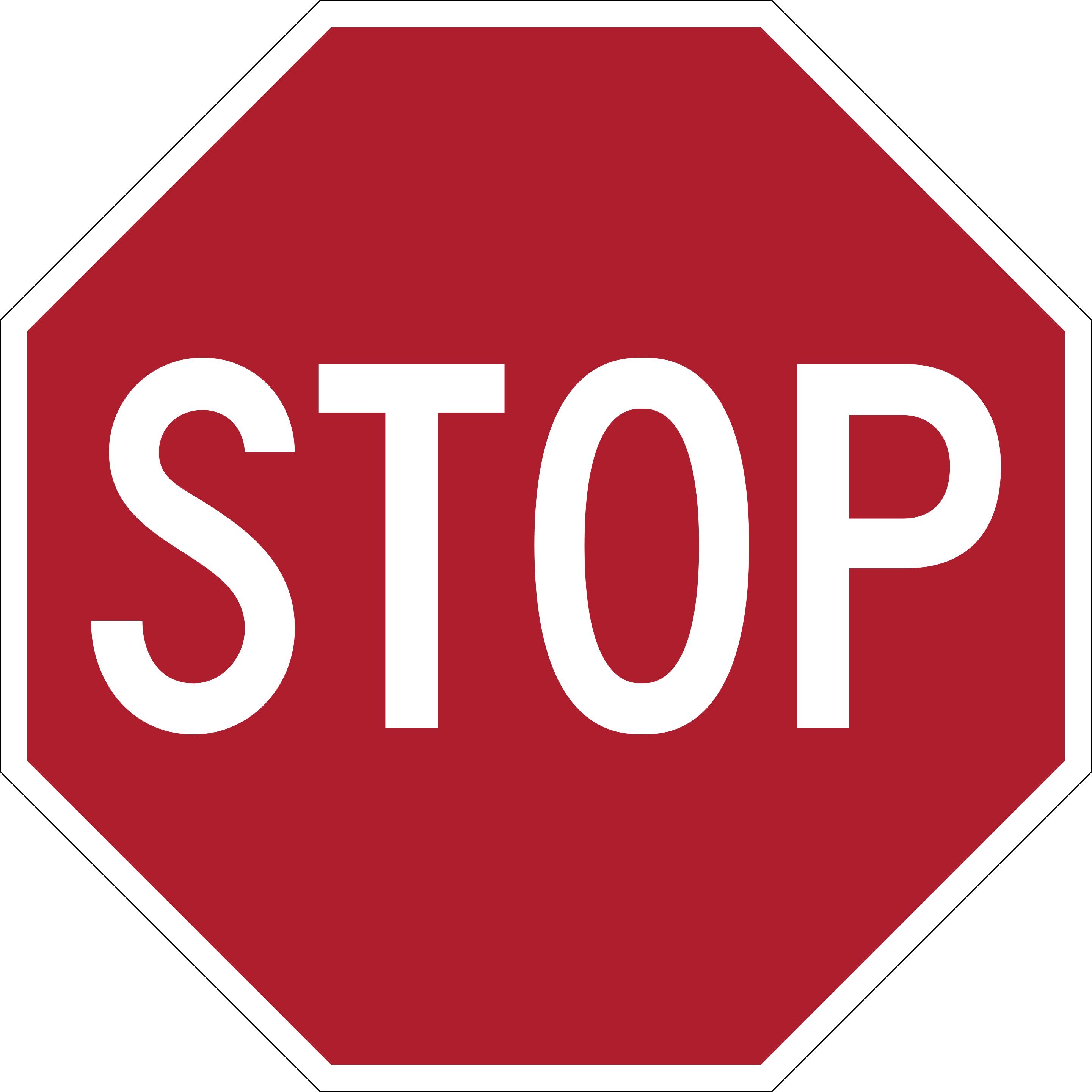
- Stay stopped until he has crossed
- Go, since no crosswalk is painted
- Go around him if there is room
- Go once he is past your bumper
Show answer
Stay stopped until he has crossed. A stop sign requires a complete stop, then yielding to other vehicles. It also requires you to stop and stay stopped for pedestrians crossing in marked or unmarked crosswalks. Every intersection has a crosswalk even without painted lines, so a person crossing in front of you at the corner is in one. Wait until he is clear, then enter the intersection only when it is safe.
Study this in the handbook: Regulatory Signs
5. Why is it risky to follow close behind a large truck?
- Trucks are required by law to brake slowly
- The driver cannot see you, and your view is blocked
- Air pushed by the truck pulls your car forward
- Trucks must signal before every stop they make
Show answer
The driver cannot see you, and your view is blocked. Large vehicles have a deep blind spot directly behind them where the driver cannot see your vehicle. Following too closely also severely reduces your own view of the road ahead. Oregon lists following drivers who cannot see you as a reason to increase your following distance. Do not pull up too close behind a stopped large vehicle either, since it may roll back slightly when starting forward.
Study this in the handbook: Motorcycles, Large Vehicles and Other Road Users
6. You are stuck behind a slow tractor on a road with a double solid yellow center line. The road ahead looks clear. May you pass?
- Yes, if you can see far enough ahead
- No, passing is not allowed there
- Yes, since a tractor is so slow
- Yes, if you keep under the limit
Show answer
No, passing is not allowed there. A double solid yellow line means passing is not allowed for traffic in either direction. A slow tractor ahead does not change that. Stay behind it with a safe following distance and wait for a broken line on your side. You may cross double solid yellow lines only to turn left into or out of a roadway, after oncoming traffic clears.
Study this in the handbook: Pavement Markings
7. Your light turns green, but traffic is backed up just past the intersection, leaving no room for your car. What should you do?
- Wait until there is room past the intersection
- Pull in, since your light is green
- Pull into the crosswalk and wait
- Go in partway so others let you through
Show answer
Wait until there is room past the intersection. Even if you have a green light, Oregon says not to enter an intersection unless there is room for your vehicle on the other side. If you enter and traffic stays stopped, you will be stuck blocking cross traffic and pedestrians when the light changes. Wait behind the stop line or crosswalk, without overhanging the crosswalk, until there is space.
Study this in the handbook: Right of Way at Intersections
8. In a two-lane roundabout, a large truck is using parts of both lanes. You are in the other lane next to it. What should you do?
- Speed up and pass it before the exit
- Drop back and do not drive beside it
- Stay beside it in your own lane
- Honk so the truck moves to one lane
Show answer
Drop back and do not drive beside it. Trucks may need to straddle both lanes of a multi-lane roundabout, and Oregon makes it illegal to pass or drive beside a truck within the roundabout. Do not try to overtake any vehicle inside the circle. Hang back, let the truck complete its path, and keep your own lane position until you exit. Large vehicles need more room to maneuver, so give them space.
Study this in the handbook: Turns, U-Turns and Roundabouts
9. On a two-lane highway, an oncoming pickup marked with OVERSIZE LOAD signs is leading a very wide load. What should you do?
- Stop on the shoulder until the load has passed
- Keep your speed and hold the center of your lane
- Flash your lights so the load's driver sees you
- Slow down and keep far right in your lane
Show answer
Slow down and keep far right in your lane. Pilot vehicles are specially marked vehicles that lead or follow a vehicle with an especially large load. When you see one in oncoming traffic, expect a wide load right behind it. Oregon says to reduce your speed and position your vehicle as far to the right as possible while staying in your lane. That gives the oversize vehicle the most room to get by without forcing you off the pavement.
10. You are stopped at a red light on a one-way street and want to turn left onto a two-way street. No traffic is coming. May you turn?
- Yes, after a full stop and yielding
- Yes, if no sign prohibits the turn
- No, wait for the signal to turn green
- Yes, if you use the left turn lane
Show answer
No, wait for the signal to turn green. Oregon allows some turns on red after a full stop, including a left turn onto a one-way road in the direction traffic flows. A left turn onto a two-way road against a red light is illegal, even when the road looks empty. On that turn you would cross lanes where oncoming drivers have the right of way. Wait for the green, then turn into the lane just to the right of the center line.
Study this in the handbook: Turns, U-Turns and Roundabouts
11. Your family is towing a travel trailer on a ball hitch behind a pickup. May the kids ride inside the trailer on the highway?
- No, riding in that trailer is against the law
- Yes, if they wear the trailer's safety belts
- Yes, on trips shorter than 30 minutes
- Yes, if an adult rides in the trailer too
Show answer
No, riding in that trailer is against the law. Oregon makes it illegal to let passengers ride in any type of trailer, with narrow exceptions: a commercial bus trailer, an independently steered trailer, or a trailer towed with a fifth-wheel device. Even a fifth-wheel trailer may carry passengers only if it has safety glass, a way to signal the driver, and an exit that opens from inside and outside. An ordinary travel trailer on a ball hitch is not an exception, so everyone rides in the tow vehicle.
12. A white sign above the middle lane of a five-lane Oregon street reads CENTER LANE TURN ONLY. Who uses that lane?
- Only drivers on the side where the sign stands
- Any driver who wants to pass slow traffic
- Left-turning drivers from both directions
- Buses and other transit vehicles
Show answer
Left-turning drivers from both directions. A Center Lane Turn Only sign marks a lane that is shared for left turns by traffic from both directions. Because a driver coming the other way may pull into the same lane, look well ahead before you move into it and watch for a car nosing in from the opposite end. It is not a place to pass slower vehicles. Oregon's pavement marking rules also say to enter a two-way left turn lane just before your turn instead of traveling along it.
Study this in the handbook: Regulatory Signs
13. A driver behind you is shouting and making rude gestures, then speeds past and cuts in front of you. What should you do?
- Speed up to show you will not back down
- Follow them closely to get their plate
- Stay out of their way; do not race them
- Flash your lights so they know they were wrong
Show answer
Stay out of their way; do not race them. Oregon calls angry or aggressive behavior by other drivers road rage, which can include driving in an illegal, unsafe, or threatening way, shouting, and rude gestures. If you see an aggressive driver, stay out of the way. Do not challenge them by going faster or trying to out-drive them. Let them go, keep a safe distance, and focus on your own driving.
14. A Stop Here for Pedestrians sign stands beside a white line painted across your lane, a few car lengths before a crosswalk. A person is walking in the crosswalk. What must you do?
- Slow down and roll through after the person passes your lane
- Stop with your front bumper at the edge of the crosswalk
- Stop only if the person is crossing in your half of the road
- Stop at the white stop line, back from the crosswalk
Show answer
Stop at the white stop line, back from the crosswalk. This sign tells drivers where to stop when someone is using the crosswalk ahead. When a pedestrian is in the crosswalk, stop at the stop line rather than pulling up to the painted crosswalk. Stopping back from the crossing lets drivers in other lanes see the person and keeps you from blocking the walking path. Stay stopped until the person is out of danger. Oregon also says it is against the law to pass a vehicle that has stopped at a crosswalk.
Study this in the handbook: Regulatory Signs
15. In a skid, you steered where you want to go, and now the car is starting to straighten out. What should you do?
- Hold the wheel where it is until you stop
- Turn the wheel back the other way
- Brake hard now that you have control
- Let go so the wheel centers itself
Show answer
Turn the wheel back the other way. In a skid, stay off the brakes and steer in the direction you want the vehicle to go. Oregon adds the next step: as soon as the vehicle begins to straighten out, turn the steering wheel back the other way. If you do not, the car may swing around in the other direction and start a new skid. Keep correcting left and right until the car is moving down the road under your control.
Study this in the handbook: Headlights and Hazardous Conditions
16. You have slowed down with two wheels off the pavement. How should you steer back onto the road?
- Turn sharply so you climb the edge quickly
- Turn hard left, then correct back to the right
- Turn just enough to get back on the road
- Keep going straight until the shoulder ends
Show answer
Turn just enough to get back on the road. After slowing down with your wheels off the pavement, Oregon says to turn the front wheels just enough to get back on the road. Do not turn sharply, or you might shoot across the road into oncoming traffic. Before that, grip the wheel firmly, keep a straight course, and slow down without braking hard. A small, controlled steering motion brings you back into your own lane.
Study this in the handbook: Avoiding Collisions and Equipment Failures
17. What should you expect as you drive into a freeway work zone in Oregon?
- Fewer or narrower lanes and a need to merge
- A flagger who stops all freeway traffic
- Wider lanes with more room around workers
- A detour that takes you off the freeway
Show answer
Fewer or narrower lanes and a need to merge. Oregon's manual describes freeway work zones this way: you can expect to keep driving through the zone, there may be fewer, narrow, or new lanes, and you can expect to merge with other lanes of traffic. You may also drive very close to cones, workers, and construction equipment. Slow down, pay attention, and obey the temporary speed limit, which applies at all times even when no workers are visible.
18. You are in the left lane, which continues, when you pass this sign. What should you expect?

- A new lane opening up on your left
- Your own lane ending in a short distance
- Cars from the ending lane merging into yours
- Oncoming traffic sharing the road ahead
Show answer
Cars from the ending lane merging into yours. A Lane Reduction sign means the lane it shows ends soon and vehicles in that lane must merge into the through lane. If you are already in the through lane, expect those vehicles to move over in front of or beside you. Watch for their signals and adjust your speed to leave a gap, and avoid speeding up to block someone who needs to merge.
Study this in the handbook: Warning, Guide and Service Signs
19. On a dry, empty highway posted at 55 mph, you feel that 70 mph would be safe. Does Oregon's basic rule let you drive 70?
- Yes, if conditions are ideal and traffic is light
- Yes, as long as you keep up with other traffic
- Yes, on interstates but not on other highways
- No, it does not allow going over the limit
Show answer
No, it does not allow going over the limit. The basic rule works only in one direction. It can require you to drive slower than the limit when conditions are poor, but it never lets you drive faster than the posted limit, even on a dry and empty road. The limit already reflects the speed considered safe under ideal conditions. If you think a road could handle more, the answer is still to stay at or below the number on the sign.
Study this in the handbook: The Basic Rule and Variable Speed Signs
20. You are on a narrow two-way country road with no center line, and a car is coming toward you. How much of the road must you give it?
- About one third of the road
- The whole road if it is going uphill
- Whatever space you do not need
- At least half of the road
Show answer
At least half of the road. Without a center line it is easy to drift toward the middle of a narrow road. Oregon's rule is that when traffic moves in opposite directions on a road with no center line, each driver must give at least half the road to oncoming traffic. Move to the right as the other car approaches and slow down if the road is tight. The rule does not give priority to a driver going uphill or to the larger vehicle.
Study this in the handbook: Right of Way at Intersections
Every question is written from the official Oregon Driver Manual. Need paper? Printable OR practice test with answer key.
Last verified 2026-10-05. How we check every question · Study all 500 as flashcards
Frequently asked questions
How many questions are on this Oregon practice test?
This fixed set has 20 questions. It is test 22 of 25 from the 500 question Oregon bank. The real OR exam asks 35 questions and you need 28 correct.
What is the passing score for the real Oregon test?
28 of 35 correct to receive a passing score That figure comes from the official Oregon source cited on the DMV facts page.
How does this fixed test relate to the full Oregon bank?
Each numbered test is a fixed set of questions in a fixed order, so you can retake the same test later and compare. Every test mixes road signs and the other topics in about the same proportion as the full bank. Tests 1 to 25 together cover every question in the Oregon bank once. The full practice page mixes the whole bank at random.
Last verified 2026-10-05. See the Oregon DMV facts page for sourced state details.