
Test 10 of 11 · 20 questions · Free 2026
OR Permit Practice Test 10
Jump to the test ↓A fixed 20 question set from the Oregon bank with answers and plain English explanations. The real OR exam is 35 questions, 80 percent to pass; take the full length version on the main practice page.
Question 1 of 20 · 0 right so far
All 20 questions in test 10
Every question below comes from the Oregon question bank on this page. Open a question to see the correct answer and the explanation. Nothing here is hidden behind a signup.
1. An Oregon school speed zone begins at which sign and ends at which sign or later speed sign?
- The flashing beacon, ending exactly one block after the school
- The school crossing sign, ending when the last student leaves the area
- The SCHOOL SPEED LIMIT 20 sign, ending at END SCHOOL ZONE or another posted speed sign
- The 25 mph sign, ending at the next intersection
Show answer
The SCHOOL SPEED LIMIT 20 sign, ending at END SCHOOL ZONE or another posted speed sign. Oregon defines the school speed zone by its posted boundaries. It starts at the SCHOOL SPEED LIMIT 20 sign and continues until an END SCHOOL ZONE sign or another posted speed sign appears. The flashing beacon is a separate warning that children may be arriving or leaving, so it is not the boundary by itself. A driver should scan ahead for the boundary signs and hold 20 mph through the defined zone, rather than guessing from the school property, a block distance, or the nearest intersection.
Study this in the handbook: Oregon Speed Limits
2. Which maneuver is prohibited by the crossed left arrow shown here?
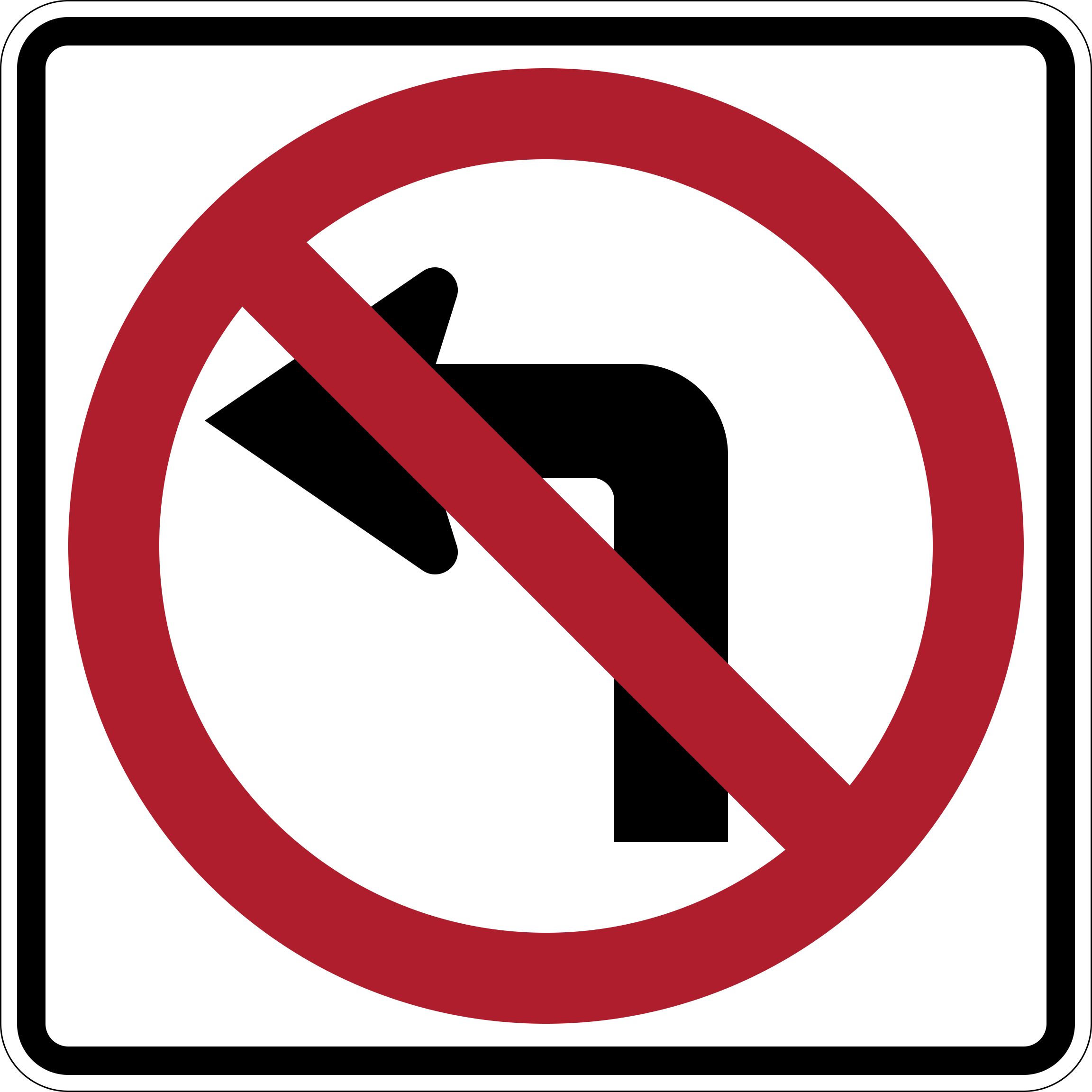
- Turning left from the approach controlled by the sign
- Making a legal right turn at the same intersection
- Proceeding straight through the intersection
- Stopping for a pedestrian in the marked crosswalk
Show answer
Turning left from the approach controlled by the sign. The symbol shows a leftward turn with a red slash, so that particular left movement is forbidden where the sign is posted. It does not automatically prohibit every other movement at the intersection. The choice “Proceeding straight through the intersection” is too broad because going straight may remain allowed unless another sign or signal restricts it. Choose a permitted direction, obey the signal, and avoid trying to begin the left turn before the sign and then correcting late. The restriction applies to the movement pictured, not to all travel.
Study this in the handbook: Regulatory Signs
3. What should a driver expect after seeing a Winding Road warning sign?

- A series of turns or curves
- A straight road with a wide shoulder
- A divided highway beginning ahead
- A mandatory detour around construction
Show answer
A series of turns or curves. The Winding Road warning signals repeated changes in direction, not one isolated bend. The divided-highway and detour choices describe different signs, and a straight-road choice contradicts the warning. Reduce speed before the first curve and keep a controlled pace through the sequence rather than accelerating between bends. Look ahead for later curves, stay to the right of the center line, and watch for bicyclists, pedestrians, or slow vehicles that may be hidden by the roadway shape.
Study this in the handbook: Warning, Guide and Service Signs
4. What does an Oregon No Turn on Red sign require?
- Turn after yielding to pedestrians even though the signal is red
- Turn after a complete stop if the intersection is clear
- Turn only when no vehicle is approaching from the left
- Wait for the signal to turn green before turning
Show answer
Wait for the signal to turn green before turning. A No Turn on Red sign prohibits turning during the red light, so the driver must wait for the signal to turn green. The usual permission for a turn after stopping does not override a posted restriction. A clear intersection, an empty left side, or yielding to pedestrians does not create an exception. Read the sign together with the signal before beginning the movement. The visual cue is the restriction beside the signal: remain behind the stop line until green, then check the crosswalk and other traffic before turning.
Study this in the handbook: Regulatory Signs
5. On a four-lane road with a painted median, a school bus has flashing red lights. Who must stop?
- Only vehicles behind the bus
- Only traffic traveling toward the bus
- Traffic in all lanes
- No one if the bus is stopped at the curb
Show answer
Traffic in all lanes. A painted median or turn lane does not create two separate roads for school-bus stopping rules. With flashing red lights, traffic in all lanes must stop and remain stopped until the bus driver turns the lights off. The same-side-only exception applies to a truly divided highway separated by an unpaved median strip or barrier. Treating a painted median as a barrier would expose children crossing from the bus side to moving traffic, so identify the type of separation before deciding who stops.
Study this in the handbook: School Buses and Railroad Crossings
6. Under Oregon's implied consent law, what can happen if a driver refuses a breath, blood, or urine test requested by police?
- Only a warning at the roadside
- A fine and possible suspension of driving privileges
- Automatic dismissal of any DUII investigation
- Permission to keep driving without restriction
Show answer
A fine and possible suspension of driving privileges. Driving in Oregon means agreeing to take a breath, blood, or urine test when a police officer asks. Refusing can bring a fine and can lead to suspension of driving privileges. A warning alone understates the possible consequence, and refusal does not dismiss an investigation. The driver also does not gain unrestricted permission to continue driving. The useful cue is implied consent: the agreement arises from operating a motor vehicle, so it is separate from whether an officer ultimately proves impairment at a particular alcohol level.
Study this in the handbook: Alcohol, Drugs and DUII
7. What is an allowed response when approaching a stopped vehicle with flashing lights on a road with two or more lanes going the same direction?
- Change lanes only when the stopped vehicle is a police car
- Keep the posted speed if a clear path is visible
- Stop in the adjacent lane until someone waves you through
- Slow at least 5 mph below the posted speed limit
Show answer
Slow at least 5 mph below the posted speed limit. On a road with two or more lanes moving in the same direction, Oregon says a driver approaching a vehicle stopped with flashing lights must change lanes so as not to drive next to it, and may also slow down by at least 5 miles per hour under the posted speed limit. The rule covers any motor vehicle stopped with lights flashing, not only police cars. Keeping the posted speed or stopping in the adjacent lane is not a listed response. Look ahead for flashing lights and allow the stopped vehicle as much room as safely possible.
Study this in the handbook: Emergency Vehicles, Stopped Vehicles and Work Zones
8. What must you do when an emergency vehicle approaches using a light or siren?
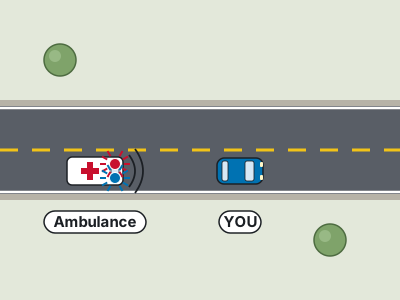
- Speed up to stay ahead of the emergency vehicle
- Move as close as safely possible to the right side and stop
- Stop in the intersection so the vehicle can go around
- Continue driving until the next traffic signal
Show answer
Move as close as safely possible to the right side and stop. When an emergency vehicle approaches with a light or siren, Oregon requires the driver to move immediately as close as safely possible to the right side of the road and stop. Stopping in an intersection can block the route, while speeding up or continuing to the next signal delays the emergency response. Remain stopped until the vehicle passes or an officer tells you to move. The practical cue is light or siren: check mirrors, signal if needed, clear the intersection when possible, and make room without creating a second hazard.
Study this in the handbook: Emergency Vehicles, Stopped Vehicles and Work Zones
9. When approaching a stopped vehicle with flashing lights on a road with two or more same-direction lanes, what should you do?
- Move into the lane closest to the stopped vehicle to signal caution
- Stay in the adjacent lane but reduce speed by 1 mph
- Change lanes so you do not drive next to it, when safe
- Follow the vehicle ahead through the scene before changing lanes
Show answer
Change lanes so you do not drive next to it, when safe. On a road with two or more lanes moving in the same direction, Oregon says you must change lanes so you do not drive next to a vehicle stopped with flashing lights, and that you may also slow down by at least 5 miles per hour under the posted limit. Moving into the lane closest to the stopped vehicle is the opposite of the rule, and a 1 mph reduction is not the stated figure. Signal, check the new lane, move over early, and allow the stopped vehicle as much room as safely possible.
Study this in the handbook: Emergency Vehicles, Stopped Vehicles and Work Zones
10. What is the heaviest vehicle an Oregon Class C non-commercial driving privilege lets you drive?
- 10,000 pounds
- 26,000 pounds
- 16,000 pounds
- 30,000 pounds
Show answer
26,000 pounds. A Class C non-commercial privilege covers vehicles such as a passenger car, moped, autocycle, van, or pickup weighing not more than 26,000 pounds, as long as the vehicle does not require a commercial license or motorcycle endorsement. The 10,000 and 16,000 pound figures understate the ceiling, so they would wrongly exclude some heavier pickups and vans a Class C driver may operate. A 30,000 pound vehicle is over the Class C limit, so this privilege does not cover it.
Study this in the handbook: Permits and Teen Licenses
11. During which period are studded tires generally allowed on Oregon roads?
- January 1 through May 31
- October 1 through February 28
- December 1 through April 30
- November 1 through March 31
Show answer
November 1 through March 31. Oregon generally allows studded tires from November 1 through March 31. The dates are a seasonal window, not a rule that begins with the first snow or ends when winter weather feels finished. October 1 starts too early, while April 30 and May 31 extend the period beyond the manual's stated end. Because studded tires can damage roads, the manual encourages alternatives such as chains or other traction tires when those options meet the need.
Study this in the handbook: Headlights and Hazardous Conditions
12. What does a double solid yellow center line mean for passing?
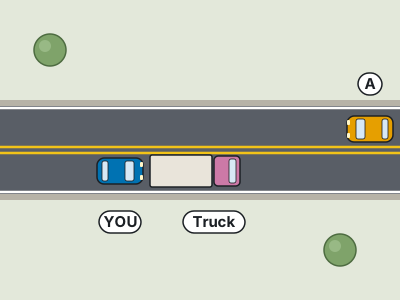
- Passing is allowed only for vehicles in the right lane
- Passing is allowed for traffic traveling both ways
- Passing is not allowed in either direction
- Passing is required before the next intersection
Show answer
Passing is not allowed in either direction. A double solid yellow center line prohibits passing for traffic moving in both directions. The two-way passing choice describes a broken yellow center line, and the lane-specific choices invent permissions that the marking does not provide. Oregon does allow a left turn across double solid yellow lines after oncoming traffic clears, but that exception is not a passing maneuver. Read the center marking before overtaking, and remain behind the vehicle until a legal passing opportunity appears.
Study this in the handbook: Pavement Markings
13. A police officer is redirecting traffic through a green signal. Which instruction must the driver follow?
- The posted speed limit without regard to the officer
- The green signal instead of the officer
- The direction given by the nearest driver
- The officer's direction to stop or proceed
Show answer
The officer's direction to stop or proceed. Oregon requires drivers to obey official signs, signals, and markings unless a police officer or road worker redirects traffic. That exception means the officer's hand signal or verbal direction controls even when the traffic light shows green. The other choices treat the signal, another driver, or the speed limit as superior instructions. Slow down, watch the person directing traffic, and follow the indicated path without trying to reconcile conflicting movements on your own.
Study this in the handbook: Regulatory Signs
14. How are traffic fines handled in Oregon work zones?
- They are waived when no worker is visible
- They are doubled in all work zones
- They are reduced for drivers who slow down
- They apply only after a flagger gives permission
Show answer
They are doubled in all work zones. Traffic fines are doubled in all Oregon work zones. The increase is tied to the work-zone designation, not to whether a worker happens to be visible at the moment. A driver cannot earn a reduction by slowing down, and a flagger's permission does not determine whether the fine rule applies. Orange traffic-control devices define these areas, where workers and equipment may be close to moving vehicles. Slow down, watch the changed roadway, and treat the doubled-fine rule as an added reason for careful attention.
Study this in the handbook: Emergency Vehicles, Stopped Vehicles and Work Zones
15. Before entering an Oregon roundabout, what traffic must a driver yield to?
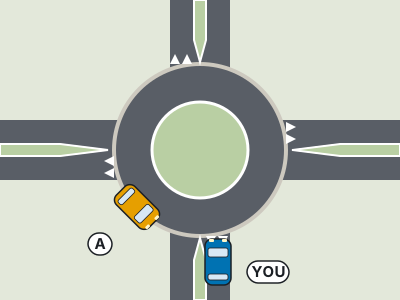
- Traffic inside and traffic exiting the roundabout
- Only vehicles entering from the left
- Vehicles behind the entering driver
- No traffic if the driver signals left
Show answer
Traffic inside and traffic exiting the roundabout. Before entering a roundabout, a driver must yield to traffic already inside and to traffic exiting the roundabout. The entering driver should wait for a gap and merge when safe. A turn signal does not remove the yielding duty, and traffic behind the vehicle does not determine who has priority. The manual also directs drivers to stop for pedestrians in the crosswalk in their lane as they approach. Slow down early, identify the intended exit, and look for both circulating and departing traffic.
Study this in the handbook: Right of Way at Intersections
16. What does Oregon consider cheating on a knowledge test?
- Using a phone or another electronic device
- Reading the permitted manual before the test begins
- Requesting audio assistance
- Taking the test in a listed language
Show answer
Using a phone or another electronic device. Oregon treats cell phone use and operation of other electronic devices during a knowledge test as cheating. The manual also lists talking, writing, note taking, and letting another person take the test as cheating conduct. Studying before the test, using available audio assistance, and selecting one of the offered languages are not identified as cheating. The practical cue is control of outside help: do not use a device or notes to obtain answers while the test is underway. A cheating finding prevents another test for 90 days.
Study this in the handbook: The Knowledge and Drive Tests
17. At what types of crosswalks must an Oregon driver stop for pedestrians?
- Only at a painted crosswalk with a signal
- At any marked or unmarked crosswalk
- Only when the pedestrian reaches the road center
- Only when the person is directly in front of the bumper
Show answer
At any marked or unmarked crosswalk. Oregon requires drivers to stop for pedestrians crossing at both marked and unmarked crosswalks. Painted lines and a traffic signal are not prerequisites for the duty to stop. Waiting until a pedestrian reaches the center of the road or the front bumper leaves too little space and ignores the protection given at an unmarked crossing. Scan every approach before moving through a crosswalk, including one without paint. The practical cue is the crossing itself, not whether road crews have added visible stripes or a signal at that location.
Study this in the handbook: Pedestrians and Bicycles
18. At speeds greater than 35 mph, when may an Oregon driver pass a bicyclist traveling in the same lane?
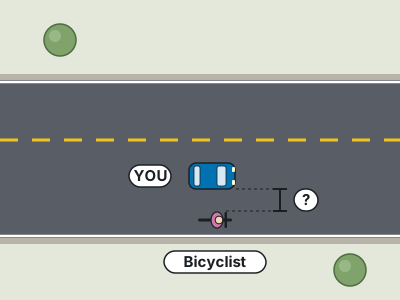
- Only with enough distance to prevent contact if the bicyclist falls
- Whenever the driver sounds the horn first
- Only by moving onto the shoulder regardless of traffic
- Never, even when a safe passing space exists
Show answer
Only with enough distance to prevent contact if the bicyclist falls. At speeds above 35 mph, Oregon permits passing a bicyclist in the lane only when the driver leaves enough distance to prevent contact if the bicyclist falls. A horn does not create the required clearance, and the rule says nothing about moving onto the shoulder to pass. The rule also does not make every pass impossible. If you cannot pass safely, slow down and remain behind the bicycle until the roadway provides the necessary space, then pass only after the safety margin exists.
Study this in the handbook: Motorcycles, Large Vehicles and Other Road Users
19. What may a blue motorist service sign indicate?
- A warning that a sharp curve is ahead
- A prohibition on passing
- Gas, food, lodging, a rest area, or a hospital
- The beginning of a one-way roadway
Show answer
Gas, food, lodging, a rest area, or a hospital. Blue motorist service signs identify services or facilities along the highway. Oregon gives examples including gas, food, lodging, rest areas, electric-vehicle charging, accessible facilities, parking, and hospitals. A no-passing instruction is regulatory, a sharp-curve notice is a yellow warning, and one-way operation is communicated by a regulatory sign or arrow. The color is a useful first filter, but drivers should still read the symbol or words for the specific facility. Blue means help or services, not a hazard command.
Study this in the handbook: Warning, Guide and Service Signs
20. Who must wear a safety belt in a vehicle on Oregon roads?
- Only the driver and the front seat passenger
- Only passengers younger than 16
- Only on highways with limits above 45 mph
- All drivers and passengers in all available seating positions
Show answer
All drivers and passengers in all available seating positions. Oregon makes safety belt use mandatory for every driver and every passenger in all available seating positions, front and back. Limiting the rule to the front seat or to younger riders misstates it, and there is no speed or road type threshold. The belt must be worn properly: no slack in the lap or shoulder portion, and never with the shoulder strap under the arm or behind the back. Younger children have additional child seat requirements until age 8 or 4 feet 9 inches.
Study this in the handbook: Seat Belts, Child Seats and Distracted Driving
QualitySpace is expanding to Oregon
We are a California-based independent insurance brokerage working on licensing in more states. We cannot help with Oregon insurance yet. Leave your email and we will let you know when we can.
Every question is written from the official Oregon Driver Manual. Need paper? Printable OR practice test with answer key.
Last verified 2026-10-05. How we check every question · Study all 220 as flashcards
Frequently asked questions
How many questions are on this Oregon practice test?
This fixed set has 20 questions. It is test 10 of 11 from the 220 question Oregon bank. The real OR exam asks 35 questions and you need 28 correct.
What is the passing score for the real Oregon test?
28 of 35 correct to receive a passing score That figure comes from the official Oregon source cited on the DMV facts page.
How does this fixed test relate to the full Oregon bank?
Each numbered test is a fixed set of questions in a fixed order, so you can retake the same test later and compare. Every test mixes road signs and the other topics in about the same proportion as the full bank. Tests 1 to 11 together cover every question in the Oregon bank once. The full practice page mixes the whole bank at random.
Last verified 2026-10-05. See the Oregon DMV facts page for sourced state details.