
Test 6 of 11 · 20 questions · Free 2026
OR Permit Practice Test 6
Jump to the test ↓A fixed 20 question set from the Oregon bank with answers and plain English explanations. The real OR exam is 35 questions, 80 percent to pass; take the full length version on the main practice page.
Question 1 of 20 · 0 right so far
All 20 questions in test 6
Every question below comes from the Oregon question bank on this page. Open a question to see the correct answer and the explanation. Nothing here is hidden behind a signup.
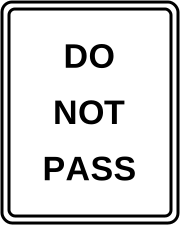
1. What restriction does the Do Not Pass sign communicate?
- Passing is prohibited in the indicated area
- Passing is required before the next curve
- Only trucks may pass other vehicles there
- The lane is reserved for vehicles turning left
Show answer
Passing is prohibited in the indicated area. Do Not Pass identifies an area where a driver may not pass another vehicle. The choices about required passing, truck-only passing, and a left-turn lane substitute different traffic controls for the sign's actual restriction. Oregon also warns drivers not to cross the center line where their view of oncoming traffic is limited, including hills, curves, intersections, railroads, and crosswalks. The useful cue is simple: a posted no-passing instruction ends the temptation to overtake, even if the road looks open.
Study this in the handbook: Regulatory Signs
2. A 16 year old wants to ride in the open bed of a friend's pickup truck on an Oregon road. What does state law say?
- It is allowed if the truck stays under 25 mph
- It is allowed on rural roads but not in cities
- It is allowed if an adult also rides in the bed
- Anyone under 18 is prohibited from riding in a pickup bed
Show answer
Anyone under 18 is prohibited from riding in a pickup bed. Oregon law bars anyone under 18 from riding on the hood, fender, running board, or any other external part of a vehicle, and the pickup bed is named in that list. The ban has no exception for low speeds, rural roads, or an adult riding along in the bed. The manual goes further and says that nobody, regardless of age, should ride in a pickup bed or on the outside of a vehicle.
Study this in the handbook: Avoiding Collisions and Equipment Failures
3. You fail your Oregon drive test on a Tuesday. When is the earliest you may retake it?
- Later that same day if an examiner is free
- One week later
- The next business day
- After a 90 day waiting period
Show answer
The next business day. Oregon makes a failed drive test wait until the next business day before a retest, so a same day second attempt is not available even if an examiner has an open slot. The rule does not impose a one week delay. A 90 day wait is the penalty for cheating on a knowledge test, a separate situation. Drive tests are by appointment only, and DMV suggests booking about three weeks ahead, so the actual date of your retest also depends on appointment availability or a certified third party tester.
Study this in the handbook: The Knowledge and Drive Tests
4. What device may a driver age 18 or older use to operate a cell phone while driving in Oregon?
- Any handheld phone held below the window
- A hands-free accessory requiring minimal finger use
- A phone held in one hand at a stoplight
- A touchscreen device mounted within reach
Show answer
A hands-free accessory requiring minimal finger use. Drivers 18 or older must use a hands-free accessory for a cell phone or other mobile electronic device. The accessory may require only minimal use of a finger to activate or deactivate it. Holding the phone or using a handheld device at a light does not meet that condition, and the rule names a hands-free accessory, not simply a touchscreen mounted within reach. Set up the hands-free function before moving, and consider assigning a passenger to handle the device so attention stays on traffic.
Study this in the handbook: Seat Belts, Child Seats and Distracted Driving
5. After stopping at a steady red signal, when may a driver turn right onto a two-way road?
- Before stopping if no cross traffic is visible
- Never, because all right turns on red are prohibited
- After a complete stop, unless a sign or officer prohibits it, and after yielding
- Only when the signal changes to a green arrow
Show answer
After a complete stop, unless a sign or officer prohibits it, and after yielding. A steady red signal permits a right turn onto a two-way road after the driver comes to a complete stop, unless a sign or police officer says otherwise. The driver must still yield to traffic and pedestrians before turning. The never and green-arrow choices remove a permission that Oregon expressly allows, while turning before stopping violates the signal rule. Check for a No Turn on Red sign, stop at the proper line, scan all approaches, and turn only into a safe opening.
Study this in the handbook: Traffic Signals
6. What does Oregon prohibit a driver from doing inside a roundabout?
- Using a right turn signal for the exit
- Overtaking or passing another vehicle
- Remaining in the selected lane
- Driving around the center island
Show answer
Overtaking or passing another vehicle. Oregon tells drivers not to attempt to overtake or pass vehicles inside a roundabout. Signaling for an exit, maintaining the selected lane, and traveling around the center island are normal parts of moving through the circular intersection. Large trucks may need to straddle both lanes, making a passing attempt especially risky. Maintain lane position, leave room for large vehicles, and wait until you are out of the roundabout before considering any passing maneuver. The lane-use signs and pavement markings should guide the entry lane.
Study this in the handbook: Turns, U-Turns and Roundabouts
7. Before crossing a transit lane to reach a driveway, whom must the driver yield to?
- Transit vehicles and people riding bicycles
- Only vehicles behind the driver
- No one if the turn signal is on
- Only pedestrians outside the intersection
Show answer
Transit vehicles and people riding bicycles. A driver crossing a transit lane for a permitted movement must yield to transit vehicles and people riding bicycles in the lane. Activating a turn signal communicates intent but does not grant priority. Traffic behind the driver is not the only concern, and the manual does not limit this duty to pedestrians outside an intersection. Scan the lane before crossing it, wait for transit or bicycle traffic to clear, and merge behind them after they pass. The lane's special use rule and its yielding rule operate together.
Study this in the handbook: Regulatory Signs
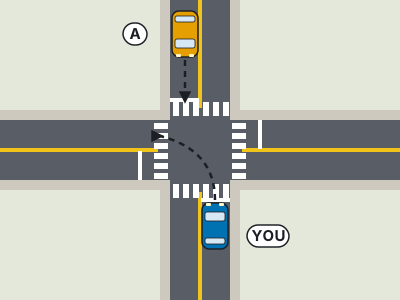
8. You are turning left on a green circular signal. When may you complete the turn?
- Only after a police officer waves the driver through
- Before checking for oncoming traffic because green gives the turning vehicle priority
- After yielding to oncoming vehicles and pedestrians and finding a safe gap
- As soon as the front wheels enter the intersection, regardless of pedestrians
Show answer
After yielding to oncoming vehicles and pedestrians and finding a safe gap. A green circle permits movement, but it does not erase the right of way held by people walking or vehicles approaching from the opposite direction. A left turn should be completed only after those road users have been yielded to and the path is safe. The choice “Before checking for oncoming traffic because green gives the turning vehicle priority” is dangerous because the signal does not give a turning driver automatic priority over oncoming traffic. Scan the crosswalk and opposing lane before steering across them, and keep watching for someone who enters late.
Study this in the handbook: Regulatory Signs
9. What does the lane reduction warning require from traffic in the marked lane?

- Merge into the through lane before the indicated lane ends
- Accelerate and remain in the lane until pavement disappears
- Use the shoulder as a permanent replacement lane
- Assume another lane will be added on the right
Show answer
Merge into the through lane before the indicated lane ends. A lane reduction warning means the indicated lane will end soon, and vehicles using it must merge into the through lane. Start looking for a safe opening early, signal, check the blind spot, and move over without forcing another driver to brake. The choice “Accelerate and remain in the lane until pavement disappears” waits too long and can turn a planned merge into an abrupt departure onto the shoulder. Maintain awareness of the lane that continues, because the warning concerns the lane ending rather than a new lane being created.
Study this in the handbook: Warning, Guide and Service Signs
10. What does a broken yellow center line indicate?
- A separation between lanes traveling in the same direction
- A two-way road where passing is allowed only on the side nearest the shoulder
- A one-way road with a reversible center lane
- A two-way road where passing may be allowed for both directions
Show answer
A two-way road where passing may be allowed for both directions. A broken yellow center line indicates a two-way road carrying traffic in opposite directions, and passing is allowed for both directions when the maneuver is otherwise safe and legal. It is not a white line separating same-direction lanes, nor does it identify a one-way road or restrict the opportunity to one shoulder side. The marking signals possibility, not automatic permission. Check sight distance, oncoming traffic, intersections, and other restrictions before crossing the center line. If any condition makes the pass unsafe, remain in your lane even though the line is broken.
Study this in the handbook: Pavement Markings
11. Is it legal in Oregon to drive at dusk in heavy rain with only your parking lights on?
- Yes, if you stay under 35 mph
- No, driving at night or in bad weather on parking lights alone is illegal
- Yes, if your fog lights are also on
- Yes, on streets that have street lights
Show answer
No, driving at night or in bad weather on parking lights alone is illegal. Oregon makes it illegal to drive a vehicle at night or in bad weather with only the parking lights on. Headlights are required from sunset to sunrise and whenever conditions make it hard to see people or vehicles 1,000 feet ahead, and heavy rain at dusk meets both concerns. Low speed, fog lights, or street lighting do not change the requirement. Parking lights have a different job: a vehicle stopped or parked on a road or shoulder must show them in limited visibility.
Study this in the handbook: Headlights and Hazardous Conditions
12. What minimum Personal Injury Protection must Oregon auto insurance include?
- $10,000 per person
- $15,000 per person
- $25,000 per person
- $20,000 per collision
Show answer
$15,000 per person. Oregon's minimums include Personal Injury Protection of $15,000 per person, covering reasonable and necessary expenses within two years after the date of the injury, such as medical and dental services. The $25,000 figure is the bodily injury minimum for one person and also the per person uninsured motorist amount. $20,000 per collision is the property damage minimum. $10,000 is below any figure the manual lists. Keeping each amount tied to its coverage type avoids mixing up these similar numbers.
Study this in the handbook: Insurance, Collisions and Reports
13. A driver takes a legal prescription drug that leaves them drowsy and slow to react, then drives. Can Oregon's DUII law apply?
- No, the DUII law covers only alcohol
- No, legally prescribed medicines are exempt
- Yes, it covers any substance that impairs your ability to drive
- Only if the driver's BAC is also 0.08% or more
Show answer
Yes, it covers any substance that impairs your ability to drive. Oregon's DUII law is not limited to alcohol. It applies to any substance that impairs your mental or physical ability to drive, which includes over the counter and prescription medications as well as marijuana. Having a prescription does not take an impairing medication outside the law. A BAC of 0.08% is not needed either, because a drug can impair a driver with no alcohol at all. The manual advises asking a doctor or pharmacist about side effects and finding other transportation when unsure about a new medication.
Study this in the handbook: Alcohol, Drugs and DUII
14. A friend crashes your car in a reportable Oregon collision and never files the DMV report. What is your duty as the owner?
- You must file the report as the owner
- None, because only the driver can report
- Ask police for their report, which replaces the DMV report
- Report only if your insurance company asks you to
Show answer
You must file the report as the owner. Oregon's reporting list covers the owner of a vehicle involved in a reportable collision when the driver fails to report it. Ownership brings its own duty, so the idea that only the driver can file is wrong. A police report does not substitute for the report owed to DMV, and nothing in the rule waits on a request from your insurer. Check whether the crash met a reporting condition, such as damage over $2,500, a tow with damage over $2,500, or any injury or death, and file within 72 hours.
Study this in the handbook: Insurance, Collisions and Reports
15. What do Oregon warning signs generally alert drivers to?
- Routes reserved for emergency vehicles
- The exact maximum speed permitted on every roadway
- Services available at the next highway exit
- Known possible hazards or a change in road conditions ahead
Show answer
Known possible hazards or a change in road conditions ahead. Yellow warning signs alert drivers to possible hazards or changing road conditions ahead. They do not set every roadway's speed, identify motorist services, or reserve routes for emergency vehicles. The manual emphasizes that the driver remains responsible for recognizing and reacting to conditions whether or not a sign is present. When a warning appears, scan farther ahead, reduce speed if needed, and prepare for the maneuver the symbol suggests instead of treating the sign as a guarantee that the hazard is absent.
Study this in the handbook: Warning, Guide and Service Signs
16. In Oregon, when is parking within 50 feet of a traffic signal or sign prohibited?
- Only for trucks
- Always, without exception
- Only at night
- When your vehicle would hide the signal or sign from view
Show answer
When your vehicle would hide the signal or sign from view. Oregon phrases this rule by effect rather than a flat ban: you may not park within 50 feet of a traffic signal or sign if your vehicle hides the signal or sign from view. The same 50 foot distance applies to the nearest rail of a railroad or light rail crossing, and a vehicle may not stand within 7 and a half feet of the tracks when it interferes with the train. The rule applies to every vehicle at every hour.
17. If an approaching train is clearly visible at a railroad crossing, when must a driver stop?
- Before the railroad tracks
- Only after the train reaches the crossing signal
- After crossing the first track
- Only if a gate is fully lowered
Show answer
Before the railroad tracks. A clearly visible approaching train is one of Oregon's listed reasons to stop before the tracks, even if gates or lights are not active. The gate-only choice ignores crossings without gates, while waiting for the train to reach a signal would leave too little margin. Never try to beat a train, and never stop on the rails. If a stop is required and no stop line exists, the manual gives a separate minimum distance from the nearest rail, so plan the stop before entering the crossing area.
Study this in the handbook: School Buses and Railroad Crossings
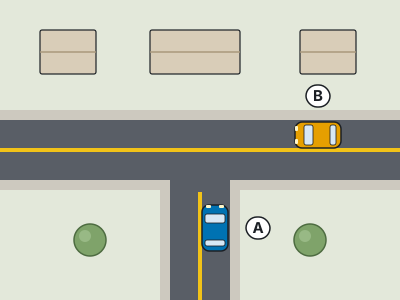
18. At an uncontrolled T intersection, whom must the driver on the ending road yield to?
- The through road only when it has a marked center line
- Only drivers approaching from the right
- Only vehicles already inside the intersection
- Drivers on the through road
Show answer
Drivers on the through road. At a T intersection with no signs or signals, the driver on the road that ends must yield to drivers on the through road. The lack of signs does not give the ending road priority, and the duty is not limited to traffic approaching from one side. A marked center line is not the condition that creates the rule. Slow before the junction, look both ways along the through road, and wait until traffic there has passed. The shape of the roadway is the cue: the road that terminates must yield before entering the continuing road.
Study this in the handbook: Right of Way at Intersections
19. What does a Right Turn Permitted Without Stopping sign below a stop sign allow?
- All traffic may ignore the stop sign
- Right-turning traffic may turn without stopping
- Left turns may proceed without yielding
- Only buses may turn without stopping
Show answer
Right-turning traffic may turn without stopping. This special sign applies to traffic turning right. It may be placed below a stop sign and allows a right turn without stopping, while other traffic must still stop and yield the right of way. It does not erase the stop requirement for every movement, and it does not create a special privilege for left turns or buses. Before turning, check pedestrians, bicycles, and vehicles that have priority. The small supplemental sign is the detail that changes the usual stop-sign instruction for that movement.
Study this in the handbook: Regulatory Signs
20. What maximum speed does Oregon set for roads and highways that do not meet another statutory speed definition?
- 45 mph
- 50 mph
- 55 mph
- 65 mph
Show answer
55 mph. Oregon sets 55 mph for roads and highways that do not fit another statutory speed definition, unless a different limit is posted. The 45 and 50 mph options are not the general figure in this passage. Sixty five mph is not the fallback maximum stated for this category. This is a maximum under ideal conditions, not a target that must be reached. The basic rule requires a reasonable and cautious speed in relation to traffic, pedestrians, road surface, visibility, weather, and hazards, so those conditions can require less than 55 mph.
Study this in the handbook: Oregon Speed Limits
QualitySpace is expanding to Oregon
We are a California-based independent insurance brokerage working on licensing in more states. We cannot help with Oregon insurance yet. Leave your email and we will let you know when we can.
Every question is written from the official Oregon Driver Manual. Need paper? Printable OR practice test with answer key.
Last verified 2026-10-05. How we check every question · Study all 220 as flashcards
Frequently asked questions
How many questions are on this Oregon practice test?
This fixed set has 20 questions. It is test 6 of 11 from the 220 question Oregon bank. The real OR exam asks 35 questions and you need 28 correct.
What is the passing score for the real Oregon test?
28 of 35 correct to receive a passing score That figure comes from the official Oregon source cited on the DMV facts page.
How does this fixed test relate to the full Oregon bank?
Each numbered test is a fixed set of questions in a fixed order, so you can retake the same test later and compare. Every test mixes road signs and the other topics in about the same proportion as the full bank. Tests 1 to 11 together cover every question in the Oregon bank once. The full practice page mixes the whole bank at random.
Last verified 2026-10-05. See the Oregon DMV facts page for sourced state details.