
Test 8 of 11 · 20 questions · Free 2026
OR Permit Practice Test 8
Jump to the test ↓A fixed 20 question set from the Oregon bank with answers and plain English explanations. The real OR exam is 35 questions, 80 percent to pass; take the full length version on the main practice page.
Question 1 of 20 · 0 right so far

All 20 questions in test 8
Every question below comes from the Oregon question bank on this page. Open a question to see the correct answer and the explanation. Nothing here is hidden behind a signup.
1. What roadway condition is shown by the Sharp Turn warning sign?
- A railroad crossing is immediately ahead
- A four-way intersection is ahead
- The road is narrowing to one lane
- A sharp turn in the road is ahead
Show answer
A sharp turn in the road is ahead. The Sharp Turn symbol warns that the road will change direction abruptly ahead. The crossroad choice belongs to a different warning symbol, and lane reduction or railroad crossing signs communicate separate hazards. The practical response is to slow before the turn, keep the vehicle in its lane, and follow any advisory speed shown. Entering too quickly can carry the vehicle across the center line or off the roadway, especially when the view beyond the turn is blocked.
Study this in the handbook: Warning, Guide and Service Signs
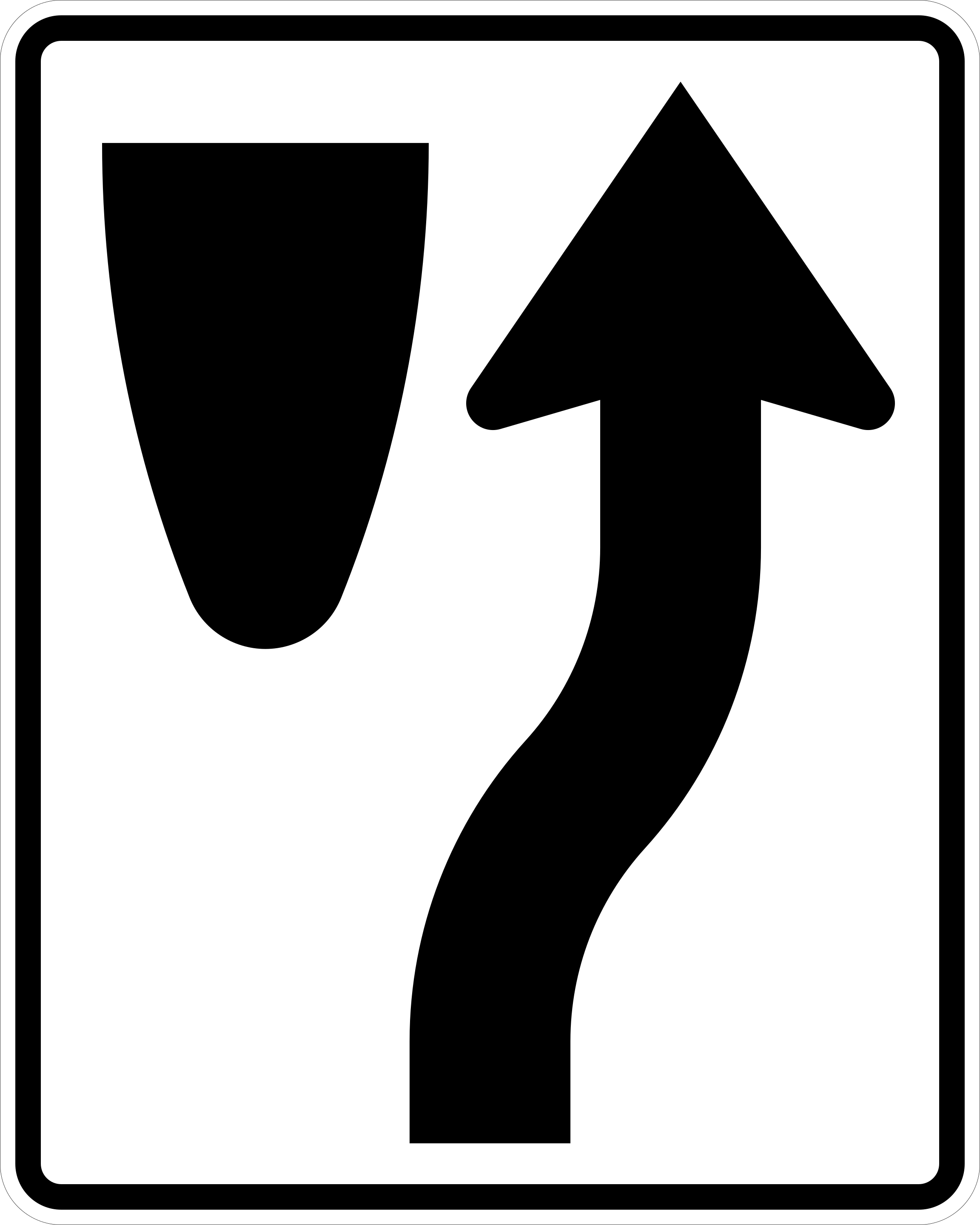
2. The pictured KEEP RIGHT sign appears before a traffic island. Where should you drive?
- Across the island if no vehicle is approaching
- To the left of the obstruction because traffic keeps left there
- To the right of the island, median, or obstruction
- Into the opposing lane until the obstruction ends
Show answer
To the right of the island, median, or obstruction. This sign marks an obstruction that divides or interrupts the roadway and directs traffic to pass on its right side. Stay within the intended lane and follow the arrow around the island or median. The choice “Across the island if no vehicle is approaching” treats the island as optional, but crossing it can damage the vehicle and create a conflict with other traffic. Slow enough to identify the channel, maintain a safe position, and watch for additional lane markings that guide the movement around the obstruction.
Study this in the handbook: Regulatory Signs
3. What should a driver expect from an Oregon pedestrian crossing warning sign?
- A pedestrian signal will remain red for the entire crossing
- People may be crossing the vehicle's path
- The crosswalk is limited to people walking from the right
- The road narrows because bicycles must use the lane
Show answer
People may be crossing the vehicle's path. A pedestrian crossing warning sign tells drivers to be alert for people crossing their path. It does not promise a particular signal phase, limit the crossing to one direction, or announce a lane narrowing. The warning should change the driver's behavior before reaching the crossing. Scan both sides of the road, reduce speed when needed, and prepare to stop for a person in the crosswalk. If the sign includes a flashing yellow beacon, it may indicate that a pedestrian is crossing, has recently crossed, or is about to cross, so continue watching rather than passing through casually.
Study this in the handbook: Warning, Guide and Service Signs
4. What happens to an Oregon driver who refuses a breath, blood, or urine test requested by a police officer?
- Nothing, refusal is a right
- Automatic jail
- A fine and possible suspension of driving privileges
- Only a warning
Show answer
A fine and possible suspension of driving privileges. By driving in Oregon you agree to take a breath, blood or urine test when asked by a police officer. If you refuse, you may receive a fine and your driving privileges could be suspended. Refusal is not a free option and does not by itself mean jail. Drivers under 21 fail the test with any amount of alcohol under the zero tolerance law, and drivers 21 and over fail at 0.08 percent or more.
Study this in the handbook: Alcohol, Drugs and DUII
5. An operator of a motorized wheelchair is using an Oregon bike lane. What must a driver do?
- Sound the horn so they move to the sidewalk
- Nothing, wheelchairs may not use bike lanes
- Yield as you would to a person riding a bicycle
- Pass closely at normal speed
Show answer
Yield as you would to a person riding a bicycle. Operators of motorized wheelchairs, scooters and personal assistive mobility devices are permitted to use Oregon bike lanes and paths, and you must yield to these operators as you would to a person riding a bicycle. The rules for passing other vehicles apply to passing them; if you cannot pass safely, slow down and remain behind until it is safe. A horn does not move them out of the bike lane, and passing closely at normal speed ignores the duty to yield.
Study this in the handbook: Pedestrians and Bicycles
6. Can driving below Oregon's speed limit still violate the basic rule?
- Yes, when the speed is unsafe for existing conditions
- No, unless the vehicle is above the posted limit
- Yes, but only when a work-zone sign is displayed
- No, if the driver is traveling with the flow of traffic
Show answer
Yes, when the speed is unsafe for existing conditions. Oregon's basic rule applies whenever the chosen speed is unsafe for existing conditions, even if the speedometer is below the posted limit. Fog, ice, congestion, a curve, or limited sight distance can make a reduced speed necessary. Being below the limit does not create an automatic safe harbor, and following surrounding traffic does not remove the driver's responsibility. A work-zone sign is not required for the basic rule to apply. Use visibility, traction, and available stopping space as cues, then slow enough to keep control and respond to hazards.
Study this in the handbook: The Basic Rule and Variable Speed Signs
7. At an intersection controlled by a steady red signal, where must you stop?
- Before the marked stop line or crosswalk, if one is present
- Before the intersection but beyond the marked crosswalk
- At the nearest point where cross traffic can see the vehicle
- After the stop line when no pedestrians are present
Show answer
Before the marked stop line or crosswalk, if one is present. A steady red signal is one of the controls covered by Oregon's intersection stopping rule. Stop before the marked stop line or crosswalk when either is provided. If neither marking exists, stop before the unmarked crossing area. Stopping beyond the crosswalk can put the vehicle where pedestrians need to walk and does not follow the stated stopping point. The useful visual cue is to identify the line or crosswalk before reaching it, then remain behind it while waiting for a permitted movement. A red signal does not erase the need to watch for vulnerable road users.
Study this in the handbook: Right of Way at Intersections
8. At an Oregon bike box, where must a driver stop for a red traffic signal?
- Anywhere in the intersection if bicycles are absent
- Inside the green box beside the bicycle symbol
- Past the box at the nearest crosswalk
- Behind the bike box, without stopping inside it
Show answer
Behind the bike box, without stopping inside it. A driver approaching a bike box must stop for the traffic signal behind the box and must not stop in the box. The green area gives people riding bicycles space in front of motor traffic at the intersection. Stopping inside it defeats that purpose and can place the vehicle where cyclists are expected to wait. The absence of a cyclist does not change the stopping location, and a driver may not roll past the box to choose a more convenient point.
Study this in the handbook: Pedestrians and Bicycles
9. Which statutory speed limit applies in an Oregon residential district when no different limit is posted?
- 15 mph
- 25 mph
- 20 mph
- 40 mph
Show answer
25 mph. A residential district has a statutory maximum of 25 mph when no other speed is posted. The 15 mph figure is reserved for alleys and narrow residential areas, which is a narrower category than every residential district. Twenty miles per hour applies in a business district and within a school speed zone. Forty mph is not the residential figure listed in the manual. The location label controls the initial choice, but the basic rule still requires a reasonable and cautious speed when traffic, visibility, weather, or road conditions make the maximum unsafe.
Study this in the handbook: Oregon Speed Limits
10. How close to a fire hydrant may a vehicle be parked in Oregon?
- No closer than 10 feet
- No closer than 15 feet
- No closer than 5 feet
- No closer than 20 feet
Show answer
No closer than 10 feet. Oregon's parking list bars parking within 10 feet of a fire hydrant. Fifteen feet is the same side distance from a fire station driveway, with 75 feet on the opposite side, and 20 feet is the distance from a marked or unmarked crosswalk at an intersection. The list also bars parking within 50 feet of a traffic signal or sign if your vehicle hides it, within 50 feet of the nearest rail of a railroad or light rail crossing, and in front of a driveway.
11. Which vehicle display is illegal for an Oregon driver to have visible while driving?
- A TV, tablet, or other video display visible to the driver
- A factory speedometer that the driver must see
- A rearview mirror showing traffic behind the vehicle
- A turn signal indicator on the dashboard
Show answer
A TV, tablet, or other video display visible to the driver. Oregon's distracted driving guidance makes it illegal for the driver to have a TV, tablet, or other video display visible while driving. The rule targets entertainment or video screens, not the ordinary instruments and mirrors needed to control and observe the vehicle. A speedometer, rearview mirror, or dashboard signal indicator serves a driving function and is not the display described here. Before moving, position or disable any video screen that could remain visible in the driver's field of view.
Study this in the handbook: Seat Belts, Child Seats and Distracted Driving
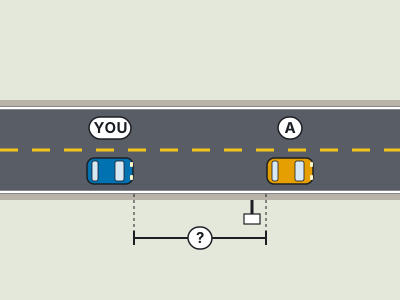
12. What following distance does the Oregon manual define as safe in ordinary conditions?
- One second at every speed
- Exactly one car length
- Two to four seconds
- Ten seconds only on freeways
Show answer
Two to four seconds. The manual defines a safe following distance as two to four seconds in ordinary driving. When traveling faster than 30 mph, it advises four seconds or more, because higher speed leaves less time to notice a hazard and increases stopping distance. One car length is not a dependable measure because the needed space changes with speed. Ten seconds is not the standard baseline. Pick a fixed object, wait for the vehicle ahead to pass it, and count until your own vehicle reaches that point.
Study this in the handbook: Space Cushion and Following Distance
13. The Oregon manual's Park Your Phone panel lists fines for mobile device offenses while driving. What is the maximum fine for a first offense?
- Up to $1,000
- Up to $100
- Up to $2,000
- Up to $2,500
Show answer
Up to $1,000. The Park Your Phone panel lists three levels. A first offense can bring a fine of up to $1,000. The $2,000 figure is the maximum for a second offense, and up to $2,500 plus six months in jail is the top level for a third. A $100 cap badly understates the penalty. Drivers under 18 may not use a phone or mobile device at all while driving, and drivers 18 or older may use one only through a hands free accessory activated with minimal use of a finger.
14. Which of these is on the Oregon manual's list of reasons a driver can lose the driving privilege?
- Paying a traffic ticket by mail
- Failing to report a vehicle collision
- Letting a licensed friend drive your insured car
- Driving slower than traffic in the right lane
Show answer
Failing to report a vehicle collision. The manual lists reasons a driver can lose the privilege: driving under the influence of alcohol, drugs, or inhalants, failing to report a vehicle collision, driving uninsured, too many traffic convictions, and failure to comply with court fines. It notes the list is not complete. Paying a ticket by mail is a way of complying with a fine, not failing to. Lending an insured car to a licensed driver appears nowhere on the list, and driving slower than traffic in the right lane is exactly where the manual tells slow drivers to be.
15. The car you were driving takes $3,000 in damage in an Oregon crash. No one is hurt and nothing is towed. What must you do?
- Nothing, because a report is needed only when someone is hurt
- File a report with DMV within 10 days
- File only if police did not come to the scene
- File a collision report with DMV within 72 hours
Show answer
File a collision report with DMV within 72 hours. A collision report on Form 735-32 is due within 72 hours when the damage to the vehicle you were driving is over $2,500, so $3,000 of damage triggers it even with no injuries and no tow. Ten days is too long. A report is not limited to injury crashes, since damage alone can make a collision reportable. A police officer at the scene does not change anything, because the manual says a police report does not replace your requirement to file with DMV.
Study this in the handbook: Insurance, Collisions and Reports
16. A 15 year old plans to take the Oregon Class C knowledge test online at home. Who must supervise the test?
- A DMV employee watching on a video call
- No one, because the webcam photos confirm identity
- A proctor over 21 years of age
- Any licensed driver who is at least 18
Show answer
A proctor over 21 years of age. Online testing is allowed for applicants under 18, but a proctor older than 21 has to supervise. The webcam photos that the system takes at the start and at random points confirm who is testing; they do not replace the proctor. The manual names a proctor for this role, not a DMV employee on a video call, and an 18 year old licensed driver is too young to serve. A proctor may supervise only two tests in a 24 hour period, and the test taker still cannot use the manual, notes, or other electronic devices.
Study this in the handbook: The Knowledge and Drive Tests
17. What does the Oregon Do Not Pass sign tell a driver?
- The road is changing from two-way to one-way traffic
- Passing is required before the next intersection
- Only trucks may pass in that area
- Passing is prohibited
Show answer
Passing is prohibited. The Do Not Pass sign is a regulatory sign that prohibits passing in the area where it is posted. The choice “Passing is required before the next intersection” reverses the instruction. The sign does not create a special privilege for trucks, and it says nothing about a change to one-way traffic. A driver should read this sign together with the pavement markings and roadway conditions, then remain behind the vehicle ahead until passing is legally allowed. The key cue is the direct command: do not pass means wait, even if the road appears open.
Study this in the handbook: Regulatory Signs
18. What should you do when your vehicle begins to skid?
- Slam on the brakes and hold the steering wheel rigidly
- Stay off the brakes and steer in the direction you want the vehicle to go
- Turn sharply away from the direction of travel
- Accelerate hard to force the tires to grip
Show answer
Stay off the brakes and steer in the direction you want the vehicle to go. A skid means the tires have lost their grip. Oregon says to stay off the brakes until the vehicle slows, then steer toward the direction you want to travel. As the vehicle straightens, correct the wheel back the other way and continue making gentle corrections until control returns. Hard braking can remain ineffective during the slide, and a sharp opposite turn can start another skid. Heavy acceleration may worsen the loss of traction. The cue is smooth steering toward the intended path, followed by small corrections rather than panic inputs.
Study this in the handbook: Headlights and Hazardous Conditions
19. What does a flashing yellow arrow allow you to do after yielding as required?
- Treat the signal as a stop sign in every case
- Proceed straight only, regardless of the arrow
- Turn without checking for pedestrians
- Make the movement shown by the arrow
Show answer
Make the movement shown by the arrow. A flashing yellow arrow permits the movement indicated by its direction, but it is not a protected movement. You must yield first to pedestrians and oncoming traffic, then proceed only when the path is safe. Proceeding straight regardless of the arrow ignores the arrow's direction. Turning without checking for pedestrians skips the required yield, and treating the signal as a stop sign in every case misreads a permissive arrow. Remember the sequence as arrow movement, yield, then go when clear. A steady green arrow is different: it means you have the right of way for the movement shown.
Study this in the handbook: Traffic Signals
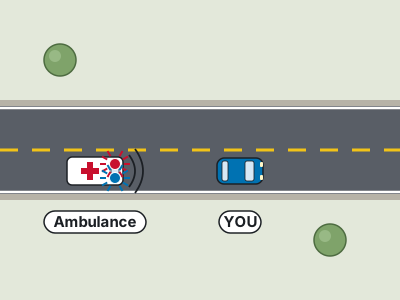
20. When an emergency vehicle approaches with a light or siren, where should a driver stop?
- In the center of the intersection so the vehicle can pass on either side
- As close as safely possible to the right side of the road, outside the intersection
- In the left lane while keeping the vehicle moving slowly
- On the shoulder only if the emergency vehicle is a fire truck
Show answer
As close as safely possible to the right side of the road, outside the intersection. Yielding to an emergency vehicle with a warning light or siren means moving as close as safely possible to the right side and stopping. Do not stop in an intersection or in a position that interferes with the emergency response. The fire-truck-only choice is too narrow because the rule also covers police vehicles and ambulances. Remain stopped until the vehicle has passed or an officer directs you to move, then keep at least 500 feet behind it.
Study this in the handbook: Emergency Vehicles, Stopped Vehicles and Work Zones
QualitySpace is expanding to Oregon
We are a California-based independent insurance brokerage working on licensing in more states. We cannot help with Oregon insurance yet. Leave your email and we will let you know when we can.
Every question is written from the official Oregon Driver Manual. Need paper? Printable OR practice test with answer key.
Last verified 2026-10-05. How we check every question · Study all 220 as flashcards
Frequently asked questions
How many questions are on this Oregon practice test?
This fixed set has 20 questions. It is test 8 of 11 from the 220 question Oregon bank. The real OR exam asks 35 questions and you need 28 correct.
What is the passing score for the real Oregon test?
28 of 35 correct to receive a passing score That figure comes from the official Oregon source cited on the DMV facts page.
How does this fixed test relate to the full Oregon bank?
Each numbered test is a fixed set of questions in a fixed order, so you can retake the same test later and compare. Every test mixes road signs and the other topics in about the same proportion as the full bank. Tests 1 to 11 together cover every question in the Oregon bank once. The full practice page mixes the whole bank at random.
Last verified 2026-10-05. See the Oregon DMV facts page for sourced state details.