
Test 20 of 25 · 20 questions · Free 2026
OR Permit Practice Test 20
Jump to the test ↓A fixed 20 question set from the Oregon bank with answers and plain English explanations. The real OR exam is 35 questions, 80 percent to pass; take the full length version on the main practice page.
Question 1 of 20 · 0 right so far
All 20 questions in test 20
Every question below comes from the Oregon question bank on this page. Open a question to see the correct answer and the explanation. Nothing here is hidden behind a signup.
1. Which yellow warning sign tells you that people on bikes and on foot regularly cross the road in that area?
- Two-Way Traffic Ahead
- Railroad Advance
- Multiuse Path Crossing
- Divided Highway Begins
Show answer
Multiuse Path Crossing. The Multiuse Path Crossing sign warns that people riding bicycles and pedestrians regularly cross the road in that area. Slow down and watch both sides of the road. Under Oregon's rules, people rolling and walking in a crosswalk are pedestrians, and anyone crossing in a crosswalk in your lane or the next lane requires you to stop and stay stopped. Yield to people riding bicycles at intersections as you would to other vehicles.
Study this in the handbook: Warning, Guide and Service Signs
2. Onto which kind of road does Oregon allow a left turn against a red light, after stopping and yielding?
- A one-way road going to your left
- Any two-way road with no oncoming cars
- A road with a center turn lane
- Any road, if no sign prohibits it
Show answer
A one-way road going to your left. Oregon allows a left turn on red only onto a one-way road that flows to your left, whether you are coming from a one-way or a two-way road. You must stop first and yield to traffic and pedestrians, and a sign may still prohibit it. A left turn onto a two-way road against a red light is illegal, because you would cross lanes where others have the right of way.
Study this in the handbook: Turns, U-Turns and Roundabouts
3. Light rain starts in the afternoon and you switch on your windshield wipers. What else does Oregon advise?
- Turn on your hazard lights
- Turn on your headlights too
- Set your cruise control
- Switch to your fog lights
Show answer
Turn on your headlights too. Rain makes it harder for other drivers to see you as well as for you to see them. Oregon advises turning on your headlights whenever your windshield wipers are on, which makes your vehicle easier for other motorists to spot. Keep your windows clear of moisture, apply the brakes sooner and more gently, and do not use cruise control while the road is wet.
Study this in the handbook: Headlights and Hazardous Conditions
4. An ambulance with its siren on passes you, and you pull back into traffic behind it. How closely may you follow it?
- No closer than 200 feet
- No closer than 300 feet
- No closer than 1,000 feet
- No closer than 500 feet
Show answer
No closer than 500 feet. After an emergency vehicle passes, Oregon requires you to stay at least 500 feet behind it. When you see or hear the warning, first drive as close as you safely can to the right side of the road and stop, outside any intersection. Stay stopped until the vehicle has passed or an officer tells you to move, then rejoin traffic and keep that 500 foot gap.
Study this in the handbook: Emergency Vehicles, Stopped Vehicles and Work Zones
5. You are waiting to turn left on a flashing yellow arrow. What signal does the oncoming traffic have?
- A steady green signal
- A steady red signal
- A flashing yellow arrow too
- A flashing red signal
Show answer
A steady green signal. A flashing yellow arrow lets you turn in the direction of the arrow, but only after yielding to pedestrians and oncoming traffic. The reason it demands care is that oncoming traffic has a steady green signal at the same time, so those drivers expect to go straight through without stopping. Wait in the intersection approach until there is a safe gap and the crosswalk you will cross is clear. Do not treat the arrow as a protected turn.
Study this in the handbook: Traffic Signals
6. What shape does the Oregon Driver Manual give for the red and white Do Not Enter sign?
- Octagon
- Square
- Triangle
- Pentagon
Show answer
Square. Oregon teaches sign shapes so you can recognize a sign before you can read it. The Do Not Enter sign is square, with red and white colors because it prohibits a movement. You will see it if you are about to go the wrong way onto a road or freeway ramp. Other shapes carry other meanings: an octagon is a stop sign, a triangle is a yield sign, and a five-sided sign marks a school zone or school crossing.
Study this in the handbook: Regulatory Signs
7. A school bus ahead of you turns on its flashing amber lights. What do they mean?
- The bus has stopped and you must stop now
- The bus is pulling back into traffic
- The bus is about to stop, so prepare to stop
- The bus is about to back up
Show answer
The bus is about to stop, so prepare to stop. School buses have flashing amber and red lights near the top of the bus, front and rear. The amber lights come first: they warn traffic that the bus is about to stop on the road to load or unload children, so you should prepare to stop. When the red lights start flashing, often with a stop arm out by the driver's window, stop before reaching the bus and stay stopped until the red lights are turned off.
Study this in the handbook: School Buses and Railroad Crossings
8. Compared with a car going the same speed, about how much distance does a large truck or bus need to stop?
- About the same distance
- About three times as much
- About twice as much
- About five times as much
Show answer
About three times as much. Recreational vehicles, trucks, commercial buses, and vehicles towing trailers take longer to speed up and need more room to maneuver. Oregon's manual says they take about three times the distance to stop compared with smaller vehicles at the same speed. Cutting in front of one and then braking leaves its driver no room to stop. When you pass a large vehicle, wait until you can see its entire front in your rearview mirror before moving over.
Study this in the handbook: Motorcycles, Large Vehicles and Other Road Users
9. You are on a long snowy highway with steady traffic. Is it a good idea to use cruise control?
- Yes, it keeps your speed smooth
- Yes, if you set it below the limit
- No, do not use it on snow or ice
- Yes, on straight stretches only
Show answer
No, do not use it on snow or ice. Oregon's manual says not to use cruise control on snow and ice, just as it says not to use it in wet conditions. Snow and ice impair your ability to see ahead and increase the distance you need to stop. Drive at slower speeds, leave more room, press the gas and brakes gently, and make turns at a reduced, steady speed. Keep your windows clear of snow, ice, and fog.
Study this in the handbook: Headlights and Hazardous Conditions
10. The lights are flashing at a railroad crossing with no stop line painted. You stop about 10 feet from the nearest rail. Is that correct?
- Yes, 10 feet is enough room
- No, stop at least 50 feet away
- No, stop at least 15 feet away
- Yes, as long as the gate clears you
Show answer
No, stop at least 15 feet away. When you are required to stop at a railroad crossing, stop at the stop line. If there is no stop line, stop at least 15 feet from the nearest rail. Do not confuse this with the 50 foot rule for parking near a crossing. After stopping, do not start across until you are sure you can do so safely and completely clear the tracks.
Study this in the handbook: School Buses and Railroad Crossings
11. You turned onto a freeway ramp by mistake, saw this sign, and pulled to the side and stopped. What should you do next?
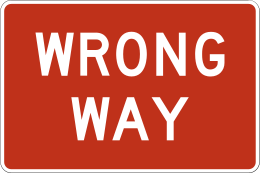
- Continue onto the freeway and exit at the next ramp
- Stay parked on the ramp until a tow truck comes
- Flash your high beams and drive up the ramp
- Use hazard lights and carefully turn around or back off
Show answer
Use hazard lights and carefully turn around or back off. A WRONG WAY or DO NOT ENTER sign at a ramp tells you that you have started onto the freeway in the wrong direction. Oregon's steps are to immediately pull off to the side of the ramp and stop, turn on your hazard lights to warn other vehicles, and then cautiously turn around or back off the ramp. Never continue onto the freeway against traffic.
Study this in the handbook: Passing and Freeway Driving
12. You are about to enter a roundabout, and a car inside is about to exit at your entry street. What must you do?
- Enter first, since it is leaving
- Stop inside the circle to let it by
- Honk so the driver knows you are coming
- Yield to it, then merge into a gap
Show answer
Yield to it, then merge into a gap. Before you enter a roundabout, Oregon says you must yield to traffic inside the roundabout and to traffic exiting it. Wait for a gap and merge into the flow, prepared to stop if necessary. Watch for pedestrians in the crosswalk at your entry, and remember that traffic inside moves counterclockwise around the center island. Yielding to exiting cars keeps you from cutting across a driver who is leaving the circle.
Study this in the handbook: Turns, U-Turns and Roundabouts
13. You are parking on a street with streetcar tracks beside the parking lane, and a solid white line separates the two. Where must your car be?
- With your left wheels resting on the line
- Fully behind the white line, clear of the track
- Within 12 inches of the nearest rail
- Anywhere, as long as your doors can open
Show answer
Fully behind the white line, clear of the track. Streetcars cannot steer around a parked car. Oregon says never to park on streetcar or train tracks and to park behind the solid white line that separates the parking area from the track. If there is no white line, park as close to the curb as possible, away from the rails. Before you open your door, check for approaching streetcars or trains, and make sure your car is clear of the tracks.
14. A raised median begins in the middle of the road ahead, and this sign stands at its tip. How should you pass the median?
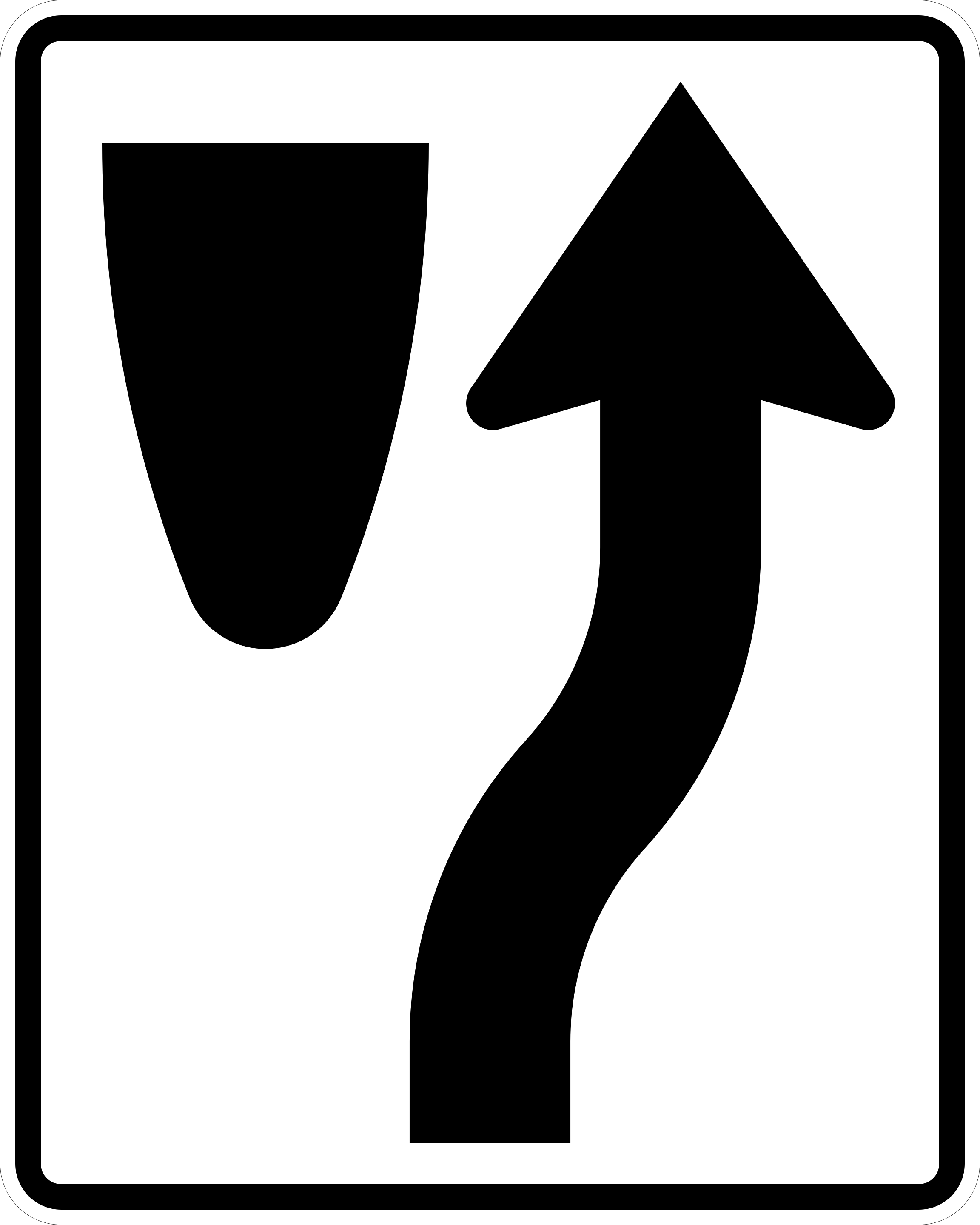
- On whichever side is less busy
- Keep to the left of it
- Stop and yield before passing it
- Keep to the right of it
Show answer
Keep to the right of it. A KEEP RIGHT sign is posted where a traffic island, median, or other obstruction divides the road ahead. Pass to the right of it. Traffic going the other way uses the left side, so cutting left of the island can put you head-on with oncoming vehicles. Slow down as you approach and stay in your lane as it bends around the obstruction.
Study this in the handbook: Regulatory Signs
15. A city bus stopped at the curb ahead turns on its left signal to pull back into your lane, and an electric sign lights up on its back. Who has the right of way?
- The bus, so you must let it back in
- You, since you are already in the lane
- Whichever vehicle is moving faster
- Nobody, until the bus fully stops again
Show answer
The bus, so you must let it back in. Public transit buses often pull to the curb to load and unload passengers. When the bus driver signals to re-enter the traffic lane and the electric sign on the back of the bus flashes yield, vehicles approaching from the rear must yield and let the bus back in. Slow down and leave room in front of you. Watch for passengers who just got off and may cross near the bus.
Study this in the handbook: Motorcycles, Large Vehicles and Other Road Users
16. You have pulled over and stopped for a fire truck using its siren. When may you start moving again?
- As soon as its siren goes quiet
- When the cars behind you begin to move
- Once it has passed or an officer tells you to
- Right away, if it is still a block back
Show answer
Once it has passed or an officer tells you to. When an emergency vehicle approaches from any direction using a light or siren, drive as close as you safely can to the right side of the road and stop, but not in an intersection. Then stay stopped until the emergency vehicle has passed or until an officer tells you to move. Do not drive or stop in a way that interferes with it. After it passes, you must stay at least 500 feet behind it.
Study this in the handbook: Emergency Vehicles, Stopped Vehicles and Work Zones
17. You are passing a car on a two-lane road. When can you signal and move back into your lane?
- As soon as your rear bumper clears its front bumper
- When you can see that car in your rearview mirror
- When the driver you passed flashes their lights
- After you are one car length past it
Show answer
When you can see that car in your rearview mirror. Passing takes judgment at both ends. Oregon warns that cutting back into your lane too soon risks sideswiping the vehicle you passed, while staying out too long risks a head-on collision. The test for returning is simple: when you can see the vehicle you passed in your rearview mirror, signal and move back into your lane. Before starting, check your mirrors and blind spot, signal, and finish the pass as soon as possible.
Study this in the handbook: Passing and Freeway Driving
18. How does the Oregon manual describe what a posted speed limit means?
- The top speed considered safe there in ideal conditions
- A target speed that drivers should try to hold
- The safe speed in any weather or traffic
- A suggested speed that police cannot enforce
Show answer
The top speed considered safe there in ideal conditions. Oregon defines a speed limit as the maximum speed considered safe for the area under ideal driving conditions. Two points matter. It is a ceiling, not a goal, and it assumes ideal conditions such as good visibility and a dry road. When visibility drops or the road is wet, snowy, or icy, the basic rule requires a speed that is reasonable and cautious for those conditions, which can be well below the posted number.
Study this in the handbook: Oregon Speed Limits
19. On a two-lane road, the car ahead of you has stopped to turn left. When may you pass it on the right?
- Any time, even if you use the gravel shoulder
- After honking so the driver knows you are there
- Never, you must always wait behind a turning car
- If you can stay on the pavement and out of a bike lane
Show answer
If you can stay on the pavement and out of a bike lane. Passing on the right is allowed in Oregon only in limited cases. One is when the vehicle ahead is making or has signaled for a left turn. Even then, there must be enough room to pass without leaving the paved part of the road or driving in a bike lane, and the road in front of the turning car must be clear. Use extra care, because drivers do not expect to be passed on the right.
Study this in the handbook: Passing and Freeway Driving
20. A painted median ahead is filled with yellow diagonal stripes. You want to turn left into a driveway on the other side. What does Oregon law say?
- You may not drive in or turn across the stripes
- You may turn across after oncoming traffic clears
- You may use the striped area as a turn lane
- You may cross if no fixed object is visible
Show answer
You may not drive in or turn across the stripes. A painted median outlined by double yellow lines can be crossed for a left turn once oncoming traffic clears. When the median is filled with yellow diagonal stripes, the rule changes: it is illegal to drive in or turn across the stripes. They warn of fixed objects ahead or areas where vehicles are not allowed. Go to the next opening or intersection and turn there instead.
Study this in the handbook: Pavement Markings
Every question is written from the official Oregon Driver Manual. Need paper? Printable OR practice test with answer key.
Last verified 2026-10-05. How we check every question · Study all 500 as flashcards
Frequently asked questions
How many questions are on this Oregon practice test?
This fixed set has 20 questions. It is test 20 of 25 from the 500 question Oregon bank. The real OR exam asks 35 questions and you need 28 correct.
What is the passing score for the real Oregon test?
28 of 35 correct to receive a passing score That figure comes from the official Oregon source cited on the DMV facts page.
How does this fixed test relate to the full Oregon bank?
Each numbered test is a fixed set of questions in a fixed order, so you can retake the same test later and compare. Every test mixes road signs and the other topics in about the same proportion as the full bank. Tests 1 to 25 together cover every question in the Oregon bank once. The full practice page mixes the whole bank at random.
Last verified 2026-10-05. See the Oregon DMV facts page for sourced state details.