
Test 17 of 25 · 20 questions · Free 2026
OR Permit Practice Test 17
Jump to the test ↓A fixed 20 question set from the Oregon bank with answers and plain English explanations. The real OR exam is 35 questions, 80 percent to pass; take the full length version on the main practice page.
Question 1 of 20 · 0 right so far
All 20 questions in test 17
Every question below comes from the Oregon question bank on this page. Open a question to see the correct answer and the explanation. Nothing here is hidden behind a signup.
1. You are using high beams on a rural road at night. An oncoming car is about 700 feet away. When must you dim?
- Right now, at 700 feet
- When it comes within 200 feet
- Only if its driver flashes you
- When it comes within 500 feet
Show answer
When it comes within 500 feet. Oregon requires you to dim your high beams when an oncoming vehicle is within 500 feet. At 700 feet the rule has not kicked in yet, but be ready to switch to low beams as the car closes in. When following another vehicle, dim within 350 feet. Whenever you are required to dim, fog lights and other auxiliary lights must be off too.
Study this in the handbook: Headlights and Hazardous Conditions
2. You are about to drive onto a road, and this sign is facing you. What does it tell you about your direction?

- The road is closed for repairs ahead
- Only local traffic may enter here
- You are about to go the wrong way
- You must yield before you enter
Show answer
You are about to go the wrong way. The square red and white sign means do not enter a road or freeway, and Oregon notes that you will see it if you are going the wrong way. If you see it facing you, do not continue. On a freeway ramp, Oregon says to pull off to the side and stop, turn on your hazard lights, and cautiously turn around or back off the ramp. Elsewhere, stop safely and find another route.
Study this in the handbook: Regulatory Signs
3. Which sign marks a sharp curve or change in direction located right at the sign itself?
- Curve
- Winding Road
- Advisory Speed
- Chevron
Show answer
Chevron. Most warning signs are posted before a hazard, but a chevron is different. Oregon says a chevron marks a sharp curve or change in the direction of the road at the sign itself. By the time you reach it, you should already have slowed down. A plain Curve sign warns of a curve somewhere ahead, and a Winding Road sign warns of a series of turns or curves.
Study this in the handbook: Warning, Guide and Service Signs
4. Late at night, the signal facing you is flashing yellow. Must you stop before entering the intersection?
- Yes, as at a stop sign
- No, slow down and go on with caution
- Yes, and wait for it to turn green
- No, keep your speed since it is late
Show answer
No, slow down and go on with caution. A flashing yellow signal means slow down and proceed with caution. You do not have to stop unless traffic or a pedestrian requires it. Watch carefully for cross traffic, which may be facing a flashing red and must stop before entering. Do not mix this up with a flashing red, which you treat the same as a stop sign. Then continue through the intersection at a careful speed.
Study this in the handbook: Traffic Signals
5. Which yellow warning sign tells you to be alert for people walking across your path?
- Side Road
- Pedestrian Crossing
- Signal Ahead
- Slippery When Wet
Show answer
Pedestrian Crossing. The Pedestrian Crossing sign, a yellow warning sign showing a walking person, tells you to be alert for people crossing your path. Some include a flashing yellow beacon showing that someone is crossing, has just crossed, or is about to cross. Slow down and look for people near the curb. If someone is in a crosswalk in your lane or the next lane, you must stop and stay stopped.
Study this in the handbook: Warning, Guide and Service Signs
6. A downtown Oregon lane is painted solid red. Who may travel continuously in it?
- Any car outside of rush hour
- Carpools carrying two or more people
- Buses, light rail trains, or bikes
- Cars that are about to turn right
Show answer
Buses, light rail trains, or bikes. Oregon uses red markings to show where transit vehicles, such as buses, light rail trains, or bikes, may travel continuously. A solid red lane is a Transit Only lane and is not for cars. Drivers may cross into it only where striped red lines or a sign allow, to turn, park, or enter a driveway, and must yield to buses and riders. Not every transit lane is red, so also watch for signs and words on the pavement.
Study this in the handbook: Pavement Markings
7. The center line has a solid yellow line and a broken yellow line. The solid line is on your side. Oncoming drivers are passing. May you?
- Yes, if oncoming drivers are passing too
- No, the solid line on your side bars you
- Yes, if the road ahead looks straight
- Yes, if the car ahead is under the limit
Show answer
No, the solid line on your side bars you. Where the center line pairs a solid and a broken yellow line, each driver reads the line on their own side. A solid yellow line on your side means you are not allowed to pass, even though oncoming drivers with the broken line on their side may. Stay in your lane until the broken line appears on your side, then pass only if the road ahead is clear and you can finish within the limit.
Study this in the handbook: Pavement Markings
8. Your small dog gets nervous in the car and wants to sit on your lap while you drive. What does Oregon say?
- A small pet in your lap is allowed
- It is fine if you keep both hands on the wheel
- It is fine on slow city streets
- Do not hold a pet in your lap or arms
Show answer
Do not hold a pet in your lap or arms. Oregon's list of distractions to avoid includes holding a person, pet, or package in your lap or arms while driving. The external passengers section repeats the point: do not hold an animal in your lap or arms when driving. Driving requires your full attention, and the size of the pet or the speed of the road does not change the rule. If a pet or passenger needs attention, pull over to the side of the road and park first.
Study this in the handbook: Seat Belts, Child Seats and Distracted Driving
9. You hear a bang, and the back end of your car starts to weave from side to side. What has most likely happened?
- A rear tire has blown out
- A front tire has blown out
- The power steering has failed
- The brakes have locked up
Show answer
A rear tire has blown out. Oregon describes two kinds of blowouts. A front tire blowout makes steering difficult and causes a strong pull to the side. A rear blowout makes the back of the vehicle weave or sway. Either way, the response is the same: grip the steering wheel firmly, slow down gradually rather than all at once, and pull off the road. Knowing the feel of each kind helps you recognize what happened.
Study this in the handbook: Avoiding Collisions and Equipment Failures
10. In Oregon, how close to a crosswalk at an intersection may you park?
- No closer than 10 feet
- No closer than 15 feet
- No closer than 30 feet
- No closer than 20 feet
Show answer
No closer than 20 feet. Oregon's no parking list bans parking within 20 feet of a marked or unmarked crosswalk at an intersection. The rule covers unmarked crosswalks too, so measure from where the crosswalk would be even if no lines are painted. Other distances in the same list include 10 feet from a fire hydrant and 50 feet from the nearest rail of a railroad crossing. The rules apply whether you are in the vehicle or not.
11. You are already partway through an intersection when you hear a siren and see an ambulance behind you. What should you do?
- Drive through, then pull right and stop
- Stop where you are in the intersection
- Pull to the right inside the intersection
- Back up to clear the intersection
Show answer
Drive through, then pull right and stop. When you see or hear an emergency vehicle, drive as close as you safely can to the right side of the road and stop, but do not stop in an intersection. If you are already in one, continue through it, then pull to the right and stop. Stay stopped until the emergency vehicle has passed or an officer tells you to move.
Study this in the handbook: Emergency Vehicles, Stopped Vehicles and Work Zones
12. At a four-way stop, a person on a bicycle stopped before you did. Who should go first?
- You, since motor vehicles go first
- Whoever is going straight through
- The bicyclist, just as a car would
- You, if you wave the rider to wait
Show answer
The bicyclist, just as a car would. Oregon tells drivers to yield to people riding bicycles at intersections the same way they yield to other vehicles. At a four-way stop, the usual courtesy that the first driver to stop goes first applies to a person on a bicycle too. Do not treat a rider as someone who should wait for cars. Bicyclists are harder to see than other vehicles, so look for them before you pull into the intersection.
Study this in the handbook: Pedestrians and Bicycles
13. On a two-lane road, a driver behind you pulls out to pass. What should you do to help?
- Speed up so the pass ends sooner
- Slow down a bit to leave room ahead of you
- Move toward the center line to block the car
- Keep your speed and ignore the passing car
Show answer
Slow down a bit to leave room ahead of you. One of the times Oregon asks you to increase your following distance is when the driver behind you wants to pass. Slow down so there is room in front of your vehicle for that driver to pull back in and finish the pass. Stay to the right while you are being passed. Speeding up or crowding the center line can trap the other car in the oncoming lane, and that is how head-on crashes start.
Study this in the handbook: Space Cushion and Following Distance
14. This sign is mounted below a crossbuck. A train has just passed. What must you check before you start across?
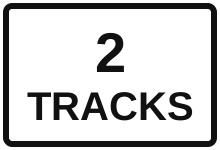
- Whether a second train is coming on another track
- Whether the gate has started to rise
- That the last car of the train shows a red light
- Only the track nearest to your vehicle
Show answer
Whether a second train is coming on another track. A sign under the crossbuck showing the number of tracks warns you that more than one train can use the crossing. After one train clears, look carefully for a second train coming on another track from either direction. The first train may have hidden it from view. Do not start across until you are sure you can completely clear every track. Never move onto the tracks just because the train you were watching is gone.
Study this in the handbook: School Buses and Railroad Crossings
15. The car ahead passes a signpost and you begin counting. You reach the same post at one-thousand-one. What does that tell you?
- You have a safe gap for city driving
- You are following too closely
- You should change lanes to pass it
- You are fine if the road is dry
Show answer
You are following too closely. Oregon's counting check works like this: when the rear of the vehicle ahead passes a sign or pole, count the seconds until you reach the same spot. If you get there before finishing at least two seconds, you are following too closely. Ease off, let the gap grow, and count again at another spot until you are no closer than two seconds. At speeds above 30 mph, the manual calls for four seconds or more.
Study this in the handbook: Space Cushion and Following Distance
16. You have stopped at a stop sign, but parked cars block your view of cross traffic. What should you do?
- Pull forward slightly and scan before going
- Go ahead, since you have already made your stop
- Honk, then drive through at a steady speed
- Wait there until another driver waves you on
Show answer
Pull forward slightly and scan before going. Stopping at the line is only the first part. If you are unable to see traffic coming from your left and right after stopping, Oregon says to pull forward slightly and scan the area before entering. Watch for pedestrians and people riding bicycles as you move up, and remember that a defensive driver never assumes a stop sign or signal will stop approaching traffic. Go only when you can see a safe gap in both directions.
Study this in the handbook: Right of Way at Intersections
17. Which of these does Oregon list as affecting how far it takes your vehicle to stop?
- The color of your vehicle
- The number of doors on it
- Whether your radio is on
- The weight of your vehicle
Show answer
The weight of your vehicle. Oregon lists the factors that affect stopping distance: road and weather conditions, the weight of your vehicle, your reaction time, and the braking ability of your vehicle. The faster you drive, the greater your stopping distance, even in ideal conditions. At 60 mph, the distance from spotting a hazard to a full stop is longer than a football field. A heavy load or a trailer adds distance, which is why the manual asks for more following room when towing.
Study this in the handbook: Space Cushion and Following Distance
18. A train is coming toward a crossing, and you think you have time to cross ahead of it. What does Oregon warn?
- Trains slow down for cars at crossings
- You may cross while the gates are still up
- It is closer than it seems and cannot stop fast
- A train's horn means it will stop for you
Show answer
It is closer than it seems and cannot stop fast. Oregon's railroad reminders include never trying to beat a train at a crossing, remembering that the train you see is closer than it seems, and knowing that trains cannot stop quickly. Together they mean your guess about having enough time is not reliable. Only cross the tracks when you are sure you can completely clear the crossing, never stop on the tracks, and remember that one train may block your view of another.
Study this in the handbook: School Buses and Railroad Crossings
19. Besides school speed zones, where does Oregon's unposted 20 mph limit apply?
- In any residential district
- On ocean shores open to cars
- In any business district
- In any public park
Show answer
In any business district. Oregon sets a 20 mph statutory limit in any business district and within a school speed zone, whether or not it is posted, unless a sign shows a different speed. Residential districts, public parks, and ocean shores where vehicles are permitted share a 25 mph limit, and alleys and narrow residential areas are 15 mph. The basic rule may require less than 20 mph when conditions call for it.
Study this in the handbook: Oregon Speed Limits
20. Under the Oregon Driver Manual, what does it mean to yield?
- Slow or stop so others can go on safely
- Always come to a complete stop first
- Honk so others know you are going
- Speed up to clear the way for others
Show answer
Slow or stop so others can go on safely. Yielding is a word you will see across the manual. Oregon defines it as slowing down or stopping to allow another vehicle or pedestrian to continue safely. Sometimes that means a full stop, and sometimes just easing off so another driver can merge or a person can finish crossing. A yield sign works the same way: reduce speed and, if needed, stop as you would for a stop sign.
Study this in the handbook: Right of Way at Intersections
Every question is written from the official Oregon Driver Manual. Need paper? Printable OR practice test with answer key.
Last verified 2026-10-05. How we check every question · Study all 500 as flashcards
Frequently asked questions
How many questions are on this Oregon practice test?
This fixed set has 20 questions. It is test 17 of 25 from the 500 question Oregon bank. The real OR exam asks 35 questions and you need 28 correct.
What is the passing score for the real Oregon test?
28 of 35 correct to receive a passing score That figure comes from the official Oregon source cited on the DMV facts page.
How does this fixed test relate to the full Oregon bank?
Each numbered test is a fixed set of questions in a fixed order, so you can retake the same test later and compare. Every test mixes road signs and the other topics in about the same proportion as the full bank. Tests 1 to 25 together cover every question in the Oregon bank once. The full practice page mixes the whole bank at random.
Last verified 2026-10-05. See the Oregon DMV facts page for sourced state details.