
Test 23 of 25 · 20 questions · Free 2026
OK Permit Practice Test 23
Jump to the test ↓A fixed 20 question set from the Oklahoma bank with answers and plain English explanations. The real OK exam is 20 questions, 75 percent to pass; take the full length version on the main practice page.
Question 1 of 20 · 0 right so far
All 20 questions in test 23
Every question below comes from the Oklahoma question bank on this page. Open a question to see the correct answer and the explanation. Nothing here is hidden behind a signup.
1. Heavy rain has left water across a road and it looks only a few inches deep. Which hidden danger does the manual warn about?
- The water will wash the tread off your tires
- The water will make your brakes grip better
- The road beneath the water may have washed away
- The water is safe once the barricades are gone
Show answer
The road beneath the water may have washed away. Among its flood safety rules, the manual warns that beneath the water's surface, roadbeds may have been washed away. Water that looks shallow can hide a missing road, so you cannot judge safety from the surface. The manual also tells you not to drive around barricades at a low-water crossing, and to turn around rather than risk a flooded roadway. Floodwater does nothing to improve your braking.
Study this in the handbook: Floods, Crashes and Roadside Emergencies
2. At a railroad crossing the gates are lowered and no train is in sight. The driver ahead of you swings around the gate. What does the manual say about this?
- It is allowed when you can see the track is clear
- It is allowed if the lights have stopped flashing
- It is allowed for one vehicle at a time
- It is illegal; stay behind the gate until it rises
Show answer
It is illegal; stay behind the gate until it rises. The manual says never to drive around the gates. If the gates are down, stop behind the gate, because it is against the law to drive through lowered gates. Do not cross the tracks until the gates are raised and the lights have stopped flashing. Seeing no train does not matter, since a train can look slower than it is and another one may be coming on a second track.
Study this in the handbook: School Buses and Railroad Crossings
3. A flagperson in a work zone signals you to stop. Where should you stop?
- In your own lane, without veering right or left
- On the shoulder, pulled off to the right
- In the other lane, to give workers room
- Just past the flagperson, where workers can see you
Show answer
In your own lane, without veering right or left. Flagpersons wear orange and use red signs or flags to direct traffic, and the law requires you to obey them. When a flagperson tells you to stop, the manual says to stop in your lane and not veer right or left. Pulling onto the shoulder or drifting into the other lane can put you in the path of workers, machinery, or oncoming cars. Stay put until the flagperson signals you to go, then proceed with caution and expect workers and equipment ahead.
Study this in the handbook: Work Zone, Guide and Service Signs
4. A pedestrian at a corner sees a green traffic light but a steady Don't Walk signal. Which one should the pedestrian obey?
- The Don't Walk signal, instead of the green light
- The green light, since it controls everyone
- Whichever signal changed most recently
- Either one, as long as no cars are coming
Show answer
The Don't Walk signal, instead of the green light. Walk and Don't Walk signals exist to direct and protect people crossing on foot or in wheelchairs. The manual says pedestrians should obey these signs, when present, instead of the traffic signal. A green light may still be showing for drivers at that moment, so the pedestrian signal is the one that applies to the person on foot. As a driver, remember that someone who started on Walk may still be finishing the crossing when the signal flashes, and you must yield to people in the crosswalk.
Study this in the handbook: Traffic Signals
5. Your car breaks down on an expressway and you have pulled onto the right shoulder. What does the manual say about getting out of the car?
- Walk along the edge of the lane to wave for help
- Never walk near the roadway, and keep children away
- Stand behind the car to warn approaching drivers
- Walk to the nearest exit along the white line
Show answer
Never walk near the roadway, and keep children away. After a breakdown, signal, pull off to the extreme right shoulder away from moving traffic, and turn on your emergency flashers. The manual then warns that when you are out of your car, you should never walk near the roadway, and you should keep children away from the traffic. Standing behind the car or walking along the lane edge puts you right next to vehicles moving at highway speeds. Stay well away from the travel lanes while you wait for help.
Study this in the handbook: Expressway Driving
6. As you enter an expressway, how should you use the acceleration lane?
- Stop at its end and wait for a large gap
- Cut across it quickly at a sharp angle
- Stay right in it and adjust speed to traffic
- Drive slowly so traffic will make room
Show answer
Stay right in it and adjust speed to traffic. When entering an expressway, you must yield to vehicles already on it. The manual says to enter in the acceleration lane and stay to the right, adjust your speed and watch the traffic, then signal left and merge into the proper lane when it is safe. The lane is there so you can adjust to the speed of traffic before merging. The manual's diagram warns not to enter at a sharp angle, and creeping along or stopping does not match your speed to the flow.
Study this in the handbook: Expressway Driving
7. If stopped traffic is blocking an intersection, where should a driver wait?
- Beyond the intersection because a green light permits entry
- Inside the intersection so the vehicle is next to the queue
- On the crosswalk, leaving the rear of the vehicle clear
- Before reaching the crosswalk until the traffic moves
Show answer
Before reaching the crosswalk until the traffic moves. When traffic has stopped and blocks an intersection, the driver must stop before reaching the crosswalk and wait for the queue to move. Entering the intersection without room to clear it can trap the vehicle across crossing traffic and pedestrians. Stopping on the crosswalk obstructs people walking, while a green light does not provide room that is not actually available. The cue is the stopped line of vehicles ahead: keep the crosswalk open, remain outside the intersection, and move only when the exit path is clear.
Study this in the handbook: Right of Way at Intersections
8. On a two-lane road, you are about 80 feet from a narrow bridge that blocks your view ahead. May you begin passing the car in front of you?
- Yes, if you can finish before the bridge
- Yes, if the car ahead is going under the limit
- No, passing is banned within 100 feet of a blocked view
- Yes, if you honk to warn oncoming drivers
Show answer
No, passing is banned within 100 feet of a blocked view. The manual says do not pass within 100 feet of an obstructed view, and it tells you to watch for bridges, viaducts, tunnels, overpasses, railroad crossings, intersections, and crosswalks. At 80 feet from a bridge that blocks your view, you are inside that distance, so stay behind the car. Hoping to finish before the bridge, a slow car ahead, or a horn warning does not create an exception. Pass later, once you have a clear view and at least 200 feet of open road.
Study this in the handbook: Passing and Turning
9. You are passing a bicyclist on a street where you can only leave about 2 feet of space. What should you do?
- Pass slowly; 2 feet is fine at low speed
- Wait until you can leave at least 3 feet
- Honk so the rider moves onto the curb
- Pass quickly to spend less time beside it
Show answer
Wait until you can leave at least 3 feet. Oklahoma law requires a driver passing a bicycle going the same direction to leave a safe distance of not less than 3 feet until safely past it. With only 2 feet available, you must wait. The manual adds never to pass a bicycle if the street is too narrow; wait until there is enough room to pass safely. Passing slowly or quickly does not make a 2-foot gap legal, and the manual says not to startle or intimidate a rider with your horn.
Study this in the handbook: Bicycles, Motorcycles, Trucks and Farm Vehicles
10. You need to park near a railroad crossing on a country road. What is the closest you may park to the nearest rail?
- 15 feet
- 30 feet
- 50 feet
- 100 feet
Show answer
50 feet. Oklahoma's list of illegal parking places includes within 50 feet of the nearest rail of a railroad crossing, so the closest you may park is 50 feet from the rail. Thirty feet is the distance for stop signs, signals, and flashing beacons, and 15 feet is the fire hydrant distance. When you must stop for a train, a separate rule requires stopping within 50 feet but no closer than 15 feet from the nearest rail.
Study this in the handbook: Parking Rules
11. A train is approaching a crossing and its warning lights are flashing. Under Oklahoma law, where must you stop?
- Within 10 feet of the nearest rail
- At least 100 feet from the nearest rail
- Within 50 feet but not closer than 15 feet
- Right at the edge of the first rail
Show answer
Within 50 feet but not closer than 15 feet. Oklahoma law says that when a signal warns of an approaching train, a gate is lowered, a flagman signals, or a train is plainly close, the driver must stop within 50 feet but not less than 15 feet from the nearest rail and may not go on until it is safe. Stopping closer than 15 feet puts your car too near a passing train, while 100 feet back is farther than the law describes. The same 15 to 50 foot range appears with the round advance warning sign.
Study this in the handbook: School Buses and Railroad Crossings
12. You approach this sign at a corner with no painted crosswalk or stop line. Where should you stop?
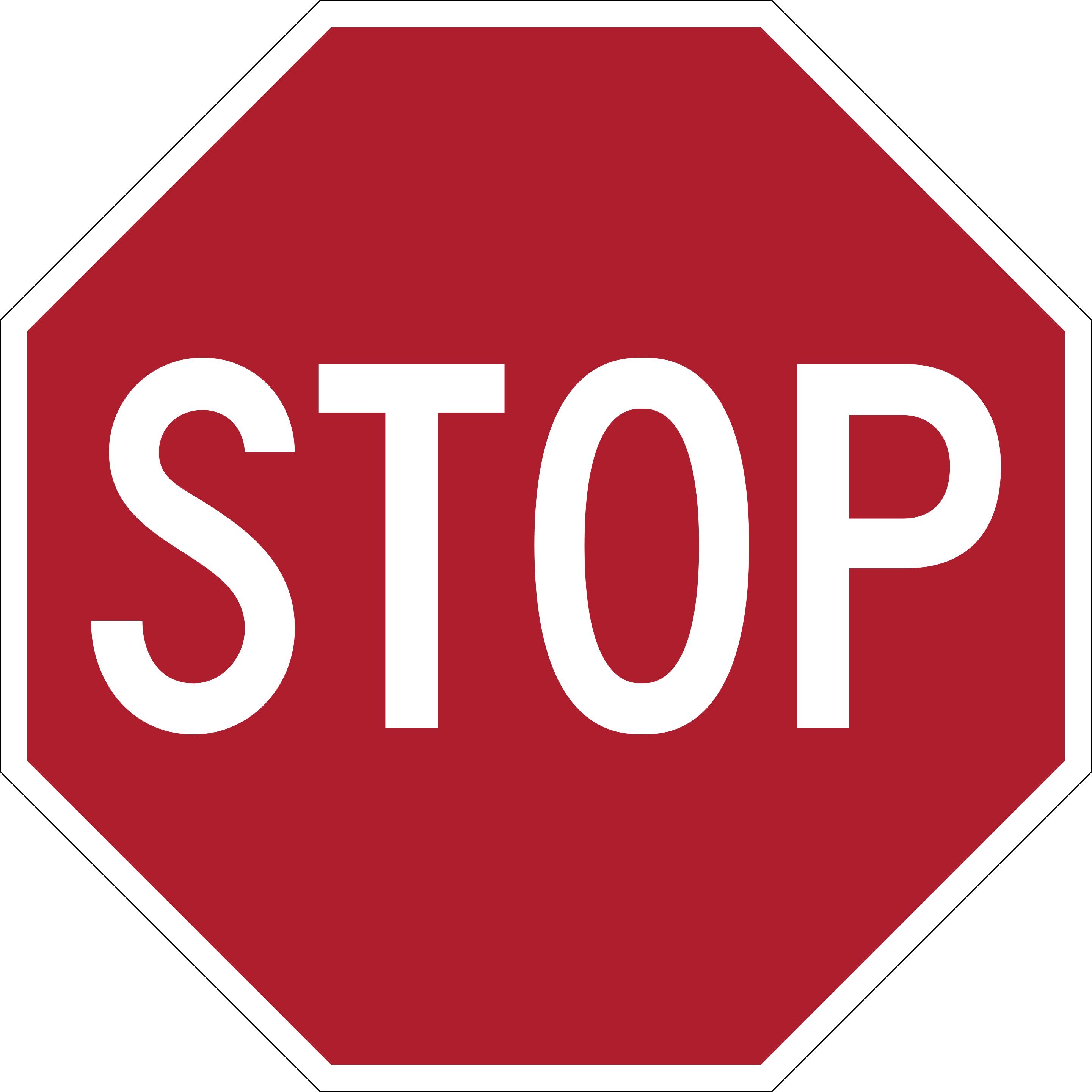
- Before the spot where a crosswalk would be
- Wherever you can first see cross traffic
- At the curb line of the cross street
- Just past the corner, inside the intersection
Show answer
Before the spot where a crosswalk would be. A stop sign calls for a complete stop, and the manual places that stop before the pedestrian crosswalk, even if it isn't marked. People on foot may cross there whether or not lines are painted, and drivers must yield to them in marked or unmarked crosswalks. Stopping farther ahead, at the curb line or inside the intersection, puts your car in their path. Once stopped, stay stopped until the way is clear in all directions before you go.
Study this in the handbook: Stop, Yield and Regulatory Signs
13. Which set of factors does the Oklahoma manual say determines your stopping distance?
- Your reaction time, conditions, weight, and brakes
- Engine size, fuel level, and the posted speed limit
- Number of passengers and the age of the car only
- Speed alone, since every car stops the same way
Show answer
Your reaction time, conditions, weight, and brakes. The manual says there is no sure way to tell exactly how long it will take to stop at a certain speed. Stopping distance depends on your own reaction time, the weather and road conditions, the weight of your vehicle, and the condition of your brakes. Speed matters too, since the braking step depends on it, but it is not the only factor. Engine size and the number of passengers are not on the list. Leave extra room when any of these factors works against you.
Study this in the handbook: Following Distance and Stopping
14. Why is it harder for drivers to judge a motorcycle's distance and speed?
- Motorcycles always travel faster than cars
- Its narrow profile and short body are hard to see
- Motorcycle headlights are dimmer by law
- Motorcycles are required to ride on the shoulder
Show answer
Its narrow profile and short body are hard to see. Among the reasons drivers don't see motorcyclists, the manual lists the motorcycle's profile: it is narrow and its body is short, which makes it harder to see and harder to estimate its distance and speed. Motorists also tend to look for other cars rather than motorcycles, and riders make frequent lane movements to adjust to the road. Motorcycles do not always go faster, and they have the right to use the lane, not the shoulder.
Study this in the handbook: Bicycles, Motorcycles, Trucks and Farm Vehicles
15. Which of these is one of the conditions the Oklahoma Basic Speed Rule says you must consider when choosing your speed?
- The time remaining before you must arrive
- How fast your car can accelerate
- The speed most other states allow
- Your own ability as a driver
Show answer
Your own ability as a driver. The Basic Speed Rule says your speed must be reasonable and proper for the conditions, and the manual lists them: the amount and speed of traffic, whether pedestrians are present, the road's surface, width, and structure, visibility, weather and air conditions, and your own driving ability. A driver with little experience may need to go slower than a seasoned driver on the same road. Being late, your car's acceleration, and other states' limits are not on the list.
Study this in the handbook: The Basic Speed Rule
16. Another car is passing you on the left on a two-lane road. What should you do?
- Speed up so the pass is over more quickly
- Move toward the center line to watch the car
- Brake hard so the car can get by sooner
- Stay in your lane and move to the right
Show answer
Stay in your lane and move to the right. When someone is passing you, the manual's first rule is to keep everyone safe by helping the other driver pass. That means staying in your lane and moving right if you are being passed on the left, which gives the passing car more room. Speeding up stretches out the time the other driver spends in the opposing lane, and drifting toward the center line takes away space. Hard braking is not called for; if an oncoming car appears, slow down and let the passing driver pull in front of you.
Study this in the handbook: Passing and Turning
17. Unless a sign shows otherwise, what is the speed limit on undivided Oklahoma state highways?
- 65 mph
- 55 mph
- 70 mph
- 75 mph
Show answer
65 mph. Oklahoma's chart of state speed limits, which apply unless otherwise posted and under normal conditions, lists 65 mph for undivided state highways. The other figures belong to different road types: controlled-access highways are 75 mph, turnpikes are 80 mph, and county roads are 55 mph. Cities and towns may set their own limits, so always watch for posted signs. Even at 65 mph, the Basic Speed Rule can require you to go slower at night, in rain, or in fog.
Study this in the handbook: Speed Limits and Expressway Speeds
18. You have a green light when a pickup on the cross street clearly is not going to stop for its red. Legally the right-of-way is yours. What should you do?
- Keep going, since the other driver is at fault
- Yield to avoid a crash, even though you are right
- Honk and continue at your speed
- Speed up to get through before the pickup
Show answer
Yield to avoid a crash, even though you are right. The manual says to always put safety first: when other people don't follow the rules of right-of-way, you should yield, even if the right-of-way belongs to you, when there is a possibility of damage or injury. Being legally right does not protect you from a pickup running a red light. Adjust your speed as you approach intersections, watch for drivers trying to beat the light, and let the violator go through before you proceed.
Study this in the handbook: Right of Way at Intersections
19. One friend had a 12-ounce beer and another had a 5-ounce glass of wine. Which statement matches the Oklahoma manual?
- The wine has much less alcohol than the beer
- The beer has much less alcohol than the wine
- Wine only matters if mixed with liquor
- Both hold about the same amount of alcohol
Show answer
Both hold about the same amount of alcohol. The manual's point is that it's not what you drink; it's how much. A 12-ounce can of beer, a 5-ounce glass of wine, and a cocktail with 1.5 ounces of 80-proof spirits all contain the same amount of alcohol. Choosing wine or beer instead of liquor does not make a drink weaker. Count every drink the same way, and remember that alcohol affects judgment almost immediately.
Study this in the handbook: Implied Consent and DUI Penalties
20. A barricade in a work zone has diagonal stripes that slope downward to the left. Which way should traffic go?
- Bear to the right of the barricade
- Bear to the left of the barricade
- Stop and wait for a flagperson
- Drive straight through the opening
Show answer
Bear to the left of the barricade. The diagonal stripes on a warning sign or barricade show the direction traffic is to pass. The manual's rule is that stripes sloping downward to the right mean bear to the right, and stripes sloping downward to the left mean bear to the left. Follow the direction the stripes slope down toward. A barricade alone does not mean stop, and driving straight ahead would take you into the closed area.
Study this in the handbook: Warning Signs
Every question is written from the official Oklahoma Driver Manual. Need paper? Printable OK practice test with answer key.
Last verified 2026-10-05. How we check every question · Study all 500 as flashcards
Frequently asked questions
How many questions are on this Oklahoma practice test?
This fixed set has 20 questions. It is test 23 of 25 from the 500 question Oklahoma bank. The real OK exam asks 20 questions and you need 15 correct.
What is the passing score for the real Oklahoma test?
15 out of 20 questions correct to pass That figure comes from the official Oklahoma source cited on the DMV facts page.
How does this fixed test relate to the full Oklahoma bank?
Each numbered test is a fixed set of questions in a fixed order, so you can retake the same test later and compare. Every test mixes road signs and the other topics in about the same proportion as the full bank. Tests 1 to 25 together cover every question in the Oklahoma bank once. The full practice page mixes the whole bank at random.
Last verified 2026-10-05. See the Oklahoma DMV facts page for sourced state details.
Return to the full Oklahoma practice test · Study road signs