
Test 17 of 25 · 20 questions · Free 2026
OK Permit Practice Test 17
Jump to the test ↓A fixed 20 question set from the Oklahoma bank with answers and plain English explanations. The real OK exam is 20 questions, 75 percent to pass; take the full length version on the main practice page.
Question 1 of 20 · 0 right so far
All 20 questions in test 17
Every question below comes from the Oklahoma question bank on this page. Open a question to see the correct answer and the explanation. Nothing here is hidden behind a signup.
1. On an icy road, the rear of your car slides to the left just as an oncoming car approaches in the other lane. What does the Oklahoma manual say about steering into the skid here?
- Always steer into the skid, no matter what
- Brake hard and steer sharply to the right
- Don't steer into oncoming traffic, even into a skid
- Let go of the wheel until the car stops
Show answer
Don't steer into oncoming traffic, even into a skid. As a general rule, if the car starts to skid, take your foot off the brake and turn the steering wheel in the direction of the skid, but only if you can do so without running off the road, hitting something, or steering into oncoming traffic. The manual gives this exact example: if you are meeting other traffic and the rear skids to the left, you would not steer into the oncoming traffic. Sudden braking increases a skid.
Study this in the handbook: Braking, Skids and Wet Roads
2. You are on a two-lane road with double solid yellow center lines and want to turn left into a driveway. May you cross the lines?
- No, double yellow lines may never be crossed
- Yes, crossing to turn left is allowed
- Yes, but only to pass a slow vehicle
- If a broken white line is also painted there
Show answer
Yes, crossing to turn left is allowed. Single or double solid yellow center lines mean do not pass, but the manual adds that you may cross the line to turn left, such as into a driveway or side road. Passing a slow vehicle across those lines is exactly what they forbid. Before turning, yield to all oncoming traffic and go only when there is enough clear distance to complete the turn without interfering with oncoming vehicles.
Study this in the handbook: Pavement Markings and Lanes
3. You are approaching an intersection when the light turns steady yellow. You could make it if you sped up. What does the Oklahoma manual say?
- Speed up so you clear it before red
- Keep your speed and go through no matter what
- Stop right away, even in the middle of it
- Don't speed up; stop if you can do so safely
Show answer
Don't speed up; stop if you can do so safely. A steady yellow light warns that the light is about to turn red. The manual says you must stop if you can stop safely before entering the crosswalk, adjust your speed as you approach so you can make a smooth stop, and not speed up to beat the light. Speeding up is how drivers end up racing through on red. Slamming to a stop inside the intersection is not the answer either; enter carefully only if you cannot stop safely.
Study this in the handbook: Traffic Signals
4. You are about to drive through an intersection on a green light when an ambulance with its siren on comes up behind you. What should you do?
- Stop right where you are in the intersection
- Speed up to stay ahead of the ambulance
- Clear the intersection, pull right, and stop
- Keep driving at the same speed in your lane
Show answer
Clear the intersection, pull right, and stop. Yield to police cars, fire engines, and ambulances using a siren or flashing lights. The manual says to pull over to the right edge of the roadway, clear of intersections, and stop until the emergency vehicle has passed. Stopping inside the intersection can block the ambulance's path, so continue through it first, then pull right and stop. Speeding up or keeping your speed in the lane does not give the ambulance room.
Study this in the handbook: Right of Way at Intersections
5. The sun sets at 7:00 p.m. By what time must your headlights be on, according to the Oklahoma manual?
- By 8:00 p.m., an hour after sunset
- By 7:00 p.m., right at sunset
- By 6:30 p.m., before sunset
- By 7:30 p.m., 30 minutes after
Show answer
By 7:30 p.m., 30 minutes after. The manual says to use your headlights beginning 30 minutes after sunset and until 30 minutes before sunrise. With sunset at 7:00 p.m., that means your lights must be on by 7:30 p.m. You must also use them whenever a road sign says headlights are required. Waiting until 8:00 p.m., an hour after sunset, is later than the rule allows.
Study this in the handbook: Headlights, Night Driving and Distractions
6. When you pass a truck in a legal passing zone, what does the Oklahoma manual tell you to do once you pull alongside it?
- Complete the pass as quickly as possible instead of staying alongside
- Match the truck's speed so its driver can see you clearly
- Slow down right after pulling in front of the truck
- Move back in front as soon as your rear bumper clears the cab
Show answer
Complete the pass as quickly as possible instead of staying alongside. The Oklahoma manual says to move into the passing lane only when it is clear and you are in a legal passing zone, then complete the pass as quickly as possible and not stay alongside the truck. Lingering beside it keeps you near the cab, where the manual places the truck's blind spots. After passing, maintain your speed instead of slowing and forcing the truck driver to brake, and move back only when you can see the front of the truck in your rearview mirror.
Study this in the handbook: Bicycles, Motorcycles, Trucks and Farm Vehicles
7. Your car has standard brakes, not antilock, and you need to slow down on a gravel or snowy road. How should you brake?
- Press the pedal hard and hold it down
- Pump the pedal rapidly several times a second
- Tap the brakes lightly, about one second apart
- Skip the brakes and coast down in neutral gear
Show answer
Tap the brakes lightly, about one second apart. On ice, snow, sleet, gravel, sand, and other loose surfaces, the manual says to tap the brakes slightly, about one second apart, because braking suddenly can make the car skid. This advice is for standard braking systems; the manual cautions never to tap antilock brakes. Holding the pedal down hard can lock the wheels, and rapid pumping is not the rhythm the manual describes. Coasting on a downgrade in neutral is itself a violation of Oklahoma law.
Study this in the handbook: Braking, Skids and Wet Roads
8. You are turning left at an intersection and an oncoming driver also wants to turn left. From which lane do you leave and into which lane do you enter?
- Leave from the left lane and enter the right lane of the new street
- Leave from the right lane and enter the left lane of the new street
- Leave from the center of the road and enter whichever lane is open
- Leave from the left lane and enter the left lane of the new street
Show answer
Leave from the left lane and enter the left lane of the new street. When you meet another driver at an intersection and both of you want to turn left, each turns to the left of the other. The manual says to leave from the left lane and enter in the left lane. Entering the right lane would swing you across the other car's path, and leaving from the right lane or the middle of the road puts you in the wrong position before the turn begins.
Study this in the handbook: Passing and Turning
9. You are getting ready to leave an expressway at the next exit. At least how far before the exit should your right signal be on?
- At least 100 feet before the exit
- Just as you reach the exit ramp
- About 25 feet before the exit
- Only after you enter the deceleration lane
Show answer
At least 100 feet before the exit. Leaving an expressway takes planning. The manual says to move to the proper lane well in advance of the exit, keep your speed at the flow of traffic until you reach it, and signal right at least 100 feet before the exit. That matches the general Oklahoma rule of signaling at least 100 feet before you turn, slow down, or stop. Signaling at the ramp or only after entering the deceleration lane gives drivers behind you almost no warning that you are about to slow.
Study this in the handbook: Expressway Driving
10. Why does the Oklahoma manual warn against passing a motorcycle too close or too fast?
- The rider might take it as a challenge to race
- Motorcycles cannot see vehicles that pass them
- The blast of air can blow it out of control
- Passing a motorcycle at all is illegal
Show answer
The blast of air can blow it out of control. When passing a motorcycle, the manual says to pass as you would pass a car, but not too close or too fast, because the blast of air from your vehicle can blow a motorcycle out of control. Passing is legal when done properly; the danger is the wind force on a narrow vehicle. The concern is not that the rider will race you or cannot see you. Leave the rider the full width of the lane as you go by.
Study this in the handbook: Bicycles, Motorcycles, Trucks and Farm Vehicles
11. You pass this yellow warning sign and see a person stepping off the curb ahead. What must you do?

- Honk and keep your speed so they wait
- Slow down, prepare to stop, and yield
- Speed up to pass before they reach your lane
- Change lanes and go around the person
Show answer
Slow down, prepare to stop, and yield. A yellow sign with a walking figure warns of a pedestrian crossing. The manual says to slow down and prepare to stop, watch both sides of the street, and yield. A person stepping off the curb has the right-of-way, so honking or racing to beat them is wrong, and changing lanes around them is not yielding. Stop if needed and let the person cross completely before you continue, keeping an eye on both sides of the street.
Study this in the handbook: Warning Signs
12. You are about to enter a highway work zone. What color will most of the warning signs, barrels, and cones be?
- Orange
- Yellow
- Brown
- Blue
Show answer
Orange. The manual's construction and maintenance section sums up the color code as orange equals work zone equals danger. Orange signs, along with barricades and channeling devices such as cones and barrels, tell you that you are nearing or in a work zone. Yellow is the color of general warning signs, brown marks recreation and cultural sites, and blue is used for service signs. When orange appears, slow to the posted speed and be ready to stop, change lanes, or follow a flagperson's instructions.
Study this in the handbook: Work Zone, Guide and Service Signs
13. You reach this sign where your road joins a busier street, and a car is coming toward the intersection on that street. What should you do?
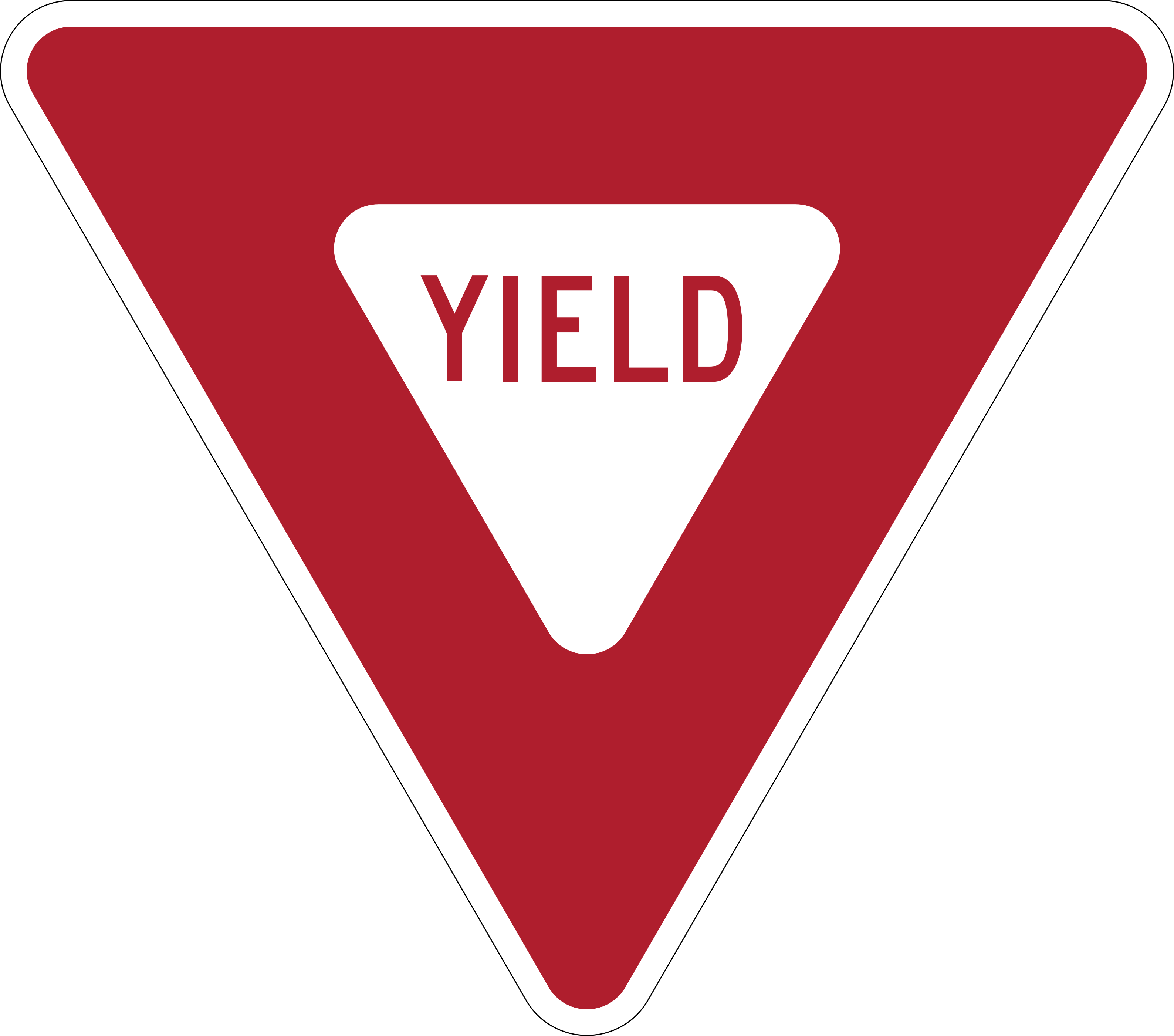
- Go first, since the other car will slow
- Slow, be ready to stop, and let it pass first
- Stop fully and wait for a green light
- Speed up so you merge ahead of it
Show answer
Slow, be ready to stop, and let it pass first. A red and white triangle means yield. The manual says to slow down and be ready to stop if needed, and to let oncoming vehicles pass before crossing or entering the flow of traffic. When a car is already approaching on the other street, that car goes first. A yield sign does not require a full stop when the way is clear, and there is no light to wait for. Speeding up to beat the other car ignores the duty to yield.
Study this in the handbook: Stop, Yield and Regulatory Signs
14. Which statement about switching from high beams to low beams at night is correct?
- Dim within 1,000 feet of a car you follow and 600 feet of an oncoming car
- Dim within 300 feet of any other vehicle on the road
- Dim only if an oncoming driver flashes first
- Dim within 600 feet of a car you follow and 1,000 feet of an oncoming car
Show answer
Dim within 600 feet of a car you follow and 1,000 feet of an oncoming car. The manual says to dim your high beams to low beams within 1,000 feet of an oncoming vehicle or within 600 feet of the vehicle you are following. The two distances are easy to swap, so remember that the longer distance applies to traffic coming toward you. A single 300 foot rule for all vehicles is not what the manual states, and you must not wait for the other driver to flash lights at you.
Study this in the handbook: Headlights, Night Driving and Distractions
15. For how long does Oklahoma law require revocation after a conviction for leaving the scene of a crash that caused injury or death?
- A 30 day suspension only
- Exactly 10 years
- No revocation; only a fine
- 6 months to 3 years
Show answer
6 months to 3 years. State law requires the driving privilege to be revoked for 6 months to 3 years for listed convictions, and failing to stop and render aid after a crash with death or injury (hit and run) is on the list. Others include vehicular manslaughter, DUI, any felony using a vehicle, perjury to get a license, and drug convictions involving a vehicle. Thirty days is too short, ten years is not the range, and revocation is mandatory, not optional.
Study this in the handbook: License Rules, Points and Penalties
16. In Oklahoma, a driver convicted of impaired driving with a BAC over 0.05 but under 0.08 for the first time faces what license suspension?
- None, because the BAC is under 0.08
- 6 months
- A 30 day suspension
- 1 year
Show answer
A 30 day suspension. Oklahoma treats a BAC above 0.05 as relevant evidence of impairment. After an impaired driving conviction, Service Oklahoma suspends the license 30 days for a first suspension, 6 months for a second, and 1 year for a third. Being under 0.08 does not make the driver safe from penalty, and the 6 month and 1 year periods belong to repeat suspensions. The court can also impose a fine and up to 6 months in jail.
Study this in the handbook: Implied Consent and DUI Penalties
17. You turn off a state highway onto a paved county road with no speed limit sign. What is the limit unless posted otherwise?
- 65 mph
- 55 mph
- 45 mph
- 35 mph
Show answer
55 mph. Oklahoma's state speed limit chart sets 55 mph for county roads unless another limit is posted. The undivided state highway you left had a 65 mph limit, so slow down when you turn onto the county road. Highways inside state parks and wildlife refuges are 35 mph. Rural roads can also carry slow farm equipment, so the Basic Speed Rule may require going slower than 55.
Study this in the handbook: Speed Limits and Expressway Speeds
18. When you parallel park along a curb in Oklahoma, how close to the curb must your car be?
- Within 18 inches
- Within 30 inches
- Within 6 feet
- Within 3 feet
Show answer
Within 18 inches. Unless signs prohibit parking or the curb is painted yellow, Oklahoma lets you park parallel to any curb, within 18 inches of it. The manual's step-by-step method ends with backing slowly into position alongside the curb, within 18 inches, then straightening the front wheels and centering the car in the space. Distances such as 30 inches, 3 feet, or 6 feet are all larger than the manual allows. On a hill, the manual tightens this to within six inches of the curb.
Study this in the handbook: Parking Rules
19. What does Oklahoma law say an alcohol concentration of more than 0.05 shows?
- It is relevant evidence that driving was impaired
- It proves the driver was sober enough to drive legally
- It matters only for drivers under 21
- It has no legal meaning below 0.08
Show answer
It is relevant evidence that driving was impaired. Whether a BAC test shows legal intoxication is not the real issue, the manual says, because impairment of judgment and skill begins well below the legal limit. Oklahoma prohibits driving while impaired by alcohol or other substances, and an alcohol concentration of more than 0.05 is relevant evidence that the driver's ability to drive was impaired. A reading under 0.08 is not proof of sobriety, and this rule is not limited to drivers under 21, who face zero tolerance for any measurable amount.
Study this in the handbook: Implied Consent and DUI Penalties
20. Is it legal in Oklahoma to coast down a hill with your car in neutral?
- Yes, it saves fuel and is allowed on any hill
- No, coasting on a downgrade that way is illegal
- Yes, but only on hills shorter than one mile
- Yes, as long as your speed stays under the limit
Show answer
No, coasting on a downgrade that way is illegal. The manual's standard transmission tips say not to coast with the gears in neutral or with the clutch pedal pushed down except when shifting, and to put the car in a lower gear when going down steep hills. It adds that coasting on a downgrade in neutral is a violation of Oklahoma law, Title 47, Section 11-1107. There is no exception for short hills or for staying under the speed limit. A lower gear lets you use the engine, rather than only the brakes, to help slow the car.
Study this in the handbook: Headlights, Night Driving and Distractions
Every question is written from the official Oklahoma Driver Manual. Need paper? Printable OK practice test with answer key.
Last verified 2026-10-05. How we check every question · Study all 500 as flashcards
Frequently asked questions
How many questions are on this Oklahoma practice test?
This fixed set has 20 questions. It is test 17 of 25 from the 500 question Oklahoma bank. The real OK exam asks 20 questions and you need 15 correct.
What is the passing score for the real Oklahoma test?
15 out of 20 questions correct to pass That figure comes from the official Oklahoma source cited on the DMV facts page.
How does this fixed test relate to the full Oklahoma bank?
Each numbered test is a fixed set of questions in a fixed order, so you can retake the same test later and compare. Every test mixes road signs and the other topics in about the same proportion as the full bank. Tests 1 to 25 together cover every question in the Oklahoma bank once. The full practice page mixes the whole bank at random.
Last verified 2026-10-05. See the Oklahoma DMV facts page for sourced state details.
Return to the full Oklahoma practice test · Study road signs