
Test 16 of 25 · 20 questions · Free 2026
OK Permit Practice Test 16
Jump to the test ↓A fixed 20 question set from the Oklahoma bank with answers and plain English explanations. The real OK exam is 20 questions, 75 percent to pass; take the full length version on the main practice page.
Question 1 of 20 · 0 right so far
All 20 questions in test 16
Every question below comes from the Oklahoma question bank on this page. Open a question to see the correct answer and the explanation. Nothing here is hidden behind a signup.
1. You are on an unmarked country road with no center line, approaching the top of a hill behind a slow tractor. May you pass before the hilltop?
- Yes, since there is no line forbidding it
- Yes, if you sound your horn first
- Yes, if the tractor moves onto the shoulder
- No, passing on hills is banned even if unmarked
Show answer
No, passing on hills is banned even if unmarked. The manual's no-passing rules include hills and curves, even if the road is not marked. Near the top of a hill you cannot see oncoming traffic, so the lack of a painted line does not make passing legal. A horn does not warn a driver you cannot see, and a tractor easing right does not give you a view over the crest. Stay behind and follow at a safe distance until you can see far enough ahead to pass safely.
Study this in the handbook: Passing and Turning
2. You are on a state highway in the country, outside any town, and enter a properly marked school zone with no number posted. What speed limit applies?
- 35 mph
- 25 mph
- 15 mph
- 20 mph
Show answer
25 mph. Oklahoma's state speed limit chart sets 25 mph for school zones on any highway outside of a municipality in a properly marked zone, unless another limit is posted. Inside cities and towns, local governments set their own limits, so watch the signs there. Where a school zone sign shows a limit with a flashing yellow light, reduce to the limit shown when the light is flashing, and watch carefully for children.
Study this in the handbook: Speed Limits and Expressway Speeds
3. You are following a large truck about 150 feet back on the highway. Could you be in the truck driver's blind spot?
- No, the rear blind spot ends at 50 feet
- No, trucks have no blind spot behind them
- Only if you are directly beside the cab
- Yes, it can extend up to 200 feet behind
Show answer
Yes, it can extend up to 200 feet behind. A truck's blind spots are immediately in front, on either side of the cab, and up to 200 feet in the rear. At 150 feet back you may still be hidden from the driver. The manual's test is simple: if you can't see the truck's mirror, the driver can't see you. Stay far enough back to see the road ahead clearly, and position your car where the driver can see you in the mirror.
Study this in the handbook: Bicycles, Motorcycles, Trucks and Farm Vehicles
4. You parked on a hill and are pulling away from the curb. After you signal and check your mirror, cars are approaching in the lane. Who has the right-of-way?
- The cars already traveling in the lane
- You, since your turn signal has been on
- The driver who is farther from the curb
- Whichever vehicle is larger
Show answer
The cars already traveling in the lane. When starting from a curb, it is your responsibility to wait for an opening and move safely into the lane, because drivers already traveling have the right-of-way. Your signal tells others what you plan to do but does not give you priority. Distance from the curb and vehicle size are not part of the rule. Check again for oncoming traffic, and drive out only when the lane is clear.
Study this in the handbook: Parking Rules
5. You are stopped behind a truck on an uphill grade. Where in your lane does the Oklahoma manual say to position your car?
- Pull up close so other cars cannot cut in
- Stay to the far right side of your lane
- Stay to the left side of your lane
- Turn off your engine until the truck moves
Show answer
Stay to the left side of your lane. When stopped behind a truck on an uphill grade, the manual says to stay to the left in your lane so the truck driver can see you. It also says to leave extra space in front of your car, in case the truck rolls back slightly when it starts to move. Pulling up close removes that cushion, and hugging the right side of the lane keeps you where the driver may not see you. Turning off your engine does nothing to make you visible.
Study this in the handbook: Bicycles, Motorcycles, Trucks and Farm Vehicles
6. On a two-lane road, a yellow pennant-shaped sign appears on the left side of the road while a tractor ahead moves slowly. What should you do?
- Stay behind the tractor until passing is allowed
- Pass now, since tractors are exempt from the zone
- Pass if you can see no oncoming cars
- Pass on the right shoulder instead
Show answer
Stay behind the tractor until passing is allowed. The yellow pennant marks a no-passing zone. The manual's meaning is do not pass and do not cross yellow lines, because you can't see far enough ahead to pass safely. A slow tractor does not create an exception; follow at a safe distance until you can see far enough ahead and the markings allow a pass. Not seeing oncoming cars is the very judgment the zone says you cannot make there, and the shoulder is never a legal passing lane.
Study this in the handbook: Stop, Yield and Regulatory Signs
7. As you back out of an angle parking space and turn the wheel, what does the Oklahoma manual warn about the front of your car?
- It stays straight no matter how you steer
- It swings the opposite way and may hit a car
- It moves the same way as the rear of the car
- It lifts slightly, so you must brake harder
Show answer
It swings the opposite way and may hit a car. When you back out of an angle space and turn, the manual reminds you that the front of your car swings opposite to the direction of your turn and can hit the car next to you. Back slowly while turning until your left front wheel passes the rear bumper of the car parked on the left, then straighten the wheels as your car comes back into the lane. The front does not stay straight or follow the rear, so keep watch on both ends of the car.
Study this in the handbook: Parking Rules
8. On a four-lane highway, how is the road divided in half, and what separates the two lanes on each side?
- A single dashed yellow line; solid white between lanes
- Two dashed white lines; a solid yellow line between lanes
- A single solid white line; dashed yellow between lanes
- Two solid yellow lines; a dashed white line between lanes
Show answer
Two solid yellow lines; a dashed white line between lanes. The manual describes a four-lane highway as divided in half by two solid yellow lines in the center, with the two lanes on each side divided by a dashed white line. Yellow lines separate traffic moving in opposite directions, and white lines separate lanes moving the same way. Solid yellow lines mean do not pass across the center, while the dashed white line means you may change lanes or pass on your side when it is safe. Mixing up the colors could put you on the wrong side of the road.
Study this in the handbook: Pavement Markings and Lanes
9. You reach an intersection where you want to turn left, but you are in the right lane. What should you do?
- Continue to the next intersection and turn from there
- Turn left from the right lane if no one is beside you
- Stop and wait for a gap to cut across to the left lane
- Signal and move over quickly inside the intersection
Show answer
Continue to the next intersection and turn from there. The manual's list of turning mistakes includes trying to turn from the wrong lane. If you aren't in the proper lane, drive to the next intersection and make the turn from the proper lane there, circling back if you must. Turning across another lane, stopping in traffic, or swerving inside the intersection all put you across the path of other traffic. To avoid the problem, move into the correct lane as soon as possible before a turn.
Study this in the handbook: Passing and Turning
10. A teen in Oklahoma's graduated licensing program is convicted of a moving violation. What happens to the teen's progress?
- The teen stays at the current level until 6 months after the conviction date
- The teen skips to an unrestricted license after paying the fine
- The license is revoked for 5 years
- Nothing changes; convictions do not affect graduated licensing
Show answer
The teen stays at the current level until 6 months after the conviction date. Oklahoma freezes a teen at the current graduated level, learner or intermediate, until 6 months have passed from the date of the conviction. It does not reward a fine with an unrestricted license, and a single moving violation does not carry a five year revocation. Saying nothing changes is also wrong, since the conviction delays the next step. The delay gives the new driver more supervised or restricted time before full privileges.
Study this in the handbook: Learner Permits and the Graduated License
11. You see this yellow warning sign on a rural highway. What does the Oklahoma manual say to do on roads marked with signs like this?

- Honk your horn every few seconds to scare animals
- Speed up to get through the area quickly
- Turn on your hazard flashers until it ends
- Be extra alert and scan the sides of the road
Show answer
Be extra alert and scan the sides of the road. A yellow diamond with a leaping deer is a deer crossing warning sign. The manual says to be extra alert when driving on roadways marked with animal crossing signs, scan the sides of the road, and watch for the reflection of your headlights in the eyes of animals. Slow down when an animal is standing near the roadway. If one runs in front of you, do not swerve, since that may cause a more serious crash. Constant honking and hazard flashers are not part of the advice.
Study this in the handbook: Headlights, Night Driving and Distractions
12. At what times of day does the Oklahoma manual say animals are most active near roads?
- At dawn and at dusk
- Around noon on hot days
- In the middle of the night
- During the morning rush hour
Show answer
At dawn and at dusk. The manual's list for reducing animal crashes starts with using caution when driving at dawn or dusk, because that is when animals are most active. It also says to be extra alert on roads marked with animal crossing signs, scan the sides of the road for your headlights reflecting in animals' eyes, and slow down when an animal is standing near the roadway. Deer and vehicle crashes most often occur from October to December. Midday heat and rush hour are not the times the manual names.
Study this in the handbook: Headlights, Night Driving and Distractions
13. A 20-year-old driver has no alcohol in the blood but shows evidence of being under the influence of another intoxicating substance. Can Oklahoma's Zero Tolerance law apply?
- No, the law covers alcohol only
- Yes, any other intoxicating substance counts too
- Yes, but only if the substance is illegal to buy
- No, unless alcohol is also found in the blood
Show answer
Yes, any other intoxicating substance counts too. Oklahoma's Zero Tolerance law makes it unlawful for a person under 21 to drive or be in actual physical control of a vehicle if they show evidence of being under the influence of any other intoxicating substance, or of the combined influence of alcohol and another substance. Alcohol does not have to be present, and the substance does not have to be illegal. The law is not limited to alcohol.
Study this in the handbook: Zero Tolerance for Drivers Under 21
14. As you wait to turn, a pedestrian is halfway across the street when the signal starts flashing Don't Walk. What should the pedestrian do, and what should you do?
- Go back to the curb; you may turn now
- Stop where they are; you may go around them
- Finish crossing; you wait until they are clear
- Run back; you may honk to hurry them
Show answer
Finish crossing; you wait until they are clear. A flashing Don't Walk signal tells pedestrians not to leave the curb, but to continue if they are already in the intersection. Someone halfway across should finish crossing, and as a driver you must yield to people in the crosswalk until they are clear. Turning around them or honking to hurry them is not yielding. The flashing signal is meant for people who have not yet started, not for those already crossing.
Study this in the handbook: Traffic Signals
15. When does alcohol begin to affect your judgment, according to the Oklahoma manual?
- Only after you feel noticeably drunk
- About an hour after your last drink
- Almost immediately, before you feel it
- Only once your BAC reaches 0.08
Show answer
Almost immediately, before you feel it. Alcohol moves quickly into your blood and to all parts of your body, and the manual says driving skills, especially judgment, are affected almost immediately. Alcohol puts good judgment on hold, so you don't know when you've had too much until it's too late. By the time you feel it, your judgment and coordination are already impaired. Waiting to feel drunk, waiting an hour, or counting on staying under 0.08 all misread how fast alcohol works.
Study this in the handbook: Implied Consent and DUI Penalties
16. You and another car reach an intersection with no signs or signals at the same moment. The other car is on your right. Who goes first?
- You do, because you are on the left
- The other car, since it is on your right
- Whichever car is traveling faster
- Whichever driver honks first
Show answer
The other car, since it is on your right. At intersections without stop signs or signals, the vehicle that entered first has the right-of-way. When two vehicles arrive at the same time, the driver on the left yields to the driver on the right. Since the other car is on your right, you are the driver on the left, so you yield and let it go first. Speed and horns do not decide right-of-way, and if the other driver yields to you anyway, proceed immediately.
Study this in the handbook: Right of Way at Intersections
17. You are driving on a main road and see a school bus with flashing red lights stopped on a side street to your right. Must you stop?
- Yes, every vehicle within sight must stop
- Yes, until all children are off the bus
- Yes, if the bus is within 100 feet
- No, the bus is on a different roadway
Show answer
No, the bus is on a different roadway. The manual lists times you don't have to stop for a school bus, and the first is when the bus is on a different roadway. A bus stopped on a side street is not on the road you are traveling, so you are not required to stop for it. Children may still be crossing near the intersection, though, so slow down, drive carefully, and be ready to stop if anyone steps into your path.
Study this in the handbook: Right of Way at Intersections
18. You are driving 30 mph and pass this sign while its yellow lights are flashing. What must you do?
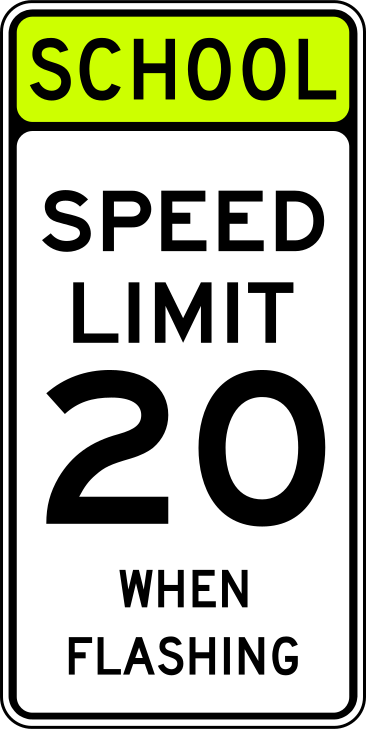
- Keep 30 mph if no children are in sight
- Slow to 25 mph, the usual school zone limit
- Slow to the speed shown and watch for children
- Slow down only if a crossing guard waves
Show answer
Slow to the speed shown and watch for children. When the yellow light on a School Zone sign is flashing, the manual says you must reduce your speed to the limit shown on the sign, watch carefully for children, and be ready to stop. The number on this sign is the one that applies, not a figure remembered from another road; 25 mph is the unposted limit only for marked school zones on highways outside a municipality. Children do not have to be visible, and no crossing guard signal is needed.
Study this in the handbook: Stop, Yield and Regulatory Signs
19. How can wearing a seat belt keep a minor fender bender from turning into a major collision?
- It makes the car's brakes work harder in a crash
- It keeps you in position to control your vehicle
- It lets you brace yourself against the steering wheel
- It pushes the airbag out faster when you are hit
Show answer
It keeps you in position to control your vehicle. Among the benefits listed in the manual, seat belts can keep a fender bender from becoming a major collision because the belted driver is still in a position to control the vehicle. A driver who is thrown sideways or out of the seat cannot steer or brake after the first impact. Seat belts do not affect the brakes or the airbag timing, and bracing against the wheel is not the reason given. The same list notes that belts reduce the force of impact against the vehicle's interior and keep people inside the vehicle.
Study this in the handbook: Insurance, Seat Belts and Child Restraints
20. It is hard to tell whether a car far ahead on the shoulder is moving or stopped. What does the Oklahoma manual suggest?
- Flash your high beams to see if it reacts
- Speed up to get a closer look sooner
- Compare it to a fixed object beside the road
- Honk and watch whether its lights come on
Show answer
Compare it to a fixed object beside the road. The manual warns drivers to watch for stopped vehicles on the shoulder ahead, because it is sometimes hard to tell whether a car in the distance is moving or stopped. Its tip is to compare the car to a fixed object, such as a sign or pole, to see whether it is changing position. Speeding up to look closer cuts your reaction time, and flashing lights or honking will not answer the question. Once you know, slow down or move over as needed.
Study this in the handbook: Following Distance and Stopping
Every question is written from the official Oklahoma Driver Manual. Need paper? Printable OK practice test with answer key.
Last verified 2026-10-05. How we check every question · Study all 500 as flashcards
Frequently asked questions
How many questions are on this Oklahoma practice test?
This fixed set has 20 questions. It is test 16 of 25 from the 500 question Oklahoma bank. The real OK exam asks 20 questions and you need 15 correct.
What is the passing score for the real Oklahoma test?
15 out of 20 questions correct to pass That figure comes from the official Oklahoma source cited on the DMV facts page.
How does this fixed test relate to the full Oklahoma bank?
Each numbered test is a fixed set of questions in a fixed order, so you can retake the same test later and compare. Every test mixes road signs and the other topics in about the same proportion as the full bank. Tests 1 to 25 together cover every question in the Oklahoma bank once. The full practice page mixes the whole bank at random.
Last verified 2026-10-05. See the Oklahoma DMV facts page for sourced state details.
Return to the full Oklahoma practice test · Study road signs