
Test 13 of 25 · 20 questions · Free 2026
OK Permit Practice Test 13
Jump to the test ↓A fixed 20 question set from the Oklahoma bank with answers and plain English explanations. The real OK exam is 20 questions, 75 percent to pass; take the full length version on the main practice page.
Question 1 of 20 · 0 right so far
All 20 questions in test 13
Every question below comes from the Oklahoma question bank on this page. Open a question to see the correct answer and the explanation. Nothing here is hidden behind a signup.
1. On a winter road that looks clear, where does the Oklahoma manual say to watch especially for black ice?
- On sunny hilltops and open straightaways
- On bridges and in shady stretches of road
- Only in city intersections with heavy traffic
- Only within 100 feet of a stop sign
Show answer
On bridges and in shady stretches of road. Even on roads or spots that seem clear, the manual tells drivers to stay alert for black ice and watch for danger spots ahead, such as bridges and shady areas. It also notes that traction varies, changing with traffic use and with sunshine or shade. Sunny hilltops and busy intersections are not the places the manual singles out. Once the car is moving, test your brakes gently to find out how much traction you actually have.
Study this in the handbook: Braking, Skids and Wet Roads
2. You see this yellow warning sign while driving in the right lane. What should you do?

- Move to the right shoulder and wait for traffic to clear
- Speed up so you can get ahead of traffic in the next lane
- Stay in your lane, because the lane beside you is ending
- Prepare to merge, because your right lane ends ahead
Show answer
Prepare to merge, because your right lane ends ahead. This warning sign shows the right lane narrowing into the lane beside it. The manual's meaning is that the right lane ends ahead and you should prepare to merge. Check your mirrors and blind spot, signal, and adjust your speed to fit into a gap in the next lane before your lane runs out. Pulling onto the shoulder does not solve the problem, and racing ahead of the other traffic makes the merge more dangerous. The lane beside you continues; it is your lane that ends.
Study this in the handbook: Warning Signs
3. Before you pull out to pass the car ahead on a two-lane road, what should you check behind you?
- That your headlights are on so you can be seen
- That the car behind has its turn signal off
- That no other car is passing or about to pass you
- That the road behind you is straight and level
Show answer
That no other car is passing or about to pass you. Passing on the left starts with checking ahead for at least 200 feet of clear roadway. The manual's next step is to be sure no other car is passing or is about to pass your car at the same time, by checking your rearview mirror and looking over your shoulder at your blind spots. If a faster car is already pulling out behind you, moving left would put you in its path. Only after that check do you signal and move into the left lane.
Study this in the handbook: Passing and Turning
4. Your car breaks down on the expressway and you have pulled onto the right shoulder with your flashers on. A friend suggests walking along the edge of the road to find help. What does the manual say?
- Walk along the white line, facing traffic
- Stand behind the car and wave at approaching drivers
- Walk toward the next exit along the shoulder
- Never walk near the roadway, and keep children away from traffic
Show answer
Never walk near the roadway, and keep children away from traffic. After a breakdown, signal, pull off to the extreme right shoulder away from moving traffic, and turn on your emergency flashers. The manual then says that when you are out of your car, you should never walk near the roadway, and you should keep children away from the traffic. Walking beside the lanes, or standing behind the car, puts you next to vehicles moving at highway speed.
Study this in the handbook: Expressway Driving
5. Someone is tailgating you. What is the first action the Oklahoma manual suggests, if it will not cause a collision?
- Brake hard so the driver backs off
- Flash your brake lights to warn them
- Speed up to put distance between you
- Move onto the shoulder right away
Show answer
Flash your brake lights to warn them. When someone is tailgating, the manual's first step is to flash your brake lights if braking will not cause a collision. Next, slow down and encourage the driver behind you to pass. If those tactics fail, pull over, stop, and let the tailgater pass, keeping your doors locked. Slamming on the brakes can cause the very crash you want to avoid, and speeding up only invites the tailgater to follow faster. Pulling onto the shoulder comes later, only if the other steps fail.
Study this in the handbook: Following Distance and Stopping
6. You are parking your car facing downhill beside a curb on an Oklahoma street. Which way should you turn your front wheels?
- Away from the curb, toward the street
- Straight ahead, parallel to the curb
- Toward the curb, until a wheel rests on it
- Toward the street, then shift to neutral
Show answer
Toward the curb, until a wheel rests on it. When parking downhill, the manual says to turn your wheels toward the curb and drive forward slowly until the wheel is against it, then shift into reverse or park. If the car should roll, the curb will stop it. Straight wheels give the curb nothing to catch, and wheels turned toward the street would steer a rolling car into traffic. Neutral is not one of the gears the manual lists for hill parking, and the parking brake should always be set.
Study this in the handbook: Parking Rules
7. You are driving in the right lane of the main road and pass this sign. A car is coming up the ramp beside you. How should you respond?

- Adjust speed or lanes so the car can merge
- Hold your speed so the car must wait
- Speed up to stay side by side with it
- Stop in your lane until it merges
Show answer
Adjust speed or lanes so the car can merge. The merge sign warns that other traffic may be moving into your lane. The manual says to be ready to change your speed and lane so other drivers can merge safely. Holding your speed to block the car, or pacing it side by side, leaves the merging driver no gap. Stopping in a travel lane creates a new hazard. Ease off, or move left when it is safe, so the car has room to enter.
Study this in the handbook: Warning Signs
8. A 19-year-old drinks one beer, then drives. A breath test shows 0.02. Has the driver broken Oklahoma's Zero Tolerance law?
- No, since 0.02 is far below the adult 0.08 limit
- No, one beer is under every legal limit
- Yes, any measurable amount is unlawful under 21
- Only if the driver also failed a sobriety test
Show answer
Yes, any measurable amount is unlawful under 21. Oklahoma's Zero Tolerance law makes it unlawful for anyone under 21 to drive with any measurable quantity of alcohol in the blood or breath at the time a test is given. A reading of 0.02 is measurable, so the 19-year-old has violated the law even though an adult at that level would be under 0.08. No other test result is required. A first offense brings a revocation of six months.
Study this in the handbook: Zero Tolerance for Drivers Under 21
9. A friend says it is fine to drive after a couple of drinks as long as you do not feel buzzed yet. Why does the Oklahoma manual say this is wrong?
- Feeling buzzed is the first sign of impairment
- Only BAC above 0.08 affects driving skills
- Judgment is impaired before you feel it
- Two drinks never affect an adult driver
Show answer
Judgment is impaired before you feel it. Because alcohol puts judgment on hold, drinkers cannot tell when they have had too much until it is too late. The manual says that by the time you feel it, your judgment and coordination are already impaired. Waiting to feel buzzed is therefore no test at all. Impairment begins well below the 0.08 legal limit, and even a small amount of alcohol reduces your ability to judge a driving situation and act quickly.
Study this in the handbook: Implied Consent and DUI Penalties
10. The car ahead passes a road sign. You count one thousand one, one thousand two, and reach the sign as you finish two. What does the three-second rule tell you?
- You are at a safe distance for all conditions
- You are following too closely; drop back
- You are too far back and should close the gap
- Two seconds is fine below 40 mph
Show answer
You are following too closely; drop back. The three-second rule uses a fixed object such as a tree, sign, or pole. Once the car ahead passes it, you should be able to count one thousand one, one thousand two, one thousand three before you reach it. Reaching the sign after only two seconds means you are following too closely, so ease off and let the gap grow. In bad weather or poor road conditions, the manual says to increase the count to four seconds.
Study this in the handbook: Following Distance and Stopping
11. Driving at night on a dark country road, you realize you could not stop before reaching objects that first appear at the edge of your headlights. What should you do?
- Slow down until you can stop within that distance
- Keep your speed and switch on high beams always
- Follow closer to the car ahead for its lights
- Speed up to shorten the time on the dark road
Show answer
Slow down until you can stop within that distance. This is called overdriving your headlights. The manual says to adjust your speed so you can stop within the distance you can see, considering how powerful your lights are and how responsive your brakes are. As soon as you see pedestrians, animals, or objects in front of you, you must be able to stop before you hit them. High beams help only in open country with no other cars nearby, and following closer or speeding up makes things worse.
Study this in the handbook: Speed Limits and Expressway Speeds
12. On a street with signals over each lane, the signal above your lane shows a flashing yellow X. What does the Oklahoma manual say this permits?
- A left turn from that lane
- Normal through travel in that lane
- Parking along that lane
- Passing slower cars in that lane
Show answer
A left turn from that lane. Lane-control signals hang over individual lanes. A steady yellow X means clear the lane, and the manual adds that if the yellow X is flashing, a left turn is permitted from that lane. It is not a signal to drive straight through, pass, or park there. A red signal means don't use the lane, and green means the lane is open for traffic. Use the flashing yellow lane only for the left turn.
Study this in the handbook: Traffic Signals
13. Parked trucks block your view of the side street as you approach an intersection. What should you do?
- Keep your speed and sound your horn as you cross
- Slow down so you can stop if a car is coming
- Speed up to clear the intersection quickly
- Move into the left lane to see around them
Show answer
Slow down so you can stop if a car is coming. When something blocks your view so that you can't see traffic on the side street, the manual says to slow down so that you can stop if a car is coming. At your normal speed, a car could enter your path before you have time to react. Speeding up shortens the time you have, a horn does not stop the other driver, and swerving into the left lane creates a new hazard. Keep your speed low until you can see the cross traffic clearly and know the way is open.
Study this in the handbook: Right of Way at Intersections
14. According to the Oklahoma manual, why do many secondary crashes happen?
- Tow trucks block lanes while clearing the first crash
- Flashing emergency lights blind approaching drivers at night
- Roads are slippery from fluids spilled in the first crash
- Drivers stare at the first crash instead of the road
Show answer
Drivers stare at the first crash instead of the road. A secondary crash is any crash that occurs because of another crash or incident. The manual says many happen because a driver becomes distracted by the sight of a crash and takes their eyes off the road. That is why moving over or slowing down around vehicles with flashing lights matters, and why drivers should not rubberneck at an incident scene. Tow trucks, spilled fluids, and bright lights are not the cause the manual names. Keep your eyes on the traffic ahead as you pass.
Study this in the handbook: Right of Way at Intersections
15. Overhead green interstate signs show an arrow above each lane. You need to stay on the highway named on the sign above the left two lanes. What should you do?
- Move into one of the lanes under that arrow
- Stay in any lane until the exit ramp appears
- Use the right lane, since exits are on the right
- Wait until the sign passes, then change lanes
Show answer
Move into one of the lanes under that arrow. Green interstate guide signs are usually mounted overhead, and the manual says their arrows show the lane or lanes to be used to follow a certain highway. If the highway you want is shown over the left two lanes, get into one of those lanes. Waiting until the split appears, or assuming every exit is on the right, can leave you making a last-minute lane change. The manual says to move to the proper lane well in advance.
Study this in the handbook: Work Zone, Guide and Service Signs
16. You are driving behind a large truck. How can you tell whether the truck driver is able to see you?
- Check whether you can see its side mirror
- Check that the truck's brake lights work
- Stay more than 50 feet behind the truck
- Turn your headlights on during the day
Show answer
Check whether you can see its side mirror. When following a truck, the manual says to position your vehicle outside the truck's blind spot and make sure the driver can see you in the mirror. Its simple test is that if you can't see the truck's mirror, the driver can't see you. A truck's blind spots are immediately in front, on either side of the cab, and up to 200 feet in the rear, so being 50 feet back can still leave you hidden. Working brake lights and daytime headlights do not put you in the driver's view.
Study this in the handbook: Bicycles, Motorcycles, Trucks and Farm Vehicles
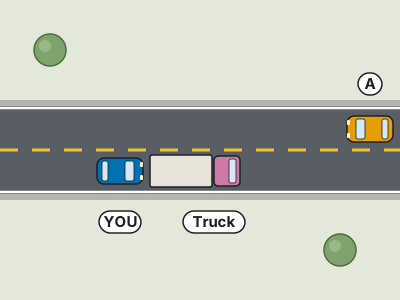
17. Before moving left to pass on a two-lane road, how much clear roadway without a no passing zone should you see ahead?
- At least 50 feet
- At least 100 feet
- At least 150 feet
- At least 200 feet
Show answer
At least 200 feet. Passing on the left starts with looking ahead. The handbook says not to move left until you are sure it is safe, and to check for at least 200 feet of clear roadway with no No Passing Zone. The 100 feet figure belongs to a different rule, the ban on passing within 100 feet of an obstructed view. Distances such as 50 or 150 feet fall short of the handbook's number. Before you pull out, also make sure no one is passing you, check your mirror and blind spot, and signal a left move.
Study this in the handbook: Pavement Markings and Lanes
18. The traffic light ahead is green, but a police officer standing in the intersection signals you to stop. What must you do?
- Go, since the green light controls traffic
- Stop, because the officer's signal overrides the light
- Slow down and go once the officer looks away
- Honk so the officer knows your light is green
Show answer
Stop, because the officer's signal overrides the light. You must obey traffic signals, except when an officer is directing traffic; then the manual says you must obey the traffic officer at all times. A green light does not override an officer's hand signal to stop. Waiting for the officer to look away or honking to point out your green light ignores that rule. Stop where directed and go only when the officer signals you to proceed.
Study this in the handbook: Traffic Signals
19. On a divided highway, you are driving behind a school bus that stops and turns on its flashing red lights. Must you stop?
- No, divided highways never require stops
- No, if you change to the left lane
- Only if children cross in front of you
- Yes, the exception covers only oncoming traffic
Show answer
Yes, the exception covers only oncoming traffic. The manual says approaching traffic is not required to stop for a school bus on a divided highway. That exception is for drivers coming from the opposite direction, on the far side of the median. A driver behind the bus is not approaching from the other side, so the normal rule applies: stop and remain stopped until the bus moves, the driver motions you on, or the red lights go off. Changing lanes to get around it is not allowed.
Study this in the handbook: Right of Way at Intersections
20. You are stopped behind a school bus with flashing red lights. The bus has not moved, but the bus driver motions for you to go ahead. What may you do?
- Stay stopped until the lights go off anyway
- Wait until the bus drives away
- Proceed carefully, as the driver motioned
- Back up and go around another way
Show answer
Proceed carefully, as the driver motioned. You must stop and remain stopped behind a school bus showing flashing red lights until one of three things happens: the bus starts moving, the driver motions for you to proceed, or the red flashing lights go off and the sign is pulled back. A motion from the bus driver is one of those signals, so you may go ahead with caution. Watch closely for children who may still be near the bus.
Study this in the handbook: Right of Way at Intersections
Every question is written from the official Oklahoma Driver Manual. Need paper? Printable OK practice test with answer key.
Last verified 2026-10-05. How we check every question · Study all 500 as flashcards
Frequently asked questions
How many questions are on this Oklahoma practice test?
This fixed set has 20 questions. It is test 13 of 25 from the 500 question Oklahoma bank. The real OK exam asks 20 questions and you need 15 correct.
What is the passing score for the real Oklahoma test?
15 out of 20 questions correct to pass That figure comes from the official Oklahoma source cited on the DMV facts page.
How does this fixed test relate to the full Oklahoma bank?
Each numbered test is a fixed set of questions in a fixed order, so you can retake the same test later and compare. Every test mixes road signs and the other topics in about the same proportion as the full bank. Tests 1 to 25 together cover every question in the Oklahoma bank once. The full practice page mixes the whole bank at random.
Last verified 2026-10-05. See the Oklahoma DMV facts page for sourced state details.
Return to the full Oklahoma practice test · Study road signs