
Test 6 of 10 · 20 questions · Free 2026
OK Permit Practice Test 6
Jump to the test ↓A fixed 20 question set from the Oklahoma bank with answers and plain English explanations. The real OK exam is 20 questions, 75 percent to pass; take the full length version on the main practice page.
Question 1 of 20 · 0 right so far
All 20 questions in test 6
Every question below comes from the Oklahoma question bank on this page. Open a question to see the correct answer and the explanation. Nothing here is hidden behind a signup.
1. Which situation is listed as a reason to stop at a highway rail crossing?
- An approaching train is plainly visible and dangerously close to the crossing
- A crossing has a crossbuck sign but no train is visible
- The road is empty and the crossing has no gate
- A driver wants to stop on the tracks to look for a train
Show answer
An approaching train is plainly visible and dangerously close to the crossing. The manual lists an approaching train that is plainly visible and in hazardous proximity as a reason the driver must not proceed through the crossing. A crossbuck requires caution and preparation, but its presence alone does not mean a train is approaching. An ungated or empty crossing still demands careful checking, and stopping on the rails creates a serious hazard. Slow before the tracks, look and listen in both directions, remain off the rails, and wait whenever the train is close enough to threaten the crossing.
Study this in the handbook: School Buses and Railroad Crossings
2. What is the purpose of Walk and Don't Walk pedestrian signals?
- To authorize vehicles to ignore a traffic signal
- To set speed limits for vehicles near intersections
- To direct and protect people crossing on foot or in wheelchairs
- To identify which lane a vehicle must use
Show answer
To direct and protect people crossing on foot or in wheelchairs. Walk and Don't Walk signals are intended to direct and protect people crossing an intersection on foot or in wheelchairs. They are pedestrian instructions, not vehicle speed signs or lane controls. A driver should still watch the traffic signal, the crosswalk, and people who may be crossing. The choice that authorizes vehicles to ignore a signal reverses the purpose of the device and creates a dangerous conflict. When approaching an intersection, scan for the pedestrian indication and yield to people who are lawfully crossing.
Study this in the handbook: Traffic Signals
3. Which observation can give you earlier warning that traffic several cars ahead is slowing?
- The number of passengers in the car behind you
- The color of the nearest vehicle's license plate
- Brake lights on vehicles four or five cars down the line
- A vehicle's fuel gauge reading
Show answer
Brake lights on vehicles four or five cars down the line. Looking beyond the nearest vehicle helps reveal a developing slowdown before it reaches your lane position. Brake lights several cars ahead can prompt you to move your foot toward the brake and create more response time. The other observations do not predict a traffic queue. Keep scanning the line ahead, compare moving vehicles with fixed objects, and preserve a space cushion so early information can become controlled action.
Study this in the handbook: Expressway Driving
4. Where must a driver stop when approaching a red octagonal stop sign?
- Only after entering the intersection far enough to see cross traffic
- Before the pedestrian crosswalk, even when the crosswalk is unmarked
- At the next street corner if no pedestrian is visible
- Beside the sign after passing the stop line
Show answer
Before the pedestrian crosswalk, even when the crosswalk is unmarked. The red octagon requires a complete stop before the pedestrian crosswalk. The manual specifically includes an unmarked crosswalk, so a driver cannot roll past the expected crossing area simply because paint is absent. Entering the intersection first risks conflict with cross traffic, and waiting for the next corner or stopping beside the sign can place the vehicle beyond the legal stopping point. After stopping, remain stopped until every direction is clear. A useful habit is to scan for pedestrians first, then look left and right before proceeding.
Study this in the handbook: Stop, Yield and Regulatory Signs
5. What does a single or double solid yellow line generally prohibit?
- Making every left turn
- Passing across the line
- Driving in the right lane
- Stopping at a marked intersection
Show answer
Passing across the line. Single and double solid yellow lines separate opposing traffic and mean that passing is prohibited. The manual allows a driver to cross the line for a left turn, so the marking is not a ban on every crossing or every turn. It also has no rule requiring the vehicle to abandon its normal lane. Read the line as a warning against overtaking, and wait for a legal passing section before moving around another vehicle.
Study this in the handbook: Pavement Markings and Lanes
6. How does the Oklahoma manual describe a careful speed under the Basic Speed Rule?
- Slow enough to block vehicles behind you
- Always equal to the highest posted limit
- Fast enough to stay ahead of traffic
- Careful and prudent, using skill and good judgment
Show answer
Careful and prudent, using skill and good judgment. The manual describes a required speed as careful and prudent, using skill and good judgment. That means the driver must respond to the actual roadway rather than blindly selecting the highest number on a sign. Matching the fastest traffic can reproduce another driver’s mistake, while driving unnecessarily slowly can also be unreasonable and unsafe. Use the posted limit as an upper boundary when conditions allow, then account for traffic, surface, visibility, road width, and pedestrians before deciding how fast to travel.
Study this in the handbook: The Basic Speed Rule
7. Where must an applicant apply for an Oklahoma driver license?
- By mailing the application to the state capitol
- In person at a Service Oklahoma Driver Testing Facility
- Only through a private insurance office
- At any vehicle repair shop
Show answer
In person at a Service Oklahoma Driver Testing Facility. An applicant must apply in person at a Driver Testing Facility operated by Service Oklahoma. That requirement allows the agency to handle the required identity review and testing process at the licensing location. Mailing an application or visiting a repair shop does not satisfy the manual's stated procedure. A quick cue is to associate the first application step with a physical Service Oklahoma testing facility, not with an office that merely sells insurance or repairs vehicles.
Study this in the handbook: Applying and the License Tests
8. How must a 6 year old who is 4 feet 5 inches tall ride in an Oklahoma vehicle?
- With no restraint if riding in the back seat
- Secured in a child passenger restraint system or a seat belt
- On an adult's lap in the front seat
- Only in a rear-facing seat
Show answer
Secured in a child passenger restraint system or a seat belt. A child at least 4 but younger than 8 who is not taller than 4 feet 9 inches must be secured in a child passenger restraint system or a seat belt. A 6 year old at 4 feet 5 inches fits that rule. The back seat alone is not a restraint, and the manual says small children should sit in the back with seat belts fastened or in a child passenger restraint system, not loose or on a lap. Rear-facing seats are required only until age 2 or the seat's limit.
Study this in the handbook: Insurance, Seat Belts and Child Restraints
9. Which situation is listed as an exception to stopping for a school bus?
- No children are visible
- The driver is running late
- The bus is on a different roadway
- The bus has been stopped for one minute
Show answer
The bus is on a different roadway. The manual says a driver does not have to stop when the bus is on a different roadway. It also lists a loading zone by a controlled access highway where pedestrians cannot cross and approaching traffic on the opposite side of a divided highway. Being late, seeing no children, or waiting for a minute does not create an exception. First identify whether the bus occupies your roadway, then apply the flashing light and stop sign rule.
Study this in the handbook: Right of Way at Intersections
10. On an Oklahoma expressway, what should a driver do if the vehicle cannot maintain the posted minimum speed?
- Use the expressway anyway and drive on the shoulder
- Do not use the expressway
- Drive in the left lane below the minimum
- Stop in the entrance ramp
Show answer
Do not use the expressway. The manual advises drivers not to use an expressway when the vehicle is not in good condition or the driver cannot or does not want to travel at or above the minimum speed. The shoulder is not a substitute travel lane, and moving left does not cure an unsafe pace. Stopping on an entrance ramp creates another hazard. Check the vehicle and choose a route suited to its condition before entering a limited access highway.
Study this in the handbook: Speed Limits and Expressway Speeds
11. What do regulatory signs tell drivers to do?
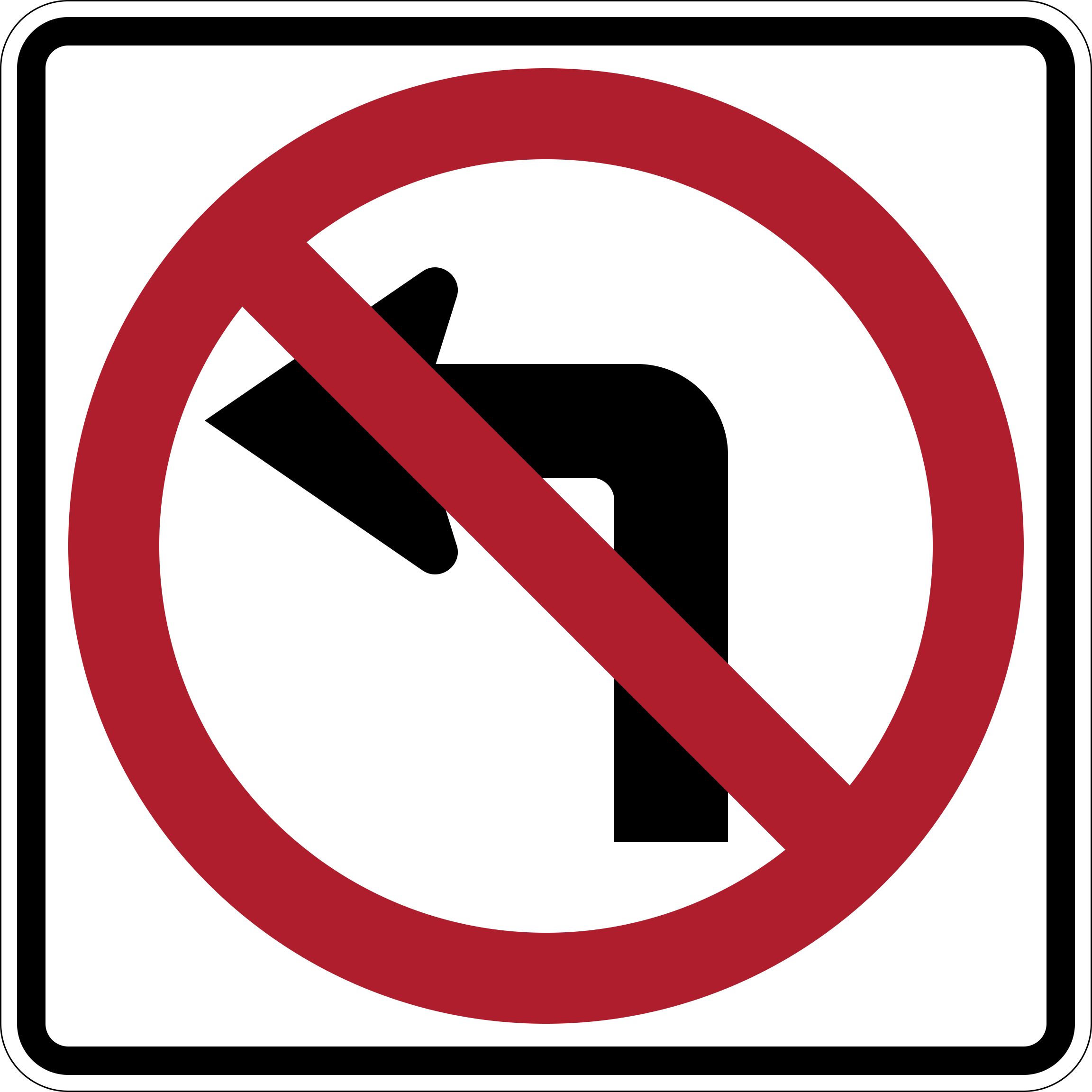
- What they must do and what they must not do
- Which roads have the highest speed limit
- Where scenic viewpoints are located
- When a vehicle may ignore traffic laws
Show answer
What they must do and what they must not do. Regulatory signs communicate requirements and prohibitions that control traffic. A driver must obey them just as with other traffic laws, including signs that restrict a movement. Speed limits are one kind of regulation, but the manual’s broader point is that these signs tell drivers what actions are required or forbidden. Scenic information is a guide function, and no sign authorizes a driver to disregard the law. Read the entire rectangular sign and follow its instruction before moving through the intersection.
Study this in the handbook: Stop, Yield and Regulatory Signs
12. An Oklahoma officer asks a driver who has not been drinking to take a breath test, and the driver refuses. What is the result?
- No penalty, because the driver was sober
- A written warning
- The officer must get a court order first, and no penalty applies
- Automatic revocation of the driving privilege
Show answer
Automatic revocation of the driving privilege. Driving in Oklahoma counts as agreement to BAC testing. Refusing the test on an officer's request results in automatic revocation of the driving privilege, even if you have not been drinking. Being sober is not a defense to refusal, and the manual describes no warning or court order step that avoids the penalty. For drivers under 21, a refusal also counts under the Zero Tolerance revocation rules.
Study this in the handbook: Implied Consent and DUI Penalties
13. By what name does the Oklahoma manual also refer to the Move Over law?
- Sherrill's Law
- Jessica's Law
- Joshua's Law
- Bernardo's Law
Show answer
Bernardo's Law. The Oklahoma manual lists the Move Over law under the name Bernardo's Law, and its penalty section heads the same rule as the Move Over Law or Bernardo-Mills Law. It requires drivers approaching a stationary vehicle with flashing lights on the side of the road to move over a lane when it is safe, or to slow down and use caution. The other three names do not appear in the manual as names for this Oklahoma rule, so they are not the correct label here.
14. According to the Oklahoma manual, what shape are most orange construction and maintenance signs?
- Octagonal
- Circular
- Diamond-shaped
- Rectangular only
Show answer
Diamond-shaped. The manual says the color orange tells you that you are nearing or in a work zone, and that most of these construction and maintenance signs are diamond-shaped, although some are rectangular. An octagon identifies a stop sign, and the manual pairs a round sign with railroad warnings, not work zones. Saying every work zone sign is rectangular is too broad because the manual names the diamond as the usual form. Read the sign early and slow to the posted speed.
Study this in the handbook: Work Zone, Guide and Service Signs
15. What penalty does the Oklahoma manual list for driving without a valid license?
- A $25 fine
- A warning for a first offense
- Only a written test
- On conviction, a fine of up to $500 or 6 months in jail or both
Show answer
On conviction, a fine of up to $500 or 6 months in jail or both. Driving without a valid license in Oklahoma carries, on conviction, a fine of up to $500 or six months in jail or both. The manual lists the same range for violating a restriction on a license. A $25 fine, a warning, or simply taking a written test does not match the listed penalty. Keep the license current, follow any restrictions printed on it, and carry it whenever you drive so you can show it if an officer asks.
Study this in the handbook: License Rules, Points and Penalties
16. What does the orange slow moving vehicle emblem identify?
- A vehicle that may use the emblem only while parked
- A vehicle authorized to exceed the posted speed limit by 25 MPH
- A vehicle traveling on a public highway at 25 MPH or less
- A passenger vehicle carrying hazardous materials at highway speed
Show answer
A vehicle traveling on a public highway at 25 MPH or less. The slow moving vehicle emblem warns that the vehicle is traveling at 25 MPH or less on a public highway. Examples include farm equipment and highway construction or maintenance equipment. It is not a speed authorization, and it does not mean the vehicle is parked or carrying hazardous materials. The practical cue is the orange emblem itself: expect a large speed difference, begin slowing early, and pass only when the roadway, markings, and sight distance make the maneuver safe and lawful.
Study this in the handbook: Work Zone, Guide and Service Signs
17. What does an orange road sign or channeling device identify?
- A hospital service
- A work zone
- A recreational area
- A railroad quiet zone
Show answer
A work zone. Orange identifies a construction or maintenance work zone. Signs, barricades, cones, and barrels use that warning color to direct traffic and protect workers and flagpersons. It is not a hospital or recreation designation, and it does not identify a railroad quiet zone. Drivers should slow to the posted speed, watch for lane changes, and be prepared to stop or follow instructions. The manual also warns that speeding fines double in a construction or maintenance zone when workers or equipment are present. The practical cue is orange together with cones, barrels, or lane-control devices.
Study this in the handbook: Work Zone, Guide and Service Signs
18. What change in traffic should you anticipate from the two opposing arrows?
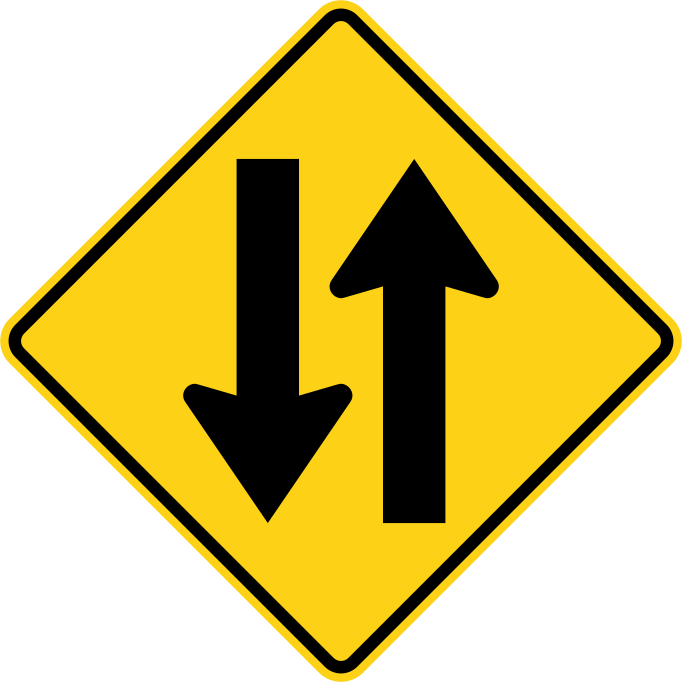
- Two-way traffic ahead, with opposing vehicles expected in the left lane
- A divided roadway begins and opposing vehicles are separated permanently
- Passing is permitted in every lane because traffic directions are separated
- The road becomes one-way in the direction of the upper arrow
Show answer
Two-way traffic ahead, with opposing vehicles expected in the left lane. The paired arrows announce that vehicles will travel in both directions ahead. Keep to the right-hand lane and expect oncoming traffic in the lane to your left. That expectation is why the divided-road and one-way choices are unsafe interpretations. A driver should also reassess passing decisions, since an approaching vehicle may occupy the opposing lane even when the road previously carried traffic one way.
Study this in the handbook: Warning Signs
19. How should a driver respond to a flashing yellow light at an intersection?
- Slow down, look both ways, and proceed carefully
- Stop and wait for a green light
- Treat it as a green arrow
- Accelerate because cross traffic must stop
Show answer
Slow down, look both ways, and proceed carefully. A flashing yellow light calls for caution. Slow down, look in both directions, drive slowly and carefully through the intersection, and be prepared to stop. It is not the same as a stop sign, so an automatic full stop is not required when the way is clear, but it also does not provide the protected movement of a green arrow. Accelerating assumes cross traffic will yield and removes the time needed to react. The cue is an active scan with reduced speed and a ready brake foot, especially where sight distance is limited.
Study this in the handbook: Traffic Signals
20. What should you do when following another vehicle in bad weather or on poor road conditions?
- Match the lead vehicle's bumper distance
- Keep the same one-second gap
- Follow within one car length
- Increase the following count to four seconds
Show answer
Increase the following count to four seconds. The manual uses a three-second rule for ordinary conditions and says to increase the count to four seconds in bad weather or poor road conditions. Wet, slick, icy, or reduced-visibility conditions lengthen the distance needed to respond and stop. A one-second gap leaves little margin, and following within one car length ignores speed. Matching the lead vehicle's bumper distance is not a measurable safety method. Pick a fixed roadside object and count after the vehicle ahead passes it. If your front reaches the object before the four-count ends, ease back.
Study this in the handbook: Following Distance and Stopping
QualitySpace is expanding to Oklahoma
We are a California-based independent insurance brokerage working on licensing in more states. We cannot help with Oklahoma insurance yet. Leave your email and we will let you know when we can.
Every question is written from the official Oklahoma Driver Manual. Need paper? Printable OK practice test with answer key.
Last verified 2026-10-05. How we check every question · Study all 218 as flashcards
Frequently asked questions
How many questions are on this Oklahoma practice test?
This fixed set has 20 questions. It is test 6 of 10 from the 218 question Oklahoma bank. The real OK exam asks 20 questions and you need 15 correct.
What is the passing score for the real Oklahoma test?
15 out of 20 questions correct to pass That figure comes from the official Oklahoma source cited on the DMV facts page.
How does this fixed test relate to the full Oklahoma bank?
Each numbered test is a fixed set of questions in a fixed order, so you can retake the same test later and compare. Every test mixes road signs and the other topics in about the same proportion as the full bank. Tests 1 to 10 together cover 200 of the 218 questions in the Oklahoma bank, each once. The full practice page mixes the whole bank at random.
Last verified 2026-10-05. See the Oklahoma DMV facts page for sourced state details.
Return to the full Oklahoma practice test · Study road signs