
Test 15 of 25 · 20 questions · Free 2026
OK Permit Practice Test 15
Jump to the test ↓A fixed 20 question set from the Oklahoma bank with answers and plain English explanations. The real OK exam is 20 questions, 75 percent to pass; take the full length version on the main practice page.
Question 1 of 20 · 0 right so far

All 20 questions in test 15
Every question below comes from the Oklahoma question bank on this page. Open a question to see the correct answer and the explanation. Nothing here is hidden behind a signup.
1. What do yellow diamond warning signs generally signal?
- The route number of the highway being traveled
- Services available at the next roadside stop
- A legal requirement to carry proof of insurance
- Conditions immediately ahead, such as hazards or changes in direction
Show answer
Conditions immediately ahead, such as hazards or changes in direction. Yellow diamond signs warn about conditions close enough ahead to affect the next driving decision. Those conditions can include a road hazard or a change in direction, so the driver should scan ahead, adjust speed, and be prepared to stop or steer as needed. A roadside service sign gives facility information, insurance proof is a legal responsibility, and a route number identifies travel direction rather than a hazard. The useful cue is the yellow diamond shape: treat it as an advance warning, then look for the specific roadway feature shown by its symbol.
Study this in the handbook: Warning Signs
2. At a crossing with more than one track, you stopped for flashing lights and a train has just passed. What must you do before crossing?
- Make sure all of the tracks are clear
- Wait exactly one minute, then cross
- Cross right away behind the last car
- Honk your horn twice, then proceed
Show answer
Make sure all of the tracks are clear. Flashing lights on a crossbuck mean a train is coming, and you must stay stopped until it has passed. Where a crossing has more than one track, the manual adds that you must be sure all tracks are clear before crossing, because another train may be coming on a different track. Rushing in behind the last car of the first train is exactly when a driver can miss that second train. No fixed waiting time or horn signal replaces looking down every track before you move.
Study this in the handbook: Work Zone, Guide and Service Signs
3. What are the three steps in stopping your vehicle, in order, according to the Oklahoma manual?
- Braking, perception, then reaction
- Reaction, braking, then perception
- Perception, reaction, then braking
- Signaling, braking, then steering
Show answer
Perception, reaction, then braking. Stopping a car happens in three steps: perception, reaction, and braking. Perception is seeing or hearing the danger and takes about half a second. Reaction is your brain telling your foot to brake, about two-thirds of a second. Only then does braking begin, and the braking time depends on speed. The manual's stopping chart shows the car covering a reaction distance before the brakes do anything, which is one reason following distance matters so much.
Study this in the handbook: Following Distance and Stopping
4. You park facing uphill on a road with no curb. Which way should you turn your front wheels?
- To the left, toward the center of the road
- To the right, so it rolls away from traffic
- Straight ahead, since there is no curb
- To the left, then leave it in neutral
Show answer
To the right, so it rolls away from traffic. Without a curb to brace against, the manual says to turn your wheels sharply to the right and shift into low gear or park. If the car should roll, it will roll away from the traffic flow rather than into it. Turning left points a rolling car toward the center of the road, and straight wheels give it no direction away from traffic. Set the parking brake every time you park on a hill.
Study this in the handbook: Parking Rules
5. You are pulling away from a curb where you parked on a hill. Who has the right-of-way?
- You do, once your turn signal is on
- Drivers already traveling in the lane
- Whichever driver is heading uphill
- You do, because you are starting on a hill
Show answer
Drivers already traveling in the lane. When starting from a curb on a hill, the manual lists the steps: start the motor, shift to the proper gear, signal, look in the mirror and to the rear, release the parking brake, and check again for oncoming traffic. It is your responsibility to wait for an opening and move safely into the lane, because the drivers already traveling have the right-of-way. A turn signal announces your plan but does not give you priority, and being on a hill does not either.
Study this in the handbook: Parking Rules
6. Your vehicle stalls on the tracks and the crossing lights begin to flash. About how much time might you have to get out before the train arrives?
- About 2 minutes
- About 5 minutes
- About 60 seconds
- About 20 seconds
Show answer
About 20 seconds. If your vehicle is on the tracks when the crossing lights begin to flash, the manual warns that you may have only 20 seconds to escape. Twenty seconds is the minimal amount of time it takes a train to reach the crossing once the warning lights activate. That is why the manual's rule is GO: get out of your vehicle right away instead of trying to restart it. Once out, run at a 45-degree angle away from the tracks toward the direction the train is coming from, then call 911.
Study this in the handbook: School Buses and Railroad Crossings
7. On a rural Oklahoma highway, what does the manual warn about large farm equipment such as combines?
- It is banned from all state highways
- It is required to stay on the shoulder
- It may be very large and use more than one lane
- It must keep up a speed of at least 45 mph
Show answer
It may be very large and use more than one lane. Be alert for slow-moving vehicles, especially in rural areas. The manual warns that tractors, combines, and other farm equipment move between fields and travel on state highways, and the equipment can be very large and use more than one traffic lane. In most cases these vehicles travel at less than 25 mph. Coming over the top of a hill at 65 mph to find one in front of you is dangerous, so expect the unexpected in farm country.
8. Which type of sign identifies highways, shows distances, marks exits, and points to parks and recreation areas?
- Regulatory signs
- Guide signs
- Warning signs
- Service signs
Show answer
Guide signs. Guide signs, which are green, white, or brown, give you travel information. The manual says they identify highways, show distances, mark exits, and point to parks and recreation areas. Service signs are a separate blue group that show where gas, food, and lodging are available. Regulatory signs set rules, and warning signs alert you to hazards. Knowing the group helps you find the information you need while keeping your eyes on traffic.
Study this in the handbook: Work Zone, Guide and Service Signs
9. Using the car-length method in the Oklahoma manual, how much space should you leave ahead of you at 50 mph?
- At least 5 car lengths
- At least 2 car lengths
- At least 10 car lengths
- At least 1 car length
Show answer
At least 5 car lengths. The manual gives two ways to set a following distance: allow at least one car length for every 10 mph of speed, or use the three-second rule. At 50 mph, one length per 10 mph means at least 5 car lengths. Two lengths or one length is far too close, and 10 lengths is what the rule would call for at 100 mph. Increase the space on slick roads, at night, in fog, or behind large vehicles.
Study this in the handbook: Following Distance and Stopping
10. At night on an expressway, your engine starts to fail. What should you do first?
- Stop in your lane and turn on interior lights
- Pull onto the left shoulder by the median
- Signal and pull off to the far right shoulder
- Keep driving slowly in the right lane to an exit
Show answer
Signal and pull off to the far right shoulder. If you have a breakdown or emergency on an expressway, the manual says to signal, then pull off to the extreme right shoulder away from moving traffic where it is safe, and turn on your emergency flashers. Stopping in a travel lane at night leaves you in the path of fast traffic, and the left shoulder is not where the manual sends you. Once stopped, never walk near the roadway, and keep children away from traffic.
Study this in the handbook: Expressway Driving
11. A 30-year-old Oklahoma driver takes a breath test that shows a BAC of 0.09, and the criminal case is later dropped. What happens to the license under the Implied Consent Law?
- Nothing, since there was no conviction
- It is still revoked, conviction or not
- It is suspended only if the driver is under 21
- It is revoked only after a second test
Show answer
It is still revoked, conviction or not. Under Oklahoma's Implied Consent Law, if a test shows a BAC of 0.08 or more, or any measurable amount for a driver under 21, the driver license will be revoked even if the driver is not convicted in court of DUI. A 0.09 reading for an adult is over that line, so the license is revoked whether or not the criminal case goes forward. No second test is needed. The revocation period ranges from 180 days to 2 years depending on the driving record.
Study this in the handbook: Implied Consent and DUI Penalties
12. On a two-lane road with a 55 mph limit, you are behind a car going 52 mph and have a clear passing zone. How fast may you go to pass it?
- Up to 65 mph while you are passing
- Up to 60 mph, since passes are short
- Any speed needed to pass quickly
- No faster than the 55 mph limit
Show answer
No faster than the 55 mph limit. Oklahoma's passing rules say you may not exceed the speed limit to pass another vehicle. With a 55 mph limit and a car going 52, you may go no faster than 55 while passing, which means the pass will take a long time. If you cannot complete the pass safely within the limit, stay behind. Before you even move left, check for at least 200 feet of clear roadway without a No Passing Zone.
Study this in the handbook: Passing and Turning
13. Which hand-and-arm signal tells other drivers that you are going to slow down or stop?
- Arm and hand pointed down, palm to the rear
- Arm and hand pointed upward
- Arm and hand extended straight out
- Arm waved in circles out of the window
Show answer
Arm and hand pointed down, palm to the rear. Oklahoma's three arm signals are made with your arm out the window. A left turn is shown with the arm and hand extended straight out, and a right turn with the arm and hand pointed upward. To show that you are slowing down or stopping, point your arm and hand down with the palm facing the rear. Extend your arm well out of the window so the signal is clear, and bring it back in when you need both hands to steer.
Study this in the handbook: Passing and Turning
14. On a multi-lane expressway, you are driving more slowly than most of the traffic around you. Which lane should you use?
- The left-hand lane, so faster cars pass on the right
- The right-hand lane, keeping clear of faster traffic
- The middle lane, so you can move either way
- Any lane, as long as you are above the minimum
Show answer
The right-hand lane, keeping clear of faster traffic. The manual's expressway lane rule is simple: use the right-hand lane when you are driving slower than other traffic, and use the middle or left-hand lane if you are traveling faster. Staying left while slow forces others to pass on the right and blocks the normal flow. Being above the minimum speed does not make any lane acceptable. The manual also says to move to the right to allow vehicles driving faster than you to pass, and to avoid weaving in and out of traffic.
Study this in the handbook: Pavement Markings and Lanes
15. You have been driving on a one-way street and now see this sign. What change should you expect?
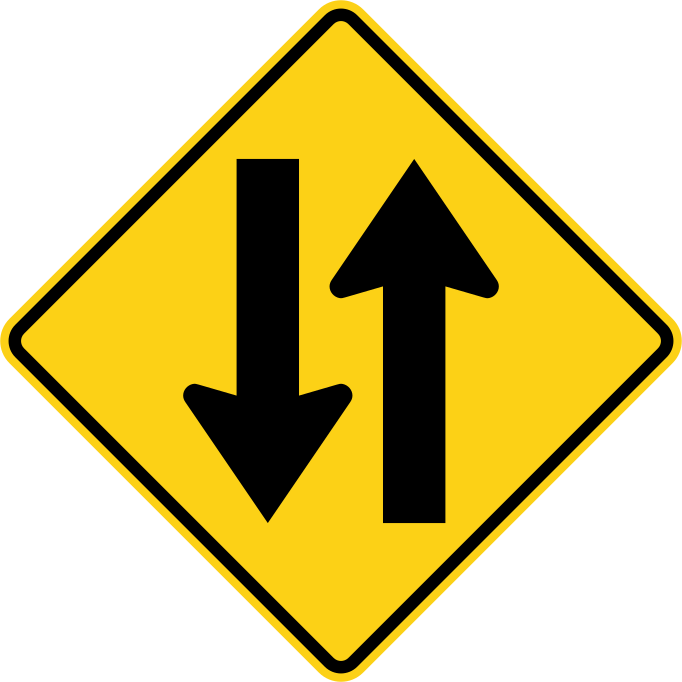
- Both lanes will carry traffic in your direction
- The road will become a divided highway
- Oncoming cars in the left lane; keep right
- A left-turn lane will open in the center
Show answer
Oncoming cars in the left lane; keep right. Two opposing arrows on a yellow warning sign mean two-way traffic is ahead. The manual says to drive in the right-hand lane and expect oncoming traffic in the left-hand lane. Coming off a one-way street, this is the moment to move right and stop treating the left lane as yours. The sign does not announce a divided highway or a center turn lane; those are shown by their own signs and markings.
Study this in the handbook: Warning Signs
16. After several drinks, a driver finds it hard to tell how far away other cars are and how fast they are moving. What does the manual say about this?
- It happens only at levels above the legal limit
- Alcohol sharpens these skills at first, then dulls them
- Alcohol affects only how the driver steers the car
- More alcohol means more trouble judging distances and speeds
Show answer
More alcohol means more trouble judging distances and speeds. The manual says that as the amount of alcohol in your body increases, your judgment will worsen and your driving skill will decrease. You will have trouble judging distances, speeds and the movement of other vehicles. This is not limited to drivers above the legal limit, and it does not start with a short period of sharper skill. Alcohol also hurts your ability to control the vehicle, not just steering.
Study this in the handbook: Implied Consent and DUI Penalties
17. A truck is passing you on the highway. How can you help the truck driver?
- Speed up so the truck finishes the pass sooner
- Move toward the center line to stay visible
- Brake hard to let the truck in right away
- Keep to the far side of your lane and ease off
Show answer
Keep to the far side of your lane and ease off. When a truck passes you, the manual says you can help the driver by keeping to the far side of your lane and reducing your speed slightly. It also says never to speed up as a truck is passing. Drifting toward the center line takes away room the truck needs. The manual asks only for a slight reduction in speed, not hard braking, so ease off the accelerator and hold your position until the truck is safely past.
Study this in the handbook: Bicycles, Motorcycles, Trucks and Farm Vehicles
18. On a three-lane road, the center lane is marked for left turns from either direction. The car ahead is slow. May you use the center lane to pass it?
- No, enter it only to make a left turn
- Yes, if no one is turning left nearby
- Yes, for short passes under 100 feet
- Yes, but only in daylight hours
Show answer
No, enter it only to make a left turn. Three-lane highways can have a center lane that drivers from either direction use for left turns. The manual says to enter that center lane only to make a left turn and that you must not pass in it. Because traffic from both directions may be waiting there to turn, using it as a passing lane can put you head-on with a turning car. No length of pass or time of day creates an exception.
Study this in the handbook: Pavement Markings and Lanes
19. You are passing a car on a two-lane road and have just moved ahead of it. When is it safe to return to the right lane?
- When you can see that car in your rearview mirror
- As soon as your rear bumper clears its front
- After you count to two from passing it
- When the other driver flashes headlights
Show answer
When you can see that car in your rearview mirror. The manual's passing steps say to pass the car ahead and not return to the right lane until you can see that car in your rearview mirror. Cutting back in as soon as your bumper clears, or after a quick count, can put you right in front of the car with no space. Another driver's headlight flash is not the test the manual gives. Once you see the car in the mirror, signal, pull into the right lane, and turn off your signal.
Study this in the handbook: Passing and Turning
20. You are turning right at a corner with no painted crosswalk lines, and a woman is stepping off the curb to cross the street you are entering. What must you do?
- Go first, since no crosswalk is marked
- Honk so she steps back onto the curb
- Yield and let her cross before you turn
- Turn quickly before she reaches your lane
Show answer
Yield and let her cross before you turn. Drivers must yield to people crossing the roadway, whether the crosswalk is marked or unmarked. A corner with no painted lines can still be an unmarked crosswalk, so the woman stepping off the curb has the right-of-way over your turn. Honking to push her back or turning quickly to beat her ignores the duty to yield. The manual also says to be especially alert in school zones and high-traffic pedestrian areas. Wait until she is clear of your path, then complete the turn.
Study this in the handbook: Right of Way at Intersections
Every question is written from the official Oklahoma Driver Manual. Need paper? Printable OK practice test with answer key.
Last verified 2026-10-05. How we check every question · Study all 500 as flashcards
Frequently asked questions
How many questions are on this Oklahoma practice test?
This fixed set has 20 questions. It is test 15 of 25 from the 500 question Oklahoma bank. The real OK exam asks 20 questions and you need 15 correct.
What is the passing score for the real Oklahoma test?
15 out of 20 questions correct to pass That figure comes from the official Oklahoma source cited on the DMV facts page.
How does this fixed test relate to the full Oklahoma bank?
Each numbered test is a fixed set of questions in a fixed order, so you can retake the same test later and compare. Every test mixes road signs and the other topics in about the same proportion as the full bank. Tests 1 to 25 together cover every question in the Oklahoma bank once. The full practice page mixes the whole bank at random.
Last verified 2026-10-05. See the Oklahoma DMV facts page for sourced state details.
Return to the full Oklahoma practice test · Study road signs