
Key points
When leaving your car, set the parking brake, put it in park or gear, turn off the motor and take the key.
Source: Handbook p. 46
“Set the parking brake. ▶ Put the gear in low, reverse or “park.” ▶ Turn off the motor. ▶ Lock the ignition and remove the key.”
Oklahoma Driver Manual, Handbook p. 46Parallel park within 18 inches of the curb.
Source: Handbook p. 47
“you may park parallel to any curb and within 18 inches of the curb.”
Oklahoma Driver Manual, Handbook p. 47When parking on a hill, stop within 6 inches of the curb.
Source: Handbook p. 47
“To Park on a Hill ▶ Parallel park as in the previous section, but stop within six inches of the curb.”
Oklahoma Driver Manual, Handbook p. 47Parking downhill, turn your wheels toward the curb.
Source: Handbook p. 48
“To brace your car when parking downhill, turn your wheels toward the curb and drive forward slowly until the wheel is against the curb”
Oklahoma Driver Manual, Handbook p. 48Uphill without a curb, turn your wheels sharply to the right so the car would roll away from traffic.
Source: Handbook p. 48
“Facing uphill, without a curb: Turn your wheels sharply to the right. Shift as above. If the car should roll, it will roll away from the traffic flow.”
Oklahoma Driver Manual, Handbook p. 48Do not park within 15 feet of a fire hydrant or within 20 feet of a crosswalk at an intersection.
Source: Handbook p. 49
“Within 15 feet of a fire hydrant. 5. On a crosswalk. 6. Within 20 feet of a crosswalk at an intersection.”
Oklahoma Driver Manual, Handbook p. 49Do not park within 30 feet of a flashing beacon, stop sign or signal at the roadside.
Source: Handbook p. 49
“Within 30 feet upon approaching any flashing beacon, stop sign or traffic control signal located at the side of the roadway.”
Oklahoma Driver Manual, Handbook p. 49Do not park within 50 feet of the nearest rail of a railroad crossing.
Source: Handbook p. 49
“Within 50 feet of the nearest rail of a railroad crossing.”
Oklahoma Driver Manual, Handbook p. 49Near a fire station, stay 20 feet from the driveway, or 75 feet on the opposite side of the street.
Source: Handbook p. 49
“Within 20 feet of the driveway entrance to any fire station or within 75 feet on the side of a street opposite the entrance”
Oklahoma Driver Manual, Handbook p. 49
Numbers to know
| Number | What it means | Manual |
|---|---|---|
| 18 inches | maximum distance from the curb when parallel parked | Handbook p. 47 |
| 6 inches | distance from the curb when parking on a hill | Handbook p. 47 |
| 15 feet | from a fire hydrant | Handbook p. 49 |
| 20 feet | from a crosswalk at an intersection | Handbook p. 49 |
| 30 feet | from a flashing beacon, stop sign or signal | Handbook p. 49 |
| 50 feet | from the nearest rail of a railroad crossing | Handbook p. 49 |
| 20 feet / 75 feet | fire station driveway, same side / opposite side | Handbook p. 49 |
Recognize these signs
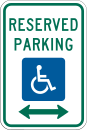
Disabled parking
3 questions from the Oklahoma practice test
1. How close to a fire hydrant may an Oklahoma driver park?
- No closer than 15 feet
- No closer than 5 feet
- No closer than 10 feet
- No closer than 30 feet
Show answer
No closer than 15 feet. Oklahoma's list of places you may not park includes within 15 feet of a fire hydrant, on a crosswalk, within 20 feet of a crosswalk at an intersection, within 30 feet on the approach to a flashing beacon, stop sign or traffic signal at the side of the road, and within 50 feet of the nearest rail of a railroad crossing. Five and ten feet would put a parked car closer to the hydrant than Oklahoma allows, and thirty feet is the signal distance.
2. In Oklahoma, how far from a stop sign or traffic signal at the side of the road must you park on the approach?
- At least 15 feet
- At least 20 feet
- At least 50 feet
- At least 30 feet
Show answer
At least 30 feet. Parking is prohibited within 30 feet upon approaching any flashing beacon, stop sign or traffic control signal located at the side of the roadway, so approaching drivers can see the control. Fifteen feet is the hydrant distance, 20 feet applies to crosswalks at intersections and fire station driveways, and 50 feet applies to the nearest rail of a railroad crossing.
3. How close to the nearest rail of a railroad crossing may an Oklahoma driver park, and how far from a fire station driveway on the opposite side of the street?
- 15 feet and 20 feet
- 100 feet and 100 feet
- 50 feet from the rail, and 75 feet on the opposite side of a signposted fire station driveway
- 25 feet and 50 feet
Show answer
50 feet from the rail, and 75 feet on the opposite side of a signposted fire station driveway. Oklahoma bars parking within 50 feet of the nearest rail of a railroad crossing and within 20 feet of the driveway entrance to any fire station, or within 75 feet on the side of the street opposite the entrance when properly signposted. Vehicles near the rail block the view of the tracks, and the fire station zone keeps room for apparatus to swing out.
Practice this topic
Lock it in with parking questions from the free Oklahoma practice test. Every answer comes with a plain English explanation.
Source: the Oklahoma Driver Manual, Chapter 9: Parking. This lesson is a plain English summary, not the law itself; where it differs, the manual and the statute govern. Last checked 2026-09-27.