
Test 12 of 25 · 20 questions · Free 2026
OK Permit Practice Test 12
Jump to the test ↓A fixed 20 question set from the Oklahoma bank with answers and plain English explanations. The real OK exam is 20 questions, 75 percent to pass; take the full length version on the main practice page.
Question 1 of 20 · 0 right so far
All 20 questions in test 12
Every question below comes from the Oklahoma question bank on this page. Open a question to see the correct answer and the explanation. Nothing here is hidden behind a signup.
1. A car has pulled out to pass you on a two-lane road. What does the Oklahoma manual say about your speed during the pass?
- Speed up so the other driver must pull back
- Don't increase it; slow if an oncoming car appears
- Match the passing car's speed to keep pace
- Brake hard right away to end the pass quickly
Show answer
Don't increase it; slow if an oncoming car appears. When someone is passing you, the manual says not to increase your speed. If a car approaches from the other direction while you are being passed, slow down and let the passing driver pull in front of you. Speeding up or matching the passing car's speed keeps it stranded in the oncoming lane. Hard braking is not required either; a steady speed, or slowing gently if an oncoming car appears, gives the passing driver room to finish.
Study this in the handbook: Passing and Turning
2. You are in a left-turn-only lane. The lights for straight traffic turn green, but your green arrow has not come on. What should you do?
- Turn now, since the main light is green
- Wait in your lane until your arrow comes on
- Move into the straight lane and go
- Turn if no oncoming cars are visible
Show answer
Wait in your lane until your arrow comes on. At signals with turn arrows, the manual says that if you are in a turning-only lane, you must wait for the arrow. The green light for straight traffic does not apply to your lane, and an empty-looking road does not change that. Switching to the straight lane at the last moment is a risky lane change near the intersection. Stay put, and when the green arrow appears, make only the turn it shows.
Study this in the handbook: Traffic Signals
3. Driving at night with high beams on, you see an oncoming car about 800 feet away. What should you do?
- Keep high beams until it is 500 feet away
- Flash your lights so it dims first
- Switch to low beams now, within 1,000 feet
- Keep high beams; dimming is for cars ahead
Show answer
Switch to low beams now, within 1,000 feet. The manual says to dim your high beams to low beams within 1,000 feet of an oncoming vehicle, or within 600 feet of a vehicle you are following. An oncoming car 800 feet away is already inside that distance, so switch to low beams now. Waiting until 500 feet is too late, and flashing your lights to make the other driver dim first is not the rule. The dimming rule covers both oncoming cars and cars ahead.
Study this in the handbook: Headlights, Night Driving and Distractions
4. A deer jumps onto the road in front of your car and you cannot stop in time. Which action does the manual tell you not to take?
- Brake as hard as you safely can
- Swerve to avoid it
- Hold the wheel steady in your lane
- Slow down as much as possible
Show answer
Swerve to avoid it. The manual says that if an animal suddenly runs in front of your vehicle, you should not swerve to avoid hitting it. Swerving may cause a more serious crash than colliding with the animal would. Braking, staying in your lane and slowing as much as you can keep the car under control. It also advises caution at dawn and dusk and scanning the sides of the road to reduce the chance of such a crash.
Study this in the handbook: Headlights, Night Driving and Distractions
5. You are towing a camper that stands 12 feet tall, and a warning sign before an underpass shows a clearance of 11 feet 6 inches. What should you do?
- Drive through slowly in the center of the lane
- Let some air out of the tires to lower it
- Find another route; it is too tall to fit
- Go through if no other vehicles are near
Show answer
Find another route; it is too tall to fit. A clearance warning before an underpass shows the height that fits under it. The manual says vehicles or loads higher than the clearance shown can't go through the underpass. A 12-foot camper is taller than an 11 foot 6 inch clearance, so you must take another route. Driving slowly, staying centered, or waiting for an empty road does not change the height, and letting air out of the tires is not a safe or reliable fix.
Study this in the handbook: Warning Signs
6. You are on a two-lane road and see this sign ahead. What is about to change, and where should you drive?

- Two-way traffic begins; expect cars on your left
- A median will separate traffic; keep to the right
- Your lane ends; merge left into the next lane
- A one-lane bridge is ahead; yield to oncoming cars
Show answer
A median will separate traffic; keep to the right. Arrows that split around a center strip warn that a divided highway is ahead. The manual says a center strip, or median, will separate the two directions of traffic, and you should keep to the right of it. Once the median begins, traffic going your way stays on the right side and oncoming traffic is beyond the strip. The sign does not mean your lane is ending or that a one-lane bridge is coming. Its opposite is the divided highway ends sign, which warns that two-way traffic is about to begin again.
Study this in the handbook: Warning Signs
7. On a two-lane road, you are coming up behind a bicyclist while a car approaches from the other direction. What should you do?
- Pass now, squeezing between the rider and the car
- Honk so the rider moves off onto the shoulder for you
- Speed up to pass before the oncoming car arrives
- Slow down, let the car pass, then give the rider room
Show answer
Slow down, let the car pass, then give the rider room. The manual says to avoid passing between a bicyclist and oncoming vehicles on a two-lane road. Slow down and allow the oncoming vehicles to pass, then move to the left to give the rider plenty of room as you pass. Oklahoma law requires at least 3 feet of clearance when passing a bicycle, which is hard to provide while squeezed against oncoming traffic. Racing ahead or honking to push the rider aside are not safe substitutes for waiting a few seconds.
Study this in the handbook: Bicycles, Motorcycles, Trucks and Farm Vehicles
8. On a standard vertical traffic signal, in what order are the lights arranged from top to bottom?
- Red, yellow, green
- Green, yellow, red
- Yellow, red, green
- Red, green, yellow
Show answer
Red, yellow, green. The manual notes that color-blind drivers can tell which light is lit by its position: red is on top, yellow is in the middle, and green is on the bottom. That fixed order is how a driver who cannot tell red from green still knows when to stop or go. Green at the top, yellow at the top, or green in the middle all break the standard arrangement. Learn the order along with each meaning: a steady red means come to a complete stop and remain stopped until the light turns green.
Study this in the handbook: Traffic Signals
9. Before entering an intersection, in what order does the Oklahoma manual tell you to look?
- Right, then left, then straight ahead
- To the left only, as right-side traffic yields
- Look both ways, then look left again
- Straight ahead only, if your light is green
Show answer
Look both ways, then look left again. The manual points out that more collisions and injuries occur at intersections than at any other place. Its instruction is to slow down, look both ways, and look left again before you enter. Ending on the left means your last check covers the side you looked at first. A green light does not remove the need to look, and traffic from the right does not always yield. The manual also notes that many intersection collisions could have been avoided if one driver had been more cautious and willing to yield.
Study this in the handbook: Right of Way at Intersections
10. On an expressway, you notice you have been driving right beside another car at the same speed for several miles. What does the Oklahoma manual advise?
- Stay beside it, since matching speed is safest
- Move closer to it so others can see you both
- Change speed or lanes so you are not alongside it
- Turn on your hazard flashers to warn the driver
Show answer
Change speed or lanes so you are not alongside it. The manual tells expressway drivers not to travel alongside other vehicles at the same speed, to avoid cars moving in packs, and to stay out of other drivers' blind spots. Riding beside another car for miles can leave you hidden from that driver. Adjust your speed or change lanes so you are no longer side by side, without blocking the normal flow of traffic. Hazard flashers are meant for breakdowns and emergencies, not for this situation.
Study this in the handbook: Pavement Markings and Lanes
11. Why do vehicles in a funeral procession drive with their headlights on?
- To show they have permission to exceed the speed limit
- Because all daytime traffic must use headlights
- To light the road for the hearse at the front
- To signal others not to drive between or interfere
Show answer
To signal others not to drive between or interfere. Motorists must yield the right-of-way to a funeral procession, and once the lead vehicle enters an intersection the rest may follow through it. The manual explains that all vehicles in the procession should have their headlights on as a signal to other drivers not to drive between them or interfere with the procession. The lights do not grant permission to speed, and they are not there to light the road. When you see a line of cars with headlights on in daylight, let the whole procession pass before you cut in.
Study this in the handbook: Right of Way at Intersections
12. A yellow warning sign shows a T intersection ahead. What should you expect to do?
- Continue straight across the intersection
- Merge with traffic from a new lane
- Stop only if a train is approaching
- Turn right or left and be prepared to yield
Show answer
Turn right or left and be prepared to yield. A T intersection sign means the road you are on ends at a cross street ahead. The warning gives you time to slow down, because you cannot continue straight; you must turn right or left. The handbook also tells you to be prepared to yield to traffic on the road you are entering. Merging situations have their own signs, and railroad crossings are announced by round yellow signs and crossbucks. Slow early, signal your turn at least 100 feet ahead, and look both ways before committing to the turn.
Study this in the handbook: Warning Signs
13. In Oklahoma's chart of speed limits that apply unless otherwise posted, which type of road has a limit of 75 mph?
- Turnpikes and toll roads
- Controlled access highways
- Undivided state highways
- Paved county roads
Show answer
Controlled access highways. Under Oklahoma's state speed limit chart, controlled-access highways have a 75 mph limit unless another limit is posted. Turnpikes are higher at 80 mph, undivided state highways are 65 mph, and county roads are 55 mph. These limits apply under normal conditions; the Basic Speed Rule still requires a slower speed when traffic, weather, or visibility make the posted figure unsafe.
Study this in the handbook: Speed Limits and Expressway Speeds
14. You are near the end of an expressway entrance ramp, and a car in the right lane is alongside you. Who must yield?
- The car on the expressway must make room
- Whoever is going faster goes first
- You must yield to the car already on it
- Neither; both may keep going side by side
Show answer
You must yield to the car already on it. Anyone merging onto an expressway must yield to the vehicles already traveling on it. Use the acceleration lane to adjust your speed, signal left, and merge only when it is safe. Drivers on the expressway are asked to adjust speed and lane to help others enter, but that courtesy does not shift the duty to yield. Speed does not decide it, and staying side by side to the end of the ramp leaves you nowhere to go.
Study this in the handbook: Expressway Driving
15. You turned your wheels away from the curb when parking uphill beside a curb. If the brakes fail, what keeps the car from rolling into traffic?
- The rear of the front tire rests against the curb
- The wheels steer the car into the street
- Nothing; the wheel position does not matter
- The car rolls forward into the space ahead
Show answer
The rear of the front tire rests against the curb. For uphill parking against a curb, the manual says to turn your wheels sharply away from the curb and back up slowly until the rear of the tire is against the curb, then shift into low gear or park. If the car should roll, the curb will stop it, because the tire is braced against it. Wheel position matters a great deal; the downhill method turns the wheels toward the curb instead. Always set the parking brake too.
Study this in the handbook: Parking Rules
16. Your right wheels drift off the pavement onto a gravel shoulder at highway speed. What should you do first?
- Hold the wheel firmly and brake lightly
- Jerk the wheel left to get back on
- Slam on the brakes to stop quickly
- Speed up to climb back onto the road
Show answer
Hold the wheel firmly and brake lightly. If you run off the pavement, the manual says to hold the steering wheel firmly, apply your brakes lightly, and reduce your speed until you can safely return. Then check traffic in both directions and, when it is safe, steer carefully back into your lane. Jerking the wheel is the kind of sudden over-correction that can make you lose control, and slamming the brakes or speeding up adds to the danger.
Study this in the handbook: Braking, Skids and Wet Roads
17. Your planned route turns right at this corner, but this sign is posted there. What should you do?
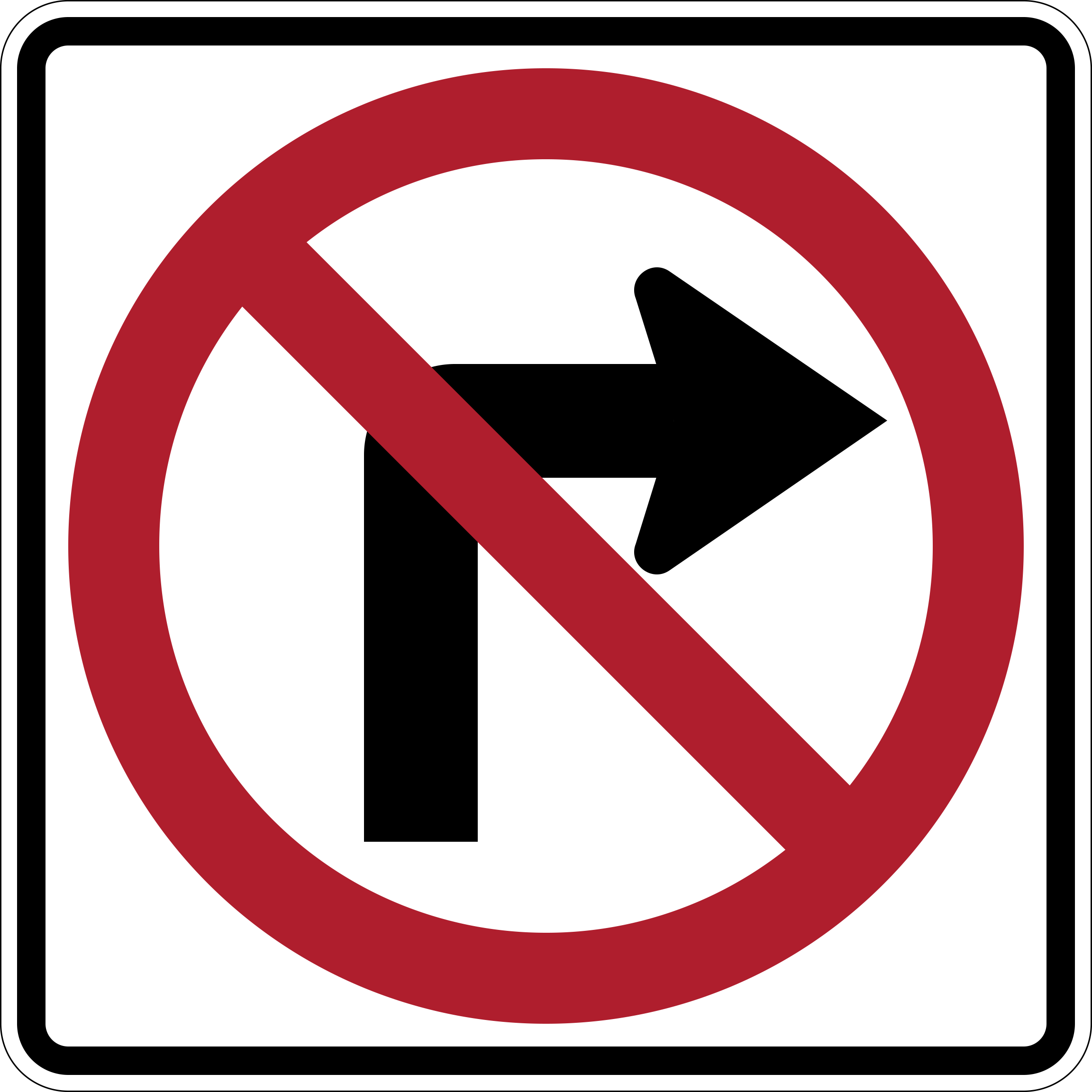
- Turn right if no pedestrians are crossing
- Turn right after coming to a full stop
- Turn right only if the light is green
- Continue on and find another way to turn
Show answer
Continue on and find another way to turn. A red circle with a line through it means do not, or not allowed. Over a right-turn arrow, it means a right turn is not allowed from that approach. Stopping first, waiting for a green light, or checking for pedestrians does not make the turn legal. Keep going and plan a different route, such as turning at the next street where the turn is permitted. Regulatory signs like this one must be obeyed just like other traffic laws.
Study this in the handbook: Stop, Yield and Regulatory Signs
18. Under Oklahoma's Zero Tolerance law, is it unlawful for a driver under 21 to drive while under the influence of a drug other than alcohol?
- Yes, other intoxicating substances count too
- No, the law covers alcohol and nothing else
- Only if the drug was illegal to buy
- Only if alcohol was also in the blood
Show answer
Yes, other intoxicating substances count too. Oklahoma's Zero Tolerance law makes it unlawful for anyone under 21 to drive, operate, or be in actual physical control of a vehicle if they have any measurable alcohol at the time of a test, show evidence of being under the influence of any other intoxicating substance, or show the combined influence of alcohol and another substance. So the law is not limited to alcohol, the substance does not have to be illegal, and no alcohol needs to be present.
Study this in the handbook: Zero Tolerance for Drivers Under 21
19. With standard brakes that are not antilock, when does maximum braking happen?
- Just before the wheels lock and stop rotating
- After the wheels lock and the car slides
- When you pump the pedal as fast as possible
- When you shift into neutral while braking
Show answer
Just before the wheels lock and stop rotating. For standard brakes, the manual says maximum braking comes just before the wheels lock and stop rotating. Too much pressure on the pedal locks the wheels, and the vehicle skids instead of stopping under control. That is why the manual tells you to apply your brakes slowly and evenly. Cars with antilock brakes use different techniques, so drivers of those cars should read the owner's manual for maximum braking instructions. Neutral is not part of the manual's braking advice.
Study this in the handbook: Braking, Skids and Wet Roads
20. You and an oncoming driver meet at an intersection, and both of you want to turn left. How should you each turn?
- Each turns to the right of the other car
- The driver on the right turns first, then the other
- Each turns wide, ending in the far right lane
- Each turns to the left of the other car
Show answer
Each turns to the left of the other car. When two oncoming drivers both turn left at an intersection, the manual says each will turn to the left of the other, so the cars pass driver's side to driver's side. Each driver leaves from the left lane and enters the left lane of the new street. Turning to the right of each other would make your paths cross in the middle of the intersection. Swinging wide into the far right lane is not part of a proper left turn.
Study this in the handbook: Passing and Turning
Every question is written from the official Oklahoma Driver Manual. Need paper? Printable OK practice test with answer key.
Last verified 2026-10-05. How we check every question · Study all 500 as flashcards
Frequently asked questions
How many questions are on this Oklahoma practice test?
This fixed set has 20 questions. It is test 12 of 25 from the 500 question Oklahoma bank. The real OK exam asks 20 questions and you need 15 correct.
What is the passing score for the real Oklahoma test?
15 out of 20 questions correct to pass That figure comes from the official Oklahoma source cited on the DMV facts page.
How does this fixed test relate to the full Oklahoma bank?
Each numbered test is a fixed set of questions in a fixed order, so you can retake the same test later and compare. Every test mixes road signs and the other topics in about the same proportion as the full bank. Tests 1 to 25 together cover every question in the Oklahoma bank once. The full practice page mixes the whole bank at random.
Last verified 2026-10-05. See the Oklahoma DMV facts page for sourced state details.
Return to the full Oklahoma practice test · Study road signs